
Results
-
 £42.95
The Platinum Jubilee March - Chris G. Shelton
The Platinum Jubilee March was written to celebrate Her Majesty, Queen Elizabeth II's seventy-year reign as monarch of the United Kingdom. Its premiere was televised live around the world as part of the Queen's Birthday Parade which marked the start of the national Platinum Jubilee celebrations. The Queen's Birthday Parade 2022 saw the First Battalion of the Irish Guards trooping their colour. To reflect this, the march begins in a celebratory style and features a melody based around the opening motif of Let Erin Remember - the regimental slow march of the Irish Guards. In traditional style, the march develops excitement both harmonically and melodically, creating a strong sense of drive before reaching a stately trio. This section has a very regal and noble feel, lending subtle harmonic nods to two of the most quintessentially British composers, Gustav Holst, and Sir William Walton. The march culminates in a bold grandioso, featuring semi-quaver lines that are underpinned by a driving trombone countermelody. A forthright restatement of the introductory fanfare brings the march to a very definite and resolved ending.
Estimated dispatch 5-14 working days
-
 £149.99
Redbad - Jan de Haan
Redbad was written for the Championship Section of the Dutch Brass Band Championships - and thus it contains plenty of musical and technical challenges. In this work of seven connected movements we get to know Redbad, who was the King of the Frisians from c. 680 to 719. The composer drew his inspiration from historical information, but also from stories, anecdotes, myths and legends around this figure. The themes within the composition are closely interwoven whereas the music is varied and appealing - from heroic motifs to the melancholy of elegies. Impressive tutti passages alternate with fragments that sound more open and in which various players can take centre stage. To crown it all, the work concludes with a majestic finale.
Estimated dispatch 5-14 working days
-
 £91.99
Pulcinella - Philip Sparke
Pulcinella was commissioned by the Taiwanese euphonium player Tzu-Hsiang Lin. Lin is a renowned soloist and teacher and a Besson Euphonium Artist. He teaches euphonium at Taipei National University of the Arts, National Taiwan University of Arts, Shih Chien University and National Kaohsiung Normal University. Lin gave the premiere of Pulcinella in both its concert band and brass band versions in January 2021. Pulcinella continues Sparke's series of euphonium solos named after characters of the Italian commedia dell'arte and opens with a long and expressive minor melody for the soloist over a brooding accompaniment. This is taken up briefly by the full band and is extended by the soloist after a change of key. A cadenza, accompanied by fragments of the main melody leads to a complete change of mood, tempo and tonality, introducing a Vivo section starting with a perky syncopated tune for the soloist. The band then uses elements of this new tune to introduce a change of key, where the soloist introduces a more lyrical second subject over a pulsing accompaniment. The band then takes this up and changes key to reintroduce the original Vivo melody, which leads to a short and acrobatic coda to bring the work to a spectacular close.
Estimated dispatch 5-14 working days
-
 £68.80
When the lights go down - Kevin Houben
Kevin Houben created with When the Lights Go Down, a wonderful chorale that can be a moment of reflection in any concert program.The resigned, magnificent melodies at the beginning of this composition slowly build up to a highlight with an increasing orchestration. The piece starts with a suggestive Adagio Meditativo, after which the main theme is immediately announced. A central bridge section takes the listener along through the different spheres at which the melodic and rhythmic drums embellish the chorale melodies. Thematic elements from the introduction brings the piece to a quiet and peaceful end.The sheer simplicity with which this work is written, makes it a resplendent, magnificent concert piece. 'When the Lights Go Down', refers to a moment when time stand still for a while, stillness within and around yourself.
Estimated dispatch 5-14 working days
-
 £49.99
Let the Bells Ring! - Robert Buckley
Robert Buckley has taken a rhapsodic approach to this version of the familiar Ukrainian Bell Carol, mixing original ideas along with the well-known melody. Every section of the band gets a chance to shine in this dazzling and skillfully crafted holiday production number, perfect for mature ensembles.
Estimated dispatch 5-14 working days
-
 £137.70
Mitt hjerte alltid vanker - Fantasi - Hans Adolph Brorson - Svein H. Giske
This arrangement was commissioned by B3 (The Bergen Woodwind Ensemble). B3 is a large woodwind ensemble located in Bergen with a mix of professional and amateur players. My Heart Remains in Wonder is a well-known Christmas hymn in Scandinavia. I wanted my version to be different to the traditional hymn tune style in which it is normally performed. One day I was outside walking and this idea came to me: an ostinato-like, mechanical skeleton of arpeggio semiquavers on which I could 'hang' the melody. However, I also wanted to do the melody line a bit different. The inspiration for this comes from folk music and the way fiddlers hardly ever lift their bow off the strings when they play. Because of this, it is important that the melody is played in a very sostenuto style in this arrangement. The harmonies lie somewhere between jazz and folk music with a little nod towards Grieg (himself heavily influenced by folk music) in the slow middle section.
Estimated dispatch 5-14 working days
-
 £183.20
Tales and Myths of Gothia - Jerker Johansson
Jerker Johansson has lived in Gothenburg, on the Swedish West Coast, since 1984, and is deeply interested in the history of the country. Gothia is the most southern part of Sweden, and Gothenburg, which was founded in 1621, is since many years an important centre for trade and shipping. Old paintings of the harbour with its gigantic sailing ships gave impulse to the heroic character of the piece. The opening fanfare is followed by a lively allegro, which eventually leads to a calm section, containing reminiscences of the fanfare. The cornets introduce a cantabile theme, and a dance reminding of the Renaissance precede a recapitulation of the allegro theme. Tales and Myths of Gothia was originally composed for concert band in 2017. The brass band version was premiered on 26 April 2019 during Oslo Brass festival by Uffes Blas Brassband, conducted by Andreas Kratz.
Estimated dispatch 5-14 working days
-
 £73.60
A Jubilee Celebration - Peter Goosensen
A Jubilee Celebration was commissioned by the Ursem Music Association to commemorate the occasion of their 50th anniversary. It is a composition with lots of variation and one where an important role is played by the percussion section. The Easy Flex 8 structure makes it possible for bands with smaller wind sections to achieve a grand and festive sound.
Estimated dispatch 5-14 working days
-
 £134.99
Alpina Brass - Jan Van der Roost
Alpina Brass was the test piece for the first division of the Fetes Cantonales on 8 and 9 June 2019 in Naters, Switzerland. It consists of three movements, and features a variety of aspects, as is common for a competitionwork. However, as a whole, it has been written in such a way that it can perfectly serve as a concert work as well. It is a challenging piece for every section and offers colourful and melodic as well as spectacular rhythmicsequences and a most impressive ending!
Estimated dispatch 5-14 working days
-
 £105.20
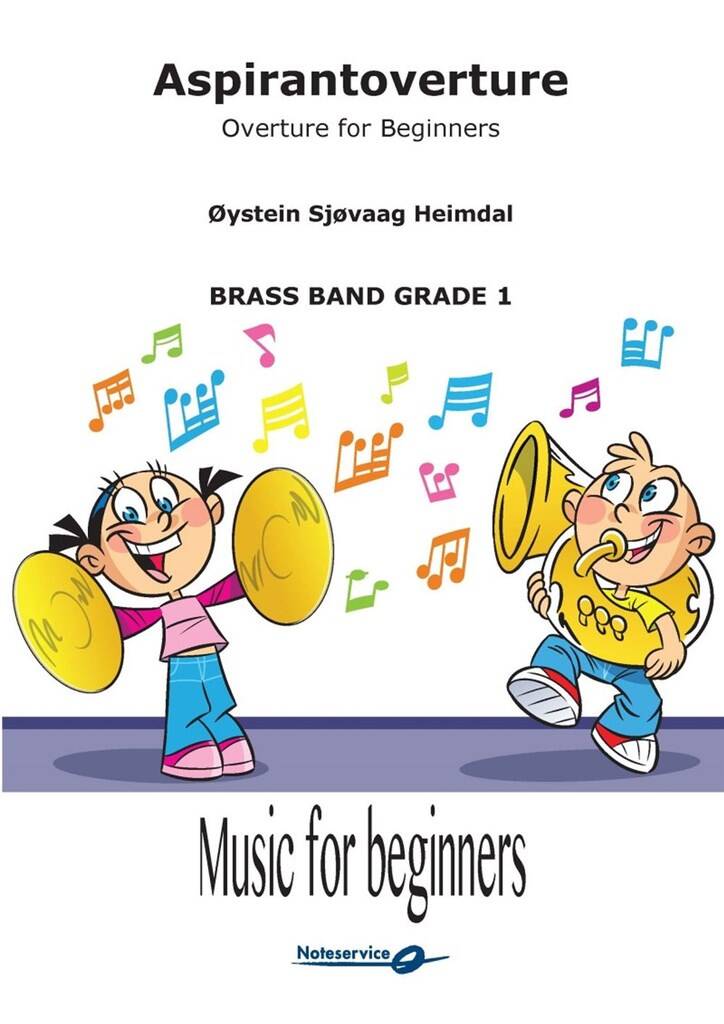
Aspirantoverture - Øystein Sjøvaag Heimdal
This original piece is intended to performed by the youngest musicians. The structure of the overture is traditional A-B-A with a slow section in the middle flanked by two Modearo sections. As the title suggest, the piece is well suited as a concert opener but also for contest use. All parts challenges the young players in many ways, both the wind- and percussionists. Please be aware of the contrasts in dynamics throughout the piece.
Estimated dispatch 5-14 working days
 View Music