
Results
-
 £91.99
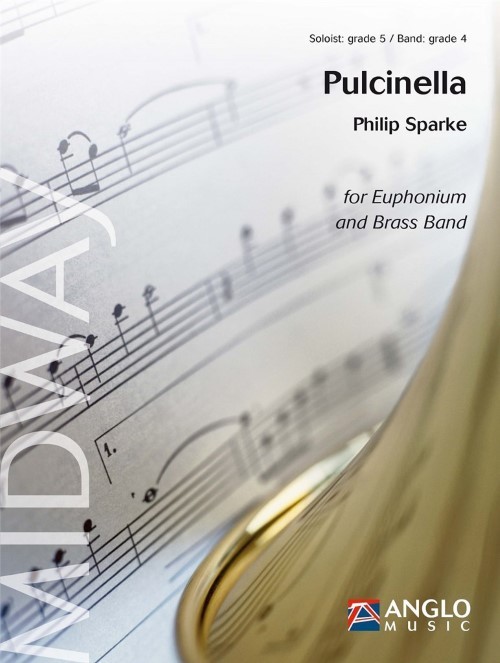
Pulcinella (Euphonium Solo with Brass Band - Score and Parts) - Sparke, Philip
Pulcinella was commissioned by the Taiwanese euphonium player Tzu-Hsiang Lin. Lin is a renowned soloist and teacher and a Besson Euphonium Artist. He teaches euphonium at Taipei National University of the Arts, National Taiwan University of Arts, Shih Chien University and National Kaohsiung Normal University. Lin gave the premiere of Pulcinella in both its concert band and brass band versions in January 2021. Pulcinella continues Sparke's series of euphonium solos named after characters of the Italian commedia dell'arte and opens with a long and expressive minor melody for the soloist over a brooding accompaniment. This is taken up briefly by the full band and is extended by the soloist after a change of key. A cadenza, accompanied by fragments of the main melody leads to a complete change of mood, tempo and tonality, introducing a Vivo section starting with a perky syncopated tune for the soloist. The band then uses elements of this new tune to introduce a change of key, where the soloist introduces a more lyrical second subject over a pulsing accompaniment. The band then takes this up and changes key to reintroduce the original Vivo melody, which leads to a short and acrobatic coda to bring the work to a spectacular close. Duration: 6.45
Estimated dispatch 7-14 working days
-
 £69.95
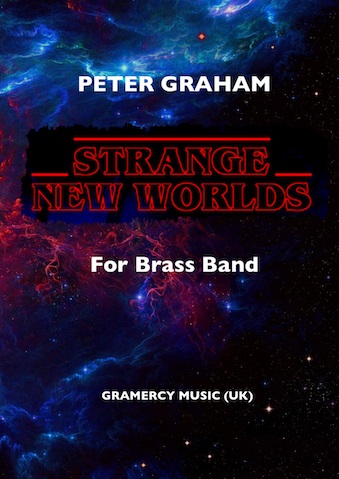
Strange New Worlds (Brass Band - Score and Parts) - Graham, Peter
Strange New Worlds was commissioned by Nicholas Childs for the National Children's Brass Band of Great Britain with funds provided by Arts Council England.The COVID-19 pandemic made it necessary for the 2020 course to transition from residential to virtual and the work was designed to accommodate this change. The participants individually filmed themselves to a click track and the videos were collated to create a "virtual" performance. The premiere was streamed live on YouTube on August 7, 2020.The work is in 5 movements with a narrative dictated by the individual movement titles. Although to me this narrative is clearly defined, multiple scenarios present themselves. Some may interpret the story as being one from the ancients while others might identify with the science-fiction of H.G. Wells. Others still will relate to the recent surge of interest in 1980s culture and the Netflix series Stranger Things (to which the title of my work pays homage). Nor would it be unreasonable to consider the piece an analogy reflecting events in 2020. Listeners will decide the story (or message) for themselves.The five movements are: I. Things to Come; II. Descent to Darkness (featuring Cornets, Trombones and Percussion); III. Resistance (featuring Horns, Baritones, Euphoniums, Basses and Percussion); IV/V. Aftermath/A New HopeDuration: 8.00
Estimated dispatch 7-14 working days
-
 £54.99
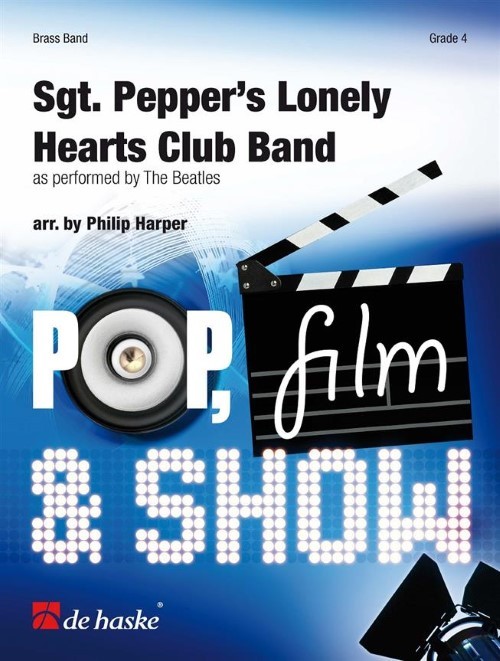
Sgt. Pepper's Lonely Hearts Club Band (Brass Band - Score and Parts) - Lennon & McCartney - Harper, Philip
Sgt. Pepper's Lonely Hearts Club Band is the most famous album by The Beatles, and perhaps of all time. When it came out in 1967 it was remarkable not only for its many great songs, but also because of the innovative recording techniques that were used on the record for the very first time, setting a new standard for many decades to come. Conductor, arranger and composer Philip Harper is a huge Beatles fan himself and had a great time creating this grade 4 arrangement!
Estimated dispatch 7-14 working days
-
 £35.00
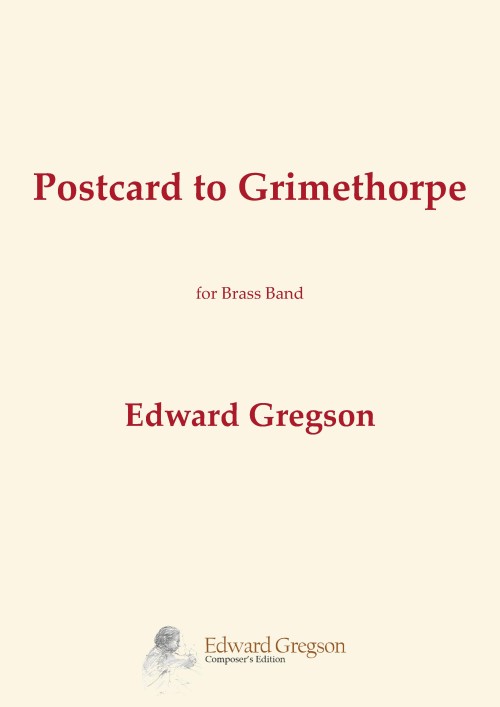
Postcard to Grimethorpe (Brass Band - Score and Parts) - Gregson, Edward
I composed the original version of Postcard to Grimethorpe in 1993 at the request of Elgar Howarth, for a concert at the Queen Elizabeth Hall, London, given by the Grimethorpe Colliery Band. This was at a time when after the Grimethorpe Colliery pit closed the future of the band was in severe jeopardy. The concert was given in aid of the band, both through publicity and funding.Then in late 2022 Jack Stamp, the American composer, conductor and educator, and at that time international composer-in-association with Grimethorpe, contacted me to say that he had discovered my short piece in the band library, and asked if I might extend it for a recording he was sponsoring for the band - the repertoire to consist entirely of music specially composed for Grimethorpe.I agreed and decided to extend the piece by using the miner's hymn Gresford, as a symbolic gesture of protest at the many thousands of miners in the UK who were made redundant from their jobs. After an angular (quasi-atonal) first section, the hymn enters, softly at first, but with each phrase it becomes more powerful and insistent, ending with the final phrase triumphantly accompanied by melodic percussion (replacing the drums and cymbals of the earlier phrases, as if the band were then on the march). However, this short work ends softly and gently, as if anger has been replaced by quiet resolution and determination, looking to the future with confidence.- Edward GregsonDuration: 3.00
Estimated dispatch 7-14 working days
-
£12.00
Postcard to Grimethorpe (Brass Band - Score only) - Gregson, Edward
I composed the original version of Postcard to Grimethorpe in 1993 at the request of Elgar Howarth, for a concert at the Queen Elizabeth Hall, London, given by the Grimethorpe Colliery Band. This was at a time when after the Grimethorpe Colliery pit closed the future of the band was in severe jeopardy. The concert was given in aid of the band, both through publicity and funding.Then in late 2022 Jack Stamp, the American composer, conductor and educator, and at that time international composer-in-association with Grimethorpe, contacted me to say that he had discovered my short piece in the band library, and asked if I might extend it for a recording he was sponsoring for the band - the repertoire to consist entirely of music specially composed for Grimethorpe.I agreed and decided to extend the piece by using the miner's hymn Gresford, as a symbolic gesture of protest at the many thousands of miners in the UK who were made redundant from their jobs. After an angular (quasi-atonal) first section, the hymn enters, softly at first, but with each phrase it becomes more powerful and insistent, ending with the final phrase triumphantly accompanied by melodic percussion (replacing the drums and cymbals of the earlier phrases, as if the band were then on the march). However, this short work ends softly and gently, as if anger has been replaced by quiet resolution and determination, looking to the future with confidence.- Edward GregsonDuration: 3.00
Estimated dispatch 7-14 working days
-
 £48.00
Gull Dances (Brass Band - Score and Parts) - Johns, Terry
The composer, who lives and works at the edge of the Forth estuary in Edinburgh has been inspired here by the intriguing "tap" dance that the gulls perform on the grass at certain times to encourage worms to break the surface. The middle movements describe the birds' "dancing" in flight, with a waltz and a slow soaring melody. The piece was written for the COOP Glasgow Brass Band on the occasion of their winning the Scottish brass band championship in 2009 and was broadcast on BBC Scotland's "Classics Unwrapped" in November of that year. Duration: 11.00. Suitable for 1st Bands and above.
Estimated dispatch 7-14 working days
-
 £105.00
Tuba Concerto (Tuba Solo with Brass Band - Score and Parts) - Vaughan Williams, Ralph - Littlemore, Phillip
Ralph Vaughan Williams' Tuba Concerto was written in 1953/4 in response to an invitation to compose a work for the Golden Jubilee of the London Symphony Orchestra. Vaughan Williams was by then in his eighty-second year. The lively, outer movements both conclude with extended cadenzas, while the beautifully lyrical Romanza is Vaughan Williams at his best. Phillip Littlemore's brass band arrangement is a welcome addition to the brass band repertoire. Suitable for Championship Section Bands. Duration: 15.00
Estimated dispatch 7-14 working days
-
 £55.00
New York (from East Coast Pictures) (Brass Band - Score and Parts) - Hess, Nigel - Littlemore, Phillip
For anyone who is familiar with this bizarre and wonderful city, this piece needs no explanation. New York is the third movement of East Coast Pictures, originally written for wind band, commissioned in 1985 by the British Youth Wind Orchestra with funds from National Westminster Bank plc. These three short 'pictures' were inspired by several visits by the composer to a small part of the USA's East Coast, an area that provides great extremes in the geography and the people. Suitable for Premier Youth/2nd Section Bands and above. Duration: 6.00
Estimated dispatch 7-14 working days
-
 £64.95
Music for Greenwich (Brass Band - Score and Parts) - Gregson, Edward
Music for Greenwich was commissioned in 1980 by the Greenwich Theatre, London, for a new production of Peter Buckman's play 'All Together Now'.In this play, about a down-at-heels brass band in the North of England brought to a new level of self-confidence and achievement by an incoming conductor, the whole cast performed a test piece on stage every night (i.e. Music for Greenwich), in readiness for a competition which they have entered and, of course, win. Although the play is as much a social commentary as anything to do with music-making, every member of the cast had to be able to play a brass instrument to a greater or lesser extent (a difficult challenge for the casting Director!).For obvious reasons, the music is not technically difficult. The work is structured as follows: a brief fanfare-like opening is followed by an allegro section, rhythmic and playful; a slow lyrical section is then introduced (a suitably nostalgic melody featuring solos for cornet and trombone), before a return to the fast music, a hint of the fanfare, and finally a climactic flourish to round things off. This is music to be enjoyed, as hopefully it was every night by the audience and actors alike.Duration: 5.00
Estimated dispatch 7-14 working days
-
£24.95
Music for Greenwich (Brass Band - Score only) - Gregson, Edward
Music for Greenwich was commissioned in 1980 by the Greenwich Theatre, London, for a new production of Peter Buckman's play 'All Together Now'.In this play, about a down-at-heels brass band in the North of England brought to a new level of self-confidence and achievement by an incoming conductor, the whole cast performed a test piece on stage every night (i.e. Music for Greenwich), in readiness for a competition which they have entered and, of course, win. Although the play is as much a social commentary as anything to do with music-making, every member of the cast had to be able to play a brass instrument to a greater or lesser extent (a difficult challenge for the casting Director!).For obvious reasons, the music is not technically difficult. The work is structured as follows: a brief fanfare-like opening is followed by an allegro section, rhythmic and playful; a slow lyrical section is then introduced (a suitably nostalgic melody featuring solos for cornet and trombone), before a return to the fast music, a hint of the fanfare, and finally a climactic flourish to round things off. This is music to be enjoyed, as hopefully it was every night by the audience and actors alike.Duration: 5.00
Estimated dispatch 7-14 working days
 View Music