
Results
-
 £34.95
CLAPP! (Brass Band) - McGhee, Paul
Clapp! was originally written in 2006 whilst studying at the Royal Welsh College of Music and Drama and was written for two players at one piano. The music uses rhythmic phasing with each rhythm assigned its own tone cluster - as each shift in rhythm occurs the harmonic structure is altered too. Melodic passages are created through the shifts in rhythm and harmony, but these only occur within the given rhythmic parameters. The music can very much be viewed as a study in momentum, with its unrelenting pulse driving us through the music.The Brass Band version of 'Clapp!!!!' was written for Manger Musikklag and Torstein Aagaard-Nilsen, receiving its premiere at the 2010 BrassWind Festival in Bergen, Norway.Duration: 3:30
Estimated dispatch 7-14 working days
-
 £37.95
Red Sky at Night (Brass Band - Score and Parts) - Lear, W. Hogarth
In 1973 the James Shepherd Versatile Brass was formed and Elgar Howarth was asked to write a piece for them to perform at a Royal Albert Hall Gala Concert, following the National Brass Band Championships. Connecting Jim's surname with the well-known saying, 'red sky at night, shepherd's delight', he found his title "Red Sky at Night". Duration: 4:00
Estimated dispatch 7-14 working days
-
 £55.00
ROYAL MILE SUITE, A (Brass Band Set - Score and Parts) - Fernie, Alan
Score and Parts. National Brass Band Championships of Great Britain Section 4 Finals 2010 .
Estimated dispatch 7-14 working days
-
 £60.99
Versailles (Brass Band - Score and Parts)
Versailles, composed by Christian Bouthier, reflects a number of impressions of the royal castle in Versailles, near Paris. There are four movements consisting of Le Chateau, Le grand Trianon, L'Appartement du Roi and Les Grandes Eaux each of which depicts a different aspect of Versailles both inside and outside. Bring a touch of regalness to any concert band programme. 06:00
Estimated dispatch 7-14 working days
-
 £34.95
A Swedish March and Fanfare (Brass Band - Score and Parts) - Gregson, Edward
A Swedish March:This little march was written in 1975 and was commissioned for the Jnkping Summer School, Sweden, where Edward Gregson was guest composer and conductor. It incorporates the old Swedish folksong Britta at its heart, but otherwise is quite conventional in every aspect.Duration: 3.00Fanfare:This fanfare was originally written for brass ensemble, organ and percussion, under the title Fanfare for Europe, and was commissioned for a concert at the Royal Albert Hall, London, to celebrate Great Britain's entry into Europe. The composer then created this version for brass band which was published in 1976.Duration: 1.30
Estimated dispatch 7-14 working days
-
 £59.95
Un Vie de Matelot (Brass Band - Score and Parts) - Farnon, Robert
A Sailor's Life. Theme and Variations for Brass BandThis work was specially composed as the test piece for the National Brass Band Championships of Great Britain, held at the Royal Albert Hall, London, on 11th October, 1975Duration: 10.00
Estimated dispatch 7-14 working days
-
£29.95
Un Vie de Matelot (Brass Band - Score only) - Farnon, Robert
A Sailor's Life. Theme and Variations for Brass BandThis work was specially composed as the test piece for the National Brass Band Championships of Great Britain, held at the Royal Albert Hall, London, on 11th October, 1975Duration: 10.00
Estimated dispatch 7-14 working days
-
 £44.95
Patterns (Brass Band - Score and Parts) - Gregson, Edward
Building musical paragraphs using short, irregular rhythmical patterns became a favourite Gregson formula in the early 1970s. Patterns is the clearest and most disciplined example. By limiting himself to a single musical motif, heard at the outset on trombones, Gregson offers a true test of technique and musicianship in a concise three part structure. The opening is another Gregson prelude with alternating patterns of 3s, 4s, 5s and 7s that are bonded by a constant quaver pulse. The music here possesses a neo-classical, pristine quality. In the central episode, the same triadic figure is transformed into a lilting barcarolle-like dialogue beginning on solo cornet and horn. When the whole band becomes involved, the trombones add a moment of bi-tonal ambiguity, which sets in motion an exuberant Latin dance and final flourish.Patterns was commissioned by the Butlins Youth Brass Band Championships for the 1974 competition at the Royal Albert Hall.Duration: 5.00
Estimated dispatch 7-14 working days
-
 £59.95
Voices of Youth (Brass Band - Score and Parts) - Gregson, Edward
The suite Voices of Youth is one of Gregson's earliest brass band compositions, written while he was still a student at the Royal Academy of Music in London. Voices of Youth was commissioned by the National Youth Brass Band of Great Britain and was premiered by them under the baton of Geoffrey Brand.The work has three movements:Nobility of Youth (Duration: 4.00)Sadness and Tenderness (Duration: 2.30)Gaiety (Duration: 2.45)In Nobility of Youth there are the rich sonorities beloved of Salvationist composers such as Eric Ball and, particularly, Ray Steadman Allen, whose music he admired. The modal contour of the melodies here and at the climax of the slow movement Sadness and Tenderness reveal lessons well learned from Holst and Vaughan Williams. Gaiety is probably the most interesting amalgam of all. Beginning in the harmonic world of Gilbert Vinter - whose influence Gregson readily acknowledges at this time - the music is transformed into a bravura waltz of which Percy Grainger might have been proud. It then veers off via a contrapuntal episode of academic correctness, into a coda that takes us into more adventurous harmonic realms.Duration: 10.00
Estimated dispatch 7-14 working days
-
 £15.00
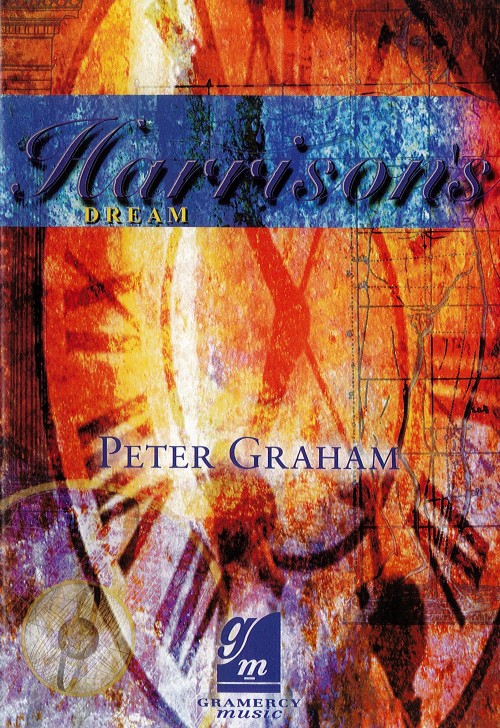
Harrison's Dream (Brass Band - Study Score) - Graham, Peter
At 8.00pm on the 22nd of October 1707, the Association, flagship of the Royal Navy, struck rocks off the Scilly Isles with the loss of the entire crew. Throughout the rest of the evening the remaining three ships in the fleet suffered the same fate. Only 26 of the original 1,647 crew members survived. This disaster was a direct result of an inability to calculate longitude, the most pressing scientific problem of the time. It pushed the longitude question to the forefront of the national consciousness and precipitated the Longitude Act. Parliament funded a prize of �20,000 to anyone whose method or device would solve the dilemma.For carpenter and self-taught clockmaker John Harrison, this was the beginning of a 40 year obsession. To calculate longitude it is necessary to know the time aboard ship and at the home port or place of known longitude, at precisely the same moment. Harrison's dream was to build a clock so accurate that this calculation could be made, an audacious feat of engineering.This work reflects on aspects of this epic tale, brilliantly brought to life in Dava Sobel's book Longitude. Much of the music is mechanistic in tone and is constructed along precise mathematical and metrical lines. The heart of the work however is human - the attraction of the �20,000 prize is often cited as Harrison's motivation. However, the realisation that countless lives depended on a solution was one which haunted Harrison. The emotional core of the music reflects on this, and in particular the evening of 22ndOctober 1707.- Peter GrahamJuly 2000 Recorded on Polyphonic QPRL219D Master Brass (Volume Fifteen). Duration: 14'30"
Estimated dispatch 7-14 working days
 View Music