
Results
-
 £40.00
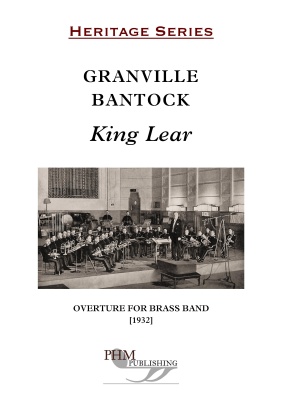
King Lear (Brass Band - Score only)
Sir Granville Bantock (1868 - 1946) composed the second of his five major brass band work for Callender's Cableworks Band, completing the commission on 30 November 1932. Based in the Thames-side district of Belvedere near Erith, the band was active between 1898 and 1961. The works band of the Callender Cable & Construction Co. Ltd, it was at the peak of its popularity during the 1930s and was a frequent broadcaster on the radio. The band employed an in-house arranger and played saxophones in its lighter material. King Lear was one of the band's major commissions and was not published in Bantock's lifetime. The manuscript score and parts were thought to be lost for decades, but were found in the library of the Haydock Band (Lancashire), which had inherited part of Callender's library of manuscripts material and bespoke arrangements after it has been transferred to nearby Prescott Cables Band after Callender's Cable Works closed.King Lear is a substantial work, in essence a dramatic tone poem in the romantic Tchaikovskian manner, presenting a series of character portraits of the foolish old king and his three daughters, Goneril, Regan and Cordelia. The music is dramatic and lyrical by turns, with the most generous lyrical episode revealing perhaps the warm-hearted Cordelia. An expansive melody that flows from this is brought back towards the end as the main climax of the work.In 2001, Bantock's score was recorded by the University of Salford Brass Band, conducted by Dr. Roy Newsome. The original is serviceable, but in comparison with the orchestral version he made in 1936 (part of which was recorded on a Paxton 78 rpm) and later brass band scores, performing editions of which were prepared by others, it lacks colour and range typical of Bantock's orchestral work. Above all it lacks percussion, which can be heard on the recorded extract. With the kind permission of the Bantock Estate, I have prepared a performing edition for publication that incorporates percussion, derived from the orchestral recording and added editorially in similar manner elsewhere. I have revoiced some of the low- lying instrumental parts to present the material in more comfortable ranges. Editorial interventions more elaborate than revoicing the original text have been identified as cue notes.- Paul HindmarshDuration: 15.00
Estimated dispatch 7-14 working days
-
 £24.95
Judd: Now is the Hour
This romantic Maori song of farewell was arranged as a cornet solo for David Daws. Within The Salvation Army, the words 'Search me, O God, and know my heart today' are now associated with this beautiful tune.
Estimated dispatch 7-14 working days
-
 £64.95
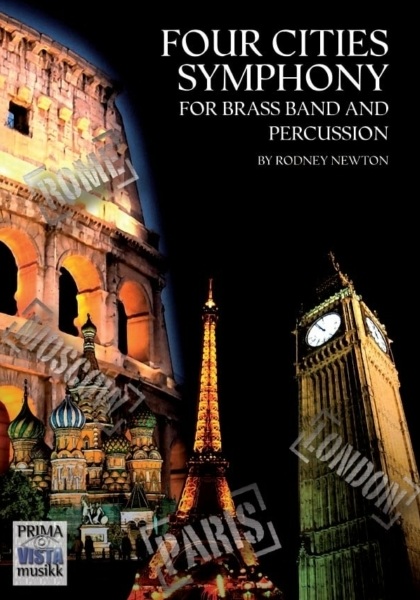
Four Cities Symphony (Brass Band - Score and Parts)
This piece was commissioned by the National Contesting Council as the 4th section test piece for the 2008 Regional Brass Band Championships of Great Britain.This symphony (the composer's 12th) has four movements played without a break. The first centres on two aspects of the city of London: its history and pageantry and its role as a busy modern metropolis.The second movement depicts Paris, its street cafes and boulevards and riverside walks, in the form of a romantic waltz.The third movement is constructed around the Gregorian chants of the Lord's Prayer (Pater noster, qui es in caelis) and the Creed (Credo in unum Deum) in an evocation of the city of Rome. After a powerful climax, mysterious tramping footsteps are heard as the ghosts or a Roman legion march through the city by night. The vision fades and the pater noster is heard once again before the movement is brought to a close with the ancient Ambrosian chant, Christus Vincit, Christus Regnet, Christus Imperat.The final movement is an evocation of the city of Moscow, with its great historic buildings, its turbulent history and its fiery traditional music. At the outset a rather dour folk-like melody is heard which is transformed into a lively Cossack dance.This work is dedicated to Howard Wilson, former principal euphonium of City of Coventry Band who, in 1972, introduced the composer to top section brass band contesting.Duration: 11.00
Estimated dispatch 7-14 working days
-
 £93.50
The Seventh Night of July (Brass Band - Score and Parts)
In Japan, July the 7th is a holiday known as Tanabata, for which large celebrations are held throughout the country. The holiday is based on a legend about a young man and a young woman who are separated by the Milky Way and can only see each other once a year on this night. The Seventh Night of July is Itaru Sakai's musical interpretation of this romantic legend. The flugel horn and euphonium solos during the middle movement represent the two main themes from the legend.
Estimated dispatch 7-14 working days
-
 £50.00
A Celebration of Youth (Score and Parts)
A Celebration of Youth was written in 2001 for the Worcester County Youth Brass Band conducted by Nicky Daw. It's a lively four minute concert piece suitable for opening or closing a programme, in turn heraldic, then romantic, and always rhythmic. Playable by most levels of bands.
Estimated dispatch 7-14 working days
-
£49.95
Tristan Encounters (Score Only)
Prelude and Transfigurations for Brass and PercussionTristan Encounters is derived form Wagner's Prelude to his opera Tristan and Isolde and comprises a series of tableaux - mood pictures which alternate between a romantic idiom and tritone-sty
Estimated dispatch 7-14 working days
-
£50.00
A Celebration of Youth - Harper, P
A Celebration of Youth was written in 2001 for the Worcester County Youth Brass Band conducted by Nicky Daw. It's a lively four minute concert piece suitable for opening or closing a programme, in turn heraldic, then romantic, and always rhythmic. Playable by most levels of bands.4th section +
In Stock: Estimated dispatch 1-3 working days
-
£45.00
Captain from Castile - Newman, A - Harper, P
A classic Alfred Newman Hollywood score from the 1947 swashbuckler starring Tyrone Power. Heroic themes, dastardly villains and romantic interludes, all with a Spanish twist, make for an explosive opener to any concert! As played and recorded by Cory Band.Championship sectionDuration 3.30 minsListen to Cory Band on BIC 2017Courtesy of World of Brass
In Stock: Estimated dispatch 1-3 working days
-
£42.00
Love Theme from Romeo and Juliet - Tchaikovsky, P - Harper, P
Adapted from Tchaikovsky's famous overture, this romantic duet features flugel and euphonium.2nd sectionDuration 3.30 minsListen to Helen and Glyn Williams with Cory Band on 'Summon the Heroes'Courtesy of World of Brass
In Stock: Estimated dispatch 1-3 working days
-
£40.00
Robin Hood Prince of Thieves - Kaymen, M - Broadbent, D
A Robin Hood for todays audiences, light years removed from the romantic vision of Errol Flynn. This is a much darker Robin Hood (with Kevin Costner's uncomfortable American accent), introducing characters (Morgan Freeman's Azheem the Moor) that are not part of the original legend. Without doubt Alan Rickman's campish Sheriff of Nottingham stole the film. Kamen's main title theme whips the listener to another time and place - medieval magic!3rd section +
In Stock: Estimated dispatch 1-3 working days
 View Music