
Results
-
 £22.50
Edward Gregson: Concertante for Piano and Brass Band
DescriptionProgramme NoteThe Concertante for Piano and Brass Band was written in 1966, when the composer was an undergraduate student at the Royal Academy of Music in London. It received its first public concert performance in 1967 at the Royal Festival Hall, London, when the composer was the soloist with the International Band of the Salvation Army, conducted by Bernard Adams. It was one of the first major works to be written for this particular combination.The Concertante is unashamedly romantic in idiom and is in three movements: Prelude, Nocturne and Rondo. The Prelude is cast in sonata form and opens with a short cadenza-like flourish from the soloist, followed by two main ideas - the first sweepingly dramatic, the second highly lyrical. The interplay between these two themes forms the main focus of the movement, and after a return to the opening theme, an exuberant codetta brings the music to a close, albeit a quiet one. https://morthanveld.com/wp-content/uploads/2017/09/Gregson-Concertante-1st-movt-clip.mp3The tender Nocturne opens with an introduction from the band that contains precursors of the two main ideas to follow. The solo piano announces the main theme, which has a slightly 'bluesy' character with its flattened third and seventh notes of the scale, and is a love song dedicated to the composer's wife-to-be. The band enters with phrases of a chorale already hinted at in the introduction - Ray Steadman-Allen's hymn tune 'Esher' - but never quite presented in its complete state. Both ideas are developed alongside each other, with eventually the first theme returning, this time with piano and band together, and building to a majestic climax, before subsiding to a peaceful coda - a return to the very opening of the movement. https://morthanveld.com/wp-content/uploads/2017/09/Gregson-Concertante-movt-2-clip.mp3The final Rondo is full of energetic rhythms and changing time patterns. The main theme is playful in character, with much interplay between soloist and band, whilst the middle section presents a new theme, and one that has more than a hint of the hymn tune 'Onward Christian Soldiers', in what amounts to a good humoured parody. The opening Rondo theme returns, this time leading to a powerful and dissonant climax from the band. This is followed by an extended piano cadenza, underlying the virtuoso aspect of the work, and leading to an energetic and life-affirming coda, which brings the work to a triumphant conclusion. https://morthanveld.com/wp-content/uploads/2017/09/Gregson-Concertante-movt-3-clip.mp3Duration: 18 minutesInstrumentation:Please note that there is no 1st/Repiano Cornet part in this work. The 1st/Repiano Cornet player should join the Solo Cornet bench. As such an extra Solo Cornet part is provided in the set of parts.Version for two pianosA version of the Concertante for two pianos is available for rehearsal purposes. Piano 1 is the solo part and Piano 2 the band reduction. However, for those pianists not needing to rehearse the work in this way, a solo piano part is also provided with the main set of band parts.To view a preview of the solo part for the first movement click here.The youthful Gregson (his work was written as a third year undergraduate) was seemingly a bit of a musical magpie - but one heck of a skilful one at that.These were shiny baubles of poise, panache and pastiche, with affectionate, remarkably mature nods of appreciation towards Gershwin, Rachmaninov, Ireland and even Elmer as well as Leonard Bernstein.The rich colour palette and flowing lines (with the tenderest of central Nocturnes) were a joy - as were the little buds of motifs that dotted the score like seeds ready to be planted on a future fertile brass band compositional field. - Iwan Fox, 4Barsrest.com, June 2019For more information on Edward Gregson's music please visit the composer's website: www.edwardgregson.com
Estimated dispatch 7-14 working days
-
 £55.00
Triumph Series Brass Band Journal, Numbers 1343 - 1346, November 2022
1343: March - Spreading the Word (Ian Clarke)This lively march features the songs Look, ye saints! the sight is glorious (S.A.S.B. 227), When we walk with the Lord (S.A.S.B. 690), I want to tell what God has done (S.A.S.B. 852), and makes reference to the old chorus When I remember that he died for me I'll never go back any more.1344: Prelude on 'Anstasis' (Sam Creamer)The Greek word anstasis translates to resurrection and particularly refers to the resurrection of Jesus Christ. The popular worship song O praise the name (Anstasis) forms the basis of this prelude. While the theme of this work is most applicable for Easter use, it could well find its place in programme and worship repertoire all year round.1345: Flugel Solo - The old rugged cross (Eiliv Herikstad)This Flugel Horn Solo (also playable by Cornet) includes chords on the soloist part so that the soloist can have improvisational freedom, or can play the written out solo.1346: March - Showers of blessing (Zachary Docter)This energetic march uses Gary Rose's melody Showers of blessing (STTL Vol.24, Pt.1).
Estimated dispatch 7-14 working days
-
£34.95
CONCERT PIECE (Morceau Symphonique) (Trombone Solo with Brass Band Set) - Guilmant - Ray Steadman-Allen
Guilmant was an organist of the Church of Trinity, Paris and was also a staff member at the Paris Conservatoire. Concert Piece (also known as Morceau Symphonique) consists of a slow prelude followed by a quicker, more brilliant section, the two linked by a cadenza. A lyrical element persists in the second section and there is a brief return to the theme of the prelude following which the music is brought to a fiery and exciting conclusion.
Estimated dispatch 7-14 working days
-
 £38.95
Unity Series Band Journal - Numbers 498 - 501, October 2021
498: Prelude - Armageddon (Munashe Chikwezvero)This prelude to worship is based on the tune Armageddon (T.B. 181) and features the well-known hymn Who is on the Lord's side? (S.A.S.B. 992) by Frances Ridley Havergal499: Joshua (William Gordon)An easy-listening swing setting of the spiritual Joshua fought the battle of Jericho.500: Trombone Solo - O save me, dear Lord! (Erik Silfverberg)This devotional setting of the song I bring thee my cares and my sorrows by General Evangeline Booth, is scored here as a trombone solo.501: This is my desire (Gavin Lamplough)Meditative music based on two popular worship songs, Reuben Morgan's This is my desire (S.A.S.B. 397) and Martin Smith's Thank you for saving me (S.A.S.B. 477).
Estimated dispatch 7-14 working days
-
 £42.00
Hymn at Sunrise (Score only) - Ray Steadman-Allen
The idea for this work was prompted by a poem - Hymn Before Sunrise - which describes the majesty of a mountain in darkness, the sounds of a nearby waterfall and so on. Nothing came of the exposure to these pictures except for general thoughts about the dawn of day and a series of movements expressing a personal response to the wonder of creation in an imaginary moment in time. The movement titles, which were added later, are intended to underline a prevailing sense of worship, wonder and exaltation. The music is pure, not pictoral, though listeners may conjure their own images. An actual hymn - Tallis' Cannon - is incorporated. There are five movements: 1. Thanksgiving: A short prelude in two parts. First a brief passage of 'dawn music' before things become more vigorous: fanfare-like music ushers in the trombone section's presentation of the Tallis tune. A broad band version concludes the movement. 2. De Profundis: A slow movement shot through with anxious questionings featuring flugel and trombone. The mood lightens a little in the centre where the soprano cornet is featured and the movement ends serenely. 3. Celebration is characterised by rhythmic drive, this is buoyant with plenty of incident pointed up by the percussion. 4. Invocation: Melodic in nature and sober in mood, the first section is a series of short solos mingled with chorale-like statements. Central to the movement is a chorale-prelude style presentation of the Tallis tune. The third section reintroduces the earlier solo music by the full ensemble. Dissolving, the music enters the last movement without a break. 5. Paean: Marked allegro con spirito there is, quite rightly, a fair amount of fun in the rejoicing. Snatches of Tallis are heard, then comes a gentle passage with a cornet solo leading to fanfare music and recapitulation. Two recitatives are succeeded by a coda which brings the work to a sonorous and exultant conclusion.
Estimated dispatch 7-9 working days
-
 £52.00
Hymn at Sunrise (Parts only) - Ray Steadman-Allen
The idea for this work was prompted by a poem - Hymn Before Sunrise - which describes the majesty of a mountain in darkness, the sounds of a nearby waterfall and so on. Nothing came of the exposure to these pictures except for general thoughts about the dawn of day and a series of movements expressing a personal response to the wonder of creation in an imaginary moment in time. The movement titles, which were added later, are intended to underline a prevailing sense of worship, wonder and exaltation. The music is pure, not pictoral, though listeners may conjure their own images. An actual hymn - Tallis' Cannon - is incorporated. There are five movements: 1. Thanksgiving: A short prelude in two parts. First a brief passage of 'dawn music' before things become more vigorous: fanfare-like music ushers in the trombone section's presentation of the Tallis tune. A broad band version concludes the movement. 2. De Profundis: A slow movement shot through with anxious questionings featuring flugel and trombone. The mood lightens a little in the centre where the soprano cornet is featured and the movement ends serenely. 3. Celebration is characterised by rhythmic drive, this is buoyant with plenty of incident pointed up by the percussion. 4. Invocation: Melodic in nature and sober in mood, the first section is a series of short solos mingled with chorale-like statements. Central to the movement is a chorale-prelude style presentation of the Tallis tune. The third section reintroduces the earlier solo music by the full ensemble. Dissolving, the music enters the last movement without a break. 5. Paean: Marked allegro con spirito there is, quite rightly, a fair amount of fun in the rejoicing. Snatches of Tallis are heard, then comes a gentle passage with a cornet solo leading to fanfare music and recapitulation. Two recitatives are succeeded by a coda which brings the work to a sonorous and exultant conclusion.
Estimated dispatch 7-9 working days
-
 £30.00
A Short Ride in a Brass Machine
DescriptionA Short Ride in a Brass Machine was written in 2006 to mark the 140th anniversary of the Brighouse and Rastrick Band and first performed in the Central Methodist Church in Brighouse by Brighouse and Rastrick conducted by James Gourlay. The title refers to the orchestral composition A Short Ride in A Fast Machine by the American composer John Adams which provided some of the inspiration for the work. The music is a simple celebratory prelude consisting of two main ideas, an expansive melody full of open fifths (giving the music a slightly "American" feel) and a short fanfare figure. After these are both heard for the first time a brief development of the fanfare material leads to a broader, warm harmonisation of the opening melody and the pulse relaxes a little before tension builds to a reiteration of the fanfare and a final triumphant version of the opening theme.Performance Notes:Percussion instruments required are 4 Timpani, Snare Drum, Bass Drum, 3 Tom-toms, 3 Wood Blocks, Suspended Cymbal, Clash Cymbals, Tubular Bells, Glockenspiel, Tam-tam.Soprano, repiano, 2nd solo cornet, 2nd and 3rd cornets will require metal straight mutes; 2nd and 3rd cornets will require harmon mutes with the tubes removed (indicated by 'TR').Duration approximately 3'30"Follow the score in the preview video below!
Estimated dispatch 7-14 working days
-
 £77.00
General Series Brass Band Journal, Numbers 2269 - 2272, August 2026
2269: Intrada - Christians Awake (Stephen Gibson)This intrada heralds the happy morning when Christians celebrate the birth of Jesus. Fanfares surround the traditional Christmas Day hymn, Christians Awake (C.C. 20), where we are encouraged to 'awake, salute the happy morn'. Written in a processional style, this music was composed as a concert opener to be performed in a large church setting.2270: Jesus loves me (Stanley Kelley)Jesus loves me! (S.A.S.B. 807) is a song many church-goers learn as children. While written for children, its message is for everyone. John 15:9 says, 'As the Father has loved me, so have I loved you.'2271: Prelude on 'Deep Harmony' (Geoffrey Nobes)This piece was written for the Blendworth Band of Hampshire. The hymn tune, by Handel Parker, is one of the most beautiful and iconic melodies ever written, with lovely harmony supporting the rise and fall of a simple but perfect melodic line.2272: To the hills (Paul Sharman)The inspiration for this arrangement came during a walking holiday in the Lake District. Looking towards the hills brought to mind the words of Psalm 121 and Ernest Rance's setting of that passage, I Lift Up My Eyes (S.A.S.B. 208), with its lovely tune Ochills. This arrangement was written shortly after the composer's return home.
Estimated dispatch 7-14 working days
-
 £62.00
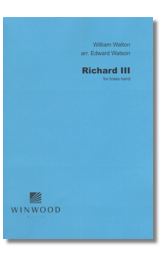
Richard III (Score only) - William Walton
It takes a special ability to compose film scores which serve the images perfectly yet translate into first class concert music. William Walton was such a talent as the continuing popularity of his brilliantly evocative film music shows. This suite presents a rich, vivid musical tapestry with all the drama of the original captured to perfection. Winwood Music are delighted to bring this music from Laurence Olivier's classic film to the brass band world in a fabulous arrangement by Edward Watson - so idiomatic that you'll think this is the original version! There are seven movements: 1. Prelude 2. Fanfare and Processional 3. Sound Drums and Trumpets & Recessional 4. Elegy 5. The Princes in the Tower 6. The Battle of Bosworth Field 7. Death of Richard and Finale
Estimated dispatch 7-9 working days
-
 £74.00
Richard III (Parts only) - William Walton
It takes a special ability to compose film scores which serve the images perfectly yet translate into first class concert music. William Walton was such a talent as the continuing popularity of his brilliantly evocative film music shows. This suite presents a rich, vivid musical tapestry with all the drama of the original captured to perfection. Winwood Music are delighted to bring this music from Laurence Olivier's classic film to the brass band world in a fabulous arrangement by Edward Watson - so idiomatic that you'll think this is the original version! There are seven movements: 1. Prelude 2. Fanfare and Processional 3. Sound Drums and Trumpets & Recessional 4. Elegy 5. The Princes in the Tower 6. The Battle of Bosworth Field 7. Death of Richard and Finale
Estimated dispatch 7-9 working days
 View Music