
Results
-
 £51.00
Atlantic Zephyrs (Trombone Solo with Brass Band - Score and Parts)
Soloist, composer and teacher Gardell Simons (1878 - 1945) achieved national prominence as trombone soloist with the Sousa Band. He later successfully made the transition to the orchestral world and became principal trombone in the Cleveland Orchestra as well as being professor of trombone at the Curtis Institute Of Music in Philadelphia.This solo dates from 1915 and describes the soft, gentle breezes of Summer. Maybe the atmosphere surrounding the many outdoor concerts in which the composer performed were his inspiration. This brass band arrangement was prepared at the request of Brett Baker for his visit to perform with Brass Band Of The Western Reserve, musical director Dr Keith M Wilkinson, in May 2010.
Estimated dispatch 7-14 working days
-
£33.00
Well, Did you Evah! - Porter, C - Somerset, G
Released in 1956, the Hollywood musical High Society was a musical remake of The Philadelphia Story. It had a star studded cast, including Frank Sinatra, Bing Crosby, Grace Kelly and Louis Armstrong (who played himself). Gavin Somerset's arrangement of Well, Did you Evah! faithfully reproduces the famous Crosby/Sinatra duet for two euphoniums. Entertainment at its best!!4th section +
In Stock: Estimated dispatch 1-3 working days
-
 £45.00
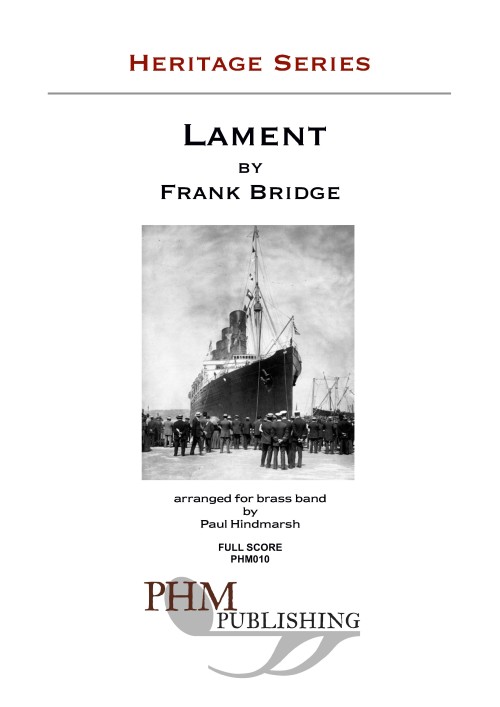
Lament (Brass Band - Score and Parts) - Bridge, Frank - Hindmarsh, Paul
The English composer Frank Bridge (1879 - 1941) did not take an active part in the First World War. However, he was devastated by the slaughter on the western and the eastern fronts, especially the loss of so many of his musicians friends and colleagues. Writing in 1963, his former pupil Benjamin Britten confessed that 'a lot of my feelings about the First World War which people seemed to see in the War Requiem came from Bridge. He had written a piano sonata in memory of a friend killed in France and though he didn't encourage me to take a stand for the sake of a stand, he did make me argue and argue and argue. His own pacifism was not aggressive, but typically gentle'.Bridge composed this Lament for string orchestra on 14 June 1915, in memory of Catherine Crompton, who drowned when the Cunard liner Lusitania was torpedoed by a German submarine on 7 May, 1915. According to figures researched by Liverpool historian Kevin Roach (www.lusitania.net), 1201 men, women and children lost their lives out of the 1962 people aboard. Ninety-four children died, including Catherine, her twin brother Paul and four other siblings. Paul Crompton, Snr. (44), a British businessman working in Philadelphia, his wife Gladys (40) and the family nanny were also drowned. How Bridge's dedication came about is uncertain. The music critic Edwin Evans, who knew Bridge well, has written that the Catherine was a young friend. It is also possible that he came across the family photograph which was published in many newspapers in the wake of the tragedy. By that time, Bridge was greatly distressed by the war as a whole. It seems perfectly in keeping with his pacifist leanings and the strength of his reaction, that this poignant and deeply touching 'war memorial' should mourn a child who he did not know, rather than one of the thousands of young men who fell in battle.Through the musical tears of this melancholy lullaby, Bridge may have regarded the death of young Catherine Crompton as symbolic of the loss of so many innocent lives in wartime. His response to this personal tragedy was characteristically spontaneous and utterly sincere. It is one of his most effective miniatures, poignant yet restrained in its lyrical beauty, with a compelling directness and simplicity of construction.This brass band transcription is pitched one tone lower than the original for string orchestra.- Paul HindmarshDuration: 5.00
Estimated dispatch 7-14 working days
-
 £51.00
Atlantic Zephyrs (Trombone Solo with Brass Band - Score and Parts) - Simons, Gardell - Wilkinson, Keith M.
Soloist, composer and teacher Gardell Simons (1878 - 1945) achieved national prominence as trombone soloist with the Sousa Band. He later successfully made the transition to the orchestral world and became principal trombone in the Cleveland Orchestra as well as being professor of trombone at the Curtis Institute Of Music in Philadelphia.This solo dates from 1915 and describes the soft, gentle breezes of Summer. Maybe the atmosphere surrounding the many outdoor concerts in which the composer performed were his inspiration. This brass band arrangement was prepared at the request of Brett Baker for his visit to perform with Brass Band Of The Western Reserve, musical director Dr Keith M Wilkinson, in May 2010.
Estimated dispatch 7-14 working days
-
 £40.00
Symphonic Dance No.3 (Brass Band - Score and Parts) - Rachmaninoff, Sergei - Littlemore, Phillip
Completed in 1940, the set of?Symphonic Dances?was Sergei Rachmaninov's last composition. The work is fully representative of the composer's late style with its curious, shifting harmonies, the almost Prokofiev-like grotesquerie of the outer movements and the focus on individual instrumental tone colours throughout.?Rachmaninov composed the Symphonic Dances four years after his Third Symphony, mostly at the Honeyman Estate, 'Orchard Point', in Centerport, New York, overlooking Long Island Sound. The three-movement work's original name was Fantastic Dances, with movement titles of 'Noon', 'Twilight' and 'Midnight'. When the composer wrote to the conductor Eugene Ormandy in late August, he said that the piece was finished and needed only to be orchestrated, but the manuscript for the full score actually bears completion dates of September and October 1940. It was premiered by Ormandy and the Philadelphia Orchestra, to whom it is dedicated, on 3rd January, 1941. This arrangement is of the last dance and is a kind of struggle between the?Dies Iraetheme, representing Death, and a quotation from Rachmaninov's own?Vespers?(also known as the All-night Vigil, 1915), representing Resurrection. The Resurrection theme proves victorious in the end as the composer actually wrote the word 'Hallelujah' at the relevant place the score (one bar after Fig. 16 in this arrangement).?Duration: 3:45
Estimated dispatch 7-14 working days
 View Music