
Results
-
 £73.00
Bass Trombone Concerto (Bass Trombone Solo with Brass Band - Score and Parts) - Wood, Gareth
Written in 2006 for Roger Argente, Gareth Wood brings his considerable experience of writing for brass, and brass bands in particular, to an instrument not often blessed with opportunities for solo exposure. It is scored for soloist accompanied by traditional brass band line-up, including timpani and two percussion, and follows the standard three-movement pattern. In the first movement, the soloist launches straight into the musical argument with a low-lying repeated quaver figure punctuated by the band. A lyrical second subject in the high register is also entrusted to the soloist, and the movement comes to a thrilling conclusion. The slow movement opens softly with the percussion, and a mournful bass line sets the mood for a thoughtful long melody. It reaches a powerful climax, which subsides to a return of the opening mood. In the march-like finale, the soloist is pitted against a number of solo instruments from the band and a driving ostinato carries the momentum through to the blazing ending. Duration: 13.00. Suitable for 1st Section Bands and above.
Estimated dispatch 7-14 working days
-
 £94.95
Dances and Arias (Brass Band - Score and Parts) - Gregson, Edward
This work was commissioned by Boosey & Hawkes Band Festivals (with funds provided by the Arts Council of Great Britain) for the National Brass Band Championships of Great Britain, held at the Royal Albert Hall, London, on 7th October 1984.Dances and Arias is in one continuous movement, but as the title suggests is a series of alternating fast and slow sections as follows: Dance - Aria I - Dance (scherzo) - Aria II - Dance. The opening dance is energetic and introduces a four-note motif (on trombones) which is the basis for much of the melodic material in the work. Throughout, there is a continuous process of thematic cross-reference and transformation.The first aria unfolds a long melody on solo cornet, eventually continued by all the solo cornets, and dissolving into a shimmering harmonic background (muted cornets, horns and baritones) over which is heard a brief self-quotation on solo tuba. This leads into the second dance, a frenetic scherzo, followed by the second aria, in the style of a lament (solo euphonium, followed by two flugel horns). This builds to a powerful climax which subsides, leaving the percussion to introduce the final toccata-like dance. It transforms material from the opening before a coda brings the music to a triumphant close. The large percussion section is an integral part in the work and uses a wide variety of instruments including timpani, glockenspiel, vibraphone, xylophone, tubular bells, tom-toms, snare drum, bongos and tam-tam.The work is dedicated to my brother and sister.- Edward GregsonDuration: 14.00
Estimated dispatch 7-14 working days
-
 £30.00
Accolade (Brass Band - Score and Parts) - Littlemore, Phillip
Accolade, meaning an award, an honour or a laudatory notice. This fanfare for brass band literally builds from the bottom up - a battery of percussion leads to the lower band's statement of the theme before passing through the middle of the band that builds a series of interjections. The theme is then restated in the upper band before the battery of percussion returns to end. The fanfare was written for Regent Brass as the title track for their 1990 recording to celebrate both their 5th anniversary and to celebrate being crowned 3rd Section Champion Band of Great Britain in 1988 - an accolade indeed!?Duration: 1:00
Estimated dispatch 7-14 working days
-
 £64.95
BRITISH ISLES SUITE FOR BRASS BAND AND PERCUSSION, A (Brass Band Set - Score and Parts) - Bates, Jonathan
2012 National Championships Finals - Fourth Section. The four movement work quotes hallowed poets and prose writers. The first movement uses Robert Burns's 'When Chill November's surly blast made field and forest bare' - a musical depiction of a Scottish highland landscape in crisp mid-winter. Movement 2 takes Dylan Thomas's 'Though lovers be lost, love shall not' and showcases soloists performing their individual love stories, finishing with an adaptation of the Welsh national anthem, whilst the third movement quotes the Irish poer, Yeats. The music links the Isle of Man and Ireland, opening with the Manx national anthem and traditional Manz dancing, before leading to a Dublin dance scene. Movement 4 quotes Shakespeare's 'Be not afraid of greatness', opening with a fanfare by percussion, then moving into Holst's In the Bleak Mid Winter and to the seventh variation of Elgar's Enigma Variations, Nimrod.
Estimated dispatch 7-14 working days
-
 £54.99
Langstrump Samba (Brass Band - Score and Parts)
The popular Swedish children's series Pippi L?ngstrump (Pippi Longstocking) is about an exceedingly strong and strong-willed little girl with red braids - who is the brainchild of Astrid Lindgren. This series has been broadcasted in many countries. I arranged its cheerful theme tune in samba style. Even with the new rhythm, the original song is still very recognizable. In the exuberant samba style, the percussion plays an important role. Within the L?ngstrump Samba, this is especially clear in the ad libitum percussion solo halfway through the arrangement. The solo can go on as long as desired, and offers plenty of freedom because of the free choice of the instruments used. 02:30
Estimated dispatch 7-14 working days
-
 £55.00
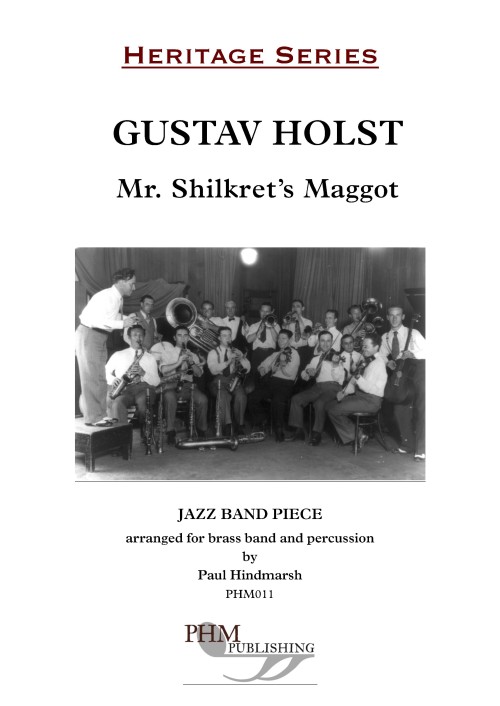
Mr Shilkret's Maggot (Brass Band - Score and Parts) - Holst, Gustav - Hindmarsh, Paul
This short piece was composed in 1932 during a visit Gustav Holst was making to the USA. He was invited by the band leader Nathaniel Shilkret to contribute to a series of piece for concert jazz band based on a folk song. Rather than using a traditional tune, Holst invented one of his own in folk song style and therefore the piece was not performed. Holst considered various titles for the piece including Mr. Shilkret's Dump, Folly and Maggot. On the manuscript he described it as a Jazz Band Piece. When the composer's daughter Imogen re-scored the piece for the English Chamber Orchestra to record under her direction in 1967, she changed decided to use the title Capriccio.Her re-orchestration involved removing the saxophone quartet, adding cor anglais and a second bassoon and changing cornet parts to trumpets. She retained the harp, extensive percussion, piano and celesta. My brass band version is based on the composer's manuscript, held at the British Library. It retains the composer's cornet parts, re-voices the woodwinds and strings, and places keyboards and harp onto glockenspiel, marimba, vibraphone and xylophone.I have selected the title Mr. Shilkret's Maggot for my scoring of Jazz Band Piece, which was first performed by The Cory Band, conducted by Philip Harper, at the Royal Northern College of Music Brass Band Festival, 29 January 2017.- Paul HindmarshDuration: 5.30
Estimated dispatch 7-14 working days
-
 £105.90
Blackbird Special (Brass Band - Score and Parts) - Gilje, Reid
Blackbird Special is a song by American band Dirty Dozen Brass Band.The song is an entertainment piece, a good concert opener or encore. When used as a concert opener one may let the different sections of the band enter the stage one by one playing in order of appearance. Percussion section may play their parts ad lib. The most important is the groove of the piece.
Estimated dispatch 7-14 working days
-
 £134.99
Origenes (Brass Band - Score and Parts) - Cardenas, Carlos
Origenes (Origins) was commissioned by the European Brass Band Association as a test piece for the challenge section of the 38th European Brass Band Championship in Freiburg, Germany 2015. It is a spectacular piece from the pen of Carlos Cardenas, who belongs to a new generation of composing talent. The clave, a rhythmic pattern, which originally comes from African music, was the inspiration for this innovative piece, all motifs and structures being derived from it. The six parts feature a wide spectrum of percussion instruments, reveal an impressive range of new sound combinations and yet are very accessible for the audience.Duration: 10.45
Estimated dispatch 7-14 working days
-
 £89.95
Of Distant Memories (Music in an Olden Style) (Brass Band - Score and Parts) - Gregson, Edward
Of Distant Memories pays homage to the brass band composers that form the backbone of the brass band repertoire and their music, and in the process summons up a kind of subconscious memory bank of the musical languages, styles and forms used by them. The music is conceived in the form of a 'traditional' tone poem, reflecting certain aspects (e.g. melodic, harmonic, textural) of those early test pieces. Although fairly traditional concepts have been kept in planning the architecture of the work, certain aspects of the instrumentation, or scoring, are more contemporary in colouristic terms, as befits a composer writing in the 21st century. However, the percussion requirements are fairly modest, similar to those used in the works of that period. The brass band tradition owes much to the composers of that period, for through their music they established a truly homogenous 'British' brass band sound which has spread throughout many parts of the world. That tradition flourishes today and remains important for today's composers, even if their musical language is far removed from that of their predecessors. Of Distant Memories is the composers own way of repaying that gratitude.Duration: 15.00
Estimated dispatch 7-14 working days
-
 £80.00
The Unfortunate Traveller (Brass Band - Score and Parts) - Holst, Imogen - Hindmarsh, Paul
Imogen Holst (1907-1984) submitted The Unfortunate Traveller (1929) as her final work as a student portfolio at the Royal College of Music, where her composition teacher was Gordon Jacob. The title was taken from Thomas Nashe's famous 1594 picaresque novel of the same title. The Suite was first performed on 12 February 1933 at her Majesty's Theatre, Carlisle, by the St. Stephen's Band, with the composer conducting. Te concert was given in memory of Holst's uncle, Dr. H.A. Lediard. Holst had been impressed with the band's performance of his A Moorside Suite at the 1928 National Brass Band Championships (The Crystal Palace, South London) and was keen to work with them. Writing in Imogen Holst, a life in music, Christopher Grogan indicates that it was Gustav Holst's suggestion to include his daughter's work in the programme, quoting Imogen Holst's remarks made in interview to The Daily Mail as follows: "....it is the first time, so far as I know, that a woman has conducted a brass band at a public concert....It has been a delight to rehearse the St. Stephen's Band. It was their performance at the Crystal Palace Festival that inspired me to write this Suite, which I have dedicated to them."Imogen Holst accompanied her father to the Crystal Palace in 1928 to hear the performances of A Moorside Suite, and was so excited by the played and, audibly, by her father's music that she decided to write a brass band piece for her final examination. Te result was The Unfortunate Traveller (1929). However, it was not possible for her to present a brass band work for examination. She arranged it for string orchestra so that it could be played before she left the RCM in July 1930. Following the premiere of the original in 1933, the manuscripts did not resurface until 1969 Imogen found them among her late mother's effects. Although she requested score and parts be destroyed, they ended up in the possession of Manchester composer John Golland, who marked up the score presumably with the intention of creating a new performing edition. The original scoring reveals a lack of experience with what can be a tricky medium.With the agreement of the Holst Foundation, a revised edition, with additional percussion, was prepared in 2011 since when the work has been fortunate to travel round the world as a concert and contest piece. The original includes drums in the March only. The title was taken from Tomas Nashe's famous 1594 picaresque novel of the same title. Several Morris Dance tunes are introduced during the course of the four short movements, including Bonnie Green Garters, Shepherd's Hey, The Rose and The Wind Blaws Cauld. Quirky twists and turns of harmony and spirited rhythms that remind us how much Imogen Holst loved tradition English dance music.In September 2025, I made a performing edition of the composer's arrangement for string orchestra. The manuscript lacks the final movement, which I arranged in a similar style, ie. without extending the upper ranges. Making this edition raised some issues regarding the accuracy of my band version and some of the solutions I used to smooth out the voicing. I have used the composer's second thoughts to refine my performing edition and to correct a textual errors.- Paul HindmarshDuration: 10.00
Estimated dispatch 7-14 working days
 View Music