
Results
-
 £44.95
Triumphant (Brass Band - Score and Parts)
Triumphant was written as the opening work for the 2024 Future All-Stars final concert. Based on the well-known hymn Victory in Jesus (S.A.S.B. 464), the piece reimagines the familiar melody and words with energetic drumline-inspired rhythms and driving Bass groove.O victory in Jesus, my Saviour, for ever!He sought me and bought me with his redeeming blood;He loved me ere I knew him, and all my love is due him -He plunged me to victory beneath the cleansing flood.Musically speaking, the rhythmic pulse should remain confident and consistent throughout, with the percussion establishing the groove and the band locking in with precision. Take time to find a tempo that allows the Bass and Percussion parts to remain clear and accurate. A slightly steadier pace will produce a stronger, more convincing groove. However, a slower tempo can result in the band's playing becoming too heavy. Melodic lines should be played on the longer side, allowing phrases to sing over the rhythmic accompaniment that can be more defined and articulated. As the work builds, be patient and disciplined with dynamics, saving the band's fullest sound for the climactic moments, maximising their impact.
Estimated dispatch 7-14 working days
-
 £99.95
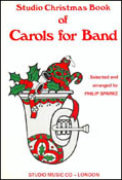
Carols for Band (Brass Band - Score and Parts)
Designed to be playable by any combination from quartet to full brass band, wind band or orchestra, the arrangements in this book with provide a practical solution to all your carolling needs. Parts are divided into Soprano, Alto, Tenor and Bass so that any suitable instrumentation will sound well, providing an equal balance of players per voice is maintained. The carols are printed in alphabetical order so they are easy to find, and comprehensively indexed under both first line and name of tune.Score, Timpani and Percussion parts are available separately.Instrumentation is as follows: Brass BandWind BandStringsSopranoEb Soprano CornetSolo Bb CornetBb Repiano & Flugel1st Flute & Piccolo2nd FluteOboe1st Bb Clarinet1st Bb Trumpet/Cornet1st ViolinAlto2nd & 3rd Bb CornetSolo Eb Horn1st Bb Trombone2nd & 3rd Bb ClarinetsEb Alto Saxophone2nd Bb Trumpet/Cornet1st F Horn2nd ViolinTenor1st & 2nd Eb Horns1st & 2nd Bb Baritones2nd Bb Trombone1st Bb EuphoniumEb Alto ClarinetBb Tenor Saxophone2nd F Horn1st & 2nd TrombonesViolaBassBass Trombone2nd Bb EuphoniumEb BassBb BassBassoonBb Bass ClarinetEb Baritone SaxophoneBass TromboneEuphoniumTubaCello/BassTitles included:Angels from the Realms of GloryAs with Gladness Men of OldAway in a MangerBrightest and BestChristians AwakeCoventry CarolDeck the HallsDing Dong, Merrily on HighFirst NowellGod Rest ye Merry, GentlemenGood King WenceslasHark the Glad SoundHark, the Herald Angels SingHolly and the IvyI Saw Three ShipsIn Dulci JubiloIn the Bleak Mid-WinterInfant HolyInfant KingIt Came Upon a Midnight ClearJingle BellsLo, He Comes with Clouds DescendingLove Came Down at ChristmasO Come, All ye FaithfulO Come, O Come, EmmanuelO Little Town of BethlehemOf the Father's Love BegottenOnce in Royal David's CitySans Day CarolSee Amid the Winter's SnowSilent NightSussex CarolThou Didst Leave Thy ThroneUnto Us is Born a SonWe Wish You a Merry ChristmasWhile Shepherds WatchedThe Brass Band Set consists of 25 Parts:1 x Eb Soprano Cornet4 x Solo Bb Cornet2 x Bb Repiano & Flugel4 x 2nd & 3rd Bb Cornet1 x Solo Eb Horn2 x 1st & 2nd Eb Horn2 x 1st & 2nd Bb Baritone1 x 1st Bb Trombone1 x 2nd Bb Trombone1 x Bass Trombone1 x 1st Bb Euphonium1 x 2nd Bb Euphonium2 x Eb Bass2 x Bb Bass
Estimated dispatch 7-14 working days
-
 £99.00
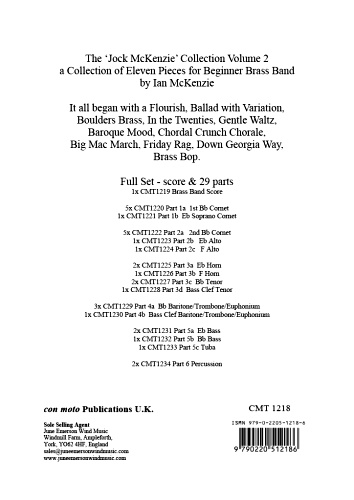
THE JOCK MCKENZIE COLLECTION Volume 2 for Brass Band (score & parts) - McKenzie, Jock
The score (CMT1219, which is ring bound on A4) shows parts 1 & 2 in Bb, part 3 in Eb and part 4 in bass clef concert pitch plus the percussion parts (drum kit & auxiliary). Each individual part book is printed on double sided B4 and presented with a colour cover. Indian Queens Junior Band plays 'Boulders Brass' on you tubeContents / Comments:
In Stock: Estimated dispatch 1-3 working days
-
 £54.99
Hymnus Antverpiae (Brass Band - Score and Parts) - Van der Roost, Jan
This hymn was commissioned by "Antwerpen 93". And this city, on the banks of the river Schelde has been nominated "Cultural Capital of Europe" for 1993. The work-group "animatie" took the initiative and commissioned a hymn, which -as the finale to a grand open-air event on 27th March- was premired by hundreds of musicians from all over Europe. Philippe Langlet (France) was the conductor at this majestic occasion. Musically speaking the piece can no doubt be labelled easy. Indeed it is meant to represent a hymn, playable by all in different instrumental combinations. Consequently a variable instrumentation was chosen and a type of music, which by native is easily accessible and uncomplicated. The conductor is free -in the instrumentation- to score this piece according to his own taste. It is perhaps advisable to use the sharp brass in the forte parts, in order to make the range in the sound of the orchestra as colourful as possible. The percussion parts are not absolutely essential, so that the hymn can also be performed without percussion.Duration: 4:00
Estimated dispatch 7-14 working days
-
 £62.00
Set To (Brass Band - Score and Parts) - Turnage, Mark-Anthony - Houlding, Christopher
Set To is dedicated to London Brass and arranged for brass band by Christopher Houlding. It was commissioned by the Aldeburgh Foundation and received its first performance on August 24th 1993 at the Maltings, Snape. Originally divided into two movements, a pensive and richly harmonic Blues and an aptly named Bacchanale, sometimes slow but mostly fast and furious. "I remember playing the original brass ensemble version of "Set To" numerous times in the early nineties with London Brass and always wondered if the composer would consider writing something for Brass Band. As Director of The Guildhall Brass Band, a possible performance opportunity arose in 2010 and I successfully approached Mark and gained his permission to scale it up for brass band with added percussion parts. I conducted the premier of this new Brass Band version at the Guildhall School of Music & Drama in February 2011 with the composer present and he liked it. Although very contemporary compared to most brass music, I feel that Mark's easily accessible style makes this rhythmically quirky and harmonically 'bluesy' work a really interesting concert piece, suitable for any occasion" - Chris Houlding. Duration: 7.30. Suitable for Championship Section Bands
Estimated dispatch 7-14 working days
-
£44.50
Brass Monkey's Ensemble Workout - David White
This selection of music is the perfect all-in-one workout for your training band. Each piece contained within the selection serves a definite purpose (all of which are given below and are printed in the score). The "Ensemble Workout" balances musical exercises and pieces of music to ensure that the end result is a better ensemble performance over all. The pieces keep the players entertained whilst ensuring they listen and work with the other players around them. Drum Kit and Percussion parts are also included. The pieces (and their objectives) included areaA UNISON WARM UP & HYMN TUNEA MINOR TUNE - no key or time signature, no dynamics, accidentals for some (sharp)PLODDING ON - time signature but no key signature, no dynamics, accidentals for some (sharp, flat natural) staccato / legato playingLITTLE WALTZ - time signature & key signature, accidentals & dotted minims & ties D.S. al Fine & repeats with 1st & 2nd time bars no dynamicsLAZY LATIN - time & key signature, dynamics & accidentals, staccato / legato playing styles, sectional repeats with 1st & 2nd time barsTHE AIKIN DRUM - 6/8 compound time, March style playing, D.C. al Coda
In Stock: Estimated dispatch 1-3 working days
-
£24.50
Farondole - Bizet - Alan Beaumont
This famous movement from Bizet's highly popular suite has long been a favorite with brass bands and their audiences alike. This new arrangement now includes better percussion parts (including timpani) and some lovely grace notes for Baritone and Repiano. The Cornet section is also arranged unusually as it is written for 3 players to play the Repiano part and 2 players to play the Solo Cornet line. A wonderful effect.
In Stock: Estimated dispatch 1-3 working days
-
 £29.50
Grandfather's Clock - G Doughty - Gavin Somerset
One of the most popular Euphonium solos in the Brass Band repertoire has now been transcribed and re-arranged for the Eb Instruments of the band. Originally arranged for Michelle Ibbotson on Soprano for Black Dyke, this transcription makes the solo perfect for Soprano Cornet, Tenor Horn or even Eb Bass. New percussion parts have also been added for this arrangement. Most bands have the original Euphonium solo in their library, and now is the chance to revive this old classic in a new light, with new soloists.
In Stock: Estimated dispatch 1-3 working days
-
 £127.95
Music of the Angels (Symphonic Brass Ensemble - Score and Parts)
In 1998 Gregson was commissioned by conductor Martyn Brabbins to write a short concert opener with choir to mark his debut as Music Director of the Huddersfield Choral Society. Entitled ...and the seven trumpets... this ten minute flourish is founded on a verse from Chapter 8 of the Revelation To John (The Apocalypse), the last book in the Bible: 'and I saw the seven Angels which stood before God: and to them were given seven trumpets'. The performance employed the full power of the Huddersfield Town Hall organ and the brass section of the BBC Philharmonic, including seven trumpets and four horns placed strategically around hall.The following year, when Gregson received a commission from the Cheshire-based Foden's Brass Band (conducted at that time by Nicholas Childs) for a work to mark its centenary in 2000, he turned to the first portion of ...and the seven trumpets... as the basis for an ambitious celebratory work entitled The Trumpets of the Angels. "The opportunity to create an extended work which would break out of the brass band mould was an important milestone for me," the composer says. In 2015 he was asked by Nicholas Childs to create a new performing edition without organ for the Black Dyke Band. This received its first performance in April 2016 at the European Brass Band Festival in Lille. In 2018, Gregson revisited the music for a third time, returning the opening fanfares to orchestral brass and transforming substantial portions of the 'Black Dyke' version to create Music of the Angels, a dramatic canvas for symphonic brass and percussion.An array of bells and gongs offer an unmistakable key to the source of Gregson's inspiration. Inscribed In tribute to Olivier Messiaen, the work's principal material and its sound world, but crucially not the underlying musical processes, are influenced by Messiaen's masterpiece for wind and percussion, Et exspecto ressurectionem mortuorum (1964). Music of the Angels begins with braying of horns suggestive of the start of an ancient ritual. Six 'angel' trumpeters, set behind the ensemble, answer in sequence, with the evocative sound of tam-tams creating the Messiaen-like aura. Once the horns have reached the performing space, four of the trumpeters deliver highly contrasting fanfare cadenzas. At the climax of this episode, the individual fanfares are presented together, as if, perhaps, to reflect the Biblical writer's apocalyptic visions of hail, fire, seas of blood and the cataclysmic destruction of man and beast.This powerful vision of death and destruction gives way to a prayerful lament, re-imagining a sung Kyrie Eleison from the 'Black Dyke' edition, with flugel horn and euphonium obligati. The hushed atmosphere is broken by tenor and side drums, and trumpets five and six, which gallop away like the Horsemen of the Apocalypse. In the biblical account their steeds had 'heads like lions with fire and smoke and sulphur issuing from their mouths'.As the reverberation of a dramatic climax dies we hear the entry of the seventh trumpet, from 'on high', blazing forth with a version of the main that extends across the entire compass of the instrument - almost three octaves. Supported by a 'holy trinity' of gongs, an 'epic' final cadenza introduces new material which is further developed in a frenetic final section. This is announced by two sets of timpani, to the left and right. Braying brass (euphoniums and horns) once more adds an air of foreboding. As the music builds towards a magisterial conclusion, the Messiaen-inspired tritones of the principal motif are smoothed out into perfect 5ths and combined with the earlier material in a full-voiced chorale, over which the seventh trumpet blazes in triumph.- Programme note by Paul HindmarshScored for1 Trumpet in E flat (Trumpet 5)6 Trumpets in B flat (Trumpet 4 doubling Flugel Horn)4 Horns in F3 Tenor Trombones1 Bass TromboneEuphonium2 Tubas2 Timpani (Percussion 3 doubles Timpani 2)Percussion (3 players): 3 Tam-tams, 3 Suspended Cymbals, Bass Drum, Tenor Drum, Snare Drum, Tubular Bells.Duration: 16.00
Estimated dispatch 7-14 working days
-
 £95.00
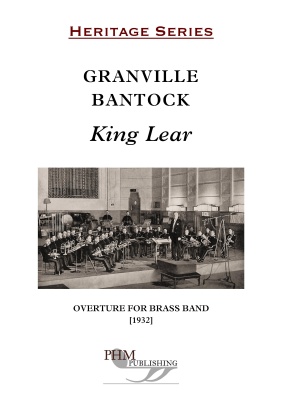
King Lear (Brass Band - Score and Parts)
Sir Granville Bantock (1868 - 1946) composed the second of his five major brass band work for Callender's Cableworks Band, completing the commission on 30 November 1932. Based in the Thames-side district of Belvedere near Erith, the band was active between 1898 and 1961. The works band of the Callender Cable & Construction Co. Ltd, it was at the peak of its popularity during the 1930s and was a frequent broadcaster on the radio. The band employed an in-house arranger and played saxophones in its lighter material. King Lear was one of the band's major commissions and was not published in Bantock's lifetime. The manuscript score and parts were thought to be lost for decades, but were found in the library of the Haydock Band (Lancashire), which had inherited part of Callender's library of manuscripts material and bespoke arrangements after it has been transferred to nearby Prescott Cables Band after Callender's Cable Works closed.King Lear is a substantial work, in essence a dramatic tone poem in the romantic Tchaikovskian manner, presenting a series of character portraits of the foolish old king and his three daughters, Goneril, Regan and Cordelia. The music is dramatic and lyrical by turns, with the most generous lyrical episode revealing perhaps the warm-hearted Cordelia. An expansive melody that flows from this is brought back towards the end as the main climax of the work.In 2001, Bantock's score was recorded by the University of Salford Brass Band, conducted by Dr. Roy Newsome. The original is serviceable, but in comparison with the orchestral version he made in 1936 (part of which was recorded on a Paxton 78 rpm) and later brass band scores, performing editions of which were prepared by others, it lacks colour and range typical of Bantock's orchestral work. Above all it lacks percussion, which can be heard on the recorded extract. With the kind permission of the Bantock Estate, I have prepared a performing edition for publication that incorporates percussion, derived from the orchestral recording and added editorially in similar manner elsewhere. I have revoiced some of the low- lying instrumental parts to present the material in more comfortable ranges. Editorial interventions more elaborate than revoicing the original text have been identified as cue notes.- Paul HindmarshDuration: 15.00
Estimated dispatch 7-14 working days
 View Music