Results
-
 £52.00
Hymn at Sunrise (Parts only) - Ray Steadman-Allen
The idea for this work was prompted by a poem - Hymn Before Sunrise - which describes the majesty of a mountain in darkness, the sounds of a nearby waterfall and so on. Nothing came of the exposure to these pictures except for general thoughts about the dawn of day and a series of movements expressing a personal response to the wonder of creation in an imaginary moment in time. The movement titles, which were added later, are intended to underline a prevailing sense of worship, wonder and exaltation. The music is pure, not pictoral, though listeners may conjure their own images. An actual hymn - Tallis' Cannon - is incorporated. There are five movements: 1. Thanksgiving: A short prelude in two parts. First a brief passage of 'dawn music' before things become more vigorous: fanfare-like music ushers in the trombone section's presentation of the Tallis tune. A broad band version concludes the movement. 2. De Profundis: A slow movement shot through with anxious questionings featuring flugel and trombone. The mood lightens a little in the centre where the soprano cornet is featured and the movement ends serenely. 3. Celebration is characterised by rhythmic drive, this is buoyant with plenty of incident pointed up by the percussion. 4. Invocation: Melodic in nature and sober in mood, the first section is a series of short solos mingled with chorale-like statements. Central to the movement is a chorale-prelude style presentation of the Tallis tune. The third section reintroduces the earlier solo music by the full ensemble. Dissolving, the music enters the last movement without a break. 5. Paean: Marked allegro con spirito there is, quite rightly, a fair amount of fun in the rejoicing. Snatches of Tallis are heard, then comes a gentle passage with a cornet solo leading to fanfare music and recapitulation. Two recitatives are succeeded by a coda which brings the work to a sonorous and exultant conclusion.
Estimated dispatch 7-9 working days
-
 £54.20
La Verbena (Brass Band - Score and Parts)
This series is for Brass Bands with a reduced number of playersThis series is without Repiano, 2nd Horn in Eb and 2nd TromboneParts included for:1 Eb Soprano Cornet5 Solo Bb Cornet3 2nd Bb Cornet2 3rd Bb Cornet1 Bb Flugel Horn1 Solo Eb Horn2 1st Eb Horn1 1st Bb Baritone2 2nd Bb Baritone (2nd Bb Trombone)1 1st Bb Trombone1 Bass Trombone2 Bb Euphonium2 Eb Bass2 Bb Bass1 Timpani2 Percussion/Drum SetOptional parts also included for:1 1st Trombone BC1 2nd Trombone BC1 Bass Trombone TC
Estimated dispatch 7-14 working days
-
 £54.20
Four Christmas Carols (Brass Band - Score and Parts)
This series is for Brass Bands with a reduced number of playersThis series is without Repiano, 2nd Horn in Eb and 2nd TromboneParts included for:1 Eb Soprano Cornet5 Solo Bb Cornet3 2nd Bb Cornet2 3rd Bb Cornet1 Bb Flugel Horn1 Solo Eb Horn2 1st Eb Horn1 1st Bb Baritone2 2nd Bb Baritone (2nd Bb Trombone)1 1st Bb Trombone1 Bass Trombone2 Bb Euphonium2 Eb Bass2 Bb Bass1 Timpani2 Percussion/Drum SetOptional parts also included for:1 1st Trombone BC1 2nd Trombone BC1 Bass Trombone TC
Estimated dispatch 7-14 working days
-
 £50.90
A Christmas Medley (Brass Band - Score and Parts)
This series is for Brass Bands with a reduced number of playersThis series is without Repiano, 2nd Horn in Eb and 2nd TromboneParts included for:1 Eb Soprano Cornet5 Solo Bb Cornet3 2nd Bb Cornet2 3rd Bb Cornet1 Bb Flugel Horn1 Solo Eb Horn2 1st Eb Horn1 1st Bb Baritone2 2nd Bb Baritone (2nd Bb Trombone)1 1st Bb Trombone1 Bass Trombone2 Bb Euphonium2 Eb Bass2 Bb Bass1 Timpani2 Percussion/Drum SetOptional parts also included for:1 1st Trombone BC1 2nd Trombone BC1 Bass Trombone TC
Estimated dispatch 7-14 working days
-
 £80.00
The Unfortunate Traveller (Brass Band - Score and Parts)
Imogen Holst (1907-1984) submitted The Unfortunate Traveller (1929) as her final work as a student portfolio at the Royal College of Music, where her composition teacher was Gordon Jacob. The title was taken from Thomas Nashe's famous 1594 picaresque novel of the same title. The Suite was first performed on 12 February 1933 at her Majesty's Theatre, Carlisle, by the St. Stephen's Band, with the composer conducting. Te concert was given in memory of Holst's uncle, Dr. H.A. Lediard. Holst had been impressed with the band's performance of his A Moorside Suite at the 1928 National Brass Band Championships (The Crystal Palace, South London) and was keen to work with them. Writing in Imogen Holst, a life in music, Christopher Grogan indicates that it was Gustav Holst's suggestion to include his daughter's work in the programme, quoting Imogen Holst's remarks made in interview to The Daily Mail as follows: "....it is the first time, so far as I know, that a woman has conducted a brass band at a public concert....It has been a delight to rehearse the St. Stephen's Band. It was their performance at the Crystal Palace Festival that inspired me to write this Suite, which I have dedicated to them."Imogen Holst accompanied her father to the Crystal Palace in 1928 to hear the performances of A Moorside Suite, and was so excited by the played and, audibly, by her father's music that she decided to write a brass band piece for her final examination. Te result was The Unfortunate Traveller (1929). However, it was not possible for her to present a brass band work for examination. She arranged it for string orchestra so that it could be played before she left the RCM in July 1930. Following the premiere of the original in 1933, the manuscripts did not resurface until 1969 Imogen found them among her late mother's effects. Although she requested score and parts be destroyed, they ended up in the possession of Manchester composer John Golland, who marked up the score presumably with the intention of creating a new performing edition. The original scoring reveals a lack of experience with what can be a tricky medium.With the agreement of the Holst Foundation, a revised edition, with additional percussion, was prepared in 2011 since when the work has been fortunate to travel round the world as a concert and contest piece. The original includes drums in the March only. The title was taken from Tomas Nashe's famous 1594 picaresque novel of the same title. Several Morris Dance tunes are introduced during the course of the four short movements, including Bonnie Green Garters, Shepherd's Hey, The Rose and The Wind Blaws Cauld. Quirky twists and turns of harmony and spirited rhythms that remind us how much Imogen Holst loved tradition English dance music.In September 2025, I made a performing edition of the composer's arrangement for string orchestra. The manuscript lacks the final movement, which I arranged in a similar style, ie. without extending the upper ranges. Making this edition raised some issues regarding the accuracy of my band version and some of the solutions I used to smooth out the voicing. I have used the composer's second thoughts to refine my performing edition and to correct a textual errors.- Paul HindmarshDuration: 10.00
Estimated dispatch 7-14 working days
-
 £34.95
Island Whirl (Brass Band - Score and Parts)
Island Whirl was commissioned by Margaret Milligan who wanted a brand new piece of music composed as a present for Ian, her husband for his 70th birthday. Ian Milligan is a keen and dedicated musician and he is the musical director of Callendar Brass, based in Callendar near Stirling in Scotland.Margaret contacted me about the possibility of composing a short lively piece which had a Scottish theme that would be ideal for Callendar Brass Band and any other ensemble to get their teeth into. This piece takes its inspiration from the traditional Scottish folk song 'An Eriskay Love Lilt' which is a particular favourite of both Margaret and Ian.With thunderous Celtic drums the piece opens in a whirlwind of sound with fanfare brass and an off-stage soloist that can perform using either the cornet or trumpet. After the exciting opening, the brass and drums die away to allow the off-stage soloist to air the traditional tune 'An Eriskay Love Lilt'.The beautiful haunting melody, keeping its originality throughout undergoes a series of changes in the accompanying harmonic material before dying away to allow the Celtic drums to return. The percussion whip the band into a frenzy as the piece gets faster and faster. Just prior to the final notes the band diminuendo to allow one last closing statement from the Eriskay Love Lilt lead by the off-stage soloist before the ensemble charge to a dramatic close.When performing this piece I would recommend the off-stage soloist taking a position somewhere in the audience, so they can almost feel part of the performance. In addition, with the two tom-tom parts that represent the Celtic drums, bands should make the most of showcasing them by getting the two drummers out to the front of the band to perform. The ideal stage position would be with the players set up in stereo with one player in front of the soprano cornet and the other in front of the solo trombone.With the various choreographed movements from both the off-stage soloist and the percussionists. This piece is a great addition to any concert repertoire and is an ideal showcase for bands who want to try something a little different.I wish Ian at 70 years young, all the very best with his music making in the many years to come and I hope this piece, composed especially for him and Callender Brass brings them many years of musical enjoyment.Paul Lovatt-Cooper
Estimated dispatch 7-14 working days
-
 £75.00
Cantata for brass band and percussion. Andrew Duncan
Recommended for - Championship bands Cantata was commissioned by The Fodens Band who gave the first performance in 2014. Cantata was used as the test piece for the Scottish Open in 2014 and was played by the Whitburn Band as their own choice piece at the European Brass Band Championships in 2016. Cantata is in three movements and fully explores the textures, technique and musicality of a top section brass band and its soloists. Includes score & parts
-
£55.00
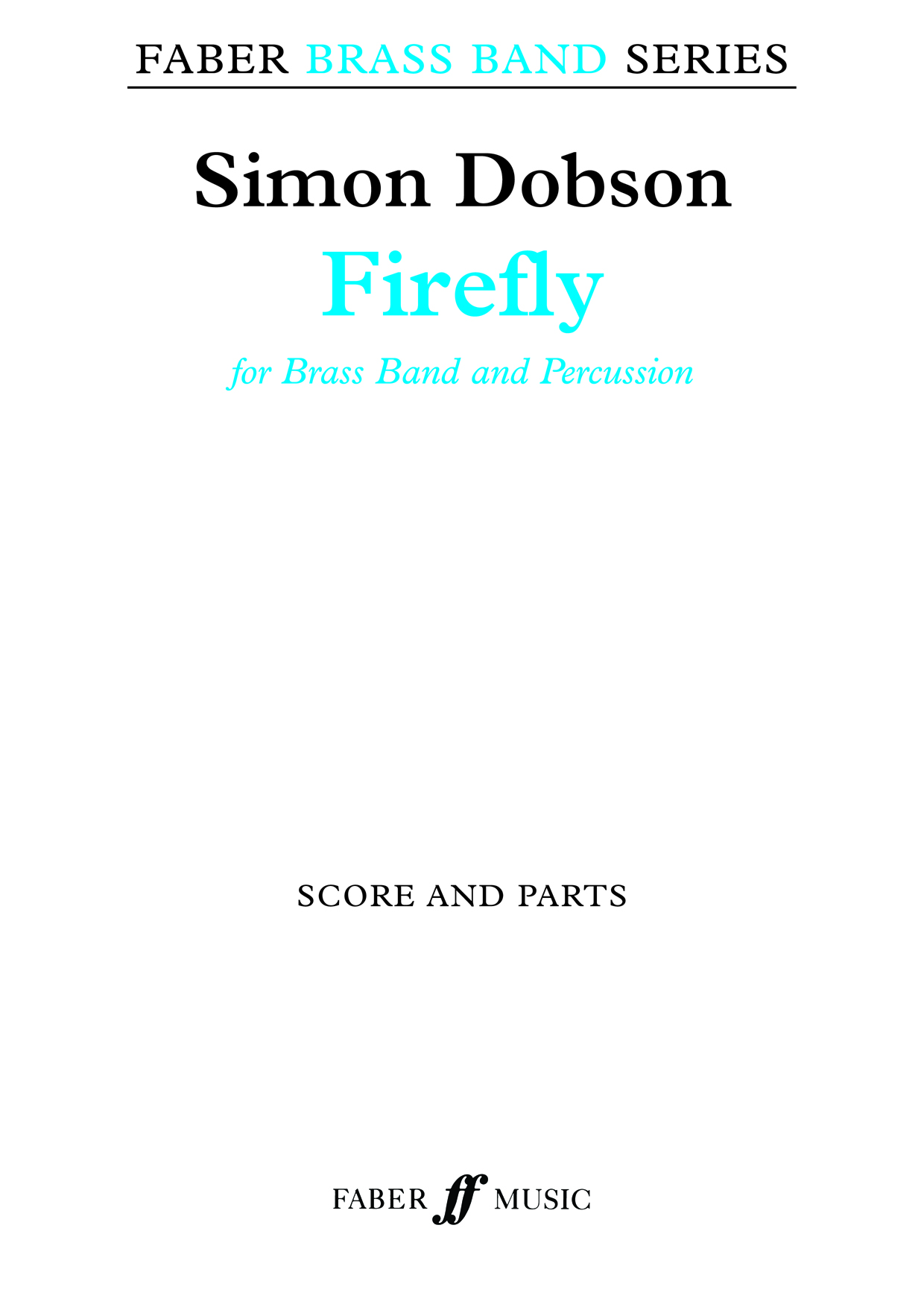
Firefly (brass band score & parts) - Simon Dobson
Firefly was composed by award-winning composer Simon Dobson (b.1981) to provide an entertaining up-tempo concert work for community and youth bands. Composed in funk-rock style, and is based on the groove beat with which it opens. Dobson says, "Firefly was written as a break from my more serious music and as a 'hat tip' to the various types of beat orientated music I listen to." It was first performed by Oslofjord Brass in Norway and in its wind version by Harmonie Shostakovich, Switzerland. Duration: 5-6 minutes. INSTRUMENTATION: 1 Eflat Sop. Cornet, Solo Cornets (4), Bflat Rep. Cornet (1), 2nd Bflat, Cornets (2), 3rd Bflat Cornets (2); Flugel horn, Solo Eflat Horn, 1st Eflat Horn, 2nd Eflat Horn; 1st Bflat Bar., 1 2nd Bflat Bar., 1st Trombone, 2nd Trombone, Bass Trombone; Bflat Euphoniums (2); Eflat Tubas (2); Bflat Tubas (2); 2 percussion
In Stock: Estimated dispatch 1-3 working days
-
 £27.50
FARMER'S GALOP (score & parts) - Farmer
The score shows brass band scoring & percussion.
In Stock: Estimated dispatch 1-3 working days
-
 £27.50
HOEDOWN (score & parts) - Frederick, Mike
The score shows brass band scoring & percussion.
In Stock: Estimated dispatch 1-3 working days