
Results
-
 £59.99
This is Me (from The Greatest Showman) (Brass Band - Score and Parts) - Pasek & Paul - Brown & Jeanbourquin
From the songwriting team who brought us Dear Evan Hansen and La La Land, the movie musical The Greatest Showman is based on the true story of P. T. Barnum, with Hugh Jackman in the title role. This arrangement of the powerful anthem from the film is a dynamic showcase for the concert stage.
Estimated dispatch 7-14 working days
-
 £154.99
Where Angels Fly (Brass Band - Score and Parts) - Houben, Kevin
Where Angels Fly was commissioned by VLAMO (Flemish Band Association). Kevin Houben wrote this work for the 2017 European Brass Band Championships in Ostend, Belgium. This is a very technical, powerful and virtuosic work with a rather fragile and soft introduction in which the main motif - derived from the Belgian composer Paul Gilson's (1865-1942) La Pri?re from Le Retour au Pays - is developed and also includes Houben's own musical signature 'HBE(N)'. Where Angels Fly is a challenging, impressive and virtuosic contest piece. Duration: 16.00
Estimated dispatch 7-14 working days
-
£13.99
Where Angels Fly (Brass Band - Study Score) - Houben, Kevin
Where Angels Fly was commissioned by VLAMO (Flemish Band Association). Kevin Houben wrote this work for the 2017 European Brass Band Championships in Ostend, Belgium. This is a very technical, powerful and virtuosic work with a rather fragile and soft introduction in which the main motif - derived from the Belgian composer Paul Gilson's (1865-1942) La Prire from Le Retour au Pays - is developed and also includes Houben's own musical signature 'HBE(N)'. Where Angels Fly is a challenging, impressive and virtuosic contest piece.Duration: 16.00
Estimated dispatch 7-14 working days
-
 £169.99
Destination Moon (Brass Band - Score and Parts) - Raphael, Paul
Destination Moon was first performed by Cory Band at the 2017 European Championships in Ostend, Belgium, and is inspired by the Belgian comic-book hero Tintin. The first part is called 'Science' and describes the development of the theory of space travel. The second part is 'Humanity' which addresses human concerns and philosophies about our place in the universe. The third part is 'The Launch' which ends with a repetition of the words 'Earth to Moon Rocket - are you receiving me?' as the rocket vanishes into a tiny speck in the sky. Duration: 18.45
Estimated dispatch 7-14 working days
-
 £39.99
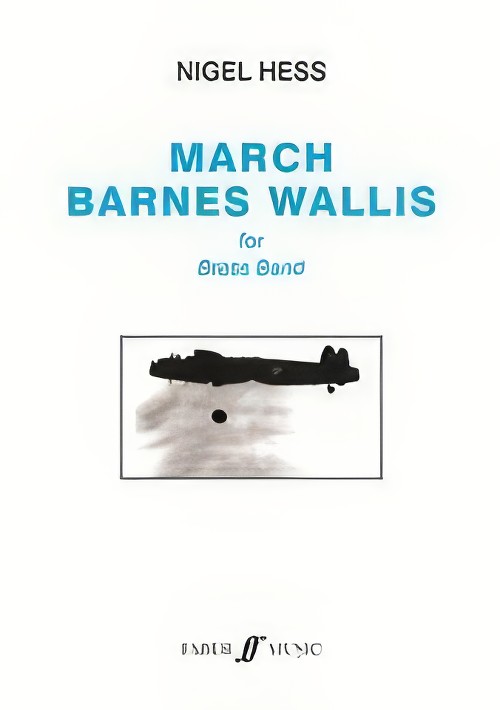
March Barnes Wallis (Brass Band - Score and Parts) - Hess, Nigel - Hindmarsh, Paul
March Barnes Wallis was commissioned by Royal Air Force Music Services to commemorate the 70th anniversary of the famous Dambuster's raid and received its first performance on BBC Radio 2's Friday Night is Music Night, broadcast live from Biggin Hill Airport on 17 June 2013 by the Central Band of the RAF, Director of Music Wing Commander Duncan Stubbs. Suitable for Premier Youth/2nd Section Bands and above. Duration: 5.30
Estimated dispatch 7-14 working days
-
 £38.00
Is That the Time? (Brass Band - Score and Parts) - Mottram, Paul
'Is That The Time' was written in 2014 for UK national award winning band 'Youth Brass 2000'. It's a showpiece in a jazzy fusion idiom with a full and central role for the kit drummer and percussionists. The temptation must be resisted to play the piece too quickly and in so doing losing the 16th note syncopations inherent within the rhythmic groove. The challenge is not so much one of getting the notes, although there are a few harmonic surprises along the way, as one of playing as a cohesive rhythmic unit. Duration: 4.30. Suitable for 1st Section Bands and above.
Estimated dispatch 7-14 working days
-
 £38.00
Leviathan (Brass Band - Score and Parts) - Denegri, Paul - Barton, Tom
"Leviathan" began its evolution as a workshop work inspired by the poem written by Heathcote Williams entitled; "Whale Nation". At the time of this workshop the tentet brass repertoire existed of extremely well written original or arranged works of a lighter nature but there was a shortage of works with a greater emotional depth and edge, hence Leviathan's early conception as an atmospheric and emotive work. The workshop piece explored whale sound and song and was a 25 minute work in two parts. After many years of the workshop sketches sitting dormant the new work Leviathan is a much shorter and concise work. It contains only one of the original melodic themes of the workshop work. Leviathan is driven and underpinned by melodic and rhythmic elements. It is a programmed work following the awe inspiring majestic might and beauty of whales through to a hunt scene, the chase, and the ultimate demise of earth's largest mammal. Originally commissioned by Superbrass for brass ensemble, this arrangement is by Tom Barton. Duration: 6.30. Suitable for 1st Section Bands and above.
Estimated dispatch 7-14 working days
-
 £59.95
Caelum Corona (Crown of Heaven) (Brass Band - Score and Parts) - Bulla, Stephen
Stephen Bulla's 'Caelum Corona' ('Crown of Heaven') portrays, in sound, a Christian's walk in faith, intended metaphorically via a musical narrative reminiscent of the early church pilgrims, their struggles and triumphs. The composer initially evokes the atmosphere of Rome at the time of St. Paul and other martyrs, thus the Latin title. Bulla marks his imaginative tone poem with dark, brooding music in the first two of three parts, in each of which he has embedded an appropriate hymn or song reference as thematic material.
Estimated dispatch 7-14 working days
-
£29.95
Caelum Corona (Crown of Heaven) (Brass Band - Score only) - Bulla, Stephen
Stephen Bulla's 'Caelum Corona' ('Crown of Heaven') portrays, in sound, a Christian's walk in faith, intended metaphorically via a musical narrative reminiscent of the early church pilgrims, their struggles and triumphs. The composer initially evokes the atmosphere of Rome at the time of St. Paul and other martyrs, thus the Latin title. Bulla marks his imaginative tone poem with dark, brooding music in the first two of three parts, in each of which he has embedded an appropriate hymn or song reference as thematic material.
Estimated dispatch 7-14 working days
-
£59.95
Inclusion (Brass Band - Score and Parts) - Sharman, Paul
Inclusion was commissioned by Bolsover District Council for the Bolsover Brass Band Summer School in July 2013, with funding from Arts Council England. The piece takes its theme from the fact that everybody, no matter what their background, should feel included in our churches and in society in general.
Estimated dispatch 7-14 working days
 View Music