
Results
-
£29.50
Dance of the Troglodytes - Naomi Styles
If your resident tuned percussionist hasn't had much to do of late, then why not present him or her with Dance of the Troglodytes? While not strictly a xylophone solo, it features this instrument strongly with fast arpeggios over a steady tune that gradually rises in intensity and excitement. 'Dance of the Troglodytes' is one of a modern day 'Carnival of the Animals' - a series of brass band tunes inspired by Christopher Lloyd's book 'What on Earth evolved?' which ranks the species which have most influenced planet Earth. The music celebrates Homo Sapiens, ranked by Lloyd as the 6th most influential species. Emerging from Africa about 160,000 years ago from Homo erectus stock, Homo Sapiens' quick thinking, manual dexterity and increasingly complex tool making skills made it the only surviving human species. Now we humans have spread to every corner of the globe, shaping it through agriculture, transportation and industry. Dance of the Troglodytes echoes the rise of humans as they emerge from primitive life and gradually create the complex world we live in today.
In Stock: Estimated dispatch 1-3 working days
-
 £34.95
Dance Music (Brass Band - Score only) - Downie, Kenneth
This music takes the form of a suite in four movements. The ever-changing spirit of the dance is reflected in the contrasting styles of each movement, ranging from the gentle lullaby to more boisterous and lively moods. Careful listeners will identify references to dance-associated tunes in each movement, concluding with the Christmas carol, 'Tomorrow shall be my dancing day'. The music is planned to be versatile and any one movement could be performed as a stand-alone item if required.
Estimated dispatch 7-14 working days
-
 £39.95
Rhapsody on a Theme by Purcell (Brass Band - Score only)
Contest VersionIn his relatively short lifetime, Henry Purcell (1659 -1695) achieved stellar musical success and was known and admired internationally by his contemporaries. He is justifiably considered one of England's greatest composers.I thought long and hard before using this magnificent theme as the basis for a band piece because I think that Benjamin Britten has said just about everything possible regarding it in his The Young Person's Guide to the Orchestra. Bearing this in mind, I tentatively set about working on this composition. Once started though, the job became fun because the theme still yielded possibilities - even after Britten!The piece is basically a set of linked variations, much like Rachmaninov's great Rhapsody on theme by Paginini. The music starts slowly and makes much use of crisply dotted rhythms - a Purcellian characteristic. The theme is heard twice before the music changes into a jaunty duple time variation based on the opening motif of Purcell's theme. After this, the mood changes to a waltz-like variation in which clear references to the original theme can be heard. The slow movement follows, and is based on rising and descending scalic figures. This variation is an 'A-B-A' movement with two similar passages framing a more vigorous middle section which features antiphonal fanfare-like figures. Without any preamble, the last variation launches itself - a rumbustious dance which has a distinctive feel to it.The theme eventually reappears as a counter-melody to this dance music before a final triumphant treatment of the melody featuring a somewhat athletic bass line. The music accelerates at the Coda and disappears in a 'puff of smoke'.- Kevin Norbury
Estimated dispatch 7-14 working days
-
 £60.99
Klezmeriana - Jan de Haan
The instrumental music of the Yiddish-speaking Jews, especially those of Eastern Europe, is known as klezmer. This terminology was originally used in Jewish cultural life as the name of a musician who played at weddings. At Jewish weddings, which usually last several days, klezmer musicians played not only dance music but also ceremonial music - for example during the wedding ceremony, and also music that was listened to during the wedding feast. Originally, there was no special term for this style of music. It was simply referred to as 'Jewish wedding music'. In the 1970s, the music - which is actually a fusion of different influences - enjoyed a resurgence in popularity and came to be known as klezmer. This music contains not only the sounds of the Balkans, but also influences of oriental and gypsy music too. Jan de Haan used no original klezmer melodies for Klezmeriana, but composed a series of sound-alike in an instrumentation for brass band.
Estimated dispatch 5-14 working days
-
 £40.00
The Unfortunate Traveller (Brass Band - Score only) - Holst, Imogen - Hindmarsh, Paul
Imogen Holst (1907-1984) submitted The Unfortunate Traveller (1929) as her final work as a student portfolio at the Royal College of Music, where her composition teacher was Gordon Jacob. The title was taken from Thomas Nashe's famous 1594 picaresque novel of the same title. The Suite was first performed on 12 February 1933 at her Majesty's Theatre, Carlisle, by the St. Stephen's Band, with the composer conducting. Te concert was given in memory of Holst's uncle, Dr. H.A. Lediard. Holst had been impressed with the band's performance of his A Moorside Suite at the 1928 National Brass Band Championships (The Crystal Palace, South London) and was keen to work with them. Writing in Imogen Holst, a life in music, Christopher Grogan indicates that it was Gustav Holst's suggestion to include his daughter's work in the programme, quoting Imogen Holst's remarks made in interview to The Daily Mail as follows: "....it is the first time, so far as I know, that a woman has conducted a brass band at a public concert....It has been a delight to rehearse the St. Stephen's Band. It was their performance at the Crystal Palace Festival that inspired me to write this Suite, which I have dedicated to them."Imogen Holst accompanied her father to the Crystal Palace in 1928 to hear the performances of A Moorside Suite, and was so excited by the played and, audibly, by her father's music that she decided to write a brass band piece for her final examination. Te result was The Unfortunate Traveller (1929). However, it was not possible for her to present a brass band work for examination. She arranged it for string orchestra so that it could be played before she left the RCM in July 1930. Following the premiere of the original in 1933, the manuscripts did not resurface until 1969 Imogen found them among her late mother's effects. Although she requested score and parts be destroyed, they ended up in the possession of Manchester composer John Golland, who marked up the score presumably with the intention of creating a new performing edition. The original scoring reveals a lack of experience with what can be a tricky medium.With the agreement of the Holst Foundation, a revised edition, with additional percussion, was prepared in 2011 since when the work has been fortunate to travel round the world as a concert and contest piece. The original includes drums in the March only. The title was taken from Tomas Nashe's famous 1594 picaresque novel of the same title. Several Morris Dance tunes are introduced during the course of the four short movements, including Bonnie Green Garters, Shepherd's Hey, The Rose and The Wind Blaws Cauld. Quirky twists and turns of harmony and spirited rhythms that remind us how much Imogen Holst loved tradition English dance music.In September 2025, I made a performing edition of the composer's arrangement for string orchestra. The manuscript lacks the final movement, which I arranged in a similar style, ie. without extending the upper ranges. Making this edition raised some issues regarding the accuracy of my band version and some of the solutions I used to smooth out the voicing. I have used the composer's second thoughts to refine my performing edition and to correct a textual errors.- Paul HindmarshDuration: 10.00
Estimated dispatch 7-14 working days
-
 £39.95
Rhapsody on a Theme by Purcell (Brass Band - Score only) - Norbury, Kevin
Contest VersionIn his relatively short lifetime, Henry Purcell (1659 -1695) achieved stellar musical success and was known and admired internationally by his contemporaries. He is justifiably considered one of England's greatest composers.I thought long and hard before using this magnificent theme as the basis for a band piece because I think that Benjamin Britten has said just about everything possible regarding it in his The Young Person's Guide to the Orchestra. Bearing this in mind, I tentatively set about working on this composition. Once started though, the job became fun because the theme still yielded possibilities - even after Britten!The piece is basically a set of linked variations, much like Rachmaninov's great Rhapsody on theme by Paginini. The music starts slowly and makes much use of crisply dotted rhythms - a Purcellian characteristic. The theme is heard twice before the music changes into a jaunty duple time variation based on the opening motif of Purcell's theme. After this, the mood changes to a waltz-like variation in which clear references to the original theme can be heard. The slow movement follows, and is based on rising and descending scalic figures. This variation is an 'A-B-A' movement with two similar passages framing a more vigorous middle section which features antiphonal fanfare-like figures. Without any preamble, the last variation launches itself - a rumbustious dance which has a distinctive feel to it.The theme eventually reappears as a counter-melody to this dance music before a final triumphant treatment of the melody featuring a somewhat athletic bass line. The music accelerates at the Coda and disappears in a 'puff of smoke'.- Kevin Norbury
Estimated dispatch 7-14 working days
-
 £29.88
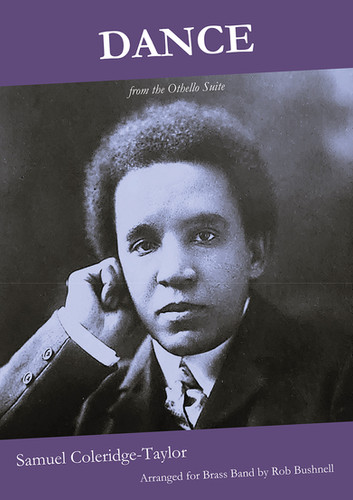
Dance from the Othello Suite (Brass Band) Coleridge-Taylor arr. Bushnell
Samuel Coleridge-Taylor is a British composer, who, from a young age, showed talent on the violin and entered the Royal College of Music, studying with Charles Villers Standford. His music become so popular that his Hiawatha trilogy was the second most performed choral piece (joint with Mendelssohn's Elijah, and only beaten by Handel's Messiah) with choral societies up and down the British Isles. In fact, Hiawatha was arranged by Charles Godfrey as a test-piece for the 1902 National Brass Band Championship of Great Britain, held at Crystal Palace.Commissioned by the theatre impresario Herbert Beerbohm, Coleridge-Taylor composed incidental music for His Majesty's Theatre London production of the Shakespeare play, Othello, in the West End, in 1909. In 1912, the play opened to the public, with a suite of five movements put together soon afterwards. The Dance, arranged here by Rob Bushnell, makes a great concert opener.This arrangement is for the British-style brass band, with alternative parts for horns in F and bass-clef lower brass. A recording of the original composition can be found at www.youtube.com/watch?v=OQeO_Ij9CV8 Duration: approx. 2.30 minutes Difficulty Level: 3rd Section + PDF download includes parts and score. Sheet music available at www.brassband.co.uk (UK) or https://satradecentral.org (USA) Instrumentation: Soprano Cornet Eb Solo Cornet Bb Repiano Cornet Bb 2nd Cornet Bb 3rd Cornet Bb Flugel Horn Bb Solo Horn Eb 1st Horn Eb 2nd Horn Eb 1st Baritone Bb 2nd Baritone Bb 1st Trombone Bb 2nd Trombone Bb Bass Trombone Euphonium Bb Bass Eb Bass Bb Timpani Percussion - Triangle, Cymbal & Bass Drum
In Stock: Estimated dispatch 1-3 working days
-
 £42.00
The Essence of Time (Score only) - Peter Graham
The Old Testament book of Ecclesiastes, Chapter 3 commences: To every thing there is a season, and a time to every purpose under the heaven; a time to be born; a time to dance; a time to love; a time to hate; a time to die; a time to mourn; a time for war; a time for peace. These extracts are each represented by a variation, or part variation, which attempt a musical portrayal of the individual characteristics of the moods of the activities listed. The 'essence' is for the interpreter and listener to decide. Duration: 13:00
Estimated dispatch 7-9 working days
-
 £52.00
The Essence of Time (Parts only) - Peter Graham
The Old Testament book of Ecclesiastes, Chapter 3 commences: To every thing there is a season, and a time to every purpose under the heaven; a time to be born; a time to dance; a time to love; a time to hate; a time to die; a time to mourn; a time for war; a time for peace. These extracts are each represented by a variation, or part variation, which attempt a musical portrayal of the individual characteristics of the moods of the activities listed. The 'essence' is for the interpreter and listener to decide. Duration: 13:00
Estimated dispatch 7-9 working days
-
 £46.00
Hymns at Heaven's Gate (Score only) - Elgar Howarth
A flourish: a crowd assembles at the gate of Heaven, saints and sinners. As in a film the immensity of the crowd is illustrated, and the camera zooms to focus onparticular groups and individuals. Monks sing a 'medieval' hymn, interrupted by the fanfares of mischievous seraphim; gradually the whole crown join in. The fanfares grow wilder, and grubby, naughty children enter, singing mock fanfares, making jazzy gestures and trying to sing a chirldren's hymn. They are joined by roughnecks who take up the fanfare idea. The camera zooms again at the entrance of Jesus. A commanding flourish causes consternation. Separate groups react, interrupted by mysterious percussion effects. Then, as the whole panorama explodes in sound, William Booth (founder of the Salvation Army) approaches awestruck. A triple Alleluia is followed by the third hymnand further Alleluias. A dance finale begins using material from the whole piece. A tumultuous climax preceds sudden quiet Alleluias, and the crown exits into Heaven to the music of the monks, reharmonised and transformed. The camera shots extend to the heavens and the stars. Duration: 15:00
Estimated dispatch 7-9 working days
 Listen to MP3
 View Music