
Results
-
 £26.99
Fraternity (Brass Band - Score Only)
This piece by Thierry Deleruyelle is based on one of the most significant events in the history of coal mining; the catastrophe at Courrieres, Northern France. It took place on 10th March 1906 and is considered the most momentous mining accident in Europe and the second most significant in the world. This work is both emotional and spectacular and tells in 7 contrasting sections the catastrophe that occurred. Fraternity was the test piece in the "Champion" category at the European Brass Band Competition 2016 in Lille, thus commemorating 110 years since the disaster at Courrieres.Duration: 15:40
Estimated dispatch 7-14 working days
-
£11.99
Fraternity (Brass Band - Study Score)
This piece by Thierry Deleruyelle is based on one of the most significant events in the history of coal mining; the catastrophe at Courrieres, Northern France. It took place on 10th March 1906 and is considered the most momentous mining accident in Europe and the second most significant in the world. This work is both emotional and spectacular and tells in 7 contrasting sections the catastrophe that occurred. Fraternity was the test piece in the Champion category at the European Brass Band Competition 2016 in Lille, thus commemorating 110 years since the disaster at Courrieres.Duration: 15.40
Estimated dispatch 7-14 working days
-
 £60.00
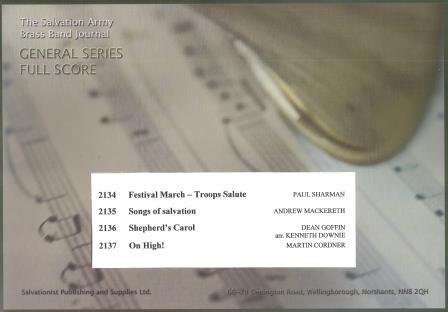
General Series Band Journal August 2014 Numbers 2134-2137
No. 2134 Festival March - Troops Salute (Paul Sharman)Written to mark the retirement of Major John Mott as Bandmaster of the Household Troops Band in 2010, this march features the tunes 'Are you washed?' and 'There's only one flag for me'. No. 2135 Songs of Salvation (Andrew Mackereth)This piece was written for Haaglanden Band in the Netherlands and contains some old Salvation Army Songs; 'Ring the bell, watchman' (T.B. 776), 'Make no delay' (T.B.730), 'Room for Jesus' (T.B. 395), 'Tell me the old, old story' (T.B. 265) and 'Praise God, I'm saved' (T.B. 770).No. 2136 Shepherd's Carol (Dean Jones arr. Kenneth Downie)Originally published in November 1955, this lovely carol was written by father and son, Dean and Henry Goffin, both of whom were Salvation Army officers. Commissioner Sir Dean Goffin was awarded his kinghthood in the Queen's Honours list of 1983No. 2137 On High! (Martin Cordner)Taking its inspiration from the world of rock music, this piece features the song, 'Lord, I lift your name on high'.
Estimated dispatch 7-14 working days
-
 £89.95
Orion (Brass Band - Score and Parts)
Orion was named after the giant huntsman in Greek mythology and is a prominent constellation located on the celestial equator and visible throughout the world. It is one of the most conspicuous and recognisable constellations in the night sky. This piece and its inspiration were composed as a tone poem creating a musical picture of this amazing phenomenon.The opening introduces the constellation. Starting mysteriously with the percussion and basses this section develops a series of rhythmic and harmonic interludes from the upper brass. As this introduction develops, the melodic line lead by the Solo Cornet and Euphonium builds as the accompanying instruments increase in their rhythmic complexity. This section climaxes with a short fanfare motif which will be a prominent theme throughout this piece.The fast rhythmic section that follows serves as a technical test for the players. The thematic device introduced by the Solo Cornets is passed around various soloists and sections within the ensemble. This part of the tone poem gives the opportunity for the ensemble to highlight their technical prowess. The fanfare motif returns to conclude this section and takes the piece into the slow middle movement.Motifs heard earlier are mixed with new ideas in this slow section which give an opportunity for a variety of soloists to demonstrate their musical prowess. After the various solo passages and cadenzas, the mood shifts dramatically to a more ominous section that builds in texture and dynamic. Concluding with our returning fanfare motif the piece then builds in momentum towards our finale section.This finale is a technical showcase which will further test the playing ability and stamina of soloists, small groups and the full ensemble. Using prominent musical themes heard throughout this piece the music builds to a glorious conclusion fitting with wonderful constellation.
Estimated dispatch 7-14 working days
-
 £40.00
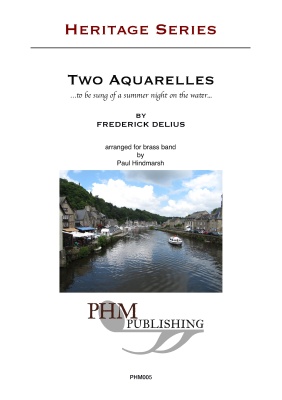
Two Aquarelles (Euphonium Feature with Brass Band - Score and Parts)
In the late spring of 1917, the Bradford born composer, Frederick Delius (1856 - 1934) composed two short part-songs at his home in Grez-sur-Loing. The river ran along the bottom of his garden and he called the two miniatures To be sung of a summer night on the water. The First World War was at its height, but one would never guess that from the languid and serene quality of these richly textured nocturnes. The songs were first heard in London on 28 June, sung by the Oriana Madrigal Society, conducted by Charles Kennedy Scott. In 1932 Delius's amanuensis, Eric Fenby, arranged them for string orchestra as Two Aquarelles. While I have taken Fenby's title, my arrangement is a note-for-note transcription of the choral original. It was prepared in early in 1993 for Besses o' th' Barn Band, of which I was Musical Director at the time. In the second song, the prominent tenor solo has been given to the solo euphonium, who should stand apart from the band in performance.- Paul HindmarshDuration: 5.00
Estimated dispatch 7-14 working days
-
 £29.95
Judd: Under Two Flags
The catalyst for this march came during Bramwell Coles brief service in the Royal Army Medical Corps at the end of World War One. It was intended as a salute to British Salvationists serving in the Armed Forces and includes quotations from several national airs like Rule Britannia, Men of Harlech, Bluebells of Scotland and God save the King (Queen).
Estimated dispatch 7-14 working days
-
 £44.95
The Dawning (Brass Band - Score and Parts)
This early Peter Graham work in Sinfonietta form, takes as its central theme Joy Webb's original melody 'There will be God', which speaks of 'the dawning of a brand new day'. Peter Graham's dramatic treatment takes us into a world of 'cosmic power' and evokes ideas that one day wars will end as God will rule supreme.
Estimated dispatch 7-14 working days
-
 £30.00
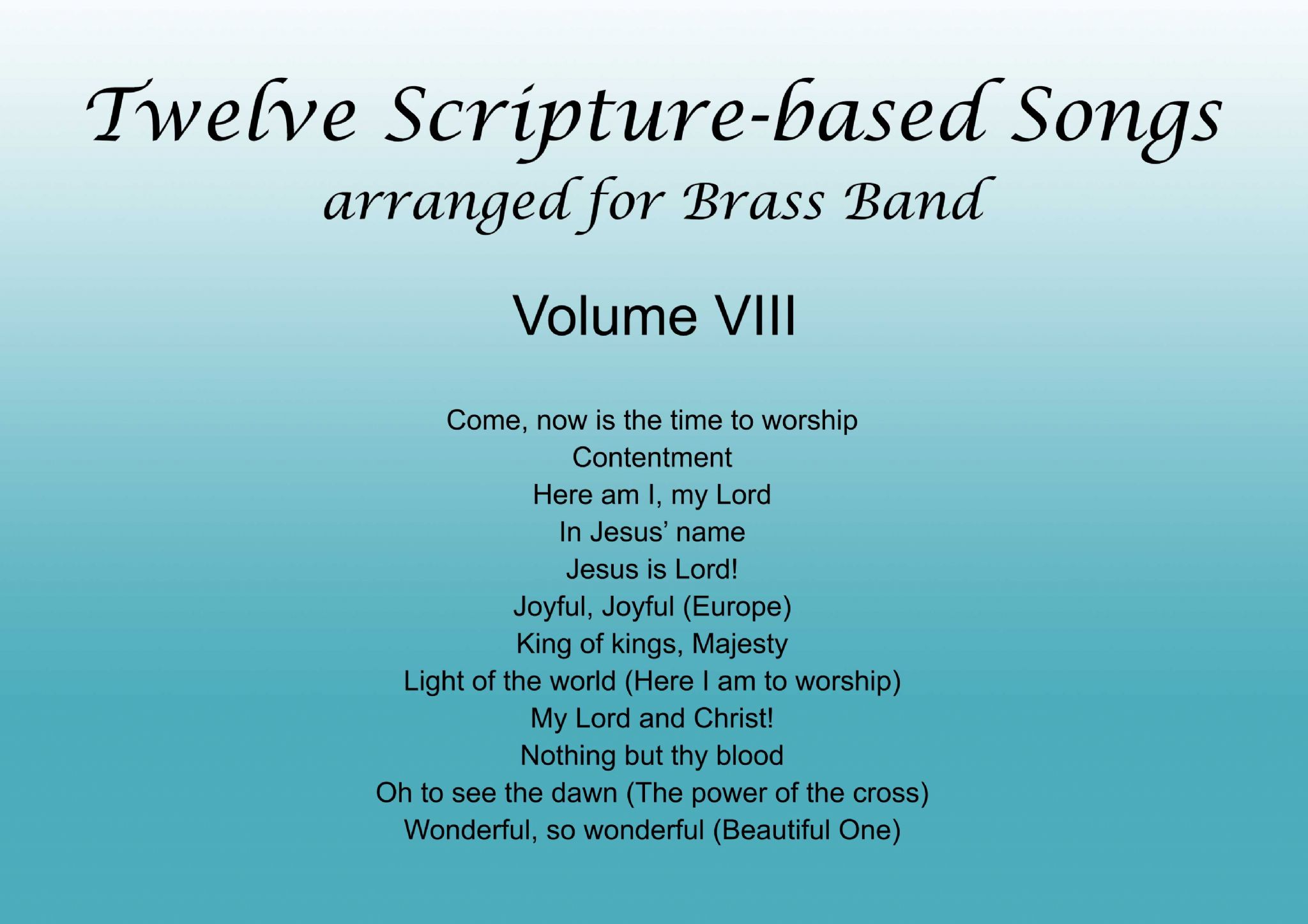
Twelve Scripture-Based Songs Volume VIII
Twelve scripture-Based Songs arranged for Brass Band (Volume VIII) are packaged and marketed in complete sets which include a full score and a set of master parts. It is intended that these parts be used as 'masters', for the purpose of photocopying a quantity of parts to accommodate the precise instrumentation needs of the band for which this has been purchased.Come, now is the time to worshipContentmentHere am I, my LordIn Jesus' nameJesus is Lord!Joyful, Joyful (Europe)King of kings, MajestyLight of the world (Here I am to worship)My Lord and Christ!Nothing but thy bloodOh to see the dawn (The power of the cross)Wonderful, so wonderful (Beautiful One)
Estimated dispatch 7-14 working days
-
 £49.95
Bestowal of a Century (Tenor Horn Solo)
Tenor Horn Solo with Brass BandBestowal of a Century (2014) was commissioned by Lowenna Taylor, and funded through her Harry Mortimer Trust award which she was presented with at the 2013 British Open Championship following the completion of her studies at the Royal Welsh College of Music in Cardiff. The 15-minute work received its world premiere at the Cornwall Youth Brass Band Christmas concert in 2014 with solosit, Lowenna, working alongside the band under the baton of Les Neish.The Bestowal refers to the presentation of the Royal Trophy by the then Prince of Wales to the famous West of England Bandsman's Festival in Bugle in 1913. Over the years it has been won by some of the greatest names in brass banding, including Black Dyke and Munn & Feltons - although more recently it has become a wonderful open festival that includes sections for local bands as well as visitors from all over the banding globe. 2014 marked the one-hundredth anniversary of the presentation of the trophy, which is the only brass band trophy to have the official seal of royal patronage.The work, in three distinct sections, opens in a mysterious way, building progressively with interjections from the horn. The composer notes its as though one can imagine different part of the trophy being put together, piece by piece, until the trophy is complete and a climax is reached. Following this, a playful theme is presented which is developed throughout the first section and interacting between soloist and band.The second movement, in complete contrast, is a lyrical melody; heart-wrenching throughout, and sits well both as part of the concerto and also as a stand-alone solo item. The third movement is light-hearted and virtuosic, demonstrating the technical capabilities of the instrument with fast and virtuosic playing, and a cadenza towards the end of the work.
Estimated dispatch 7-14 working days
-
£38.50
Steila da Nadal (Christmas Star)
Steila da Nadal was conceived in a single thought, one of continuois melody - and, figuratively speaking, - of an everlasting peaceful world. At the beginning the main theme refers to the Star of Bethlehem. The second theme is marked by it quick beat and describes the journey of the shepherds.
Estimated dispatch 7-14 working days