
Results
-
 £55.00
Triumph Series Brass Band Journal, Numbers 1392 - 1395, November 2026
1392: March - Joyful Salute (Paul Drury)This march was written in 2014 to celebrate the 125th Anniversary of Rutherglen Corps and features three songs: Sweeter as the years go by; I love him better every day (S.A.S.B. 844); and The voice of Jesus.1393: The wondrous cross (Adrian Lyons)This arrangement combines two powerful melodies: Boston and The power of the Cross. The words of When I survey (S.A.S.B. 208) are woven together with the modern hymn by Keith Getty and Stuart Townend through a linking musical passage. Although particularly appropriate for Easter worship, both songs draw our attention to the central message of the Gospel and the sacrificial love revealed at Calvary, making the piece suitable for use throughout the Christian year.1394: Turn your eyes upon Jesus (Paul Sharman) This is a straightforward arrangement of Turn Your Eyes Upon Jesus (S.A.S.B. 445). Written by Helen Lemmel in 1918, the chorus was inspired by words from a tract by the missionary Lilias Trotter: "Turn your eyes upon Him, look full into His face and you will find that the things of earth will acquire a strange new dimness." Its timeless message continues to encourage Christians to look beyond earthly concerns and fix their attention upon Christ.1395: Cornet Solo - Suo Gn (Ivor Bosanko)Suo Gn is one of the best-known traditional Welsh lullabies. An anonymous folk melody, first published around 1800, it expresses a mother's love and tenderness as she gently comforts her child to sleep. Its simple beauty and lyricism have ensured its enduring popularity.
Estimated dispatch 7-14 working days
-
 £34.95
Deep River (Eb Solo with Low Brass Ensemble - Score and Parts)
Solo for Eb Bass with Low Brass Ensemble (Euphoniums 1 & 2, Eb Bass 2 and Bb Bass 1 & 2)Deep River is one of the best known of the spirituals originating among the enslaved Africans in the United States during the 18th and 19th centuries. Although primarily expressions of religious faith, spirituals were also veiled protest songs, the sense of oppression conveyed in the lyrics being clear to present day performers:Deep River,My home is over Jordan.Deep River, Lord.I want to cross over into campground.Oh, don't you want to go,To the Gospel feast;That Promised Land,Where all is peace?(Includes treble and bass clef parts)
Estimated dispatch 7-14 working days
-
 £39.95
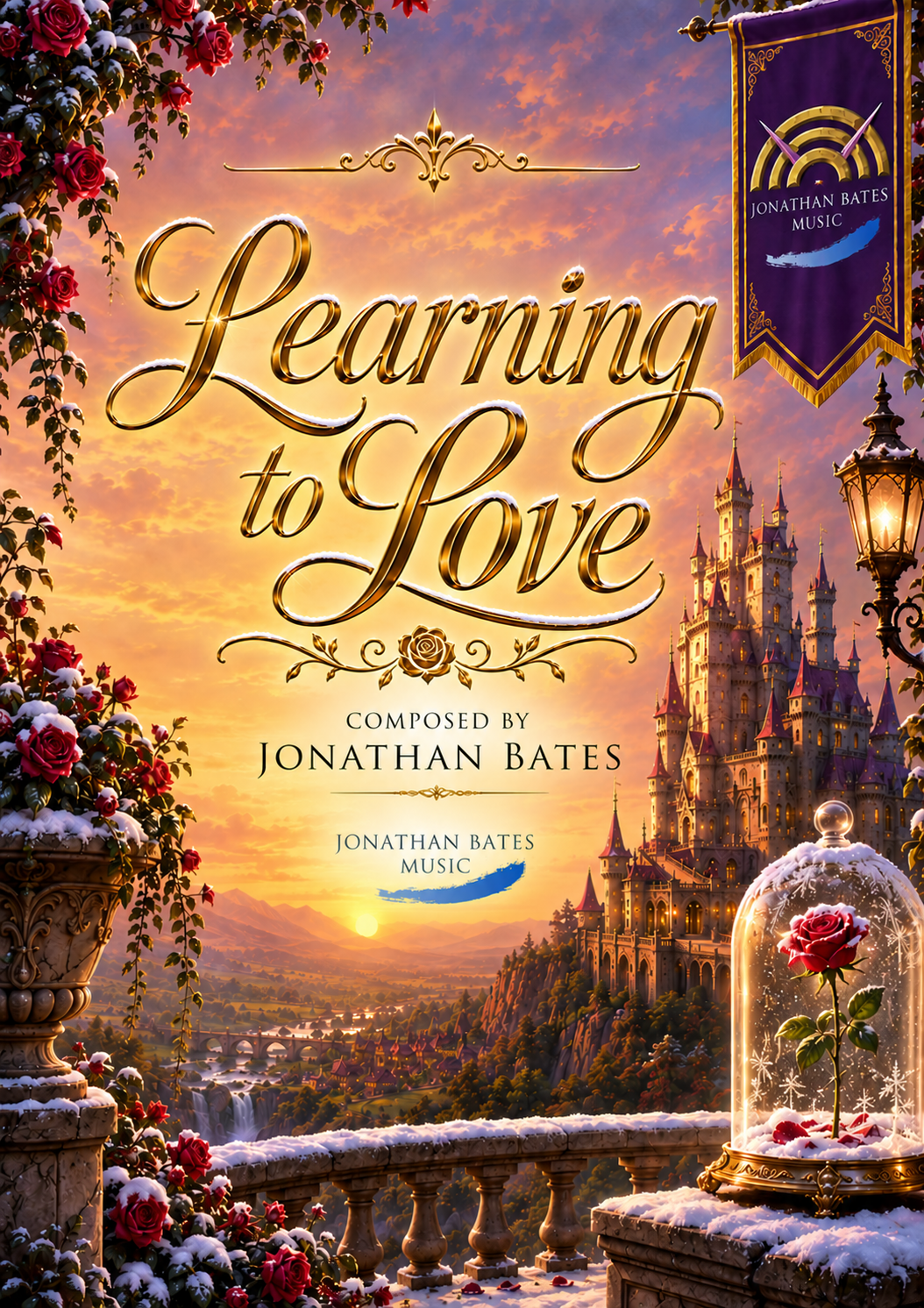
Learning To Love - Jonathan Bates
As the days passed, friendship between the pair blossomed into something deeper. Belle encouraged the Beast to show kindness, patience and generosity, while he opened his heart for the very first time. Together they explored the castle, shared stories and discovered joy in one another's company. Yet, with every passing day, another petal fell from the enchanted rose, and time to break the Beast s curse was running out.
In Stock: Estimated dispatch 1-3 working days
-
 £95.00
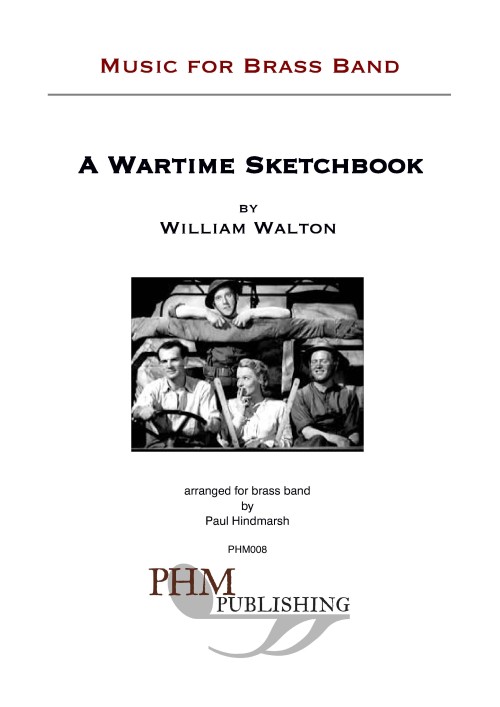
A Wartime Sketchbook (Brass Band - Score and Parts) - Walton, William - Hindmarsh, Paul
Early in 1941 William Walton, 39, received his call-up papers. He was by then one of the most eminent of British composers and was exempted from military service on condition that he provided music for films deemed to be of 'national importance'. Scoring Lawrence Olivier's Shakespeare epic Henry V in 1943 was the most substantial of these wartime projects. His role in patriotic films from 1941 and 42 like The Foreman went to France, Next of Kin, Went the day Well and The First of the Few was to provide appropriate title music and some underscoring at key moments. Walton extracted the most substantial portions of the latter as the popular Spitfire Prelude and Fugue for orchestra. The remaining music remained unpublished until 1990, when Christopher Palmer assembled the highlights into A Wartime Sketchbook. I was intrigued to hear these examples of Walton's wartime music and having discovered that they would fit naturally and idiomatically onto the brass band, I arranged six of the numbers into a suite for Besses o' th' Barn Band, which I was conducting at the time.In 1995 the brass band suite was recorded by the famous Black Dyke Mills Band as part of an all Walton album which I produced for the ASV label (ASV CD WHL 2093). This award- winning CD also included Walton's First Shoot, in the edition by Elgar Howarth, my transcription of movements from Music for Children and two substantial brass versions by Edward Watson of the suite from Henry V (with narrator) and the March and Siegfried Music from The Battle of Britain music.Prologue: This is the stirring title music from Went the day Well, a screen play by Graham Greene about a German airborne invasion of an English village. The main theme leads toBicycle Chase: Characteristic musical high-jinks for J.B.Priestley's The Foreman went to France.Refugees: From the same film, this is a poignant accompaniment to the long march of refugees. As Ernest Irving, the film's musical director, put it, "this really makes your feet sore and your knees sag."Young Siegfrieds: This lively movement comes from the music that Walton composed for The Battle of Britain in 1968, with the assistance of Malcolm Arnold, but which the film's producer rejected. It portrays first the Berliners, cheerfully ignoring the black-out and then, in the trio, the Young Siegfrieds of the Luftwaffe, courtesy of a parody of Siegfried's horn call from Wagner's opera.Romance: A soldier and a Dutch refugee snatch a few tender moments together in Next of Kin.Epilogue: At the end of The Foreman went to France, the French look forward with hope and optimism to eventual liberation.- Paul HindmarshDuration: 14.00
Estimated dispatch 7-14 working days
-
£40.00
A Wartime Sketchbook (Brass Band - Score only) - Walton, William - Hindmarsh, Paul
Early in 1941 William Walton, 39, received his call-up papers. He was by then one of the most eminent of British composers and was exempted from military service on condition that he provided music for films deemed to be of 'national importance'. Scoring Lawrence Olivier's Shakespeare epic Henry V in 1943 was the most substantial of these wartime projects. His role in patriotic films from 1941 and 42 like The Foreman went to France, Next of Kin, Went the day Well and The First of the Few was to provide appropriate title music and some underscoring at key moments. Walton extracted the most substantial portions of the latter as the popular Spitfire Prelude and Fugue for orchestra. The remaining music remained unpublished until 1990, when Christopher Palmer assembled the highlights into A Wartime Sketchbook. I was intrigued to hear these examples of Walton's wartime music and having discovered that they would fit naturally and idiomatically onto the brass band, I arranged six of the numbers into a suite for Besses o' th' Barn Band, which I was conducting at the time.In 1995 the brass band suite was recorded by the famous Black Dyke Mills Band as part of an all Walton album which I produced for the ASV label (ASV CD WHL 2093). This award- winning CD also included Walton's First Shoot, in the edition by Elgar Howarth, my transcription of movements from Music for Children and two substantial brass versions by Edward Watson of the suite from Henry V (with narrator) and the March and Siegfried Music from The Battle of Britain music.Prologue: This is the stirring title music from Went the day Well, a screen play by Graham Greene about a German airborne invasion of an English village. The main theme leads toBicycle Chase: Characteristic musical high-jinks for J.B.Priestley's The Foreman went to France.Refugees: From the same film, this is a poignant accompaniment to the long march of refugees. As Ernest Irving, the film's musical director, put it, "this really makes your feet sore and your knees sag."Young Siegfrieds: This lively movement comes from the music that Walton composed for The Battle of Britain in 1968, with the assistance of Malcolm Arnold, but which the film's producer rejected. It portrays first the Berliners, cheerfully ignoring the black-out and then, in the trio, the Young Siegfrieds of the Luftwaffe, courtesy of a parody of Siegfried's horn call from Wagner's opera.Romance: A soldier and a Dutch refugee snatch a few tender moments together in Next of Kin.Epilogue: At the end of The Foreman went to France, the French look forward with hope and optimism to eventual liberation.- Paul HindmarshDuration: 14.00
Estimated dispatch 7-14 working days
-
 £124.95
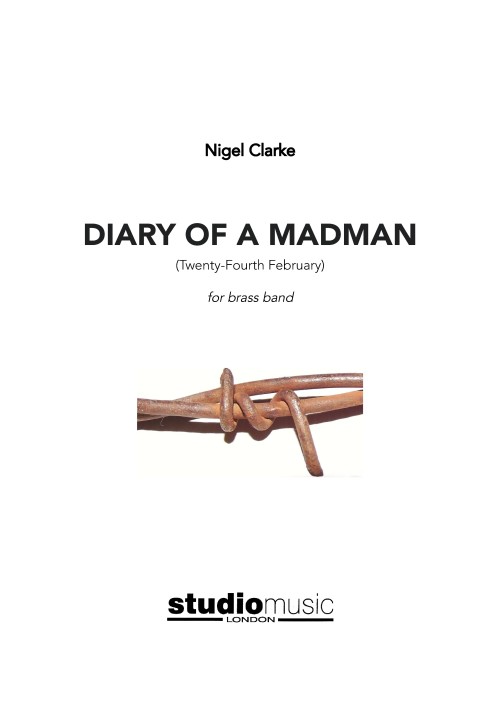
Diary of a Madman (Twenty-Fourth February) (Brass Band - Score and Parts) - Clarke, Nigel
From the beginning of history, warlords, emperors and dictators have risen up, some benign but many of them a scourge on humanity. Names that resonate to this day include Julius Caesar, Caligula, Genghis Khan, Ivan IV (The Terrible), Attila the Hun, Vlad IV (The Impaler), Hitler, Stalin, Mao Zedong, Pol Pot, all of whom were responsible for wanton destruction and the torture and death of millions of victims, either citizens of invaded countries and territories and or indeed, their own peoples.Diary of a Madman starts with a light-hearted march that gives the impression of toy tin soldiers parading in a brightly-coloured ceremonial pageant from a fairy tale, conveying peace and innocence. This spectacle is abruptly interrupted by a 'shock and awe' fanfare-like march, symbolising aggression and war. This theme grinds slowly to a halt, and an atmosphere of introspection, sadness and despair takes over. Rising above the smoky theatre of war, we then hear a distant cornet give a rendition of the Ukrainian Nation Anthem (The glory and freedom of Ukraine has not yet perished. Luck will still smile on us brother-Ukrainians). The solo cornet soon enters a fragile duet with a second cornet accompanied by dark undertones. One by one, we hear short shards of aggressive fanfare-like figures from various instruments in the band. The mood breaks - we hear strident fortissimo whole-tone scales representing pealing church bells, warning of danger. In contrast, we also hear pianissimo whole-tone scales announcing that the enemy's troops are falling back. A counter-offensive soon takes centre stage, and battles and skirmishes are heard, with short quotations from Mussorgsky's `Great Gates of Kyiv' symbolising the defenders' heroic struggle.All sides are victims of the Dictator's ambition! The slow central section offer us moments of melancholic beauty and utilises Henry Purcell's `When I am laid in earth' (`Dido's Lament' from Dido and Aeneas 1688). This music represents the loss of homes, dignity and loved ones. There are occasional hints at better times as the theme of the parading toy tin soldiers is heard from afar, like a distant memory.To announce the final push, we hear a church bell strike and an air raid siren signalling a ferocious musical counter-attack. After one final rendition of the Purcell theme, Diary of a Madman closes with a mood of triumph over tyranny.- Nigel Clarke
Estimated dispatch 7-14 working days
-
£57.95
Diary of a Madman (Twenty-Fourth February) (Brass Band - Score only) - Clarke, Nigel
From the beginning of history, warlords, emperors and dictators have risen up, some benign but many of them a scourge on humanity. Names that resonate to this day include Julius Caesar, Caligula, Genghis Khan, Ivan IV (The Terrible), Attila the Hun, Vlad IV (The Impaler), Hitler, Stalin, Mao Zedong, Pol Pot, all of whom were responsible for wanton destruction and the torture and death of millions of victims, either citizens of invaded countries and territories and or indeed, their own peoples.Diary of a Madman starts with a light-hearted march that gives the impression of toy tin soldiers parading in a brightly-coloured ceremonial pageant from a fairy tale, conveying peace and innocence. This spectacle is abruptly interrupted by a 'shock and awe' fanfare-like march, symbolising aggression and war. This theme grinds slowly to a halt, and an atmosphere of introspection, sadness and despair takes over. Rising above the smoky theatre of war, we then hear a distant cornet give a rendition of the Ukrainian Nation Anthem (The glory and freedom of Ukraine has not yet perished. Luck will still smile on us brother-Ukrainians). The solo cornet soon enters a fragile duet with a second cornet accompanied by dark undertones. One by one, we hear short shards of aggressive fanfare-like figures from various instruments in the band. The mood breaks - we hear strident fortissimo whole-tone scales representing pealing church bells, warning of danger. In contrast, we also hear pianissimo whole-tone scales announcing that the enemy's troops are falling back. A counter-offensive soon takes centre stage, and battles and skirmishes are heard, with short quotations from Mussorgsky's `Great Gates of Kyiv' symbolising the defenders' heroic struggle.All sides are victims of the Dictator's ambition! The slow central section offer us moments of melancholic beauty and utilises Henry Purcell's `When I am laid in earth' (`Dido's Lament' from Dido and Aeneas 1688). This music represents the loss of homes, dignity and loved ones. There are occasional hints at better times as the theme of the parading toy tin soldiers is heard from afar, like a distant memory.To announce the final push, we hear a church bell strike and an air raid siren signalling a ferocious musical counter-attack. After one final rendition of the Purcell theme, Diary of a Madman closes with a mood of triumph over tyranny.- Nigel Clarke
Estimated dispatch 7-14 working days
-
 £45.00
LA FIESTA (Brass Band) - Corea, Chick - Harper, Philip
Chick Corea is an American pianist and composer of Sicilian and Spanish descent, whose long career in jazz music continues to this day. A member of Miles Davis's hand in the 1960s, lie formed his own band Return to Forever in the 1970s before establishing himself as one of the greats of modern jazz. La Fiesta was composed in 1972 and included on Return to Forever's debut album. The music is in one in a bar waltz time and switches between Latin carnival style and jazz waltz, with stand-up solos for cornet, baritone and tenor horn. This arrangement was performed as part 01 the Cory Band's winning Brass in Concert programme in 2012. The publisher of this works suggests that it should be playable by championship section bands.
Estimated dispatch 7-14 working days
-
 £34.95
Happy Land (Cornet Solo with Brass Band - Score and Parts) - Camsey, Terry
This composition is a very challenging one for the soloist and requires the accompaniment to be subservient at all times. The soloist will find it helpful to, generally, adopt a very light and playful style. As a young aspiring cornet player, the composer was influenced by a number of soloists of that day, one being Del Staigers of the Goldman Band in the USA. Many of the musical motifs reflect that influence and it is hoped that this solo will, in turn, inspire the many aspiring cornet players of today.
Estimated dispatch 7-14 working days
-
£17.50
Happy Land (Cornet Solo with Brass Band - Score only) - Camsey, Terry
This composition is a very challenging one for the soloist and requires the accompaniment to be subservient at all times. The soloist will find it helpful to, generally, adopt a very light and playful style. As a young aspiring cornet player, the composer was influenced by a number of soloists of that day, one being Del Staigers of the Goldman Band in the USA. Many of the musical motifs reflect that influence and it is hoped that this solo will, in turn, inspire the many aspiring cornet players of today.
Estimated dispatch 7-14 working days
 View Music