
Results
-
 £95.00
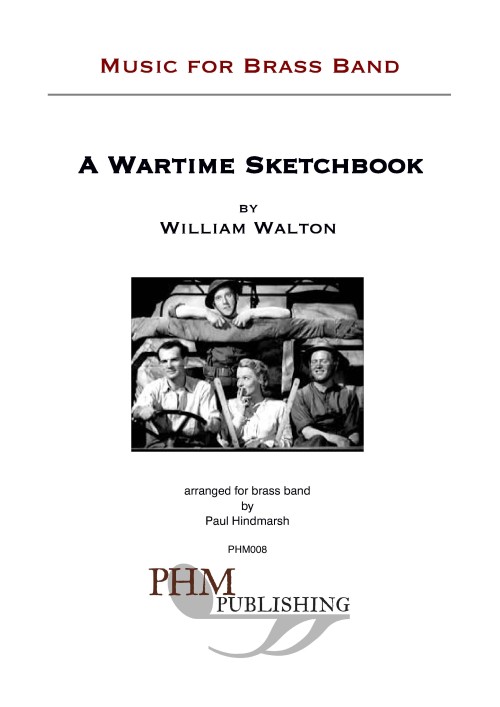
A Wartime Sketchbook (Brass Band - Score and Parts) - Walton, William - Hindmarsh, Paul
Early in 1941 William Walton, 39, received his call-up papers. He was by then one of the most eminent of British composers and was exempted from military service on condition that he provided music for films deemed to be of 'national importance'. Scoring Lawrence Olivier's Shakespeare epic Henry V in 1943 was the most substantial of these wartime projects. His role in patriotic films from 1941 and 42 like The Foreman went to France, Next of Kin, Went the day Well and The First of the Few was to provide appropriate title music and some underscoring at key moments. Walton extracted the most substantial portions of the latter as the popular Spitfire Prelude and Fugue for orchestra. The remaining music remained unpublished until 1990, when Christopher Palmer assembled the highlights into A Wartime Sketchbook. I was intrigued to hear these examples of Walton's wartime music and having discovered that they would fit naturally and idiomatically onto the brass band, I arranged six of the numbers into a suite for Besses o' th' Barn Band, which I was conducting at the time.In 1995 the brass band suite was recorded by the famous Black Dyke Mills Band as part of an all Walton album which I produced for the ASV label (ASV CD WHL 2093). This award- winning CD also included Walton's First Shoot, in the edition by Elgar Howarth, my transcription of movements from Music for Children and two substantial brass versions by Edward Watson of the suite from Henry V (with narrator) and the March and Siegfried Music from The Battle of Britain music.Prologue: This is the stirring title music from Went the day Well, a screen play by Graham Greene about a German airborne invasion of an English village. The main theme leads toBicycle Chase: Characteristic musical high-jinks for J.B.Priestley's The Foreman went to France.Refugees: From the same film, this is a poignant accompaniment to the long march of refugees. As Ernest Irving, the film's musical director, put it, "this really makes your feet sore and your knees sag."Young Siegfrieds: This lively movement comes from the music that Walton composed for The Battle of Britain in 1968, with the assistance of Malcolm Arnold, but which the film's producer rejected. It portrays first the Berliners, cheerfully ignoring the black-out and then, in the trio, the Young Siegfrieds of the Luftwaffe, courtesy of a parody of Siegfried's horn call from Wagner's opera.Romance: A soldier and a Dutch refugee snatch a few tender moments together in Next of Kin.Epilogue: At the end of The Foreman went to France, the French look forward with hope and optimism to eventual liberation.- Paul HindmarshDuration: 14.00
Estimated dispatch 7-14 working days
-
£40.00
A Wartime Sketchbook (Brass Band - Score only) - Walton, William - Hindmarsh, Paul
Early in 1941 William Walton, 39, received his call-up papers. He was by then one of the most eminent of British composers and was exempted from military service on condition that he provided music for films deemed to be of 'national importance'. Scoring Lawrence Olivier's Shakespeare epic Henry V in 1943 was the most substantial of these wartime projects. His role in patriotic films from 1941 and 42 like The Foreman went to France, Next of Kin, Went the day Well and The First of the Few was to provide appropriate title music and some underscoring at key moments. Walton extracted the most substantial portions of the latter as the popular Spitfire Prelude and Fugue for orchestra. The remaining music remained unpublished until 1990, when Christopher Palmer assembled the highlights into A Wartime Sketchbook. I was intrigued to hear these examples of Walton's wartime music and having discovered that they would fit naturally and idiomatically onto the brass band, I arranged six of the numbers into a suite for Besses o' th' Barn Band, which I was conducting at the time.In 1995 the brass band suite was recorded by the famous Black Dyke Mills Band as part of an all Walton album which I produced for the ASV label (ASV CD WHL 2093). This award- winning CD also included Walton's First Shoot, in the edition by Elgar Howarth, my transcription of movements from Music for Children and two substantial brass versions by Edward Watson of the suite from Henry V (with narrator) and the March and Siegfried Music from The Battle of Britain music.Prologue: This is the stirring title music from Went the day Well, a screen play by Graham Greene about a German airborne invasion of an English village. The main theme leads toBicycle Chase: Characteristic musical high-jinks for J.B.Priestley's The Foreman went to France.Refugees: From the same film, this is a poignant accompaniment to the long march of refugees. As Ernest Irving, the film's musical director, put it, "this really makes your feet sore and your knees sag."Young Siegfrieds: This lively movement comes from the music that Walton composed for The Battle of Britain in 1968, with the assistance of Malcolm Arnold, but which the film's producer rejected. It portrays first the Berliners, cheerfully ignoring the black-out and then, in the trio, the Young Siegfrieds of the Luftwaffe, courtesy of a parody of Siegfried's horn call from Wagner's opera.Romance: A soldier and a Dutch refugee snatch a few tender moments together in Next of Kin.Epilogue: At the end of The Foreman went to France, the French look forward with hope and optimism to eventual liberation.- Paul HindmarshDuration: 14.00
Estimated dispatch 7-14 working days
-
 £89.95
St Magnus (Brass Band - Score and Parts) - Downie, Kenneth
Commissioned by the Scottish Brass Band Association for the 2004 European Brass Band Championships in Glasgow. This music is a set of variations on the tune known as St Magnus, which is attributed to Jeremiah Clarke. Most people will associate it with Thomas Kelly's hymn which begins: "The Head that once was crowned with thorns is crowned with glory now". The tune is very simple, consisting of just two, four-bar phrases. Neither is there much in the way of rhythmic variety, every note being a crotchet with the exception of two quavers, and the last note in each phrase. Within such a simple structure, however, lies considerable strength.
Estimated dispatch 7-14 working days
-
£44.95
St Magnus (Brass Band - Score only) - Downie, Kenneth
Commissioned by the Scottish Brass Band Association for the 2004 European Brass Band Championships in Glasgow. This music is a set of variations on the tune known as St Magnus, which is attributed to Jeremiah Clarke. Most people will associate it with Thomas Kelly's hymn which begins: "The Head that once was crowned with thorns is crowned with glory now". The tune is very simple, consisting of just two, four-bar phrases. Neither is there much in the way of rhythmic variety, every note being a crotchet with the exception of two quavers, and the last note in each phrase. Within such a simple structure, however, lies considerable strength.
Estimated dispatch 7-14 working days
-
 £89.95
Infinity (Brass Band - Score and Parts) - Redhead, Robert
In the post-modern age in which we live, 'absolutes' are difficult for many to comprehend. Yet infinity, which means absolute, total, all-embracing, having no limits or boundaries in time, space, extent, or magnitude, has always been central to the Christian's concept of God.Through the ages, as human understanding has grown, particularly at a remarkable rate from the latter part of the twentienth century, Christianity has been continually challenged to interpret traditional beliefs in the light of new discoveries, but always within the reality of the infinite Being. In addition, scripture tells us that 'humanity was made in God's image'. Humankind is part of God's creation and as such, responsible for its upkeep. Such a commission has never been more relevant than in this present age. Psalm 8 creates a great picture of the majesty, eternal, infinte quality of God and yet reveals the desire of God to share in spirit with humankind. It recognises humankind as being, not a tool of the infinite, but as a creative contributing part of the ongoing movement and activity of the infinite. The music is deliberately melodic in context, creating a sense of unity with the infinite, in tandem with the varying expressions of individuality. It is not based on the Psalm but reflects some of the sentiments lying therein. The 'hymn-like' theme expresses the nature of the Divine using the Old Testament image of the infinite God coming to finite humankind, not in the 'wind', the 'earthquake', the 'fire', but in the 'still small voice' of quietness (1 Kings 19: 11-13). The ensuing musical development, in different styles and patterns, expresses this continual link between infinite and finite. Thus the conclusion, rather than being a symbol of might, power and magnificence, reflects the same sentiment as the opening.
Estimated dispatch 7-14 working days
-
£44.95
Infinity (Brass Band - Score only) - Redhead, Robert
In the post-modern age in which we live, 'absolutes' are difficult for many to comprehend. Yet infinity, which means absolute, total, all-embracing, having no limits or boundaries in time, space, extent, or magnitude, has always been central to the Christian's concept of God.Through the ages, as human understanding has grown, particularly at a remarkable rate from the latter part of the twentienth century, Christianity has been continually challenged to interpret traditional beliefs in the light of new discoveries, but always within the reality of the infinite Being. In addition, scripture tells us that 'humanity was made in God's image'. Humankind is part of God's creation and as such, responsible for its upkeep. Such a commission has never been more relevant than in this present age. Psalm 8 creates a great picture of the majesty, eternal, infinte quality of God and yet reveals the desire of God to share in spirit with humankind. It recognises humankind as being, not a tool of the infinite, but as a creative contributing part of the ongoing movement and activity of the infinite. The music is deliberately melodic in context, creating a sense of unity with the infinite, in tandem with the varying expressions of individuality. It is not based on the Psalm but reflects some of the sentiments lying therein. The 'hymn-like' theme expresses the nature of the Divine using the Old Testament image of the infinite God coming to finite humankind, not in the 'wind', the 'earthquake', the 'fire', but in the 'still small voice' of quietness (1 Kings 19: 11-13). The ensuing musical development, in different styles and patterns, expresses this continual link between infinite and finite. Thus the conclusion, rather than being a symbol of might, power and magnificence, reflects the same sentiment as the opening.
Estimated dispatch 7-14 working days
-
£10.00
Infinity (Brass Band - Study Score) - Redhead, Robert
In the post-modern age in which we live, 'absolutes' are difficult for many to comprehend. Yet infinity, which means absolute, total, all-embracing, having no limits or boundaries in time, space, extent, or magnitude, has always been central to the Christian's concept of God.Through the ages, as human understanding has grown, particularly at a remarkable rate from the latter part of the twentienth century, Christianity has been continually challenged to interpret traditional beliefs in the light of new discoveries, but always within the reality of the infinite Being. In addition, scripture tells us that 'humanity was made in God's image'. Humankind is part of God's creation and as such, responsible for its upkeep. Such a commission has never been more relevant than in this present age. Psalm 8 creates a great picture of the majesty, eternal, infinte quality of God and yet reveals the desire of God to share in spirit with humankind. It recognises humankind as being, not a tool of the infinite, but as a creative contributing part of the ongoing movement and activity of the infinite. The music is deliberately melodic in context, creating a sense of unity with the infinite, in tandem with the varying expressions of individuality. It is not based on the Psalm but reflects some of the sentiments lying therein. The 'hymn-like' theme expresses the nature of the Divine using the Old Testament image of the infinite God coming to finite humankind, not in the 'wind', the 'earthquake', the 'fire', but in the 'still small voice' of quietness (1 Kings 19: 11-13). The ensuing musical development, in different styles and patterns, expresses this continual link between infinite and finite. Thus the conclusion, rather than being a symbol of might, power and magnificence, reflects the same sentiment as the opening.
Estimated dispatch 7-14 working days
-
 £119.99
Landscapes (Brass Band - Score and Parts) - Moren, Bertrand
Concerto Grosso for Brass Band and PercussionLandscapes is a work structured around two main ideas. On the one hand, the music freely paints some of the superb landscapes I've seen during several of my trips around the world. Listeners should, however, not be influenced by this programmatic framework and are encouraged to build their own 'mind pictures'. On the other hand, Landscapes constitutes a test piece for each section of the brass band. Indeed, each musical landscape highlights a particular register. A small group of soloists is given the opportunity to fully display its skills in dialogue with the rest of the band (the tutti), hence the name 'concerto grosso'. Landscapes also relies on the band's different soloist musicians when it comes to express highly complex, musically and technically challenging passages.
Estimated dispatch 7-14 working days
-
 £44.99
Landscapes (Brass Band - Score only) - Moren, Bertrand
Concerto Grosso for Brass Band and PercussionLandscapes is a work structured around two main ideas. On the one hand, the music freely paints some of the superb landscapes I've seen during several of my trips around the world. Listeners should, however, not be influenced by this programmatic framework and are encouraged to build their own 'mind pictures'. On the other hand, Landscapes constitutes a test piece for each section of the brass band. Indeed, each musical landscape highlights a particular register. A small group of soloists is given the opportunity to fully display its skills in dialogue with the rest of the band (the tutti), hence the name 'concerto grosso'. Landscapes also relies on the band's different soloist musicians when it comes to express highly complex, musically and technically challenging passages.
Estimated dispatch 7-14 working days
-
£10.00
St Magnus (Brass Band - Study Score) - Downie, Kenneth
This music is a set of variations on the tune known as St Magnus, which is attributed to Jeremiah Clarke. Most people will associate it with Thomas Kelly's hymn which begins: "The Head that once was crowned with thorns is crowned with glory now". The tune is very simple, consisting of just two, four-bar phrases. Neither is there much in the way of rhythmic variety, every note being a crotchet with the exception of two quavers, and the last note in each phrase. Within such a simple structure, however, lies considerable strength.
Estimated dispatch 7-14 working days
 View Music