
Results
-
£72.00
Dalstroka innafor - Tone Hulbaekmo - Elisabeth Vannebo
An old weather forecast on the Norwegian radio inspired Tone Hulbaekmo to write this song.Folk musician and composer Tone Hulbaekmo comes from Tolga, a small place in Norway. She have toured worldwide and many of her CD-released have received great acclaim both from the audiences and critics. Some of them have also won "Spellemannsprisen", the Norwegian equivalent to the Grammy award.Valleys Beyond is a Norwegian folk music style named "reinlender". It has to be played with a light swinging feel.
Publisher Closed for Holidays. Est Delivery 13-14th Aug
-
 £30.00
The Wind Beneath My Wings
A beautiful Baritone duet setting of this legendary ballad.Tim Paton writes:My band colleague, friend and baritone player, Eileen Ludlow, asked me on several occasions to arrange this well loved song as a baritone duet for her and Clare. So asa birthday present for Eileen, this is my contribution to an ever growing number of pieces featuring the long neglected baritone player!
In Stock: Estimated dispatch 3-5 working days
-
 £35.00
The Witches' Sabbath - Berlioz
An effective arrangement of the exciting finale from Berlioz's greatest masterpiece 'Symphonie Fantastique'.This new 'finisher' is all about an opium induced fantasy Berlioz had about rescuing a woman he was madly in love with from a group of evil witches and other assorted ghouls.After many brilliant musical descriptions of the eerie scenes, Berlioz triumphantly rescues his beloved narrowly saving her from being sacrificed by the witches!First performed by Whitburn Band at Spennymoor 24 and recorded by them on the 'Live from Spennymoor 24' CD.
In Stock: Estimated dispatch 3-5 working days
-
 £84.95
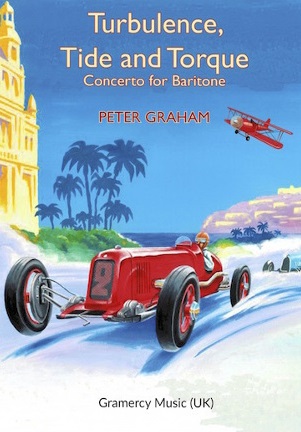
Turbulence, Tide and Torque (Baritone Solo with Brass Band - Score and Parts) - Graham, Peter
Concerto for BaritoneTurbulence, Tide and Torque can be considered to be a companion piece to my 2008 Euphonium Concerto In League with Extraordinary Gentlemen, and indeed can be performed on Euphonium (vintage or medium bore instrument preferred). Whereas the gentlemen in question in the latter work were fictional (e.g. Sherlock Holmes and Phileas Fogg), the former pays tribute to three real life women who were very much true pioneers and heroines of their age.Turbulence: Harriet Quimby (b. 1875) was one of the world's best woman aviators, her significant and historic achievement being the first woman to fly across the English Channel. Sadly, in her lifetime very few people were aware of her 1912 accomplishment; potential press coverage was dominated by the sinking of The Titanic only two days before.Grace Darling (b. 1815) is a name much more familiar to the public today, and in her lifetime she was lauded as a national heroine. A humble lighthouse keeper's daughter from Northumberland, her participation in the rescue of survivors from the wrecked paddle-steamer Forfarshire is well documented (a museum dedicated to her achievements located in Bamburgh, the town of her birth). This movement, Tide, develops a main theme from my large scale work Harrison's Dream, reflecting on the souls lost in the disaster.The final movement Torque, opens with a sudden gear change such as might have been undertaken by Dorothy Levitt (b. 1882), the woman's world land speed record holder, in her Napier racing car. Levitt, who following her 1906 record-breaking achievement was described as the Fastest Girl on Earth, went on to write extensively about her experiences, encouraging females to take up motoring through her articles in The Graphic newpaper.Turbulence, Tide and Torque was commissioned by and is dedicated to Katrina Marzella as part of an Arts Council of England funded residency I was awarded with the Black Dyke Band in 2018.- Peter GrahamDuration: 15.00
Estimated dispatch 7-14 working days
-
 £80.00
The Unfortunate Traveller (Brass Band - Score and Parts) - Holst, Imogen - Hindmarsh, Paul
Imogen Holst (1907-1984) submitted The Unfortunate Traveller (1929) as her final work as a student portfolio at the Royal College of Music, where her composition teacher was Gordon Jacob. The title was taken from Thomas Nashe's famous 1594 picaresque novel of the same title. The Suite was first performed on 12 February 1933 at her Majesty's Theatre, Carlisle, by the St. Stephen's Band, with the composer conducting. Te concert was given in memory of Holst's uncle, Dr. H.A. Lediard. Holst had been impressed with the band's performance of his A Moorside Suite at the 1928 National Brass Band Championships (The Crystal Palace, South London) and was keen to work with them. Writing in Imogen Holst, a life in music, Christopher Grogan indicates that it was Gustav Holst's suggestion to include his daughter's work in the programme, quoting Imogen Holst's remarks made in interview to The Daily Mail as follows: "....it is the first time, so far as I know, that a woman has conducted a brass band at a public concert....It has been a delight to rehearse the St. Stephen's Band. It was their performance at the Crystal Palace Festival that inspired me to write this Suite, which I have dedicated to them."Imogen Holst accompanied her father to the Crystal Palace in 1928 to hear the performances of A Moorside Suite, and was so excited by the played and, audibly, by her father's music that she decided to write a brass band piece for her final examination. Te result was The Unfortunate Traveller (1929). However, it was not possible for her to present a brass band work for examination. She arranged it for string orchestra so that it could be played before she left the RCM in July 1930. Following the premiere of the original in 1933, the manuscripts did not resurface until 1969 Imogen found them among her late mother's effects. Although she requested score and parts be destroyed, they ended up in the possession of Manchester composer John Golland, who marked up the score presumably with the intention of creating a new performing edition. The original scoring reveals a lack of experience with what can be a tricky medium.With the agreement of the Holst Foundation, a revised edition, with additional percussion, was prepared in 2011 since when the work has been fortunate to travel round the world as a concert and contest piece. The original includes drums in the March only. The title was taken from Tomas Nashe's famous 1594 picaresque novel of the same title. Several Morris Dance tunes are introduced during the course of the four short movements, including Bonnie Green Garters, Shepherd's Hey, The Rose and The Wind Blaws Cauld. Quirky twists and turns of harmony and spirited rhythms that remind us how much Imogen Holst loved tradition English dance music.In September 2025, I made a performing edition of the composer's arrangement for string orchestra. The manuscript lacks the final movement, which I arranged in a similar style, ie. without extending the upper ranges. Making this edition raised some issues regarding the accuracy of my band version and some of the solutions I used to smooth out the voicing. I have used the composer's second thoughts to refine my performing edition and to correct a textual errors.- Paul HindmarshDuration: 10.00
Estimated dispatch 7-14 working days
-
£40.00
The Unfortunate Traveller (Brass Band - Score only) - Holst, Imogen - Hindmarsh, Paul
Imogen Holst (1907-1984) submitted The Unfortunate Traveller (1929) as her final work as a student portfolio at the Royal College of Music, where her composition teacher was Gordon Jacob. The title was taken from Thomas Nashe's famous 1594 picaresque novel of the same title. The Suite was first performed on 12 February 1933 at her Majesty's Theatre, Carlisle, by the St. Stephen's Band, with the composer conducting. Te concert was given in memory of Holst's uncle, Dr. H.A. Lediard. Holst had been impressed with the band's performance of his A Moorside Suite at the 1928 National Brass Band Championships (The Crystal Palace, South London) and was keen to work with them. Writing in Imogen Holst, a life in music, Christopher Grogan indicates that it was Gustav Holst's suggestion to include his daughter's work in the programme, quoting Imogen Holst's remarks made in interview to The Daily Mail as follows: "....it is the first time, so far as I know, that a woman has conducted a brass band at a public concert....It has been a delight to rehearse the St. Stephen's Band. It was their performance at the Crystal Palace Festival that inspired me to write this Suite, which I have dedicated to them."Imogen Holst accompanied her father to the Crystal Palace in 1928 to hear the performances of A Moorside Suite, and was so excited by the played and, audibly, by her father's music that she decided to write a brass band piece for her final examination. Te result was The Unfortunate Traveller (1929). However, it was not possible for her to present a brass band work for examination. She arranged it for string orchestra so that it could be played before she left the RCM in July 1930. Following the premiere of the original in 1933, the manuscripts did not resurface until 1969 Imogen found them among her late mother's effects. Although she requested score and parts be destroyed, they ended up in the possession of Manchester composer John Golland, who marked up the score presumably with the intention of creating a new performing edition. The original scoring reveals a lack of experience with what can be a tricky medium.With the agreement of the Holst Foundation, a revised edition, with additional percussion, was prepared in 2011 since when the work has been fortunate to travel round the world as a concert and contest piece. The original includes drums in the March only. The title was taken from Tomas Nashe's famous 1594 picaresque novel of the same title. Several Morris Dance tunes are introduced during the course of the four short movements, including Bonnie Green Garters, Shepherd's Hey, The Rose and The Wind Blaws Cauld. Quirky twists and turns of harmony and spirited rhythms that remind us how much Imogen Holst loved tradition English dance music.In September 2025, I made a performing edition of the composer's arrangement for string orchestra. The manuscript lacks the final movement, which I arranged in a similar style, ie. without extending the upper ranges. Making this edition raised some issues regarding the accuracy of my band version and some of the solutions I used to smooth out the voicing. I have used the composer's second thoughts to refine my performing edition and to correct a textual errors.- Paul HindmarshDuration: 10.00
Estimated dispatch 7-14 working days
-
 £87.99
Sunday in the Park (Tenor Horn Solo with Brass Band - Score and Parts) - Sparke, Philip
Sunday in the Park was written for tenor horn virtuoso Sheona White, and commissioned by her partner, Matt Wade, as a Christmas present. Composer Philip Sparke had known and admired Sheona's playing for many years, having produced her first solo CD and written pieces for her previously. Both composer and performer are huge fans of the late Karen Carpenter, Sheona in part modelling her sound on the singer's sultry voice; so it was decided that this new solo would be a piece which, whilst not being a 'Carpenters' pastiche, paid tribute to their relaxed style and rich harmonic language. Sunday in the Park opens with an accompanied cadenza for the soloist, which leads to a gentle rhythmic melody with a laid-back feel. This is taken up by the band but the soloist sparks a change of mood by introducing a faster light rock interlude. This reaches a climax, at which point the music unwinds until the original mood returns. A variation on the original melody leads to a short cadenza from the soloist, which brings the work to a peaceful close.Duration: 7:00
Estimated dispatch 7-14 working days
-
 £74.99
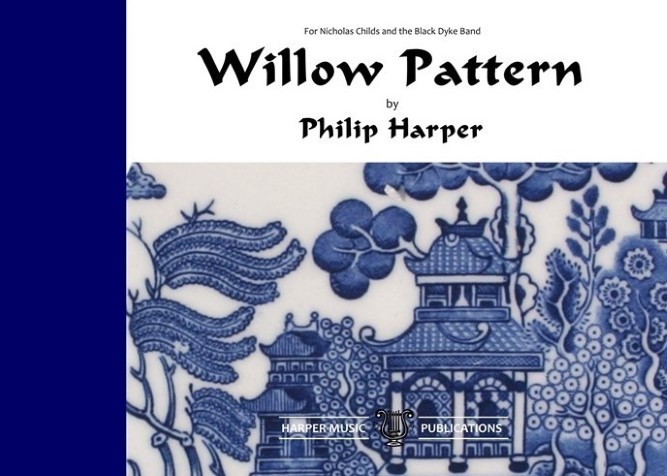
Willow Pattern (Brass Band - Score and Parts) - Harper, Philip
Composed in 2009 for Nicholas Childs and the Black Dyke BandThis piece tells the Willow Pattern legend through music. Several leitmotifs are used both for the different characters and also for some of the important emotions in the tale. Additionally, Knoon-se's part is mainly played by the flugel horn, Chang by the euphonium, the Mandarin by the Eb Bass and the Duke Ta-jin by the trombone.The Willow Pattern Legend:Once, in ancient China, there lived a wealthy and powerful Mandarin who had a beautiful daughter, Knoon-se. She had fallen in love with Chang, a humble accountant, which angered her father who imprisoned her in the Pavilion by the river with only the exotic birds for company. She learnt that the Mandarin planned to marry her to the pompous Duke Ta-jin and that the wedding would take place on the day the blossom fell from the willow tree, so she sent Chang a message: "Gather thy blossom, ere it be stolen". The Duke arrived by sea amid great fanfare when the tree was heavy with bud, and nights of magnificent banquets followed. After one such occasion when the Mandarin slept, Chang crept over the crooked fence and tiptoed into the Pavilion to rescue Knoon-se, but as they escaped the alarm was raised. They fled over the bridge with the Mandarin close on their heels brandishing his whip. They managed to escape by boat to a secluded island where they lived happily for a time. Meanwhile, the Mandarin learned of their refuge and, intent on revenge, he ordered his soldiers to kill them. As Knoon-se and Chang slept at night, the men set fire to the pagoda in which they lived and the lovers perished in the flames. However, the Gods, moved by the lovers' plight, transformed their souls into two turtle-doves which rose from the charred remains, soaring above the Earth, symbolising eternal happiness.Willow Pattern is dedicated to the memory of Jean Harper who passed away as I was completing the piece and who was a great collector of porcelain and china-ware.Duration: 12:00
Estimated dispatch 7-14 working days
-
 £55.00
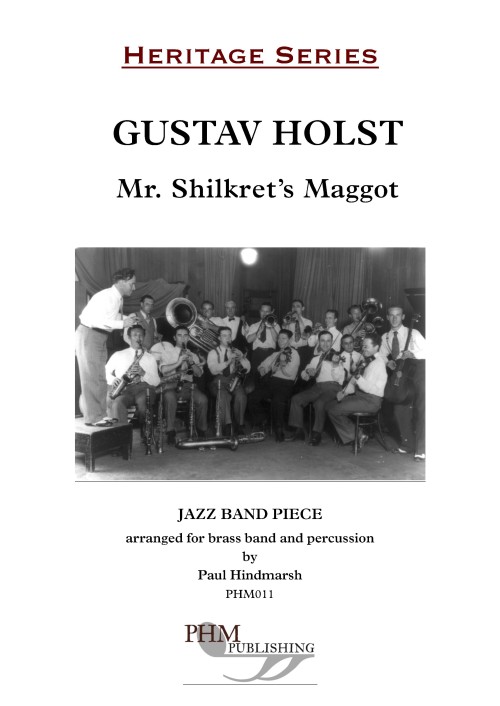
Mr Shilkret's Maggot (Brass Band - Score and Parts) - Holst, Gustav - Hindmarsh, Paul
This short piece was composed in 1932 during a visit Gustav Holst was making to the USA. He was invited by the band leader Nathaniel Shilkret to contribute to a series of piece for concert jazz band based on a folk song. Rather than using a traditional tune, Holst invented one of his own in folk song style and therefore the piece was not performed. Holst considered various titles for the piece including Mr. Shilkret's Dump, Folly and Maggot. On the manuscript he described it as a Jazz Band Piece. When the composer's daughter Imogen re-scored the piece for the English Chamber Orchestra to record under her direction in 1967, she changed decided to use the title Capriccio.Her re-orchestration involved removing the saxophone quartet, adding cor anglais and a second bassoon and changing cornet parts to trumpets. She retained the harp, extensive percussion, piano and celesta. My brass band version is based on the composer's manuscript, held at the British Library. It retains the composer's cornet parts, re-voices the woodwinds and strings, and places keyboards and harp onto glockenspiel, marimba, vibraphone and xylophone.I have selected the title Mr. Shilkret's Maggot for my scoring of Jazz Band Piece, which was first performed by The Cory Band, conducted by Philip Harper, at the Royal Northern College of Music Brass Band Festival, 29 January 2017.- Paul HindmarshDuration: 5.30
Estimated dispatch 7-14 working days
-
 £69.99
Tribute to Whitney Houston (Brass Band - Score and Parts) - Bond & Brown
It has been too many years since the American pop singer Whitney Houston passed away, but the world has not forgotten her beautiful voice. Her timeless hits, from ballads to wonderful dance tracks, are still heard on the radio. This attractive medley includes some of her greatest successes:How Will I KnowSaving All My Love for YouI Wanna Dance with SomebodyI Will Always Love YouDuration: 5.45
Estimated dispatch 7-14 working days
 View Music