
Results
-
 £21.95
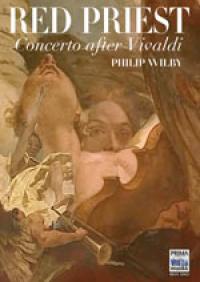
Red Priest (Brass Band - Study Score)
Concerto After VivaldiDuring his lifetime, Antonio Vivaldi was known as 'il Prete Rosso', the Red Priest, thanks to his youthful ordination and his flaming red hair. The son of a violinist at San Marco in Venice, Vivaldi's musical pedigree was impeccable and an excellent start to his career was coupled with astounding energy and productivity. His vast output of concerti grossi, using soloists in groups, inspired this composition and performers may choose appropriate stage positions for the various groupings of cornets and trombones, spaced around the performance area. The score quotes freely from some of Vivaldi's most popular compositions, including 'Winter' from The Four Seasons, the motet Nisi Dominus, the famous Gloria and the fugue from the Concerto grosso in D minor found in L'Estro Armonico.However, it is the musical spirit of Vivaldi, a close contemporary of both Handel and Casanova, that inspired this music, which should be played with a mixture of accuracy and abandoned virtuosity. The musical images in this piece have clear associations in the composer's mind with individual Venetian locations, ranging from bustling street scenes to vaulted interiors, and describing the famous journey down the Grand Canal, past the Doge's Palace, to the Ospedale della Pieta where Vivaldi worked for so many years.Duration: 14.00
Estimated dispatch 7-14 working days
-
 £32.95
Variations for Brass Band (Score Only)
The great British brass band tradition has been fostered since 1860 by an annual competition for bands. Held in the Crystal Palace until that edifice burned in the 1930s, it is a major event at the Royal Albert Hall in London. Each year there is a new test piece, required of all bands and in 1957, Ralph Vaughan Williams (by then a revered, grandfatherly figure in British music) was finally persuaded to write a composition for that purpose.The 12-minute composition comprises a theme and 11 variations. The brief variations are in a variety of moods and styles, including a waltz, a polonaise, a chorale, a canon, an arabesque, and a fugue. It tests ensemble coordination, command of and flexibility concerning styles, and richness of sound.
Estimated dispatch 7-14 working days
-
 £66.00
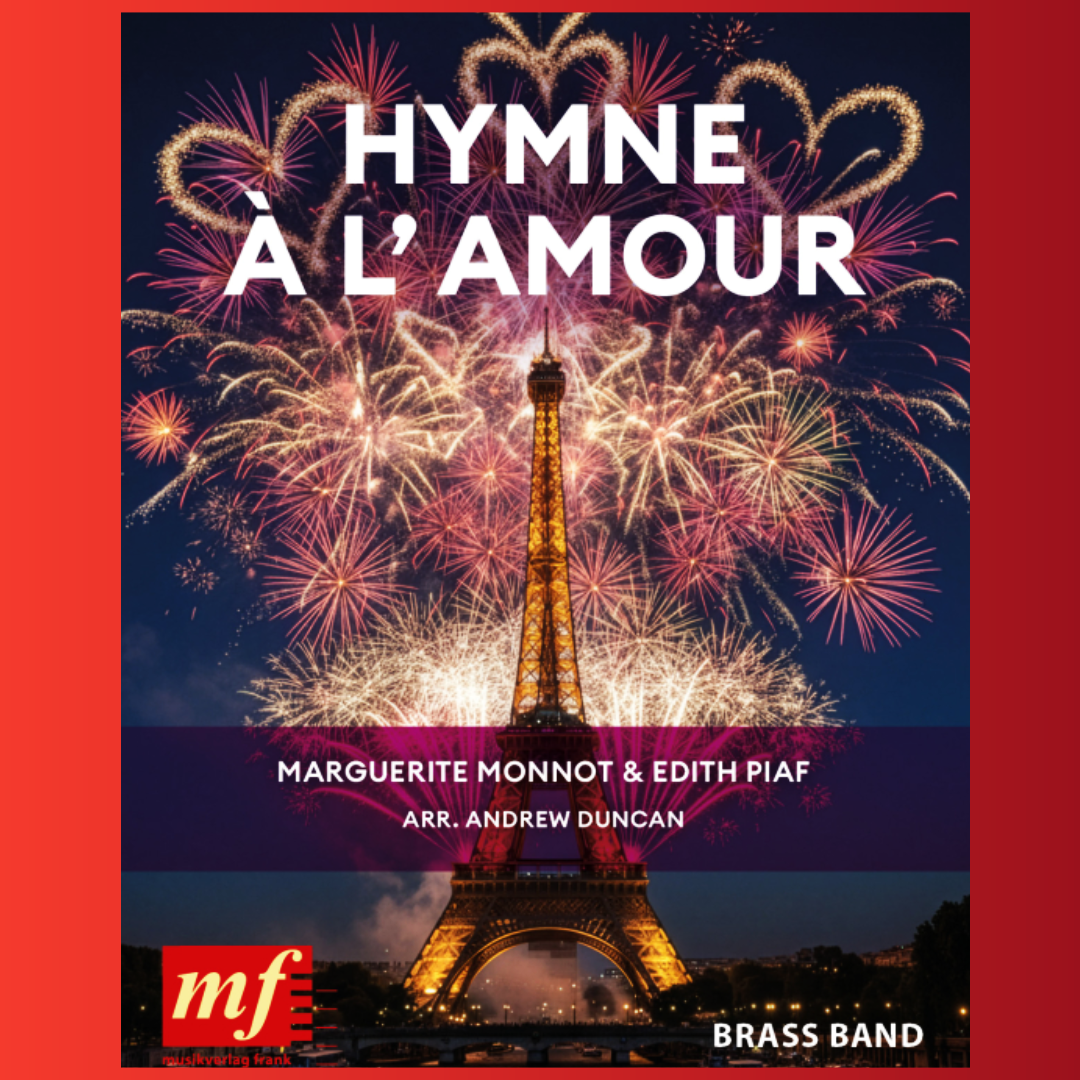
Hymne A L' Amour for Brass Band
Title: Hymne A L'Amour Composers: Marguerite Monnot & Edith Piaf Arranger: Andrew Duncan Instrumentation: Brass Band Publisher: Musikverlag Frank Description An arrangement of the beautiful French song Hymne A L'Amour arranged for brass band by Andrew Duncan This arrangement was originally sung by Edith Piaf then Josh Groban and more recently by Celine Dion in a memorable performance on the Eiffel Tower at the 2024 Paris Olympics. The Cooperation Band conducted by Katrina Marzella played this arrangement at Brass in Concert 2025 as the finale of their winning performance and was an audience favourite. It has been much shared on social media and can also be streamed on World Of Brass Play. The arrangement for brass band can be played with and without a marimba. There are alternate parts to the marimba within the band. Versions for Concert Band and Fanfare Band also available. IN STOCK
-
£44.95
NONE OTHER NAME (Brass Band Set) - Erik Leidzen
None Other Name was written for the 1960 tour of England by the New York Staff Band of The Salvation Army and can justifiably be termed a classic of brass band repertoire. It is best described as a symphonic medley of six songs focused on the name of Christ; The Saviour's Name; Jesus is the Sweetest Name I know; There's a Wonderful Name, 'tis Jesus; He's the Lily of the Valley; Jesus, the Very Thought of Thee (St. Agnes); All Hal the Power of Jesus' Name (Diadem).
Estimated dispatch 7-14 working days
-
 £48.56
A Christmas Fantasia - Brass Band (Andrew Wainwright)
Premiered in 2010 by Virtuosi GUS Band, this descriptive work features the carols 'Noel Nouvelet', 'God Rest Ye Merry Gentlemen', 'A Great and Mighty Wonder', 'The Infant King', 'Tomorrow Shall be my Dancing Day' and 'Of the Father's Heart Begotten'. "A Christmas Fantasia is a Salvation Army style selection - the kind of fusing of familiar carols that Ray Steadman-Allen and Leslie Condon were so good at. Andrew has learned well!" Paul Hindmarsh, British Bandsman magazine To view the Canadian Staff Band performing the work, please visit: https://www.youtube.com/watch?v=jFpQpLQSqUs Includes score and full set of parts. Sheet music available exclusively from World of Brass - www.worldofbrass.com Difficulty Level: 2nd Section + Instrumentation: Soprano Cornet Eb Solo Cornet Bb Repiano Cornet Bb 2nd Cornet Bb 3rd Cornet Bb Flugel Horn Bb Solo Horn Eb 1st Horn Eb 2nd Horn Eb 1st Baritone Bb 2nd Baritone Bb 1st Trombone Bb 2nd Trombone Bb Bass Trombone Euphonium Bb Bass Eb Bass Bb Timpani Percussion 1-2
In Stock: Estimated dispatch 1-3 working days
-
 £11.20
Christmas Processional (Brass Band Additional Parts) Trad. arr. Wainwright)
An effective opener to any Christmas concert, based on the French carol, 'Bring a torch, Jeanette, Isabella'. It tells the story of a group of children in medieval Provence, dressed up as shepherds and milkmaids, carrying torches and candles as they proceed to the stable. As they draw closer and their excitement increases, they are constantly reminded by their parents to keep the noise down so that they don't wake up the baby Jesus. The music begins quietly and builds to a majestic conclusion. "If I were still conducting bands regularly, this would certainly be on my list as a Christmas concert opener - it sets the energy and mood most effectively. The scoring is terrific." Paul Hindmarsh, British Bandsman magazine This arrangement also includes optional Organ and Hand bells parts. For a follow-the-score video of Virtuosi GUS Band performing the work, please visit: https://www.youtube.com/watch?v=2GasDfecnyY Sheet music available exclusively from World of Brass - www.worldofbrass.com Includes score and full set of parts. Difficulty Level: 2nd Section + Instrumentation: Solo Horn F 1st Horn F 2nd Horn F 1st Baritone B.C. 2nd Baritone B.C. 1st Trombone B.C. 2nd Trombone B.C. Euphonium B.C. Bass B.C. (Bass Eb Part) Bass B.C. (Bass Bb Part)
In Stock: Estimated dispatch 1-3 working days
-
 £37.35
Christmas Processional - Brass Band & opt. Organ (Trad. arr. Andrew Wainwright)
An effective opener to any Christmas concert, based on the French carol, 'Bring a torch, Jeanette, Isabella'. It tells the story of a group of children in medieval Provence, dressed up as shepherds and milkmaids, carrying torches and candles as they proceed to the stable. As they draw closer and their excitement increases, they are constantly reminded by their parents to keep the noise down so that they don't wake up the baby Jesus. The music begins quietly and builds to a majestic conclusion. "If I were still conducting bands regularly, this would certainly be on my list as a Christmas concert opener - it sets the energy and mood most effectively. The scoring is terrific." Paul Hindmarsh, British Bandsman magazine This arrangement also includes optional Organ and Hand bells parts. For a follow-the-score video of Virtuosi GUS Band performing the work, please visit: https://www.youtube.com/watch?v=2GasDfecnyY Sheet music available exclusively from World of Brass - www.worldofbrass.com Includes score and full set of parts. Alternative parts for Horns in F, and Baritones, Trombones, Euphonium and Tubas in Bass Clef are available here. Difficulty Level: 2nd Section + Instrumentation: Soprano Cornet Eb Solo Cornet Bb Repiano Cornet Bb 2nd Cornet Bb 3rd Cornet Bb Flugel Horn Bb Solo Horn Eb 1st Horn Eb 2nd Horn Eb 1st Baritone Bb 2nd Baritone Bb 1st Trombone Bb 2nd Trombone Bb Bass Trombone Euphonium Bb Bass Eb Bass Bb Timpani Percussion 1-3 Organ (optional) Hand bells (optional)
In Stock: Estimated dispatch 1-3 working days
-
 £33.62
Spanish Dance - Brass Band (Traditional arr. Andrew Wainwright)
Based on the traditional Spanish carol 'Riu Riu Chiu', this exciting foot-tapping item was premiered at Butlins Mineworkers Championships in 2010. Recorded on Virtuosi GUS Band's CD 'Christmas Fantasia - The Music of Andrew Wainwright', it has since proved to be a popular concert item. "Spanish Dance winds up to a whirlwind climax with a respectful nod in the direction of Morley Calvert's 'Canadian Folk Song Suite' - very clever." Paul Hindmarsh, British Bandsman magazine For a follow-the-score video of this work please visit: https://www.youtube.com/watch?v=jjskWuOH_YU Includes score and full set of parts. Sheet music available exclusively from World of Brass - www.worldofbrass.com Difficulty Level: 1st Section + Instrumentation: Soprano Cornet Eb Solo Cornet Bb Repiano Cornet Bb 2nd Cornet Bb 3rd Cornet Bb Flugel Horn Bb Solo Horn Eb 1st Horn Eb 2nd Horn Eb 1st Baritone Bb 2nd Baritone Bb 1st Trombone Bb 2nd Trombone Bb Bass Trombone Euphonium Bb Bass Eb Bass Bb Timpani Percussion 1-2
In Stock: Estimated dispatch 1-3 working days
-
 £39.95
Impulse (Brass Band - Score and Parts)
This work represents a brief, musical study of the practical expression of faith by Salvationists. Why do we do what we do? The beginning of the piece reflects the busyness and drive of those who feel called to Rescue the perishing (S.A.S.B. 927). Motivated by compassion, there is a constant, insistent urgency to accomplish this mission, and referenced is Albert Orsborn's song Except I am moved with compassion (S.A.S.B. 626). From here, the piece builds to a climactic, full statement of Rescue the perishing.
Estimated dispatch 7-14 working days
-
 £59.95
Aftershock (Brass Band - Score and Parts)
In this piece, the term "aftershock" serves as a metaphor for the Christian Church: commissioned by Jesus to carry forward the impact of his ministry and message. The Church is the spiritual aftershock of Christ's life, death, and resurrection - reverberating through history and into the present.Musically, the piece is constructed in three movements and built around motifs that pulse, echo, and resonate, symbolising the ongoing influence of Christ through his Church. Several well-known Christian songs are woven into its fabric, each contributing to the narrative of mission and worship. Build your Kingdom here (Rend Collective) affirms the Church's identity as "the hope on earth," while Major Leonard Ballantine's And you will be my witnesses (M.S. 1992-10) recalls Jesus' call to spread the gospel.The reflective central section features Matt Redman's I will offer up my life in spirit and truth, expressing personal devotion of a believer seeking to serive within the global Church.The finale draws on a traditional Salvation Army song by William Drake Pennick (S.A.S.B. 937), urging believers to proclaim the gospel far and wide: Tell the world, O tell the world!Make salvation's story heard;In the highways, in the byways,And in lands beyond the sea,do some witnessing for JesusWheresoever you may be.
Estimated dispatch 7-14 working days