
Results
-
 £61.99
Non, Je Ne Regrette Rien (No Regrets) - Michel Vaucaire & Charles Dumont - Frank Bernaerts
Estimated dispatch 10-14 working days
-
 £59.70
 -
 £34.95
Judd: Il Est Ne (He is Born)
This French traditional carol has great charm and grace. This arrangement calls for rhythmic vitality, delicacy and sure-footedness.
Estimated dispatch 7-14 working days
-
£27.00
Il Est Ne Le Divin Enfant
Es ist geboren, das gottliche Kind / He Is Born The Holy Child
Estimated dispatch 7-14 working days
-
 £34.95
Il Est Ne (He Is Born) (Brass Band - Score and Parts) - Norbury, Kevin
This French traditional carol has great charm and grace. This arrangement calls for rhythmic vitality, delicacy and sure-footedness.
Estimated dispatch 7-14 working days
-
£17.50
Il Est Ne (He Is Born) (Brass Band - Score only) - Norbury, Kevin
This French traditional carol has great charm and grace. This arrangement calls for rhythmic vitality, delicacy and sure-footedness.
Estimated dispatch 7-14 working days
-
£47.50
Christmas Fancies - James Curnow
Combine holiday favorites with just a touch of Eurpean flair! Including the songs: Christ Is Born (Il Est Ne); Fum Fum Fum and Hark The Herald Angels Sing, you can't help but capture the joy these carols bring! Richly varied and full sounding, it will appeal to all!
Estimated dispatch 5-14 working days
-
£118.99
Elegy I - Jacob de Haan
Elegy I 'Jealousy' has been named after John Donne's poem of the same name. This English poet (1572-1631) wrote an entire series of elegies, each with its own theme. Jealousy can trigger various emotions, ranging from disappointment, grief, or regret, to madness and anger. All these emotions have been incorporated into this composition. Jacob de Haan was inspired by three different works of art: a poem (the aforementioned poem by John Donne), a painting by the Norwegian painter Edvard Munch (Jealousy in the Garden) and an old French chanson about jealousy (Je ne l'ose dire) by the sixteenth-century French composer Pierre Certon. The music refers repeatedly to thischanson - sometimes through key notes from the melody that serve as the starting point for new, isolated themes and sometimes through quotations of the original version
Estimated dispatch 5-14 working days
-
 £36.89
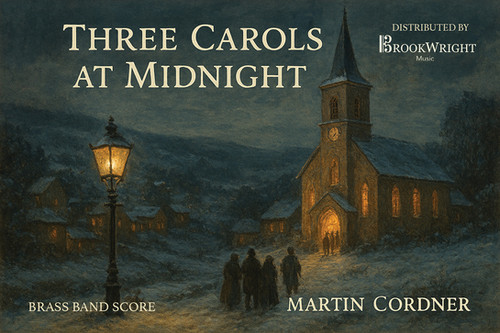
Three Carols at Midnight (Brass Band) Martin Cordner
Rooted in the sacred stillness of a French village on Christmas Eve, this suite by Martin Cordner draws upon traditional carols that have echoed through centuries of candlelit chapels and midnight vigils. Each movement offers a window into the Nativity story: I. Mystery: Noel Nouvelet (Christmas Comes Anew) opens with modal wonder, evoking the anticipation of Christ's coming and the quiet awe of Advent. II. Cradle: Entre le boeuf et l'ane gris (Between the Ox and the Grey Donkey) rests in pastoral tenderness, where the newborn Savior lies between humble beasts, watched over by angels and the Virgin. III. Joy: Il est ne, le divin enfant (He is born, the Divine Infant) bursts forth in celebration, proclaiming the divine birth with rustic dance and jubilant praise. Together, these carols form a musical triptych - moving from mystery to intimacy to exultation. Three Carols at Midnight invites listeners to step into the hush of a French Noel, where the sacred story is told not only in word, but in melody, memory, and light. All proceeds support the mission and ministry of The Salvation Army Delaware Command, USA. To view a rolling score video of the work please visit www.youtube.com/watch?v=fUcCluBS18Q Difficulty level: 4th Section + Duration: approx. 5.00 minutes This PDF download includes parts and score. Sheet music available at www.brassband.co.uk or www.durhammusicshop.co.uk (UK) or https://satradecentral.org (USA) Instrumentation: Soprano Cornet Eb 1st Cornet Bb 2nd Cornet Bb 1st Horn Eb 2nd Horn Eb 1st Baritone Bb 2nd Baritone Bb 1st Trombone Bb 2nd Trombone Bb Bass Trombone Euphonium Bb Bass Eb Bass Bb Percussion 1-2 Glockenspiel
In Stock: Estimated dispatch 1-3 working days
-
 £51.95
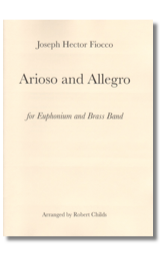
Arioso and Allegro - Joseph Hector Fiocco arr. Philip Wilby and Robert Childs
Joseph Hector Fiocco (1703-41) was the most famous member of a family of Belgian musicians. As well as being a church musician, Joseph was a violin maker, professor of Latin and Greek, and a distinguished harpsichord player. His famous allegro, originally written for harpsichord, lies well for the euphonium. It requires a steady tempo throughout its compass and dynamic range, and is ideal for improving technique and stamina. The lyrical arioso demands well-shaped phrases and ne breath control.
Estimated dispatch 7-9 working days
 View Music