
Results
-
 £137.70
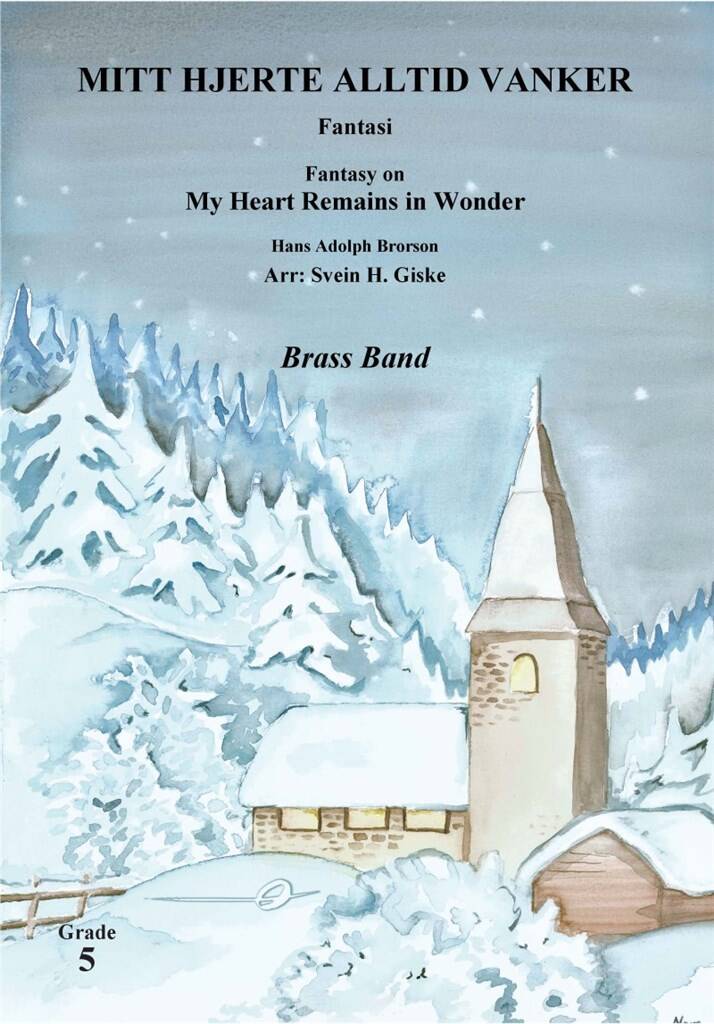
Mitt hjerte alltid vanker - Fantasi - Hans Adolph Brorson - Svein H. Giske
This arrangement was commissioned by B3 (The Bergen Woodwind Ensemble). B3 is a large woodwind ensemble located in Bergen with a mix of professional and amateur players. My Heart Remains in Wonder is a well-known Christmas hymn in Scandinavia. I wanted my version to be different to the traditional hymn tune style in which it is normally performed. One day I was outside walking and this idea came to me: an ostinato-like, mechanical skeleton of arpeggio semiquavers on which I could 'hang' the melody. However, I also wanted to do the melody line a bit different. The inspiration for this comes from folk music and the way fiddlers hardly ever lift their bow off the strings when they play. Because of this, it is important that the melody is played in a very sostenuto style in this arrangement. The harmonies lie somewhere between jazz and folk music with a little nod towards Grieg (himself heavily influenced by folk music) in the slow middle section.
Estimated dispatch 5-14 working days
-
 £228.70
Fanfare and Chorale - Egil Hovland - Ray Farr
This arrangement (or edition) for brass band will give the possibility for more performances of this fine work by Hovland. The composer, before his death, examined my work and made no suggestions for changes, and his approving comments were complimentary and encouraging. The work was originally written for Concert Band in 1966 as Op. 54a to St. Olaf College Band in the US. It was transcribed in 1967 for symphony orchestra as Op. 54b by the composer himself. The challenges in arranging the piece for brass band were mostly concerned with satisfactorily covering the upper register used by piccolo, flutes and clarinets, and while there are wonderful brass players around who have amazing high registers, I have aimed this edition at a level achievable by reasonably good brass band players who are willing to give time and effort into the proper preparation and delivery of the music. Having worked on this new edition with a top-class brass band, I think it sounds wonderful and interestingly different to the original. Besides the obvious differences of tone-colour and absent high notes, I have used in my scoring, the option for using a vibraphone in place of a celeste. Vaughan Williams, in his Variations for brass band writes for celeste, but because the instrument is quite rare, performances have been mostly given using a glockenspiel- but this, of course sounds two octaves higher than it was intended. I think that vibraphone and brass is an excellent combination and recommend it without hesitation in this piece. Every detail of articulation and dynamic has been considered, so in order to keep the integrity of the music, please do not change anything in the name of "interpretation". As Ravel says- "What is there to interpret?" Ray Farr
Estimated dispatch 5-14 working days
-
 £39.99
Fanfare for the Best - Thomas Doss
Fanfare for the Best is a short composition inspired by best friends and memories of good times in pleasant company. I wrote this piece for the 50th birthday of my friend Otto M. Schwarz.
Estimated dispatch 5-14 working days
-
 £60.99
With a Little Help from My Friends - John Lennon - Philip Harper
This song was originally recorded by The Beatles on their iconic Sgt. Pepper's Lonely Hearts Club Band album. Many people also know this song because of Joe Cocker's breakthrough performance at the legendary Woodstock festival in 1969. Philip Harper's fantastic arrangement manages to evoke the atmosphere and sounds of the original Beatles version.
Estimated dispatch 5-14 working days
-
 £33.62
Fanfare Prelude on 'Richmond' (Brass Band) Charles Wesley arr. Andrew Wainwright
Fanfare Prelude on 'Richmond' was written for the inaugural Texas Brass Fest, held at Round Top Festival Institute on 27 May 2023, for the four premier brass bands in Texas - Austin, Dallas, Houston and San Antonio Brass Bands. It is based on the much loved hymn of the church by Charles Wesley, which is also known as 'O For a Thousand Tongues to Sing', the first verse of which reads: O for a thousand tongues to sing my great Redeemer's praise, the glories of my God and King, the triumphs of his grace! For maximum effect it is suggested that cornets and trombones are staged stood around the band, although if this is not possible then traditional band formation will be acceptable. To view a video of the premiere performance featuring the massed bands of Austin, Dallas, Houston and San Antionio at Texas Brass Fest 2023, please visit www.youtube.com/watch?v=22GJM4A6mbM or the Chicago Staff Band at www.youtube.com/watch?v=Gjp8N_U9U2c PDF download includes score and full set of parts. Sheet music available from: UK - www.brassband.co.uk USA - www.solidbrassmusic.com Difficulty Level: 2nd Section + Instrumentation: Soprano Cornet Eb Cornets 1-5 Bb Flugel Horn Bb Solo Horn Eb 1st Horn Eb 2nd Horn Eb 1st Baritone Bb 2nd Baritone Bb 1st Trombone Bb 2nd Trombone Bb Bass Trombone Euphonium Bb Bass Eb Bass Bb Timpani Percussion 1-3
In Stock: Estimated dispatch 1-3 working days
-
 £29.88
Fanfare for the Olympians (Brass Band) Aaron Stanley
VIEW SCORE PDF This uplifting and rhythmic fanfare by American composer J. Aaron Stanley will be an ideal alternative to the traditional fare that is written in celebration of the Olympic Games. The composer writes: 'Most of my works start with a concept and working title in mind before I even begin composing. But Fanfare for the Olympians, on the other hand, was titled afterward, allowing the music to suggest its own title. The festive, anticipatory nature of the work seems to build excitement and tension for something celebratory and grandiose, like the Olympic Games. Written in 2000, at the time, I was obsessed with quartal harmonies and asymmetrical meters. But the driving eighth-note pulse of alternating 2+2+3 / 3+2+2 is what drives the fanfare forward to its epic climax.' Sheet music available from: UK - www.brassband.co.uk USA - www.solidbrassmusic.com Difficulty Level: 2nd Section + Instrumentation: Soprano Cornet Eb Solo Cornet Bb Repiano Cornet Bb 2nd Cornet Bb 3rd Cornet Bb Flugel Horn Bb Solo Horn Eb 1st Horn Eb 2nd Horn Eb 1st Baritone Bb 2nd Baritone Bb 1st Trombone Bb 2nd Trombone Bb Bass Trombone Euphonium Bb Bass Eb Bass Bb Timpani Percussion 1-2
In Stock: Estimated dispatch 1-3 working days
-
 £33.62
My Bonnie - Brass Band (Kenneth Downie)
VIEW SCORE PDF This three-minute fantasy waltz was commissioned by John Ward, conductor of Fulham Brass Band, to celebrate the first birthday of his daughter, Bonnie. The result is a work that is full of Kenneth Downie's customary imagination and musical signatures. Based on the Scottish folk song My Bonnie lies over the ocean, there is also a subtle reference to Away in a Manger to signify Bonnie's Christmas Day arrival. For a follow-the-score video based on a performance by Brass Band Willebroek, please visit: https://www.youtube.com/watch?v=SKNd_ocryZY PDF download includes score and full set of parts. Sheet music available from: UK - www.brassband.co.uk USA - www.solidbrassmusic.com Difficulty Level: 2nd Section + Instrumentation: Soprano Cornet Eb Solo Cornet Bb Repiano Cornet Bb 2nd Cornet Bb 3rd Cornet Bb Flugel Horn Bb Solo Horn Eb 1st Horn Eb 2nd Horn Eb 1st Baritone Bb 2nd Baritone Bb 1st Trombone Bb 2nd Trombone Bb Bass Trombone Euphonium Bb Bass Eb Bass Bb Timpani Glockenspiel Percussion
In Stock: Estimated dispatch 1-3 working days
-
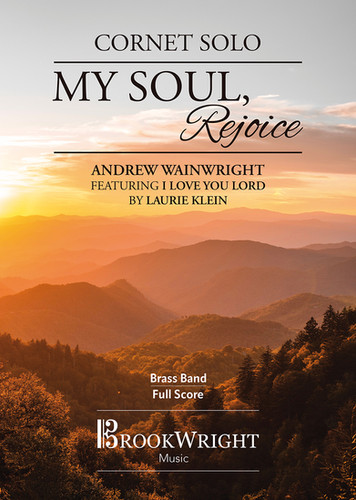 £48.56
My soul, rejoice (Cornet Solo with Brass Band) Andrew Wainwright
My soul, rejoice (Andrew Wainwright) was commissioned in 2022 by Elizabeth Malovance, principal cornet of the Chicago Staff Band. A spirited and celebratory work, it is designed to showcase the dual nature of the cornet: its sparkling technical agility and its rich, vocal lyricism. The music begins in meditative fashion before transitioning into a joyful caprice featuring playful syncopations which are handed around the band. This is followed by a reflective section based on the much-loved worship song I love you Lord by Laurie Klein. The work concludes with a reprise of the original theme, building in momentum and intensity. Through a series of brilliant runs and virtuosic flourishes, the soloist leads the charge toward a majestic and triumphant finale, bringing the work to a ringing, glorious close. The solo was recorded by Richard Marshall on the 2026 CD Gothique Fantasy - The Music of Andrew Wainwright, which was his last solo recording of his 20-year tenure as principal cornet of Black Dyke Band. Technical Requirements & Electroacoustic Integration This work features an optional digital delay effect for the soloist, indicated in the score by "pedal on" and "pedal off" markings. If the required equipment is unavailable, the piece can be performed entirely acoustically. To listen to Beth Malovance performing the work with the Chicago Staff Band please visit https://on.soundcloud.com/c8IoU3CF3srTD4z0wX Duration: approx. 8 minutes Difficulty Level (Band): 2nd Section + Soloist: Advanced This PDF download includes the full score and parts. Sheet music available at www.brassband.co.uk (UK) or https://satradecentral.org (USA) Instrumentation: Soprano Cornet Eb Solo Cornet Bb 1st Cornet Bb 2nd Cornet Bb Flugel Horn Bb Solo Horn Eb 1st Horn Eb 2nd Horn Eb 1st Baritone Bb 2nd Baritone Bb 1st Trombone Bb 2nd Trombone Bb Bass Trombone Euphonium Bb Bass Eb Bass Bb Timpani & Bass Drum Percussion 1-3
In Stock: Estimated dispatch 1-3 working days
-
 £48.56
A Christmas Fantasia - Brass Band (Andrew Wainwright)
Premiered in 2010 by Virtuosi GUS Band, this descriptive work features the carols 'Noel Nouvelet', 'God Rest Ye Merry Gentlemen', 'A Great and Mighty Wonder', 'The Infant King', 'Tomorrow Shall be my Dancing Day' and 'Of the Father's Heart Begotten'. "A Christmas Fantasia is a Salvation Army style selection - the kind of fusing of familiar carols that Ray Steadman-Allen and Leslie Condon were so good at. Andrew has learned well!" Paul Hindmarsh, British Bandsman magazine To view the Canadian Staff Band performing the work, please visit: https://www.youtube.com/watch?v=jFpQpLQSqUs Includes score and full set of parts. Sheet music available exclusively from World of Brass - www.worldofbrass.com Difficulty Level: 2nd Section + Instrumentation: Soprano Cornet Eb Solo Cornet Bb Repiano Cornet Bb 2nd Cornet Bb 3rd Cornet Bb Flugel Horn Bb Solo Horn Eb 1st Horn Eb 2nd Horn Eb 1st Baritone Bb 2nd Baritone Bb 1st Trombone Bb 2nd Trombone Bb Bass Trombone Euphonium Bb Bass Eb Bass Bb Timpani Percussion 1-2
In Stock: Estimated dispatch 1-3 working days
-
 £33.62
Fanfare Prelude - Now thank we all our God (Brass Band & Organ) arr. Downie
This rousing fanfare prelude for Brass Band and optional Organ by Kenneth Downie is based on the monumental hymn Now thank we all our God, which dates from 17th century Germany. The arrangement is featured on the CD Classic Hymns for Orchestra - The Symphonic Music of Kenneth Downie (available here) as a symphonic brass setting. The arranger writes: 'The depth of the words is underpinned by the grandeur of the music, so I have tried to reflect the same regal approach in my setting for brass band.' This arrangement will be an ideal opener or prelude for concerts or church services. To view a rolling score video of the work please visit www.youtube.com/watch?v=olrdFskDfac PDF download includes score and parts. Additional parts for Horns in F, and Baritone, Trombone, Euphonium and Tuba in bass clef are available here. Sheet music available from: UK - www.brassband.co.uk USA - https://satradecentral.org Difficulty Level: 2nd Section + Length: 3.15 minutes Instrumentation: Soprano Cornet Eb Solo Cornet Bb 1st Cornet Bb 2nd Cornet Bb Flugel Horn Bb Solo Horn Eb 1st Horn Eb 2nd Horn Eb 1st Baritone Bb 2nd Baritone Bb 1st Trombone Bb 2nd Trombone Bb Bass Trombone Euphonium Bb Bass Eb Bass Bb Timpani Percussion 1-3 Organ (optional)
In Stock: Estimated dispatch 1-3 working days
 View Music
 Watch video