
Results
-
£50.00
Hobson's Brass - Malcolm Arnold
Hobson's Brass is Malcolm Arnold's score to David Lean's 1954 film, Hobson's Choice, was one of three collaborations between the composer and director. It's a story of Henry Hobson, played by Charles Laughtan who runs a successful bootmaker's shop in nineteenth-century Salford. A widower with a weakness for the pub, he tries forcefully to rule the lives of his three unruly daughters.Brass Band Grade 5: 1st Section.Duration 10 minutes.
In Stock: Estimated dispatch 1-3 working days
-
 £34.95
By Water and the Word - Jonathan Bates
DURATION: 4'00". DIFFICULTY: 4th+. 'By Water and the Word' was composed for 2020 Brass Band Summer School in memory of it's long-standing course administrator Philip Biggs, who passed away in 2019. Aside from his work with BBSS, Philip was also the renowned administrator for the National Youth Brass Band of Great Britain where my first opportunities as a writer of brass music were presented. It's a certainty to say that without Philip's work at the head of this organisation, there's zero chance I would be able to do what I do today as a musician, and for that it was a huge honour to write this short work in his memory. Under Maestro Bramwell Tovey, each course would conclude with an encore of The Day Thou Gavest (St. Clements) and one of the most used hymn tunes throughout the week was The Church's One Foundation (Aurelia). Since then, these two tunes have become synonymous with the NYBBGB and in turn Philip's life & work, so I felt it fitting to combine these two wonderful sacred melodies into a new work paying homage to those memories. .
In Stock: Estimated dispatch 1-3 working days
-
 £29.95
Prayer to St Michael - Jonathan Bates
DURATION: 4'00". DIFFICULTY: Moderate. 'Prayer to Saint Michael' is a solo for Euphonium, composed for the Wantage Band and inspired by the life of a young Johann Sebastian Bach, who following the death of both parents by the age of only 10 moved to live with his older brother - Johann Christoph Bach - who was the church organist at St Michael's Church in Ohrdruf. It was in this church where Bach spent many hours studying and performing, being instructed by Johann Christoff on the clavichord. Within 6 years, the young Bach had been enrolled in the prestigious St Michael's School in Luneberg. . "St. Michael the Archangel, illustrious leader of the heavenly army, . defend us in the battle against principalities and powers, . against the rulers of the world of darkness and the spirit of wickedness in high places. Come to the rescue of mankind, . whom God has made in His own image and likeness, . and purchased from Satan's tyranny at so great a price. The Holy Church venerates you as her patron and guardian. The Lord has entrusted to you the task of leading the souls of the redeemed to heavenly blessedness. Entreat the Lord of peace to cast Satan down under our feet, . so as to keep him from further holding man captive and doing harm to the Church. Carry our prayers up to God's throne, . that the mercy of the Lord may quickly come and lay hold of the beast, . the serpent of old, Satan . and his demons, casting him in chains into the abyss, . so that he can no longer seduce the nations. Amen.". .
In Stock: Estimated dispatch 1-3 working days
-
£70.00
Macbeth - Peter Meechan
Commissioned by the Scottish Brass Band Association for the 2007 Scottish Open Championship, Macbeth takes itsa inspiration from the Shakespeare play of the same name. Character portraits (Of the three witches as well as Macbeth himself), abstractions (The lament), and scenes (Macbethas final battle with Macduff) make up the nine sections of the piece.i: WitchesThe prophecies of the three witches are an integral part of the play, and in this opening section, these mysterious characters are represented by three different sections of music that introduces the listener to the musical material of the piece.ii: DaggerMacbethas aIs this a dagger I see before theea speech, where an imaginary dagger leads him to contemplate the pending murder, builds in intensity before the bell tolls at itsa conclusion - a sign from Lady Macbeth that Duncan is now alone.iii: General MacbethA character portrait of Macbeth - a fearless General who has led his armies to defeat foes from all over Europe. His ambition and flair that make him such a great General are also the characteristics that lead to his eventual downfall.iv: Contemplations of Lady MacbethAlone and mad, Lady Macbeth ponders all that has gone, before taking her own life.v: LamentAlthough the play tells of Macbeth not feeling the pain of his wifeas death, this lament ponders not only her death, but the tale as a whole.vi: Tomorrow and tomorrow and tomorrowIt is in this final soliloquy that we see the ultimate tragedy of Macbeth - the realisation that his life is ultimately worthless.vii: A spell still castThis acts as an prologue to section eight, restating the original awitchesa music, before heading into Macbethas final battle.viii: Final BattleMacbethas final battle, where he locks swords with Macduff.ix: Not of woman bornMacbethas realisation that the witches have misled him comes all too late, as Macduff beheads Macbeth, fulfilling the last prophecy.
Estimated dispatch 12-14 working days
-
 £38.95
Unity Series Band Journal - Numbers 550 - 553, February 2026
550: March - Century of celebration (Stephen Smith)This march follows a traditional pattern and should be accessible for most bands. It was written for the 100th anniversary of Camp Gifford in Loon Lake, Washington, therefore included are well-known songs with references to water as the camp is located on the shores of Deer Lake.551: Going Home (Alan Williams)Richard Jukes' song I'm a soldier bound for Glory (S.A.S.B. 856) displays the confidence of someone with a steadfast faith who is certain that by loving and serving their God they will be accepted into his Kingdom. This assurance results in a joyful song of testimony. Whilst not a direct setting of the five verses, the dance-like rhythm of this cha-cha should reflect the positive and encouraging nature of the lyrics and be full of joy and spirit.552: Whosoever will may come (Noel Jones)This is a two-verse arrangement of the song Whosoever will may come (S.A.S.B. 405), with words written by William John McAlonan and music composed by Alfred Braine. This song is included in the Invitation and Challenge section of the song book. The arrangement should be played in a spirited style.553: March - Sing a praise of celebration (Marcus Venables)This music was written at the request of the Singapore Central Corps Band, who asked that the work be based on two specific meaningful melodies. The first is To the Glory and Praise of God by Robert Redhead, a tune rooted in corporate worship and joyful proclamation, calling God's people to lift their voices in thanksgiving. The other is Home, a beloved Singaporean song that speaks of belonging.
Estimated dispatch 7-14 working days
-
 £38.95
Unity Series Band Journal - Numbers 522 - 525, October 2023
522: Festival March - The Rescuers (Andrew Hedley)This exciting and bright festival march comes from a new contributor to the band journals. Andrew Hedley is a bandsman at Chester-le-Street Corps and a member of the Euphonium Section of the International Staff Band. This work contains inventive harmonic and melodic patterns and we hope this will be the first of many works from this composer to be seen in our journals.523: Moses and Pharaoh (Ralph Pearce)This piece owes its creation to the playing of the Montclair Citadel Young Peoples' Band in the Sunday School assembly every weekend. The song Pharaoh, Pharaoh is extremely popular and is sung with gusto and much movement. The presentation of this song derives for an accompaniment written for the band to play along with the singing. To widen its use, the spiritual Go down, Moses (STTL Vol.7, Part 2) was added to make the present composition. This music should have drive throughout and be played with a sense of fun.524: Lord, to thee (Alan Williams)This is a setting of the tune Hendon (T.B. 249). The piece uses the first verse of Frances Ridley Havergal's commonly associated text 'Take my life and let it be consecrated, Lord, to thee' (S.A.S.B. 623), and from there it takes its title.525: Song Arrangement - This is why (Noel Jones)This music is based on the tune This is why (T.B. 353) by Elisha Albright Hoffman and this two-verse arrangement reflects the great song of testimony Would you know why I love Jesus (S.A.S.B. 912). An associated scripture reference is found in Mark 10:45 'For even the Son of Man did not come to be served, but to serve, and to give his life as a ransom for many'. The motif 'Would you know' occurs in the opening bars and is repeated throughout the piece, along with fragments of the first verse. The chorus confirms the hoy that Christians experience knowing that Christ's sacrifice has bought forgiveness for our wrongdoings.
Estimated dispatch 7-14 working days
-
 £55.00
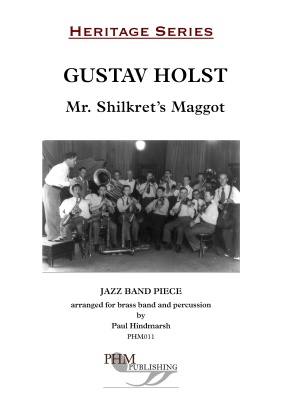
Mr Shilkret's Maggot (Brass Band - Score and Parts)
This short piece was composed in 1932 during a visit Gustav Holst was making to the USA. He was invited by the band leader Nathaniel Shilkret to contribute to a series of piece for concert jazz band based on a folk song. Rather than using a traditional tune, Holst invented one of his own in folk song style and therefore the piece was not performed. Holst considered various titles for the piece including Mr. Shilkret's Dump, Folly and Maggot. On the manuscript he described it as a Jazz Band Piece. When the composer's daughter Imogen re-scored the piece for the English Chamber Orchestra to record under her direction in 1967, she changed decided to use the title Capriccio.Her re-orchestration involved removing the saxophone quartet, adding cor anglais and a second bassoon and changing cornet parts to trumpets. She retained the harp, extensive percussion, piano and celesta. My brass band version is based on the composer's manuscript, held at the British Library. It retains the composer's cornet parts, re-voices the woodwinds and strings, and places keyboards and harp onto glockenspiel, marimba, vibraphone and xylophone.I have selected the title Mr. Shilkret's Maggot for my scoring of Jazz Band Piece, which was first performed by The Cory Band, conducted by Philip Harper, at the Royal Northern College of Music Brass Band Festival, 29 January 2017.- Paul HindmarshDuration: 5.30
Estimated dispatch 7-14 working days
-
 £95.00
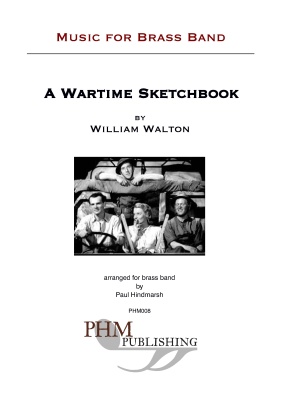
A Wartime Sketchbook (Brass Band - Score and Parts)
Early in 1941 William Walton, 39, received his call-up papers. He was by then one of the most eminent of British composers and was exempted from military service on condition that he provided music for films deemed to be of 'national importance'. Scoring Lawrence Olivier's Shakespeare epic Henry V in 1943 was the most substantial of these wartime projects. His role in patriotic films from 1941 and 42 like The Foreman went to France, Next of Kin, Went the day Well and The First of the Few was to provide appropriate title music and some underscoring at key moments. Walton extracted the most substantial portions of the latter as the popular Spitfire Prelude and Fugue for orchestra. The remaining music remained unpublished until 1990, when Christopher Palmer assembled the highlights into A Wartime Sketchbook. I was intrigued to hear these examples of Walton's wartime music and having discovered that they would fit naturally and idiomatically onto the brass band, I arranged six of the numbers into a suite for Besses o' th' Barn Band, which I was conducting at the time.In 1995 the brass band suite was recorded by the famous Black Dyke Mills Band as part of an all Walton album which I produced for the ASV label (ASV CD WHL 2093). This award- winning CD also included Walton's First Shoot, in the edition by Elgar Howarth, my transcription of movements from Music for Children and two substantial brass versions by Edward Watson of the suite from Henry V (with narrator) and the March and Siegfried Music from The Battle of Britain music.Prologue: This is the stirring title music from Went the day Well, a screen play by Graham Greene about a German airborne invasion of an English village. The main theme leads toBicycle Chase: Characteristic musical high-jinks for J.B.Priestley's The Foreman went to France.Refugees: From the same film, this is a poignant accompaniment to the long march of refugees. As Ernest Irving, the film's musical director, put it, "this really makes your feet sore and your knees sag."Young Siegfrieds: This lively movement comes from the music that Walton composed for The Battle of Britain in 1968, with the assistance of Malcolm Arnold, but which the film's producer rejected. It portrays first the Berliners, cheerfully ignoring the black-out and then, in the trio, the Young Siegfrieds of the Luftwaffe, courtesy of a parody of Siegfried's horn call from Wagner's opera.Romance: A soldier and a Dutch refugee snatch a few tender moments together in Next of Kin.Epilogue: At the end of The Foreman went to France, the French look forward with hope and optimism to eventual liberation.- Paul HindmarshDuration: 14.00
Estimated dispatch 7-14 working days
-
£40.00
A Wartime Sketchbook (Brass Band - Score only)
Early in 1941 William Walton, 39, received his call-up papers. He was by then one of the most eminent of British composers and was exempted from military service on condition that he provided music for films deemed to be of 'national importance'. Scoring Lawrence Olivier's Shakespeare epic Henry V in 1943 was the most substantial of these wartime projects. His role in patriotic films from 1941 and 42 like The Foreman went to France, Next of Kin, Went the day Well and The First of the Few was to provide appropriate title music and some underscoring at key moments. Walton extracted the most substantial portions of the latter as the popular Spitfire Prelude and Fugue for orchestra. The remaining music remained unpublished until 1990, when Christopher Palmer assembled the highlights into A Wartime Sketchbook. I was intrigued to hear these examples of Walton's wartime music and having discovered that they would fit naturally and idiomatically onto the brass band, I arranged six of the numbers into a suite for Besses o' th' Barn Band, which I was conducting at the time.In 1995 the brass band suite was recorded by the famous Black Dyke Mills Band as part of an all Walton album which I produced for the ASV label (ASV CD WHL 2093). This award- winning CD also included Walton's First Shoot, in the edition by Elgar Howarth, my transcription of movements from Music for Children and two substantial brass versions by Edward Watson of the suite from Henry V (with narrator) and the March and Siegfried Music from The Battle of Britain music.Prologue: This is the stirring title music from Went the day Well, a screen play by Graham Greene about a German airborne invasion of an English village. The main theme leads toBicycle Chase: Characteristic musical high-jinks for J.B.Priestley's The Foreman went to France.Refugees: From the same film, this is a poignant accompaniment to the long march of refugees. As Ernest Irving, the film's musical director, put it, "this really makes your feet sore and your knees sag."Young Siegfrieds: This lively movement comes from the music that Walton composed for The Battle of Britain in 1968, with the assistance of Malcolm Arnold, but which the film's producer rejected. It portrays first the Berliners, cheerfully ignoring the black-out and then, in the trio, the Young Siegfrieds of the Luftwaffe, courtesy of a parody of Siegfried's horn call from Wagner's opera.Romance: A soldier and a Dutch refugee snatch a few tender moments together in Next of Kin.Epilogue: At the end of The Foreman went to France, the French look forward with hope and optimism to eventual liberation.- Paul HindmarshDuration: 14.00
Estimated dispatch 7-14 working days
-
 £37.35
A Fugal Overture (Brass Band) Gustav Holst arr. Rob Bushnell
A Fugal Overture was written in 1922 by Gustav Holst. It was first performed at the Royal Opera House, Covent Garden on 14 May 1923 and was used as an opening work to Holst's one-act opera The Perfect Fool. It received its concert premiere on 11 October 1923 at one of Henry Wood's Queen's Hall Promenade Concerts. It is an early example of neoclassicism and was influenced by the counterpoint of J. S. Bach, despite its unconventional use of the fugal process. Holst began writing the piece in the summer of 1922, having hoped to develop it into a ballet. It is divided into three sections, the fugal subject with its distinct 3+3+2 pattern, a slower section with solos at the end, and a third section where the subject returns. Although reviews of the piece were mixed at the time of its premiere, the likes of Adrian Boult have said it was "an invigorating work that could effectively start any [...] concert". In more recent years, it has been compared to John Adam's A Short Ride in a Fast Machine. This arrangement is for the British-style brass band, with alternative parts for horns in F and bass-clef lower brass. A recording of the original composition can be found here: www.youtube.com/watch?v=a8xfwJyFq2E. Duration: Approx. 5.40 minutes Difficulty Level: 1st Section + PDF download includes parts and score. Sheet music available from www.brassband.co.uk Instrumentation: Soprano Cornet Eb Solo Cornet Bb Repiano Cornet Bb 2nd Cornet Bb 3rd Cornet Bb Flugel Horn Bb Solo Horn Eb 1st Horn Eb 2nd Horn Eb 1st Baritone Bb 2nd Baritone Bb 1st Trombone Bb 2nd Trombone Bb Bass Trombone Euphonium Bb Bass Eb Bass BbTimpani Percussion 1-2
In Stock: Estimated dispatch 1-3 working days
 View Music