
Results
-
 £55.00
Coronation Scene. - Modest Mussorgsky
Few operas have had such a remarkable history as Mussorgsky's masterpiece Boris Godunov. It exists in no less than three complete versions by the composer himself, as well as posthumous editions andorchestrations by Rimsky-Korsakov (from which this arrangement is taken), Shostakovich and others.The Coronation Scene is set in the Square of the Moscow Kremlin, between the Cathedral of the Assumption and theCathedral of Archangel Michael, the year is 1598. After being crowned as Tsar, Boris Godunov acknowledges the people's acclamations and the bells of the two cathedrals, as well as many churches within the vicinity, canbeheard ringing out across St Petersburg.Available here are the score and parts for Mussorgsky's Coronation Scene (Boris Godunov), as arranged for Brass Band by Phillip Littlemore.
Estimated dispatch 5-14 working days
-
 £102.60
Milonga del Angel - Astor Piazzolla - Sverre Stakston Olsrud
This arrangement was made after hearing Astor Piazzolla's 1986 recording of his own work written in 1965.The original instrumentation of bandoneon, violin and string bass is here arranged for three wind soloists with Concert Band.The Eb Cornet is the main soloist (filling the bandoneon role), while the trombone and Solo Bb Cornet shares the violin part as a kind of flirting undertone to the Eb Cornet.It's not possible to make a 100% correct notation of the solo parts, so it's recommended to listen to the record album "Zero Hour" from 1986 to get the best impression of the work.Enjoy "Milonga Del Angel" and imagine a small, dark cafe in Buenos Aires!
Estimated dispatch 5-14 working days
-
 £154.99
REM-scapes - Thomas Doss
Sweet echoes of Beethoven's Moonlight Sonata in the introduction bring a gentle slumber. Breathing is calm and sleep holds the promise of rest and relaxation.With the onset of the REM sleep phase, however, in which most dreams take place and where the day's events are worked through, we hear other sounds played.With distorted sounds, reminiscent of an old gramophone, the music pulls the listener inevitably ever deeper into the dreamscape, in a very realistic dangerous situation that comes to a dramatic head. It triggers a desperate struggle between theimpulse to awaken and the exhausting urge to flee. For a short moment, it seems as if the wakeful urge has won out, before dream's powerful spell is again cast, and there's no escape...
Estimated dispatch 5-14 working days
-
 £60.99
Consolation - Jan de Haan
Wer nur den lieben Gott lasst walten was composed by Georg Neumark in about 1641 and was subtitled 'Trostlied' literally meaning consolation song. Songbooks at the time showed the popularity of this song and it is still well-known today partly due to Johann Sebastian Bach's use of the melody for one of his own chorals. In Jan de Haan's arrangement the choral is heard twice, once, alternating with the original motif from the introduction and a second time, without interruption, reflecting the composer's original intention - a song of consolation.
Estimated dispatch 5-14 working days
-
 £125.00
Titan's Progress - Hermann Pallhuber
Commissioned by Austria's leading brass band, Brass Band Oberoesterreich, Titan's Progress is a series of descriptive, virtuoso episodes based on the principal character of the novel by Jean Paul. This was also theoriginal subject of Mahler's Symphony No. 1, from which Hermann Pallhuber derives much of his material. The work has proved an exceptionally popular test piece all over the world. Titan's Progress wasthe selected test piece for the British Open Brass Band Championship, held at Symphony Hall, Birmingham on Saturday 12th September 2009. Brass Band Grade 6: Championship Duration: 17 minutes Thescoreprovided with this set is a larger format, B4 size.
Estimated dispatch 5-14 working days
-
 £159.99
Omaggio - Philip Sparke
Omaggio was commissioned by Steven Mead in celebration of his 60th birthday and in memory of his father, Rex. He gave the premiere of the brass band version in Rome in March 2022, accompanied by the Italian Brass Band conducted by Filippo Cangiamilla. The concert band premiere took place on 6th July that year as part of the 2022 Spanish International Tuba Euphonium Conference, accompanied by the Banda municipal de musica de Malaga. The concerto is set in 3 continuous movements, which are united by a recurring syncopated interval of a fifth. The first movement, FANTASIA, opens with this motive accompanying an extended monologue for the soloist. This is followed by a lengthy bridge passage by the band (piano), which is eventually joined by the soloist, who guides the music back to the opening soliloquy, leading to an energetic central section. This develops until the opening material again returns to introduce the second movement, BALLAD, which revolves around an expressive melody for the soloist, interspersed by accompanied cadenzas. The third movement, THE KING TRIUMPHANT, pays homage to Steven's late father, Rex, and its title alludes both to Rex's name ('Rex' being Latin for 'king') as well as his love of Eric Ball's Salvationist masterpiece, The Kingdom Triumphant. The finale is an energetic tour-de-force featuring an acrobatic 6/8 melody, which is interrupted twice by the magnificent hymn tune, Helmsley, which Ball uses so effectively in The Kingdom Triumphant. A galloping coda brings the work to a close.
Estimated dispatch 5-14 working days
-
 £127.30
Root Beer Rag - Billy Joel - Svein H. Giske
Root Beer Rag was written for the 1974 album release Streetlife Serenade by American pianist/vocalist/composer Billy Joel. After the success his own recording, several other pianists have performed it both on record and stage. There's also many arrangements of the song made, some of them featuring soloist(s). This arrangement for Brass Band by Svein H. Giske was written to Askoy Brass Band for their participation in the entertainment-competition Siddis Brass in 2016. It's very virtuosic and challenge almost all sections of the band.
Estimated dispatch 5-14 working days
-
 £85.00
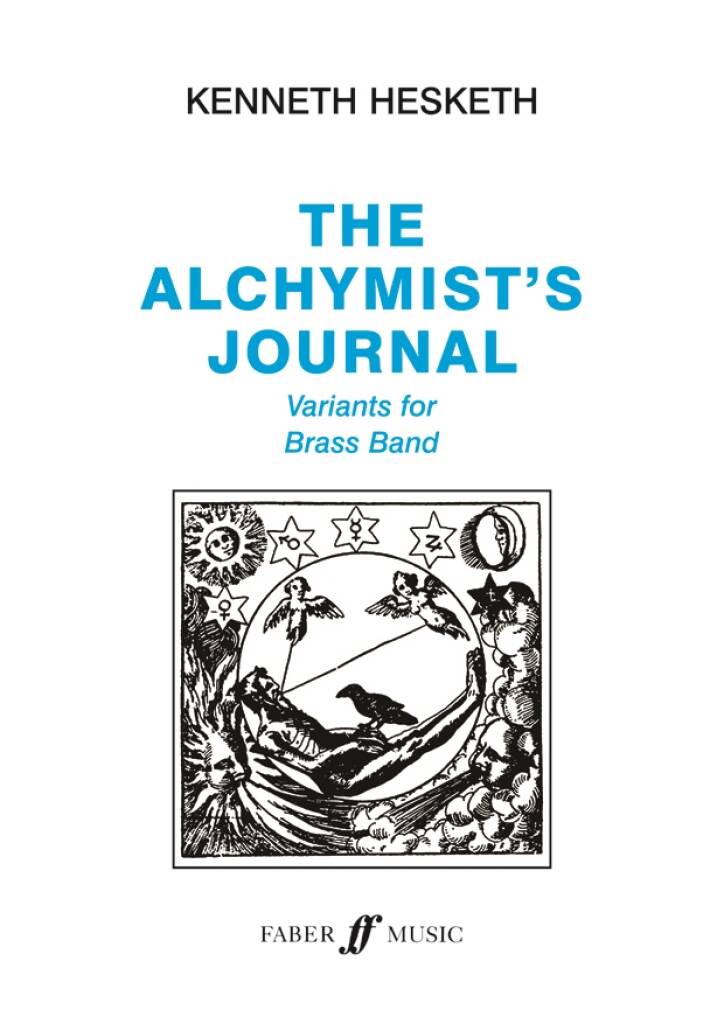
Alchymist's Journal. - Kenneth Hesketh
'The Alchymist's Journal' gets its title from the book of the same name by American author Evan S. Connell. The book fictionalises a number of famous Alchemist's writings, each one developing another's thoughts thuscontinuing one idea but changing it subtly to provide a new view point or way of thinking. This process is, in fact, alchemical as one idea transmutes into another. This idea is parallel to the processes at work within thesevariants. The whole work is constructed from 6 notes (C, A, B flat, E flat, F sharp, E) and is presented in nine different sections, each individual in mood but still based upon the original pitches. This is not a thematic setofvariations, as the themes are developed one at a time from small segments of the six notes. For example, the opening theme is the complete number of pitches, the second theme uses three notes transposed then repeated at theoriginal level, and so on. Harmonically, the six notes can be divided into two triads, A minor and E flat minor - each key beginning and ending the piece respectively. Whilst this is essentially abstract music with noprogramme there is an introduction, menacing scherzo, slow reflective section followed by a recap of the scherzo and final coda. 'The Alchymist's Journal' was commissioned by the Brass Band Heritage Trust at the suggestionof Paul Hindmarsh, to whom the work is dedicated.
Estimated dispatch 5-14 working days
-
 £154.99
Spiriti - Thomas Doss
A Bach chorale stands at the centre of this work (Fur deinen Thron tret ich hiermit).Anton Bruckner was one of Johann Sebastian Bach's great admirers. His work is full of the spirit of that musical genius. For Thomas Doss, it was Bruckner's spirit that always seemed to be with him while working on Spiriti. Bruckner's spirit is captured in this composition by a quote from the chorale of his Fifth Symphony at the end of the piece.The introduction, written in the style of a funeral march, already displays the first fragments of the chorale. Like splinters they are strewn throughout the first Allegro, combining and recombining in turbulent, powerful tuttipassages. As the music becomes more rambunctious, the Bach-like fragments begin to swirl around each other, only to be scattered once more.The middle-section is of a more pensive nature. The Religioso character gives the audience time to reflect. The music is meditative and the quarter-note (or crotchet) elements mimic a soul that is yearning and crying out.The third part of the piece finally leads, by way of minimalist elements and the fragments mentioned earlier, to a magnificent presentation of the Bach chorale. As the church bells ring out, one can almost hear the great masters presiding at the organ.
Estimated dispatch 5-14 working days
-
 £164.99
Diamond Concerto - Philip Sparke
Diamond Concerto was commissioned by Musikverein Morschied from Germany - Dr. Eric Grandjean, conductor - for a special concert featuring Steven Mead as guest soloist. Together they gave the world premiere on 28th April 2012 in the town theatre of Idar-Oberstein.The commission is a highlight in the 30-year friendship between composer and soloist, which has included many mutual CD projects and concerts and, now, a concerto. Sparke had Steven Mead's special euphonium sound in his head throughout the composition process and made free use of the variety of styles which the world-renowned virtuoso has made his own during his highly successful solo career.The village ofMorschied lies to the west of Frankfurt am Main in the area known as the German Road of Precious Stones, which is famous for its thriving gem industry. Because of this it was decided to give the commission a local connection by choosing the title, Diamond Concerto. Each of the three movements is named after a famous diamond:1 EARTH STARis rather stern in mood, opening with a free fantasy for the soloist over a static chord from the band. This leads to an Allegro Moderato in minor mode where small motives are gradually repeated and developed by both band and soloist.2 OCEAN DREAMuses a varied quote from the composer's Music for Battle Creek, including a melting slow melody that was originally written with Steven Mead in mind.3 BLUE HEARTwas written, at Steven Mead's suggestion, in bebop style and takes the form of a jazz waltz. The quasi-improvisatory central section features a call-and-response passage for the soloist and upper woodwinds.Soloist: Difficulty 6Diamond Concerto is available for euphonium and piano (AMP 374-401) as well as for euphonium and concert band (AMP 354-010).
Estimated dispatch 5-14 working days
 View Music