
Results
-
 £19.95
All the Nations (Brass Band - Score only) - Trigg, Roger
Originally written for the Melbourne Staff Band 125th Anniversary, the central theme of the music is from Psalm 86 verse 9. The?tune is derived from 'Lobe den herren' before a setting of the tune 'St Peter' in a more reflective manner is presented. An invitation?to worship as a group of God's people is presented in the contemporary song 'Come, now is the time to worship' before the original?material is presented and the tune 'St Peter' is heard in a full, exciting conclusion.
Estimated dispatch 7-14 working days
-
 £44.95
Princethorpe Variations (Brass Band - Score and Parts) - Downie, Kenneth
Colourful harmony, rhythmic flair and melodic invention are the hallmarks of this excellent set of variations by Kenneth Downie, based on the well known church tune, Princethorpe.This major work demonstrates the well-known characteristics of the composer: colourful harmony, rhythmic flair and melodic invention, all encapsulated in scoring which is engulfing both to players and listeners alike. Following a presentation of the theme there are five variations culminating in what can be described as either a finale or coda.Theme. The composer shows his originality in the harmonic sense of this introduction. Perhaps it could be suggested that over-indulgence of rubato may be a temptation to be avoided.Sections A to F. Relentless rhythmic drive is of paramount importance in this first variation. Conscientious observance of dynamics is of course an essential requirement in conveying the exciting quality of the music; there are moments of sudden contrast of which all will need to be aware. Moving between the time-signatures of 5/4 and 6/4 these sections are built from strong easily-identifiable fragments of the theme. These is a significant increase in temp at letter F which will further the exciting impact of the music.Sections G & H. In a pastorale style this short, gentle variation affords a contrast in style between the previous and succeeding ones. The gentle undulating character of the melodic lines is governed by the Allegretto grazioso directive.Sections I to M. Commencing two bars before letter I the music is now exuberant and the tempo and style is that of a march in compound time. In this exhilarating movement there are moments of contrast and indeed of delicacy which are a foil to the more energetic moments. Rhythmic control will be essential to maintain a consistent tempo. As elsewhere in the work, the percussion section will contribute much to the success of the performance there are bars where this section alone is heard and there are important entries for glockenspiel.Sections N & O. With emotional content this Adagio variation has the first two notes of the melody as its melodic impetus. Apart from just over two bars at O (where there is an interpolatory phrase from Cornets and Trombones), the melodic line is entrusted to the plaintive sounds of the horn section. Cornets and Trombones provide a change of tone colour at the beginning of section O. Under a poco rall, this very expressive variation is concluded; there is an important link supplied by Eb Bass.Sections P & Q. A lively march-tempo is launched immediately and these sections are in the nature of an introduction to the final variations. There is a quickening of pace at Q which assists the generation of excitement which should be an essential part of the performance. Solo Cornets introduce a melodic line at Q which anticipates the compound time of the following section.Sections R & S. The Solo Cornet theme of the previous section is now a contrapuntal line accompanying the theme tune. With an elongation of the notes in the melody, the conductor will need to call on the sustaining powers of the band and at no time should the interesting accompanying lines be allowed to detract from the sonorous presentation of the basic theme.Sections T, U & V. Following a poco rit, the finale begins at letter T with the directive, molto vivace. There is much detail to be rehearsed, not least being the dynamic contrasts which are encountered. As throughout the work, the listener should have no difficulty in identifying the thematic sources of the composer's music.
Estimated dispatch 7-14 working days
-
£22.50
Princethorpe Variations (Brass Band - Score only) - Downie, Kenneth
Colourful harmony, rhythmic flair and melodic invention are the hallmarks of this excellent set of variations by Kenneth Downie, based on the well known church tune, Princethorpe.This major work demonstrates the well-known characteristics of the composer: colourful harmony, rhythmic flair and melodic invention, all encapsulated in scoring which is engulfing both to players and listeners alike. Following a presentation of the theme there are five variations culminating in what can be described as either a finale or coda.Theme. The composer shows his originality in the harmonic sense of this introduction. Perhaps it could be suggested that over-indulgence of rubato may be a temptation to be avoided.Sections A to F. Relentless rhythmic drive is of paramount importance in this first variation. Conscientious observance of dynamics is of course an essential requirement in conveying the exciting quality of the music; there are moments of sudden contrast of which all will need to be aware. Moving between the time-signatures of 5/4 and 6/4 these sections are built from strong easily-identifiable fragments of the theme. These is a significant increase in temp at letter F which will further the exciting impact of the music.Sections G & H. In a pastorale style this short, gentle variation affords a contrast in style between the previous and succeeding ones. The gentle undulating character of the melodic lines is governed by the Allegretto grazioso directive.Sections I to M. Commencing two bars before letter I the music is now exuberant and the tempo and style is that of a march in compound time. In this exhilarating movement there are moments of contrast and indeed of delicacy which are a foil to the more energetic moments. Rhythmic control will be essential to maintain a consistent tempo. As elsewhere in the work, the percussion section will contribute much to the success of the performance there are bars where this section alone is heard and there are important entries for glockenspiel.Sections N & O. With emotional content this Adagio variation has the first two notes of the melody as its melodic impetus. Apart from just over two bars at O (where there is an interpolatory phrase from Cornets and Trombones), the melodic line is entrusted to the plaintive sounds of the horn section. Cornets and Trombones provide a change of tone colour at the beginning of section O. Under a poco rall, this very expressive variation is concluded; there is an important link supplied by Eb Bass.Sections P & Q. A lively march-tempo is launched immediately and these sections are in the nature of an introduction to the final variations. There is a quickening of pace at Q which assists the generation of excitement which should be an essential part of the performance. Solo Cornets introduce a melodic line at Q which anticipates the compound time of the following section.Sections R & S. The Solo Cornet theme of the previous section is now a contrapuntal line accompanying the theme tune. With an elongation of the notes in the melody, the conductor will need to call on the sustaining powers of the band and at no time should the interesting accompanying lines be allowed to detract from the sonorous presentation of the basic theme.Sections T, U & V. Following a poco rit, the finale begins at letter T with the directive, molto vivace. There is much detail to be rehearsed, not least being the dynamic contrasts which are encountered. As throughout the work, the listener should have no difficulty in identifying the thematic sources of the composer's music.
Estimated dispatch 7-14 working days
-
 £133.70
Spirit of Time (Brass Band - Score and Parts) - Schwarz, Otto M.
Zeitgeist; transformations; a departure for new shores... these are buzzwords we often encounter nowadays. Above all in this digital age, it is essential that we face changes positively and that we make the very best of them. Music is emotion! Otto M. Schwarz begins many of his lectures with this phrase, and this is exactly what we feel in this new concert work. Rapid, and full of energy, is the leap into a new chapter, wonderful opportunities are waiting to be discovered in uncharted lands. But change is not only loud and momentous. The creative power of the future lies dormant in the inventive spirit of the individual, quietly, thoughtfully, silently and alone! The final sequence of this work is all about good vibes: it lights the way to a positive future and stands for the dawn of a new era!Duration: 10.00
Estimated dispatch 7-14 working days
-
 £125.00
New London Pictures (Brass Band - Score and Parts) - Hess, Nigel - Littlemore, Phillip
New London Pictures represents elements of London in the 21st Century. The Millennium Bridge describes the pedestrian's journey across this wonderful new landmark bridge over the Thames, starting at the imposing Tate Modern, crossing the busy river, and onwards to St. Paul's Cathedral with its bells ringing out over the great city. London Eye is an incredibly large ferris wheel situated on the South Bank of the River Thames. This movement depicts a 'flight' on this riverside wheel, at the top of which the panoramic view of London is breath-taking and the expanse of the music is a suitable depiction of the view. As with all modern cities, London is over-crowded with motor vehicles. London is the first major city in Europe to adopt a Congestion Charge, and this piece (with its stop and go traffic lights) is both racy and comical. Here are Londoners attempting to go about their business in the face of overwhelming odds..... Suitable for Premier Youth/2nd Section Bands and above. Duration: 15.00
Estimated dispatch 7-14 working days
-
 £29.95
Dalaro (Brass Band - Score and Parts) - Gregson, Edward
The name of Edward Gregson is well known in Salvationist circles as well as in the wider music world, his music receiving performances and being recorded and published regularly. This music is individual and of high worth with an assured technique. It is always a pleasurable task for the musician to handle music with these qualities, whether one is editor, conductor or player.Written in connection with the International Salvation Army Students' Fellowship Conference held in Dalaro, Sweden in 1964, this is a 'festival' rather than processional march. Section C is a tune from the Swedish Tune Book (No. 303 in the 1945 edition), Jag gar till det land dar ovan (I go to that Land above). There is a slight divergence from the tune book version (labelled, by the way, as an English tune); this could well be the manner in which the tune is sung - we are all aware of the way in which congregations modify tunes.
Estimated dispatch 7-14 working days
-
 £89.95
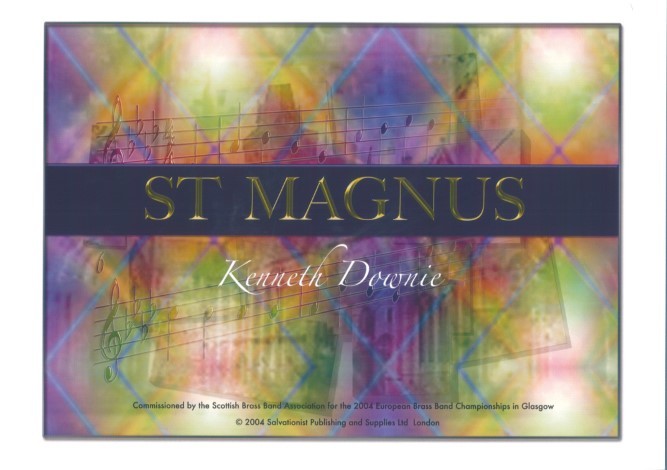
St Magnus (Brass Band - Score and Parts) - Downie, Kenneth
Commissioned by the Scottish Brass Band Association for the 2004 European Brass Band Championships in Glasgow. This music is a set of variations on the tune known as St Magnus, which is attributed to Jeremiah Clarke. Most people will associate it with Thomas Kelly's hymn which begins: "The Head that once was crowned with thorns is crowned with glory now". The tune is very simple, consisting of just two, four-bar phrases. Neither is there much in the way of rhythmic variety, every note being a crotchet with the exception of two quavers, and the last note in each phrase. Within such a simple structure, however, lies considerable strength.
Estimated dispatch 7-14 working days
-
£44.95
St Magnus (Brass Band - Score only) - Downie, Kenneth
Commissioned by the Scottish Brass Band Association for the 2004 European Brass Band Championships in Glasgow. This music is a set of variations on the tune known as St Magnus, which is attributed to Jeremiah Clarke. Most people will associate it with Thomas Kelly's hymn which begins: "The Head that once was crowned with thorns is crowned with glory now". The tune is very simple, consisting of just two, four-bar phrases. Neither is there much in the way of rhythmic variety, every note being a crotchet with the exception of two quavers, and the last note in each phrase. Within such a simple structure, however, lies considerable strength.
Estimated dispatch 7-14 working days
-
£44.95
Christ-Hymn (Brass Band - Score and Parts) - Redhead, Robert
Christ-Hymn is an expression of response to the ancient Christian hymn quoted by Paul in his letter to the Philippian church (Philippians 2:5-11). After an opening which creates a tone of sadness and quiet suffering, the following music is a joyous expression of the truth that 'He is exalted', 'His name is above all names' and 'Every tongue will confess that Jesus Christ is Lord'.
Estimated dispatch 7-14 working days
-
£22.50
Christ-Hymn (Brass Band - Score only) - Redhead, Robert
Christ-Hymn is an expression of response to the ancient Christian hymn quoted by Paul in his letter to the Philippian church (Philippians 2:5-11). After an opening which creates a tone of sadness and quiet suffering, the following music is a joyous expression of the truth that 'He is exalted', 'His name is above all names' and 'Every tongue will confess that Jesus Christ is Lord'.
Estimated dispatch 7-14 working days
 View Music