
Results
-
 £59.99
Hava Nagila - Philip Sparke
Hava Nagila (the title means 'let us rejoice') is perhaps the best known example of a style of Jewish music called 'klezmer'. Klezmer music originated in the 'shtetl' (villages) and the ghettos of Eastern Europe, where itinerant Jewish troubadours, known as 'klezmorim', had performed at celebrations, particularly weddings, since the early Middle Ages.'Klezmer' is a Yiddish term combining the Hebrew words 'kley' (instrument) and 'zemer' (song) and the roots of the style are found in secular melodies, popular dances, Jewish 'hazanut' (cantorial music) and also the 'nigunim', the wordless melodies intoned by the 'Hasidim' (orthodox Jews).Since the 16th century, lyrics hadbeen added to klezmer music, due to the 'badkhn' (the master of ceremony at weddings), to the 'Purimshpil' (the play of Esther at Purim) and to traditions of the Yiddish theatre, but the term gradually became synonymous with instrumental music, particularly featuring the violin and clarinet. The melody of Hava Nagila was adapted from a folk dance from the Romanian district of Bucovina. The commonly used text is taken from Psalm 118 of the Hebrew bible.
Estimated dispatch 5-14 working days
-
 £69.99
Have Mercy, Lord - Johann Sebastian Bach - Philip Sparke
Have Mercy, Lord from J.S. Bach's St Matthew Passion is one of the most beautiful arias from the baroque period. In Philip Sparke's arrangement, it is envisaged that the soloists stand together as a group stage right, while the other musicians stand behind to form the tutti group. This piece is easily playable for both the soloists and the band, and will create a beautiful moment of reflection whether performed on the concert stage or in a church.
Estimated dispatch 5-14 working days
-
£54.99
Vilja-Lied - Franz Lehár - John Blanken
Franz Lehar was born in Komarom, Hungary on 30th April 1870. From the age of fifteen he received composition and violin lessons at the Prague conservatory from Anton n Dvorak. In 1905 he composed The Merry Widow which became an instant worldwide success. The libretto of this operetta provides a succession of intimate arias and duets with festive ensembles. The Vilja-Lied is one of these arias. In this edition for brass band all the poignant beauty of the original remains.
Estimated dispatch 5-14 working days
-
 £60.99
Nun komm, der Heiden Heiland - Traditional - Jacob de Haan
The well-known chorale Nun komm, der Heiden Heiland (Let the Earth Now Praise the Lord) was written by Martin Luther in 1524 and derives from a translation of a hymn from the 4th century before Christ. The melody was composed by JohannWalter, however Johann Sebastian Bach used it as a basis for many cantatas. This arrangement by Jacob de Haan gives your band the chance to perform an attractive version of this beautiful chorale.
Estimated dispatch 5-14 working days
-
 £60.99
Allein Gott in der Hoh' sei Ehr - Jacob de Haan
Jacob de Haan begins his arrangement of the well-known hymn Allein Gott in der Hoh' sei Ehr (All Glory Be to God on High) with a quotation from his own Missa Katharina, a mass for choir, soprano, and band. To this melody he sets the Latin text from the last part of the Gloria. The chorale is then heard after an interlude and can, at the director's discretion, be accompanied by the choir singing in either German or English. A perfect work for church concerts.
Estimated dispatch 5-14 working days
-
£105.20
This is Halloween - Danny Elfman
This Is Halloween is a song by composer Danny Elfman from the 1993 film, "The Nightmare Before Christmas". In the movie it's performed by the residents of the fictional "Halloween Town", which is the films main setting, and introduces thetowns Halloween-centered lifestyle. Differently from the vast majority of Disney movies, in several countries The Nightmare Before Christmas was released only with subtitles, since the movie was originally considered to be "too dark and scary forkids", and was thus released as a film for adults.
Estimated dispatch 5-14 working days
-
 £129.99
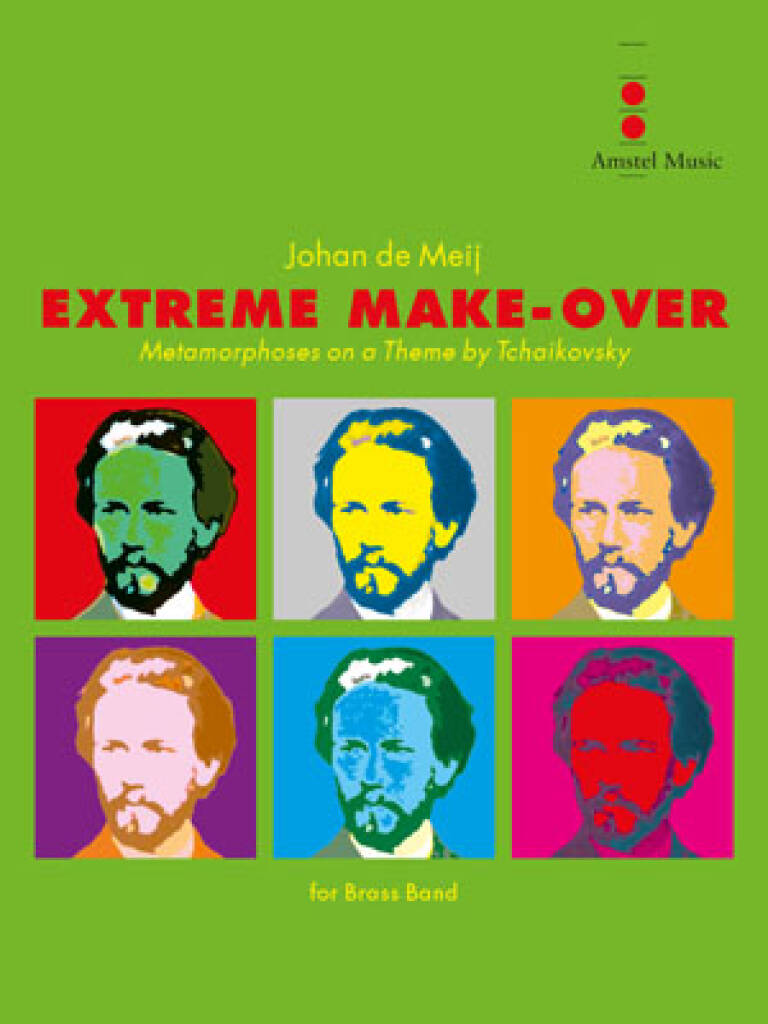
Extreme Make-Over - Johan de Meij
The work, set as the test-piece for the 2005 European Brass Band Championships was inspired by a theme from the second movement of Tchaikovsky's String Quartet No.1 (Andante Cantabile). It consists of a number of musical metamorphoses on the theme and includes several excerpts from Tchaikovsky's Fourth and Sixth Symphonies and Romeo and Juliet. The most unconventional element of the work is instrumentation for ten tuned bottles to be played by members of the Cornet section. This gives the piece an Indonesian Gamelan effect. Why not give your players something to get their teeth into with this impressive major new work.
Estimated dispatch 5-14 working days
-
 £105.20
Ompa til du dor - Janove Ottesen - Øystein Sjøvaag Heimdal
This song is taken from the first record album by Norwegian band Kaizers Orchestra. The song is one of the most well-known from this band. Kaizers Orchestra was famous in Norway for it's energic style, both on record and stage, a style that this arrangement tries to capture. The guitar and electric bass parts are optional.
Estimated dispatch 5-14 working days
-
 £104.99
Purcellian Fantasia - Jan de Haan
This composition is based on the march from Henry Purcell's Music for the funeral of Queen Mary II, a work written in 1694. In this fantasia, various movements flow from one to the next following the main theme; these movements not onlyelaborate on the theme, but also contrast with it. At times, the thematic material diverges so much, that the work acquires a character of its own; however, the composer often refers back to fragments of the theme. This work was test piece in the 4thdivision of the Dutch National Brass Band Championships (NBK) in 2017.
Estimated dispatch 5-14 working days
-
 £154.99
Where Angels Fly - Kevin Houben
Where Angels Fly was commissioned by VLAMO (Flemish Band Association). Kevin Houben wrote this work for the 2017 European Brass Band Championships in Ostend, Belgium. This is a very technical, powerful and virtuosic work with a rather fragile and soft introduction in which the main motif derived from the Belgian composer Paul Gilson's (1865-1942) La Priere from Le Retour au Pays is developed and also includes Houben's own musical signature 'HBE(N)'. Where Angels Fly is a challenging, impressive and virtuosic contest piece.
Estimated dispatch 5-14 working days
 View Music