
Results
-
£85.00
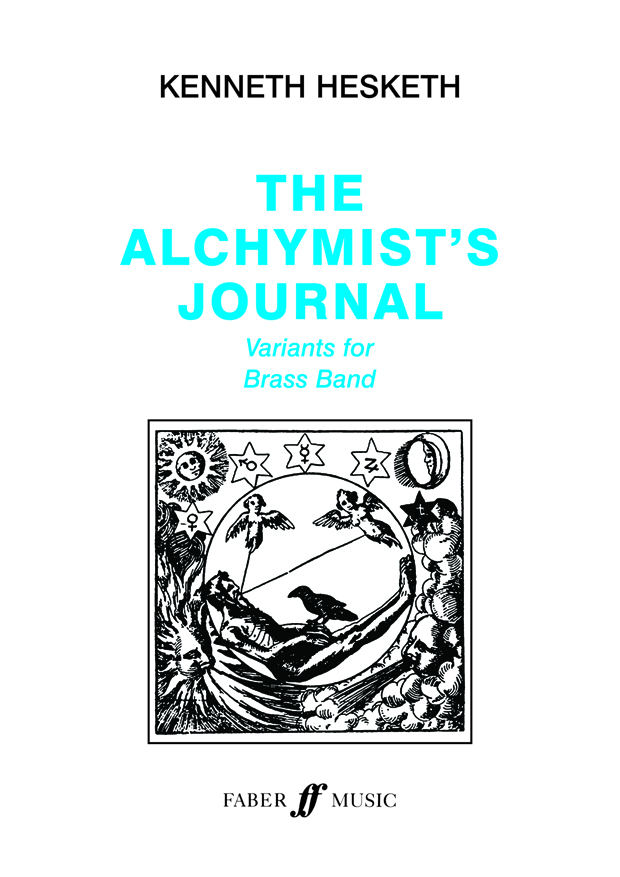
The Alchymist's Journal - Kenneth Hesketh
The Alchymist's Journal (Variants for Brass Band) was commissioned by Faber Music Band Consultant Paul Hindmarsh in 2001, with the support of the Brass Band Heritage Trust, as a substantial concert/contest challenge that would be within the compass of the country's most able youth and first section bands. It received its first performance in January 2002, by Black Dyke Band under Nicholas Childs, as part of the Royal Northern College of Music Festival of Brass.Since its original publication, composer Kenneth Hesketh has made a number of revisions to the work. Most of these were included in the recording made by Foden's Band (Bramwell Tovey) for NMC Recordings (NMC D142). This definitive new edition, including all the composer's revisions, has been specially prepared for the 2015 National Brass Band Championships of Great Britain and is the text that all bands performing will be required to use.Brass Band Grade 5: 1st SectionDuration: 12 minutes.
In Stock: Estimated dispatch 1-3 working days
-
 £29.95
Cafe 1719 - Jonathan Bates
DURATION: 2'30". DIFFICULTY: 1st Section+. 'Caf 1719' was composed for the Wantage Silver Band as part of their entertainment contest sets based on the music of Johann Sebastian Bach in 2019. This particular short, jazz-inspired work is composed in tribute to the great French Pianist Jacques Loussier (1934-2019) who received global acclaim for his jazz interpretations of Bach's music, along with many other classical composers. Despite being born in the same year and living in the same country, Bach and Handel never actually met, but what if they had? Cafe 1917 acts as a musical meeting point - in a fictional Jazz Cafe by the Rhine, with the tenor horn section performing a 'Loussier-esque' version of Bach's 'Prelude No.2 in C Minor' whilst on the other side of the cafe, the trombone section follow suit with their take on Handel's 'Bourree from Music for the Royal Fireworks'. Eventually the two meet, share ideas and incorporate them into each other's melodies. Amongst the 2 main featured works by Bach and Handel, the tutti interludes are constructed on music from Bach's 'Toccata and Fugue in D Minor'. .
In Stock: Estimated dispatch 1-3 working days
-
 £30.00
Amazing Grace (W. Walker arr. by Paul Pennicotte-Henrie) - Brass Band Sheet Music Full Score and Parts - LM642
COMPOSER: W. WalkerARRANGER: Paul Pennicotte-Henrie"Amazing Grace" is a Christian hymn published in 1779 by English Anglican clergyman, abolitionist, and poet John Newton. It is possibly the most sung and most recorded hymn in the world and is especially popular in the United States, where it is used for both religious and secular purposes. Newton wrote the words from personal experience; he grew up without any particular religious conviction, but his life's path was formed by a variety of twists and coincidences that were often put into motion by others' reactions to what they took as his recalcitrant insubordination. He was pressed into service with the Royal Navy, and after leaving the service, he became involved in the Atlantic slave trade.In 1748, a violent storm battered his vessel off the coast of County Donegal, Ireland, so severely that he called out to God for mercy. While this moment marked his spiritual conversion, he continued slave trading until 1754 or 1755, when he ended his seafaring altogether. Newton began studying Christian theology and later became an abolitionist.Ordained in the Church of England in 1764, Newton became the curate of Olney, Buckinghamshire, where he began to write hymns with poet William Cowper. "Amazing Grace" was written to illustrate a sermon on New Year's Day of 1773. It is unknown if there was any music accompanying the verses; it may have been chanted by the congregation. It debuted in print in 1779 in Newton's and Cowper's Olney Hymns, but settled into relative obscurity in England. In the United States, "Amazing Grace" became a popular song used by Baptist and Methodist preachers as part of their evangelizing, especially in the American South, during the Second Great Awakening of the early 19th century. It has been associated with more than 20 melodies. In 1835, American composer William Walker set it to the tune known as "New Britain" in a shape note format; this is the version most frequently sung today.
In Stock: Estimated dispatch 3-5 working days
-
 £34.95
Gallant Sister, The - Jonathan Bates
DURATION: 5 minutes. DIFFICULTY: 4th+. The Gallant Sister was commissioned by the Spennymoor Town Band, and the title is a reference to the local wartime community hero Kate Maxey, who was awarded the Royal Red Cross award for gallantry and distinguished service in the field after being seriously injured in March 1918 whilst working as a Sister in France.
In Stock: Estimated dispatch 1-3 working days
-
 £29.88
March - His Royal Banner (Brass Band) Jonathan Mead
This upbeat, foot-tapping march by Welsh composer Jonathan Mead features the two well known Welsh tunes of Aberystwyth and God Bless The Prince of Wales. Aberystwyth is set as a big bold bass solo and careful attention will need to be paid to make sure that it sounds clean and together. God Bless The Prince of Wales first appears as a traditional hymn tune, before returning in a more vibrant, lively style, with florid scalic passages for the solo cornets and euphoniums. The march was written with St David's Day in mind, although will be an appropriate addition to concert programme throughout the year as either an opener or finisher. Difficulty Level: 3rd Section + Sheet music available from: UK - www.brassband.co.uk USA - www.solidbrassmusic.com Instrumentation: Soprano Cornet Eb Solo Cornet Bb Repiano Cornet Bb 2nd Cornet Bb 3rd Cornet Bb Flugel Horn Bb Solo Horn Eb 1st Horn Eb 2nd Horn Eb 1st Baritone Bb 2nd Baritone Bb 1st Trombone Bb 2nd Trombone Bb Bass Trombone Euphonium Bb Bass Eb Bass Bb Percussion Clash Cymbals Glockenspiel
In Stock: Estimated dispatch 1-3 working days
-
£29.95
The Land of the Long White Cloud (Score Only)
Dating from 1979, The Land of the Long White Cloud (Aotearoa) was Philip Sparke's first test-piece. It was commissioned by the New Zealand Brass Band Association for their 1980 National Championships (their centenary year) and set for the European Brass Band Championships, the same year, at the Royal Albert Hall in London. Aotearoa was the name given to New Zealand by its Polynesian settlers whose first sight of the islands was a long, flat cloud lying low over the land. The work has no specific programme although many have seen pictures of the surging ocean in the opening bars. A faster dance-like section leads to a slow, haunting solo for soprano cornet; this is taken up by the whole band before earlier material returns. The dance-like tune is, this time, given a fugal treatment and the opening bars return to close the work.Philip Sparke was born in London and studied composition, trumpet and piano at the Royal College of Music, where he gained an ARCM. It was at the College that his interest in bands arose. He played in the College wind orchestra and also formed a brass band among the students, writing several works for both ensembles.At that time, his first published works appeared - Concert Prelude (brass band) and Gaudium (wind band). A growing interest in his music led to several commissions, his first major one being this featured piece for the Centennial Brass Band Championships in New Zealand - The Land of the Long White Cloud. He has written for brass band championships in New Zealand, Switzerland, Holland, Australia and the UK, including three times for the National Finals at the Royal Albert Hall.In September 2000, he was awarded the Iles Medal of the Worshipful Company of Musicians for his services to brass bands and in 2005 Music of the Spheres won the National Band Association/William D. Revelli Memorial Band Composition Contest. In 2011, he received the BUMA International Brass Award for his contribution to brass music.His conducting and adjudicating activities have taken him to most European countries, Scandinavia, Australia, New Zealand, Japan, Taiwan, South Korea, Canada and the USA. In May 2000, he took the major step of becoming a full-time composer by founding his own publishing company, Anglo Music Press. The company is devoted to publishing his brass band, concert band, fanfare band and instrumental publications as well as recordings dedicated to his latest works.
Estimated dispatch 7-14 working days
-
 £22.50
Edward Gregson: Concertante for Piano and Brass Band
DescriptionProgramme NoteThe Concertante for Piano and Brass Band was written in 1966, when the composer was an undergraduate student at the Royal Academy of Music in London. It received its first public concert performance in 1967 at the Royal Festival Hall, London, when the composer was the soloist with the International Band of the Salvation Army, conducted by Bernard Adams. It was one of the first major works to be written for this particular combination.The Concertante is unashamedly romantic in idiom and is in three movements: Prelude, Nocturne and Rondo. The Prelude is cast in sonata form and opens with a short cadenza-like flourish from the soloist, followed by two main ideas - the first sweepingly dramatic, the second highly lyrical. The interplay between these two themes forms the main focus of the movement, and after a return to the opening theme, an exuberant codetta brings the music to a close, albeit a quiet one. https://morthanveld.com/wp-content/uploads/2017/09/Gregson-Concertante-1st-movt-clip.mp3The tender Nocturne opens with an introduction from the band that contains precursors of the two main ideas to follow. The solo piano announces the main theme, which has a slightly 'bluesy' character with its flattened third and seventh notes of the scale, and is a love song dedicated to the composer's wife-to-be. The band enters with phrases of a chorale already hinted at in the introduction - Ray Steadman-Allen's hymn tune 'Esher' - but never quite presented in its complete state. Both ideas are developed alongside each other, with eventually the first theme returning, this time with piano and band together, and building to a majestic climax, before subsiding to a peaceful coda - a return to the very opening of the movement. https://morthanveld.com/wp-content/uploads/2017/09/Gregson-Concertante-movt-2-clip.mp3The final Rondo is full of energetic rhythms and changing time patterns. The main theme is playful in character, with much interplay between soloist and band, whilst the middle section presents a new theme, and one that has more than a hint of the hymn tune 'Onward Christian Soldiers', in what amounts to a good humoured parody. The opening Rondo theme returns, this time leading to a powerful and dissonant climax from the band. This is followed by an extended piano cadenza, underlying the virtuoso aspect of the work, and leading to an energetic and life-affirming coda, which brings the work to a triumphant conclusion. https://morthanveld.com/wp-content/uploads/2017/09/Gregson-Concertante-movt-3-clip.mp3Duration: 18 minutesInstrumentation:Please note that there is no 1st/Repiano Cornet part in this work. The 1st/Repiano Cornet player should join the Solo Cornet bench. As such an extra Solo Cornet part is provided in the set of parts.Version for two pianosA version of the Concertante for two pianos is available for rehearsal purposes. Piano 1 is the solo part and Piano 2 the band reduction. However, for those pianists not needing to rehearse the work in this way, a solo piano part is also provided with the main set of band parts.To view a preview of the solo part for the first movement click here.The youthful Gregson (his work was written as a third year undergraduate) was seemingly a bit of a musical magpie - but one heck of a skilful one at that.These were shiny baubles of poise, panache and pastiche, with affectionate, remarkably mature nods of appreciation towards Gershwin, Rachmaninov, Ireland and even Elmer as well as Leonard Bernstein.The rich colour palette and flowing lines (with the tenderest of central Nocturnes) were a joy - as were the little buds of motifs that dotted the score like seeds ready to be planted on a future fertile brass band compositional field. - Iwan Fox, 4Barsrest.com, June 2019For more information on Edward Gregson's music please visit the composer's website: www.edwardgregson.com
Estimated dispatch 7-14 working days
-
 £29.95
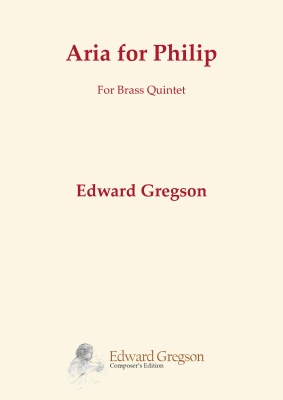
Aria for Philip (Brass Quintet - Score and Parts)
Instrumentation:2 Trumpets in CHorn in FTromboneTubaWritten in memory of Philip Jones, this short work was first performed at his memorial concert held at the Royal Northern College of Music in 2000. Scored for Brass Quintet, it was performed by former members of the Philip Jones Brass Ensemble.My friendship with Philip Jones stretched back to my student days, when my Quintet for Brass was performed during my final year at the Royal Academy of Music. Philip was present at that premiere in 1967, and soon after that his ensemble performed and broadcast the Quintet on a UK Tour, including a performance in the finals of the BBC Young Composer's Competition. I owe him a huge debt of gratitude for promoting a work by a then unknown young composer.I use a brief quote from the opening of my 1967 Brass Quintet in this work, which is generally rather sombre in character, except for the sudden change of mood and tempo in the short final section, when the clouds suddenly lift and the sun shines through.- Edward GregsonDuration: 5.00
Estimated dispatch 7-14 working days
-
 £54.95
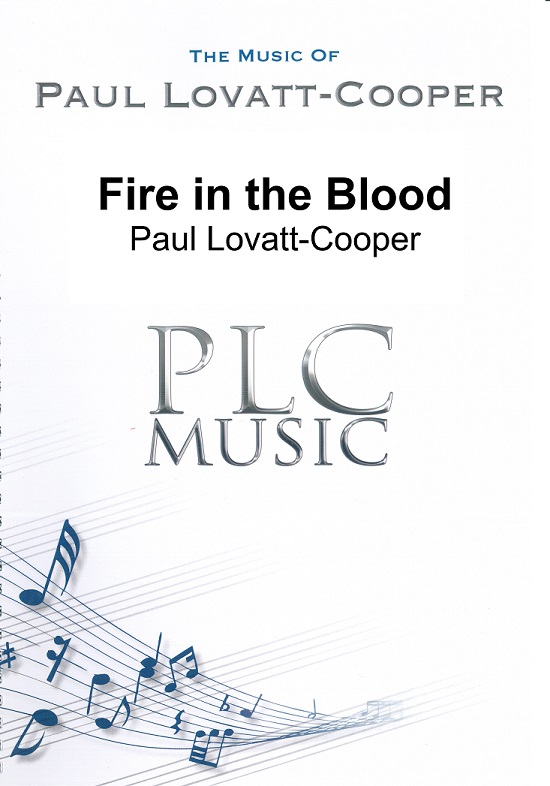
Fire in the Blood (Brass Band - Score and Parts)
Fire in the Blood was commissioned by Dr Stephen Cobb for the 120th anniversary of the International Staff Band of the Salvation Army. The piece was composed for the celebration concert where the ISB were joined by several other staff bands from around the world to perform independently to a sell-out capacity crowd at Britain's most famous concert hall The Royal Albert Hall. Fire in the Blood received its world premier at the 'ISB 120' concert at the Royal Albert Hall on June 4th 2011.With this piece I wanted to acknowledge music that had an impact on me through my Salvation Army upbringing. When thinking of a title for this piece I had no hesitation than to reflect and re-word the Salvation Army's motto under their famous crest 'Blood and Fire'.When composing Fire in the Blood I wanted to use three songs of worship that have been prevalent in the Salvation Army's services over a number of years. Opening with Richard Phillips' setting of Psalm 95, 'Sing for Joy', the music is vibrant and full of energy, I wanted to capture the spirit of the well known words of Scripture. The music then moves into a more reflective section that includes Howard Davies' emotive song melody 'Lord, you know that we love you' and Laurie Klein's worship song 'I love you Lord'.A re-statement of the opening Psalm setting follows and this, in turn, leads into a dramatic and powerful finale that combines two pivotal statements drawn from the slower, reflective section: I love you lord, and I lift my voice to worship you, O my soul rejoice and Lord, you know that we love you with a final flourish from Psalm 95: Come let us sing joy to the Lord!Paul Lovatt-Cooper
Estimated dispatch 7-14 working days
-
 £24.95
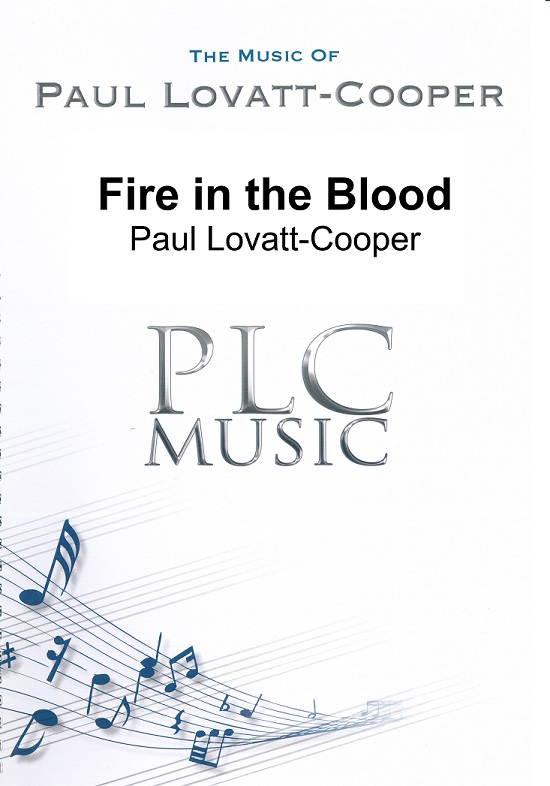
Fire in the Blood (Brass Band - Score only)
Fire in the Blood was commissioned by Dr Stephen Cobb for the 120th anniversary of the International Staff Band of the Salvation Army. The piece was composed for the celebration concert where the ISB were joined by several other staff bands from around the world to perform independently to a sell-out capacity crowd at Britain's most famous concert hall The Royal Albert Hall. Fire in the Blood received its world premier at the 'ISB 120' concert at the Royal Albert Hall on June 4th 2011.With this piece I wanted to acknowledge music that had an impact on me through my Salvation Army upbringing. When thinking of a title for this piece I had no hesitation than to reflect and re-word the Salvation Army's motto under their famous crest 'Blood and Fire'.When composing Fire in the Blood I wanted to use three songs of worship that have been prevalent in the Salvation Army's services over a number of years. Opening with Richard Phillips' setting of Psalm 95, 'Sing for Joy', the music is vibrant and full of energy, I wanted to capture the spirit of the well known words of Scripture. The music then moves into a more reflective section that includes Howard Davies' emotive song melody 'Lord, you know that we love you' and Laurie Klein's worship song 'I love you Lord'.A re-statement of the opening Psalm setting follows and this, in turn, leads into a dramatic and powerful finale that combines two pivotal statements drawn from the slower, reflective section: I love you lord, and I lift my voice to worship you, O my soul rejoice and Lord, you know that we love you with a final flourish from Psalm 95: Come let us sing joy to the Lord!Paul Lovatt-Cooper
Estimated dispatch 7-14 working days

 Watch video
 View Music