
Results
-
£54.99
Inter-Pop - Kees Vlak
Five movements in techno-pop style. The work begins with Rock March with a few pithy chords over a driving percussion accompaniment. Feeling Free is a slow ballad. Rockarab is devoted to 'the ship of the desert', the camel. Little Chi Yan is a very charming, romantic song for a sweet little girl. In Disco Lights, we hear the stirring sounds of drums and bass guitar while the lights flash in the crowded discotheque.
Estimated dispatch 5-14 working days
-
£60.99
Eventide (Song of Liberation) - Jacob de Haan
A composition with the liberation from the Second World War as its theme. After a solemn introduction one hears the melody of the hymn Abide with you, which was sung a lot during the war. Following there are variations on the theme, finally leading to the magisterial conclusion that represents the ultimate liberation.The work may be interpreted as popular music (with the part for drumset), but a more serious version without drums is possible and, indeed, preferable.
Estimated dispatch 5-14 working days
-
 £33.62
March - Helping Hands (Rob Bushnell) Brass Band
Helping Hands was written for the British Bandsman March Composition Contest, entered into category 2 (marches for 3rd/4th section bands). The piece is loosely programmatic in nature: The introductio is fanfare-like, announcing the date of the next Whit Friday Contests and the bands' anticipation of and preparation for the event. The first section is the march of the volunteers, as they descend upon the many venues, ready to run the contests. The second section (bars 35 to 52) sees the contests start. The bands strike up, march, finish and go from place to place, whilst the volunteers manage them, the audiences, and all manner of issues and problems thrown at them. The third section (bars 53 to 69) represents the bad weather which has, at times, presented itself on that particular Friday. But everyone carries on (possibly the sun comes out) and we enjoy the day. The trio uses the hymn St. Vincent by Sigismund Neukomm: St. Vincent de Paul is the patron saint of charities and volunteering, hence its use here. The piece is influenced by marches that are commonly heard during the Whit Friday March Contests, using motifs, rhythms and harmonic progressions (sparingly) throughout the piece. March-card sized parts included, with alternatives for horns in F and lower brass in bass clef. To view a rolling score video of the piece please visit www.youtube.com/watch?v=diqDoe0XpcA PDF download includes score and parts. Sheet music available from: UK - www.brassband.co.uk USA - https://satradecentral.org Difficulty Level: 3rd Section + Length: 3.50 minutes Instrumentation: Soprano Cornet Eb Solo Cornet Bb Repiano Cornet Bb 2nd Cornet Bb 3rd Cornet Bb Flugel Horn Bb Solo Horn Eb 1st Horn Eb 2nd Horn Eb 1st Baritone Bb 2nd Baritone Bb 1st Trombone Bb 2nd Trombone Bb Bass Trombone Euphonium Bb Bass Eb Bass Bb Drums
In Stock: Estimated dispatch 1-3 working days
-
 £25.95
Heed the Word - Lucy Pankhurst
Lucy Pankhurst created this impressive work in support of a charitable project, known in 2005 as Brass Band Aid. The organisation called for original compositions to be included in a follow-up CD release - Into Africa to help raise funds for projects in Adet, Africa, and to build awareness of the Make Poverty History campaign.Lucy's creativity and imagination are very prevalent in this work - a complete mix of powerful energy and poignant emotions flow from the score. A strong use of pulsating drums are balanced with sheer tranquility and rich chords. It exudes hope and positivity and perhaps, through its title, offers a gentle warning to listen carefully to the concerns that are aired around us - not least in recognition of the challenges facing the very communities the CD was aiming to help.The work was recorded by the Prairie Brass Band, US and featured on the Brass Band Aid CD - Into Africa.
In Stock: Estimated dispatch 3-5 working days
-
 £30.00
Manhattan Spiritual - Tim Paton
I have arranged this incredibly memorable Big Band piece by Billy Maxted as a feature for the Timps and Kit, inspired by the man who made it famous, that spectacular drummer and showman - ERIC DELANEY -who, at the age of 83, is still performing in the UK and further afield. A book by Eddie Sammons about his astonishing career, including contributions from many famous artists and lots of amusing anecdotes, should be available in 27. The City of Lincoln Band inform me that this was one of their most popular items on their visit to Germany.The Timpani and Drum Kit parts will need good players. To get the best effect, a set of three timps is required, although an optional part for two timps is included. The timps and drums are coordinated, so the parts need to be played as written. For those bands with more than two percussionists, there is a third part, which, although optional, would certainly add to the overall effect. Although the Timp & Drum parts are technically demanding, the remainder of the parts are within the capability of most players."I'm sure this item will be a huge success with popular light music audiences everywhere". Robert Childs
In Stock: Estimated dispatch 3-5 working days
-
 £33.62
La Chica sin nombre (Trombone Solo with Brass Band) Rob Wiffin
A vibrant, rhythmic solo for trombone and band. La Chica sin Nombre was written in March 2020 at the request of Brett Baker, who wanted something in Latin style, resulting in a Mambo-type dance piece. For the right percussion sound, Conga drums and Mambo Bell/Timbales are recommended rather than a drum kit, and the piece should be played with an appropriate feel for Latin music. It should sound light and easy to play but has a few tricky moments - especially the cadenza-like sections from F to H. The virtuosic section at letter G can be cut if required. Audio demo: https://soundcloud.com/user-565396545/la-chica-sin-nombre-trombone Duration: Approx. 4.20 minutes Difficulty Level (Band): Medium Soloist: Advanced This PDF download includes the full score and parts. Sheet music available at www.brassband.co.uk (UK) or https://satradecentral.org (USA)
In Stock: Estimated dispatch 1-3 working days
-
 £34.95
Island Whirl - Paul Lovatt-Cooper
Commissioned by Margaret Milligan for Ian, her husband who is the musical director of Callendar Brass, based in Callendar near Stirling in Scotland. With Celtic drums and the use of the Scottish traditional song 'An Eriskay Love Lilt' the piece works very well as a lively concert/2nd half opener or even as a piece to liven up the middle of a concert programme. Circa 3'30".
Estimated dispatch 10-14 days
-
 £28.95
La Chica sin Nombre (Trombone Solo with Brass Band - Score and Parts) - Wiffin, Rob
A vibrant, rhythmic solo for trombone and bandLa Chica sin Nombre was written in March 2020 at the request of Brett Baker. He wanted something in Latin style so I chose to go for a Mambo-type dance piece. In obtaining the right percussion sound I would always ask for Conga drums and Mambo Bell/Timbales rather than drum kit. The piece needs to be played with an appropriate feel for Latin music. It should sound light and easy to play but has a few tricky moments- especially the cadenza-like sections from F to H. The virtuosic section at letter G can be cut if required.- Rob WiffinDuration: 4.15
Estimated dispatch 7-14 working days
-
 £35.00
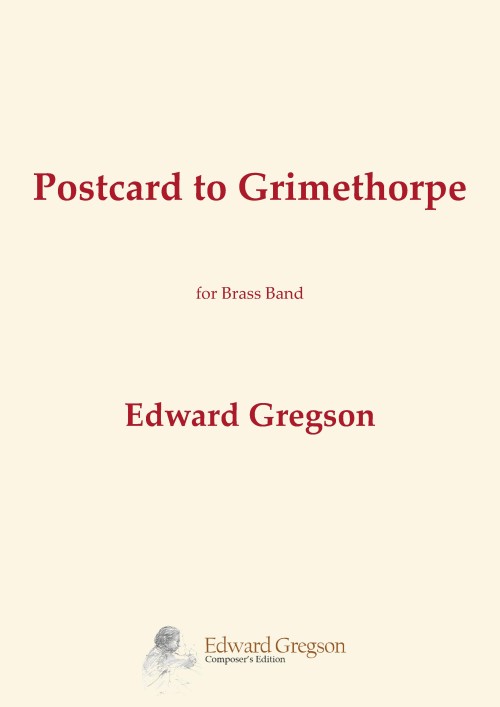
Postcard to Grimethorpe (Brass Band - Score and Parts) - Gregson, Edward
I composed the original version of Postcard to Grimethorpe in 1993 at the request of Elgar Howarth, for a concert at the Queen Elizabeth Hall, London, given by the Grimethorpe Colliery Band. This was at a time when after the Grimethorpe Colliery pit closed the future of the band was in severe jeopardy. The concert was given in aid of the band, both through publicity and funding.Then in late 2022 Jack Stamp, the American composer, conductor and educator, and at that time international composer-in-association with Grimethorpe, contacted me to say that he had discovered my short piece in the band library, and asked if I might extend it for a recording he was sponsoring for the band - the repertoire to consist entirely of music specially composed for Grimethorpe.I agreed and decided to extend the piece by using the miner's hymn Gresford, as a symbolic gesture of protest at the many thousands of miners in the UK who were made redundant from their jobs. After an angular (quasi-atonal) first section, the hymn enters, softly at first, but with each phrase it becomes more powerful and insistent, ending with the final phrase triumphantly accompanied by melodic percussion (replacing the drums and cymbals of the earlier phrases, as if the band were then on the march). However, this short work ends softly and gently, as if anger has been replaced by quiet resolution and determination, looking to the future with confidence.- Edward GregsonDuration: 3.00
Estimated dispatch 7-14 working days
-
£12.00
Postcard to Grimethorpe (Brass Band - Score only) - Gregson, Edward
I composed the original version of Postcard to Grimethorpe in 1993 at the request of Elgar Howarth, for a concert at the Queen Elizabeth Hall, London, given by the Grimethorpe Colliery Band. This was at a time when after the Grimethorpe Colliery pit closed the future of the band was in severe jeopardy. The concert was given in aid of the band, both through publicity and funding.Then in late 2022 Jack Stamp, the American composer, conductor and educator, and at that time international composer-in-association with Grimethorpe, contacted me to say that he had discovered my short piece in the band library, and asked if I might extend it for a recording he was sponsoring for the band - the repertoire to consist entirely of music specially composed for Grimethorpe.I agreed and decided to extend the piece by using the miner's hymn Gresford, as a symbolic gesture of protest at the many thousands of miners in the UK who were made redundant from their jobs. After an angular (quasi-atonal) first section, the hymn enters, softly at first, but with each phrase it becomes more powerful and insistent, ending with the final phrase triumphantly accompanied by melodic percussion (replacing the drums and cymbals of the earlier phrases, as if the band were then on the march). However, this short work ends softly and gently, as if anger has been replaced by quiet resolution and determination, looking to the future with confidence.- Edward GregsonDuration: 3.00
Estimated dispatch 7-14 working days
 View Music