
Results
-
 £62.00
Set To (Brass Band - Score and Parts) - Turnage, Mark-Anthony - Houlding, Christopher
Set To is dedicated to London Brass and arranged for brass band by Christopher Houlding. It was commissioned by the Aldeburgh Foundation and received its first performance on August 24th 1993 at the Maltings, Snape. Originally divided into two movements, a pensive and richly harmonic Blues and an aptly named Bacchanale, sometimes slow but mostly fast and furious. "I remember playing the original brass ensemble version of "Set To" numerous times in the early nineties with London Brass and always wondered if the composer would consider writing something for Brass Band. As Director of The Guildhall Brass Band, a possible performance opportunity arose in 2010 and I successfully approached Mark and gained his permission to scale it up for brass band with added percussion parts. I conducted the premier of this new Brass Band version at the Guildhall School of Music & Drama in February 2011 with the composer present and he liked it. Although very contemporary compared to most brass music, I feel that Mark's easily accessible style makes this rhythmically quirky and harmonically 'bluesy' work a really interesting concert piece, suitable for any occasion" - Chris Houlding. Duration: 7.30. Suitable for Championship Section Bands
Estimated dispatch 7-14 working days
-
 £49.99
Occasional Overture (Brass Band - Score and Parts) - Britten, Benjamin - Hindmarsh, Paul
Benjamin Britten composed his Occasional Overture Op.38, for the opening of the BBC Third Programme on 29th September 1946, when it was performed by the BBC Symphony Orchestra under Sir Adrian Boult. It was not heard again until 1982, when the composer's Executors decided that it should be revived. Given the dominance of brass and woodwind in this concise but exciting work, versions for brass band and wind band have been prepared for Britten's centenary year. Suitable for Championship Section Bands. Duration: 8.00
Estimated dispatch 7-14 working days
-
 £110.00
To Every Thing There is a Season (Cornet Solo with Brass Band - Score and Parts) - Rutter, John - Noble, Paul
Upon first hearing this beautiful composition by John Rutter, it seemed obvious that it would not only be a great piece for combined Band and Chorus, but also would be a perfect solo for trumpet. Therefore, in addition to the arrangement for either combined band and chorus, or trumpet solo and band, this arrangement for Brass Band is now available as well. The beauty and simplicity of the piece should certainly allow it to become a mainstay in the repertoire of trumpet solos at any level.
Estimated dispatch 7-14 working days
-
 £95.00
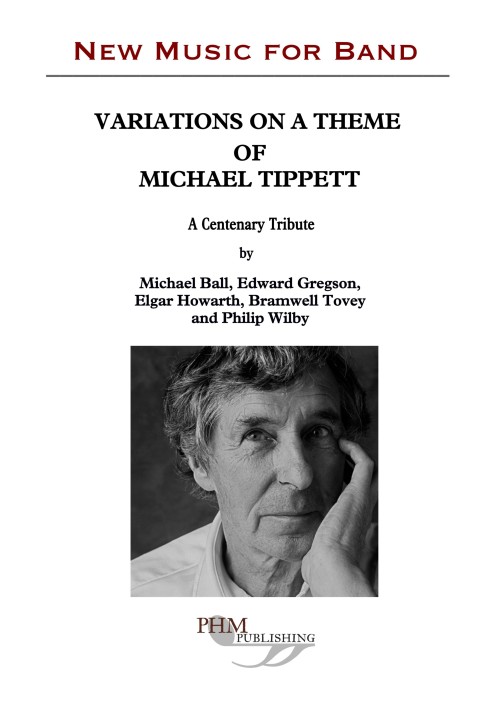
Variations on a Theme of Michael Tippett (Brass Band - Score and Parts) - Hindmarsh, Paul
A Centenary Tribute by Michael Ball, Edward Gregson, Elgar Howarth, Bramwell Tovey and Philip WilbyThis unique 'pice d'occasion' arose out of a telephone conversation in 2004 with Alan Wycherley, who was the soprano cornet player of the Foden's Richardson Band at the time. He indicated that the band would like to include an original birthday tribute for Edward Gregson (60) and Elgar Howarth (70) in its concert at the 2005 RNCM Festival of Brass in Manchester. I have been Artistic Director of Manchester's Festival of Brass since it was established in 1990 as a BBC Radio 3 series, As the centenary of the birth of Sir Michael Tippett fell on 5 January 2005, I devised this collective work as a way of embracing all three anniversaries in a novel way.The idea of joint compositions is not a new one in the classical music world. In the 1860s, Verdi was joined by a number of his contemporaries in a Requiem Mass for Rossini. In this country there have been a number of orchestral examples over the past fifty years, but never before for the brass band. Although Tippett composed only one work for brass band, Festal Brass with Blues, his orchestral works and operas are full of idiomatic brass writing. The theme I chose for this celebration is one of Tippet's most memorable miniatures featuring wind and brass. In the opera Midsummer Marriage it marks the entry of the Ancients. It is also included in the orchestral Suite in D (1948), for the Birthday of Prince Charles.I invited five of the leading contemporary voices in brass band music to add their own creative perspectives to the little Tippett theme, with it's characteristic rhythms, embellishments and modality - the Lydian mode. Each contribution was designed to fit into a tonal and formal template to give the whole work a flow and continuity. In Danse des Amis, Bramwell Tovey has composed a jazzy, humorous variation. Inspiration came from Tippett's love of jazz and, more personally, from the characteristically syncopated gait of the distinguished music critic John Amis, who Tovey once observed leaving a performance of Tippett's opera King Priam before the end. Incidentally, that performance was conducted by Elgar Howarth.We hear Edward Gregson in lyrical mode. His Midsummer Song is redolent of the sound world of Tippett's opera A Midsummer Marriage and it ends with a brief reference to a favourite of Gregson's, Tippett's Concerto for Orchestra. Michael Ball provides a brief moment of light, airy activity bringing to mind perhaps Tippett's love of Shakespearian fantasy, especially The Tempest. Elgar Howarth juxtaposes a slowed down version of the processional theme with distant recollections of fanfares from King Priam. Philip Wilby has rounded the tribute off with a spectacular fugue. During its inexorable progress Wilby ingeniously introduces the two other birthday references - the three-note musical signature that Elgar Howarth includes in much of his music and the characteristic theme which begins Edward Gregson's substantial work for brass an organ The Trumpets of the Angels. An elaborated reprise of Tippett's little theme is followed by a dynamic coda.- Paul HindmarshDuration: 13.00
Estimated dispatch 7-14 working days
-
£40.00
Variations on a Theme of Michael Tippett (Brass Band - Score only) - Hindmarsh, Paul
A Centenary Tribute by Michael Ball, Edward Gregson, Elgar Howarth, Bramwell Tovey and Philip WilbyThis unique 'pice d'occasion' arose out of a telephone conversation in 2004 with Alan Wycherley, who was the soprano cornet player of the Foden's Richardson Band at the time. He indicated that the band would like to include an original birthday tribute for Edward Gregson (60) and Elgar Howarth (70) in its concert at the 2005 RNCM Festival of Brass in Manchester. I have been Artistic Director of Manchester's Festival of Brass since it was established in 1990 as a BBC Radio 3 series, As the centenary of the birth of Sir Michael Tippett fell on 5 January 2005, I devised this collective work as a way of embracing all three anniversaries in a novel way.The idea of joint compositions is not a new one in the classical music world. In the 1860s, Verdi was joined by a number of his contemporaries in a Requiem Mass for Rossini. In this country there have been a number of orchestral examples over the past fifty years, but never before for the brass band. Although Tippett composed only one work for brass band, Festal Brass with Blues, his orchestral works and operas are full of idiomatic brass writing. The theme I chose for this celebration is one of Tippet's most memorable miniatures featuring wind and brass. In the opera Midsummer Marriage it marks the entry of the Ancients. It is also included in the orchestral Suite in D (1948), for the Birthday of Prince Charles.I invited five of the leading contemporary voices in brass band music to add their own creative perspectives to the little Tippett theme, with it's characteristic rhythms, embellishments and modality - the Lydian mode. Each contribution was designed to fit into a tonal and formal template to give the whole work a flow and continuity. In Danse des Amis, Bramwell Tovey has composed a jazzy, humorous variation. Inspiration came from Tippett's love of jazz and, more personally, from the characteristically syncopated gait of the distinguished music critic John Amis, who Tovey once observed leaving a performance of Tippett's opera King Priam before the end. Incidentally, that performance was conducted by Elgar Howarth.We hear Edward Gregson in lyrical mode. His Midsummer Song is redolent of the sound world of Tippett's opera A Midsummer Marriage and it ends with a brief reference to a favourite of Gregson's, Tippett's Concerto for Orchestra. Michael Ball provides a brief moment of light, airy activity bringing to mind perhaps Tippett's love of Shakespearian fantasy, especially The Tempest. Elgar Howarth juxtaposes a slowed down version of the processional theme with distant recollections of fanfares from King Priam. Philip Wilby has rounded the tribute off with a spectacular fugue. During its inexorable progress Wilby ingeniously introduces the two other birthday references - the three-note musical signature that Elgar Howarth includes in much of his music and the characteristic theme which begins Edward Gregson's substantial work for brass an organ The Trumpets of the Angels. An elaborated reprise of Tippett's little theme is followed by a dynamic coda.- Paul HindmarshDuration: 13.00
Estimated dispatch 7-14 working days
-
 £27.00
Auld Lang Syne (Brass Band - Score and Parts) - Wilkinson, Keith M.
It is a tradition in most English-speaking countries to sing this song at the stroke of midnight on New Year's Eve to usher in the New Year. The words are at least partially written by Robert Burns and the words "Auld Lang Syne" literally mean "old long ago" or "the good old days", providing a moment of reflection before moving forwards into the New Year.The tubular bells, although pitched, sound midnight when they enter at bar 10.This arrangement was prepared for Brass Band of the Western Reserve, musical director Keith M Wilkinson, to perform at First Night, Akron, Ohio, December 31st, 2007. The following choreography is suggested:Commence the performance with all the cornets scattered around the auditorium.At the end of bar 18 invite the audience to sing along with the band.At bar 27 the cornets move to stand in front of the other members of the band to lead to the stirring conclusion. Should auld acquaintance be forgot and never brought to mind?Should auld acquaintance be forgot and days of auld lang syne?For auld lang syne, my dear, for auld lang syne,We'll take a cup of kindness yet, for auld lang syne.
Estimated dispatch 7-14 working days
-
 £104.99
Brass Dynamics (Brass Band - Score and Parts) - Cesarini, Franco
Composed for the 2nd section of the Swiss Brass Band Championships Brass Dynamics is perfect as a major work for any concert. It is centred on the form of an (A-B-A) overture with the initial dynamic theme setting the tone for the entire work and reoccurring in each movement. Composer Franco Cesarini has a masterful feel for brass band orchestration and brings out the best of all instruments and instrument combinations. Enrich your concert repertoire with this fascinating work.Duration: 8:45
Estimated dispatch 7-14 working days
-
 £82.95
Occasion (Brass Band - Score and Parts) - Gregson, Edward
Occasion was published especially for the National Youth Brass Band Championship of Great Britain, held at the Royal Albert Hall, London, on 4th October, 1986.Occasion for Brass Band is in four movements: Fanfare, Festivities, Elegy and Dance. The opening Fanfare was originally written as a Wedding Fanfare for Paul and Hazel Patterson in 1981, while the Elegy and Dance were commissioned as a test-piece for the first Westsound/Ayrshire Invitation Contest in 1982 for the leading bands in Scotland. Festivities was therefore written last, to complete the work and give it its essentially 'festive' character. Except for the Elegy, which is contemplative, the music throughout is extrovert and joyful. The opening Fanfare may be performed separately - of the Fanfare may be left out entirely, making the work a three movement Suite.Duration: 11 minutes
Estimated dispatch 7-14 working days
-
£37.95
Occasion (Brass Band - Score only) - Gregson, Edward
Occasion was published especially for the National Youth Brass Band Championship of Great Britain, held at the Royal Albert Hall, London, on 4th October, 1986.Occasion for Brass Band is in four movements: Fanfare, Festivities, Elegy and Dance. The opening Fanfare was originally written as a Wedding Fanfare for Paul and Hazel Patterson in 1981, while the Elegy and Dance were commissioned as a test-piece for the first Westsound/Ayrshire Invitation Contest in 1982 for the leading bands in Scotland. Festivities was therefore written last, to complete the work and give it its essentially 'festive' character. Except for the Elegy, which is contemplative, the music throughout is extrovert and joyful. The opening Fanfare may be performed separately - of the Fanfare may be left out entirely, making the work a three movement Suite.Duration: 11 minutes
Estimated dispatch 7-14 working days
-
 £35.00
Carol of the Bells (Brass Band - Score and Parts) - Littlemore, Phillip
This popular Christmas piece was composed by Mykola Leontovych around 1916. It is based on a Ukrainian folk chant known as 'Shchedryk', a New Year's carol. However, it was not until after the composer's death in 1921 that it was first introduced to Western audiences, when the Ukrainian National Choir included it on their tour of Europe and the Americas that same year. The film composer John Williams incorporated it into the score for the 1990 film Home Alone and he is credited for bringing it to a wider audience still, although it had been released on Christmas albums by a number of popular artists before that. This transcription for brass band has been adapted from the arrangement by Robert Prizeman, who created it for Libera, the world famous boys choir that he both founded and directs. Their unique, enchanting and, some say, heavenly sound delights audiences throughout the world through extensive concerts, recording and TV broadcasts. This brass band transcription introduces this skilled choral arrangement to a new genre and a whole new audience as well. Duration: 3.00
Estimated dispatch 7-14 working days
 View Music