
Results
-
 £77.00
General Series Brass Band Journal, Numbers 2242 - 2245, April 2024
2242: Fanfare Prelude - Faithful in every way (Simon Gash)Lord, I come before your throne of grace (S.A.S.B. 378) has become a popular song for Sunday worship. These words of great assurance are married to a strong tune which, unlike many contemporary worship songs, suits the brass band idiom well. Although this piece will work without Percussion, the Snare Drum part, which underpins a lot of the piece, will help drive the music forward.2243: The wonders of thy grace (Norman Bearcroft)Herbert Booth's song Within my heart, O Lord, fulfil (S.A.S.B. 211) was the inspiration behind Lieut-Colonel Norman Bearcroft's three-verse setting of the hymn tune Wareham, with the title being taken from the lyrics of verse two.2244: Trombone Solo - I will wait (Andrew Mackereth)Major Leonard Ballantine has an astonishing gift for contemporary song writing. This song is a brilliant example of this, taking the idea of Jesus waiting patiently for us to accept the fullness of his offer of love.This arrangement was made at the request of Andrew Justice, former Principal Trombonist of The International Staff Band. For many years, Andrew has used this song with piano accompaniment. In making this arrangement, the composers aim was to capture the transparency you can create in piano playing.2245: The battle cry! (David Edmonds)Inspired by Lorne Barry's Trinity (F.S. 599), this piece would be well suited as a concert opener but would work in many settings as a contribution to worship. Its main feature is the driving rhythmic pattern in the Bass and Percussion sections. The music needs to be played with confidence and purpose. As the title suggests, it is a strong, inspiring battle cry, corralling the troops. This is a setting of the song by Stuart Townend and Keith Getty, O Church, arise (S.A.S.B. 819), which has become popular in recent years, not only within The Salvation Army, but also the wider Christian church.
Estimated dispatch 7-14 working days
-
 £38.95
Unity Series Band Journal - Numbers 510 - 513, October 2022
510: March - There is a fountain (Zachary Docter)This bright and cheerful march takes two songs as its basis; Jesus loves me! This I know (S.A.S.B. 807) and There is a fountain (S.A.S.B 202).511: Shine, Jesus, shine (Marcus Venables)While this piece was originally written for young people at a summer music camp in Canada, the piece is a light programme item suitable for smaller ensembles of any age.512: My Trust (Alan Williams)This setting is based on the simple chorus In thee, O Lord, do I put my trust (S.A.S.B 594). Ordinarily heard in 3/4 times, this 4/4 version of the tune has the space for reflection written into the notation.513: Power in the blood (Martyn Thomas)This is a blues/rock arrangement of the traditional hymn Would you be free from your burden of sin? (S.A.S.B 451). It can be used as a stand-alone piece or equally well as an accompaniment for congregational singing.
Estimated dispatch 7-14 working days
-
 £38.95
Unity Series Band Journal - Numbers 506 - 509, June 2022
506: Lord of all hopefulness (Gary Rose)The hymn Lord of all hopefulness, Lord of all Joy (S.A.S.B. 772) and its associate tune, Slane, creates a reflective work beautifully penned by Gary Rose507: Carol Arrangement - Glory in the highest (Sam Creamer)This Christmas favourite is given the classic Count Basie big band swing style - a perfect addition to your December concerts.508: Meditation - In Holiness (Dean Jones)Written for Merthyr Tydfil Corps band, this expressive work pieces together the tunes Hereford (T.B. 16) and Beethoven (T.B. 5).509: March - Ellan Vannie (Paul Sharman)The opening statement of this march reference the tune Ellan Vannin (T.B. 366) which gives rise to the title. 'Ellan Vannin' is Manx Gaelic for 'Isle of Man' and this music was written for a musician's weekend at Douglas Corps
Estimated dispatch 7-14 working days
-
 £38.95
Unity Series Band Journal - Numbers 502 - 505, February 2022
502: See, what a morning (Gary Rose)This music is based on the popular Easter song of the same title (also known as Resurrection Hymn) by Keith Getty and Stuart Townsend (S.B.S. Volume VII).503: Light Force (Stephen Gibson)Originally written for a Young People's Band play-day, this exciting work brings together original themes as well as references to Jesus bids us shine (S.A.S.B. 870) and Shine, Jesus, shine (S.A.S.B. 261).504: Cornet Solo - Into your holiness (Jrgen Ijsendorn)Written for Martin Oosterbeek, who served in the military and undertook a tour of duty in Afghanistan, this work uses When I look into your holiness (T.B. 927), a song that provided solace during his time away.505: March - Turn to the Lord (Charles Craig)A tradition-style march perfect for groups with little rehearsal time.
Estimated dispatch 7-14 working days
-
 £100.00
Handel in the Band (Brass Band - Score and Parts)
Handel in the Band is a virtuoso set of symphonic variations on one of Handel's best known keyboard dances, the Sarabande from his Suite in D minor, HWV 437, based on the Spanish traditional dance La Folia. Kenneth Downie's work was commissioned by Brass Band Treize Etoiles, for performance at the 2013 Swiss National Brass Band Championships, where it was conducted by James Gourlay. The title is a reference to Percy Grainger's popular Handel in the Strand, and is indicative of the witty and theatrical nature of the music, which is more playful than conventional competition pieces and as such offers different challenges to brass bands as well as being thoroughly entertaining for audiences.Kenneth Downie is one of the most respected and experienced brass band composers. His music has been widely performed and published throughout the brass band world since the 1960s.Handel in the Band was selected as the set work for the Championship Section final of the 2018 National Brass Band Championships of Great Britain, which took place at the Royal Albert Hall, London, on 6th October 2018.Duration: 15.00
Estimated dispatch 7-14 working days
-
£19.99
Handel in the Band (Brass Band - Score Only)
Handel in the Band is a virtuoso set of symphonic variations on one of Handel's best known keyboard dances, the Sarabande from his Suite in D minor, HWV 437, based on the Spanish traditional dance La Folia. Kenneth Downie's work was commissioned by Brass Band Treize Etoiles, for performance at the 2013 Swiss National Brass Band Championships, where it was conducted by James Gourlay. The title is a reference to Percy Grainger's popular Handel in the Strand, and is indicative of the witty and theatrical nature of the music, which is more playful than conventional competition pieces and as such offers different challenges to brass bands as well as being thoroughly entertaining for audiences.Kenneth Downie is one of the most respected and experienced brass band composers. His music has been widely performed and published throughout the brass band world since the 1960s.Handel in the Band was selected as the set work for the Championship Section final of the 2018 National Brass Band Championships of Great Britain, which took place at the Royal Albert Hall, London, on 6th October 2018.
Estimated dispatch 7-14 working days
-
 £34.95
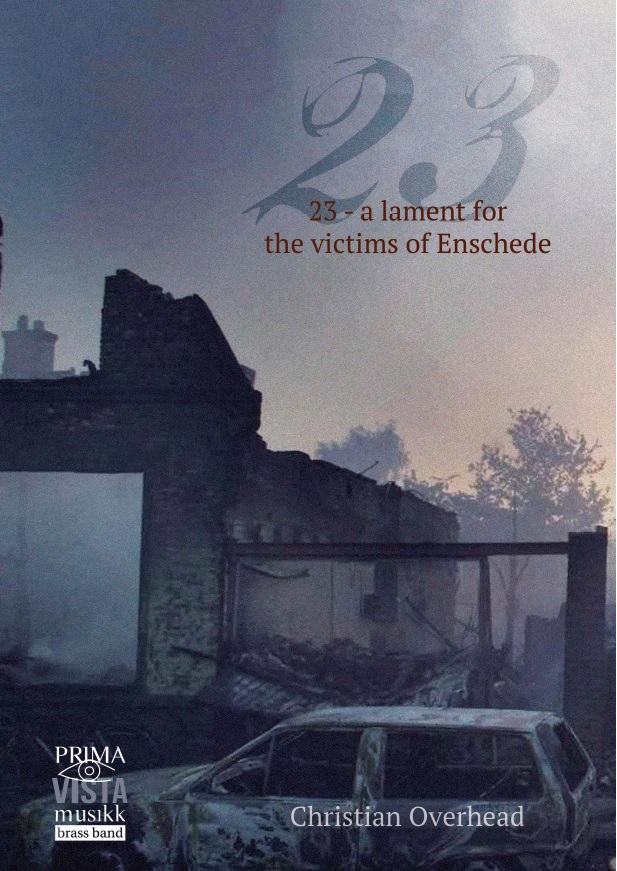
23 - A Lament for the Victims of Enschede (Brass Band - Score and Parts)
23 was composed for Brass Band Schoonhoven, and used as part of their programme for Brass in Concert in November 2016.On the 13 th May 2000, the Netherlands was shocked by an explosion in Roombeek - a district of Enschede, near the German border - after a fire broke out at a local fireworks depot. 23 people lost their lives in the tragic events. This piece pays tribute to their memory.The numbers 2 and 3 form the basis of the piece. The use of 5/4 allows the music to flow, alternating between 2 + 3 and 3 + 2; there are frequent passages where triplet quavers clash with straight quavers; and the tuned percussion make use of a scale composed of alternating intervals of 2 and 3 semitones.
Estimated dispatch 7-14 working days
-
 £15.99
Beecher Variations (Brass Band - Score only)
In this beautiful composition, melodic fragments of the hymn tune Beecher are morphed into a series of variations, showing the melody in various moods from expressive, then quiet and soft, to bright and triumphant in the end. Written as a test piece in the 4th division for the Dutch Brass Band Championships in 2015, the music features challenging solo parts for cornet, soprano cornet, flugelhorn and euphonium. A great work for the concert or contest stage!Duration: 12.00
Estimated dispatch 7-14 working days
-
£69.95
Horn Concerto (Horn Solo with Brass Band)
Horn in F/E flat with Brass BandComposed in 1971 for Ifor James, the Concerto for French Horn and Band revealed some of those elements that have made Gregson's music so popular with audiences (and not just brass band audiences) worldwide: the boldness of his melodies, with the interval of the fourth revealing his admiration for the music of Paul Hindemith; his incisive rhythms, betraying the influence of another favourite composer, Bla Bartk; an admirable economy of means; and the clarity of his scoring.Each of the Concerto's three movements displays a different facet of the French Horn's character. The first is serious, symphonic in impulse, the rising fourths of the opening gesture giving the music an almost Germanic weight. In the slow movement, the soloist becomes the first among equals, sharing with the cornet soloist some typically haunting melodies. The lyrical flow is interrupted at the mid-point by mysterious, fleet-of-foot cadenzas. A rondo finale brings the concerto to a lighthearted conclusion. The rising fourths here are the impulse for a jaunty theme which reveals another of Gregson's early influences - William Walton, and in particular that composer's Partita for orchestra.
Estimated dispatch 7-14 working days
-
£59.99
Lyonesse (Brass Band - Score and Parts)
Lyonesse was commissioned by the Brass Band Heritage Trust as the test piece for the Finals of the National Youth Brass Band Championships held in Manchester in April 2005. This atmospheric music, ideal as a test piece for First and Second section bands, takes its inspiration from the lost kingdom of Lyonesse, the mythical spur of land linking Cornwall and the Scilly Isles, and its associated legend of Tristan and Isolde.Suitable for 1st Section Bands and aboveDuration: 13.00
Estimated dispatch 7-14 working days