
Results
-
 £25.00
Zephyrus. March for Brass Band
Recommended - Suitable for all bands The Big Blow, was a formal record attempt to create the largest brass band in the world. It took place at Butlin's Resort, Skegness on 20 January 2007, and it's main goal was to raise money in support of the work of Brass Band Aid, and specifically to provide long-term sponsorship for two children in the village of Adet in Ethiopia. The Music Company (UK) Ltd were one of the Official Partners of The Big Blow, providing the performance piece for the record attempt. Andrew Duncan wrote 'Zephyrus' to mark the occasion. The title takes its name from the Greek God of the West Winds - Zephyrus. Zephyrus is a traditional British brass band march with an interesting African-feel lilt to the trio. This is enhanced by optional percussion instruments including djembi and bongos, which can alternatively be covered by standard drum kit. The Music Company are pleased to continue their support of Brass Band Aid by offering a donation to this worthy charity for every set of this music sold. Includes score & parts
-
 £42.00
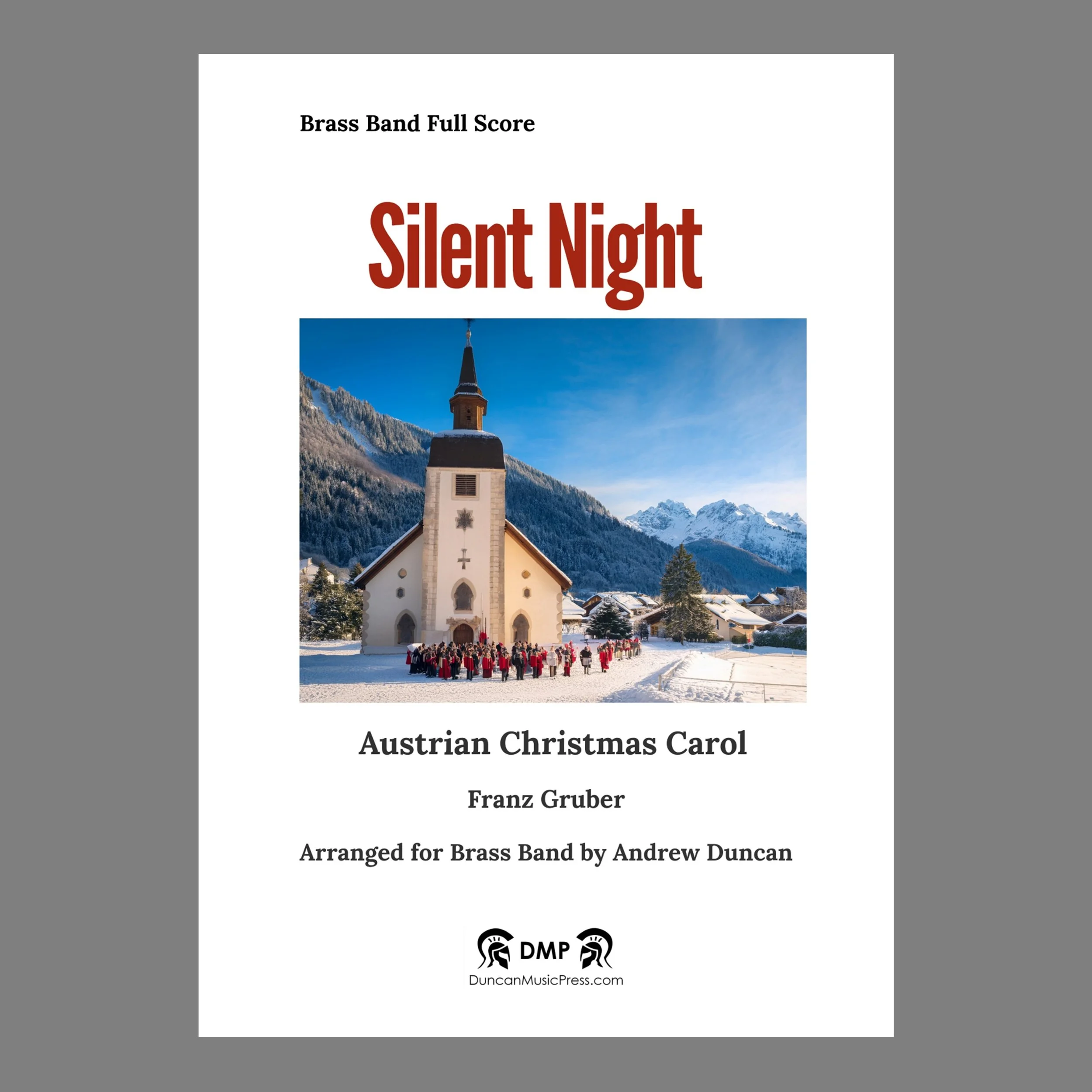
Silent Night. Franz Gruber arranged for brass band by Andrew Duncan
Silent Night is an Austrian Christmas Carol written by Franz Gruber, (1787-1863). Franz Gruber was an primary school teacher, organist and composer who lived in the village of Arndorf in Austria. Silent Night (Stille Nacht) has become one of the best loved Christmas Carols ever written. This arrangement for brass band imagines Christmas morning in a small Austrian village, such as Arndorf, with the sound of the local church bells ringing out along with the sound of a choir singing Silent Night accompanied by the local band.. The arrangement features the tubular bells playing a simple descending scale, which is also played by muted cornets (2nd and 3rd cornets). After 2 verses of the hymn the coda features a short trombone trio with a jazzy feel which leads into a final scale from the tubular bells and cornets bringing the piece to a peaceful close. To hear a sound file of Silent Night scroll down.
-
.png) £34.95
£34.95Casper's Lament (for Brass Band) - Jonathan Bates
'Casper's Lament' was composed for the Foden's Band's appearance at the 2021 Brass in Concert Championships held at The Sage, gateshead. The music is inspired by the lesser known side to 'Casper the Friendly Ghost'; a "good ghost" who much to the annoyance of his uncles chooses to help people rather than scare them. Despite the uplifting and joyful narrative to the 'Casper' stories, there is a much more tragic back story of how he come to be. Casper's mother passed away during his birth leaving him to be raised solely by his extremely devoted father until the age of 12 when having begged his father for a sled to play in the snow Casper contracted pneumonia from playing out in the cold for too long and passed away shortly after. Throughout Casper's childhood years, the pair were inseparable. So much so, that after his tragically young death, Casper simply could not leave his father to be alone in the mortal world and as a result he stuck around as the ghost we love come to know and love through the many books, series and films over the years. . .
In Stock: Estimated dispatch 1-3 working days
-
£25.00
Fanfare for a Festival - Peter Meechan
Fanfare for a Festival is a short fanfare for brass band.Fanfare for a Festival was commissioned by Mark Bousie for the Sellers International Youth Band who premiered the work at the 2007 National Music for Youth festival in Symphony Hall, Birmingham, UK..
Estimated dispatch 12-14 working days
-
 £40.00
Concerto for Trombone (with brass band) - Andrew Duncan
Andrew Duncan composed this extraordinary solo for trombone with brass band accompaniment for his friend and trombone virtuoso, Andrew Berryman.This piece is a true showcase for the soloist across three movements - Allegro, Lullaby and Rondo.The outer movements demonstrate the technical skill of the soloist, whilst the slow movement (Lullaby) displays the beautiful lyrical style of the Trombone.Look and Listen (courtesy of Thomas Callaux and Brassage Brass Band):Discography: Concerto for Trombone has been recorded byAndrew Berryman (English Landscapes)Brett Baker (Bakers Dozen)Jacques Mauger (Reflections of Freedom)Concerto for Trombone is suitable for advanced trombone players and is also available with piano accompaniment.
In Stock: Estimated dispatch 3-5 working days
-
 £25.00
First Attempt (brass band) - Tim Paton
This concert march, composed by Tim Paton for brass band, has taken inspiration from the inimitable style of the 'march king', Kenneth J Alford.It's an upbeat, cheerful march which has stood the test of time - it was premiered back in 1970 on the Rozel Bandstand by the Weston-Super-Mare Silver Band!Marches have always been a favourable choice in brass band concert programmes, so here's a great opportunity to bring a new offering to the table which helps lift spirits through its catchy pulse and creativity.Also available as a version for brass ensemble.
In Stock: Estimated dispatch 3-5 working days
-
 £77.00
General Series Brass Band Journal, Numbers 2250 - 2253, December 2024
2250: Prelude on 'Rhosymedre' (Ralph Vaughan Williams trs. Douglas Engle)The English composer Ralph Vaughan Williams' work Three Preludes (founded on Welsh Hymn Tunes) was published for the organ in 1920. This is a transcription of the second movement of that work. The words associated with the hymn tune are by Samuel Crossman, My song is love unknown (S.A.S.B. 149), and vividly depict the events of Holy Week. The music is gentle and solemn and would be appropriate for a Good Friday service or as a moment of repose in a concert. 2251: Hosanna Shuffle (Sam Creamer)The half-time shuffle groove is a popular feel developed by alternative rock/pop bands of the 1980s. It marries elements of rock and swing styles together to form a new and infectious feel - Hosannah Shuffle being written as a tribute to this fusion of musical styles. Contrary to a swing style, shuffle brings the pulse back onto the beat while maintaining the swung quaver rhythms to create a rock-type rhythmic drive. 2252: Everlasting Love (Keith Manners)This piece was written for the London North East Music School in 2004. The theme of the week was 'Making a stand for Christ', reminding the school that it only takes one person to make such a stand before others follow. The music starts with a lone Solo Cornet playing the melody of Graham Kendrick's song Such Love (S.A.S.B. 199). One by one, other parts join in with the theme.2253: Festival March (Michael Cooper)This piece represents the first published brass composition of Bandmaster Michael Cooper, who is the Bandmaster at Brisbane City Temple Corps. This imposing festival march features the tunes I want to be a soldier (T.B. 683), Lift up the banner (T.B. 90) and My Jesus, I love thee (T.B. 506). These tunes depict the idea that spiritual warfare is an essential component of one's faith, success of which is articulated in the final verse of My Jesus, I love thee (S.A.S.B. 878).
Estimated dispatch 7-14 working days
-
 £55.00
Triumph Series Brass Band Journal, Numbers 1355 - 1358, November 2023
1355: March Medley - Pardoned Forever (Keith Manners)This collection of Easter-themed melodies should be played with enthusiasm and vigour. Featuring the songs He lives (S.A.S.B. 229), Chris is alive! Let Christians sing (S.A.S.B. 217) and No more! No more! He remembers sins no more (S.A.S.B. 460), the positive message of Easter Sunday is reflected in this bright march style.1356: Selection - I love the sweetest name (Noel Jones)This devotional selection includes three songs that feature the name of Jesus and derives its title from the following lines of those songs; 'How sweet the name of Jesus sounds' (S.A.S.B. 78), 'O, how I love the Saviour's name! The sweetest name on earth' (S.A.S.B. 94) and 'Sweetest name on mortal tongue' (S.A.S.B. 93).1357: Renewal (Harold Burgmayer)Will J. Brand penned the song Renewal (S.A.S.B. 634), with music by Bramwell Coles, for 'Day of Renewal' meetings conducted by General Albert Orsborn in October 1949. It was published in that form in The Musical Salvationist in 1951. Over time these meaningful words of consecration became wedded to an alternative tune, a lovely melody by Oscar Ahnfelt known as Trust in God (T.B. 903). This setting for band is based on a male-voice arrangement, conceived for a time of renewed consecration, sung by massed bands at the Canadian Staff Band's 50th Anniversary Festival in 2019.1358: Groove Hosanna! (Munashe Chikwezvero)This is a funk setting of three well-known melodies associated with Jesus' triumphal entry into Jerusalem. Today, such celebratory processions, and indeed most large gatherings, usually feature rich forms of music-making. Music provides atmosphere and generates excitement, and it is hoped that a funk inspired arrangement of these songs will inspire listeners to 'move to the groove'. The first two songs, Children of Jerusalem (S.A.S.B. 356) and Give me joy in my heart, keep me praising (S.A.S.B. 362) encourage us to sing 'Loud hosannas to our King!'. The words of the third song, When his salvation bringing, remind us that he "smiled to hear their song".
Estimated dispatch 7-14 working days
-
 £55.00
Triumph Series Brass Band Journal, Numbers 1351 - 1354, July 2023
1351: The anointed King (Marcus Venables)This piece was originally written as a massed band item for the Ontario Central-East Divisional Music Day in 2019. The updated version includes two songs, King of kings, majesty (S.A.S.B. 376) and O worship the King (S.A.S.B. 52) to a rhythmic setting of the tune Laudate Dominum (T.B. 481). Both songs present the contrasting characteristics of God; the powerful King and gentle, loving Saviour.1352: A suite of English Christmas carols (Kenneth Downie)This suite is the result of a request for a piece of music featuring exclusively English Christmas carols.The first movement features The holly and the ivy (C.C. 87). In sharp contrast, the second movement calls for a broad, sensitive, song-like approach. Using The cherry tree carol (C.C. 85), a much slower tempo than is normally applied to encourage the listener to see this beautiful tune in a new light. The rumbustious arrival of the finale is based on I saw three ships come sailing in (C.C. 44) with the festive mood prevailing until the end.1353: Nothing but thy blood (Norman Bearcroft)This two-verse setting of Richard Slater's much-loved hymn Nothing but thy blood (S.A.S.B. 769) appears straight-forward in nature, but requires a careful sense of the musical line across all parts.1354: Meditation - Reflections on Advent (Andrew Blyth)Two well-known carols, Away in a manger (C.C. 12) and Silent Night! (C.C. 77) are featured alongside original material. The piece attempts to convey a sense of reflection and meditation on the wonderful and awe-inspiring Advent story.
Estimated dispatch 7-14 working days
-
 £40.00
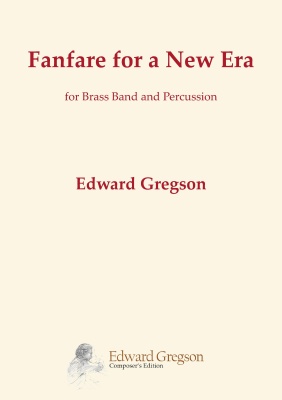
Fanfare for a New Era (Brass Band - Score and Parts)
Fanfare for a New Era is the most substantial of Edward Gregson's fanfares and was the result of a private commission by Lady Sheila Stoller to celebrate the opening in April 2017 of the Stoller Hall at Chetham's School of Music, Manchester. Gregson dedicated it to Sir Norman Stoller, who donated the funding for the new concert hall. The Fanfare was designed to fill the whole space, with separate brass choirs - trumpets, horns, trombones and tuba - playing their own music. A solo trumpeter playing 'on high' announces first the four horns and timpani, who enter with a stately measure. Next the herald trumpeter ushers in trombones, tuba and drums, with a faster dance. Finally, the remaining three trumpets amplify the peeling of bells. All four elements then come together, surrounding the audience with a 'joyful noise' of festive brass and percussion.Duration: 3.00
Estimated dispatch 7-14 working days
 View Music