
Results
-
 £60.99
Ammerland (Brass Band - Score and Parts) - De Haan, Jacob
Ammerland brings you a vivid impression of this enchanting region by the Zwischenahner Lake (Germany)! The rural landscape of Ammerland combines fields covered with yellow rape blossoms, lush meadows, seemingly endless country roads and an exquisite lake. Let yourself be lured away on a short musical trip to beautiful Ammerland. Enjoy nature, the lake and the brilliant colours of a unique landscape.Duration: 3:10
Estimated dispatch 7-14 working days
-
 £65.00
ATLANTIC (Brass Band) - Wilby, Philip
Recorded on Polyphonic QPRL215D Master Brass (Volume Thriteen). Duration: 14:10.
Estimated dispatch 7-14 working days
-
 £59.99
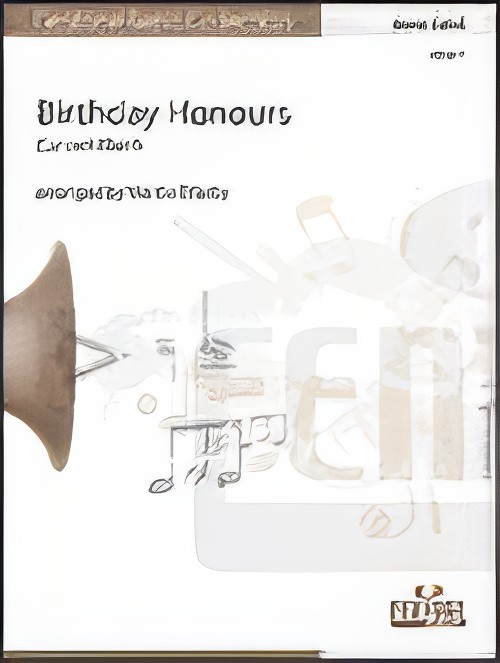
BIRTHDAY HONOURS (Brass Band) - Ellerby, Martin
4th Section. Birthday Honours was premiered in 2007 to celebrate the 70th birthday of British Composer Guy Woolfenden and makes a perfect piece to mark any anniversary, or as a surprise on someone's actual birthday. Duration: 2:10
Estimated dispatch 7-14 working days
-
 £35.00
Blaenwern (Love Divine, All Loves Excelling) (Brass Band - Score and Parts) - Rowlands, William - McKnight, Iain
A talented church musician, Rowlands reputedly composed a large number of hymn tunes and anthems yet it is just this tune alone, Blaenwern, written in the early part of the 1900s that he is known for today.?Commonly used as a setting for the hymn 'Love Divine, All Loves Excelling', it is one of the most popular choices for hymns selected for weddings and featured at number 5 in the BBC Songs of Praise 'Top 10 Hymns of All Time'; indeed it was chosen for the wedding of HRH Prince William and Catherine Middleton in 2011. Duration: 4:20
Estimated dispatch 7-14 working days
-
 £60.00
Capriol Suite (Brass Band - Score and Parts) - Warlock, Peter - Littlemore, Phillip
Peter Warlock's set of set of six dances in renaissance style, Capriol Suite, is by far his most famous work. The suite consists of Basse-Danse, a lively dance for older folk; a stately Pavane; a delicate, yet lively Tordion; Bransles (pronounced 'Brawl'), a fast country dance which works its way into a frenzy, continuously building in speed and excitement; Pieds-en-l'air, with its beautifully serene lines and Mattachins, an exhilarating sword dance with its driving rhythm, culminating in violent dissonances bringing the piece to a spirited close. This is a new arrangement suitable for any band, including those in the 4th Section that relish a challenge. Percussion has been added in all but one of the movements, and is for two players. Duration: 10:00
Estimated dispatch 7-14 working days
-
 £34.95
Christians Awake (Brass Band - Score and Parts) - Lovatt-Cooper, Paul
This Christmas fanfare is a great way to start a concert or a second half. It has lots of excitement in the fanfare while the use of the Christmas carol Christians Awake gives it a fantastic sense of occasion.Ideal for 3rd section bands and upwards.Duration: 2:10.
Estimated dispatch 7-14 working days
-
£60.99
Consolation (Brass Band - Score and Parts)
Wer nur den lieben Gott l?sst walten was composed by Georg Neumark in about 1641 and was subtitled 'Trostlied' literally meaning consolation song. Songbooks at the time showed the popularity of this song and it is still well-known today partly due to Johann Sebastian Bach's use of the melody for one of his own chorals. In Jan de Haan's arrangement the choral is heard twice, once, alternating with the original motif from the introduction and a second time, without interruption, reflecting the composer's original intention - a song of consolation. 03:10
Estimated dispatch 7-14 working days
-
£76.99
Famous Folksongs (Brass Band - Score and Parts) - Kildevann, Dagmar
In 'Famous Folksongs' we are taken on a musical trip around the world, from France to the USA and from South America to the Middle East. Dagmar Kildevann arranged eight word famous folk songs in very different ways. From traditional (Lolo mi boto) to modern (Le coq est mort) and from swing (Sur le pont) to rock (Michael row the boat). Bon voyage, have a pleasant journey! Oh, and by the way, don't forget your passport!Duration: 10:00
Estimated dispatch 7-14 working days
-
 £45.00
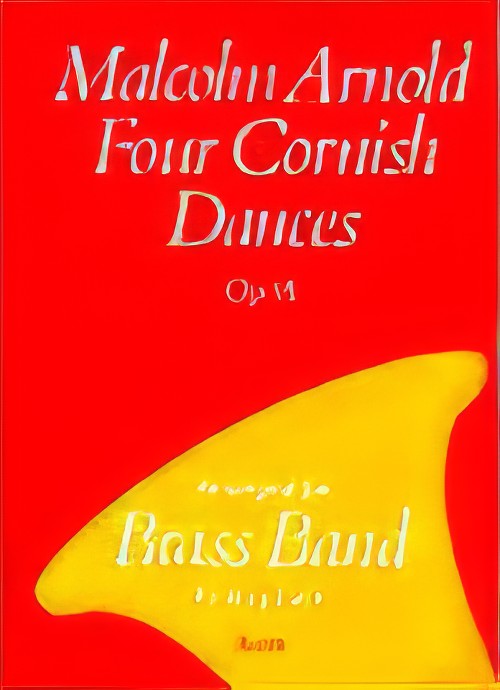
Four Cornish Dances Op.91 (Brass Band - Score and Parts) - Arnold, Malcolm - Farr, Ray
Ray Farr's arrangement of Malcolm Arnold's suite Four Cornish Dances brilliantly retains the atmosphere of the orchestral original with its evocation of Cornish sea-farers, of deserted tin mines, of marching bands, Methodism, May Days and Moody and Sankey hymns.Suitable for 1st Section Bands and aboveDuration: 10.00
Estimated dispatch 7-14 working days
-
£15.99
Four Cornish Dances Op.91 (Brass Band - Score only) - Arnold, Malcolm - Farr, Ray
Ray Farr's arrangement of Malcolm Arnold's suite Four Cornish Dances brilliantly retains the atmosphere of the orchestral original with its evocation of Cornish sea-farers, of deserted tin mines, of marching bands, Methodism, May Days and Moody and Sankey hymns.Suitable for 1st Section Bands and aboveDuration: 10.00
Estimated dispatch 7-14 working days
 View Music