
Results
-
 £34.95
Vain Resistance (Brass Band - Score and Parts) - Ritman, Olaf
This extended suite was written for the Amsterdam Staff Band by its own Bandmaster. It features the tunes St. John in the first movement and Moscow in the third with a more reflective original melody within the second movement evoking the listener to 'Be still and know that I am God'.
Estimated dispatch 7-14 working days
-
£17.50
Vain Resistance (Brass Band - Score only) - Ritman, Olaf
This extended suite was written for the Amsterdam Staff Band by its own Bandmaster. It features the tunes St. John in the first movement and Moscow in the third with a more reflective original melody within the second movement evoking the listener to 'Be still and know that I am God'.
Estimated dispatch 7-14 working days
-
 £48.00
Alloy (Brass Band - Score and Parts) - Wilcox, Chris
Alloy was originally commissioned in 2009 by Redbridge Music Service as a performance goal for beginner brass instrumentalists who had received free tuition in schools across the borough. The aim of the piece was to provide an inspirational opportunity for beginner players to perform alongside intermediate and advanced level instrumentalists. Alloy is an 8-minute work for metallic instruments, which is reflected in its title. It is a fusion piece with elements from traditional Indian Raga, Drum & Bass grooves, Jazz, Rock and African rhythms alongside the more 'classical' melodic brass styles. What culminates is a vibrant and exciting contemporary work. Also included are 4 optional easy beginner brass parts in all keys. Duration: 8.00. Suitable for 1st Section Bands and above.
Estimated dispatch 7-14 working days
-
 £44.99
Firefly (Brass Band - Score and Parts) - Dobson, Simon
Firefly was composed by award-winning composer Simon Dobson (b.1981) to provide an entertaining up-tempo concert work for community and youth bands. Composed in funk-rock style, and is based on the groove beat with which it opens. Dobson says, "Firefly was written as a break from my more serious music and as a 'hat tip' to the various types of beat orientated music I listen to." It was first performed by Oslofjord Brass in Norway and in its wind version by Harmonie Shostakovich, Switzerland. Duration: 5-6 minutes.
Estimated dispatch 7-14 working days
-
£34.95
Song of the Night Sky (Cornet Solo with Brass Band - Score and Parts) - Bond, Christopher
Orpheus is known as the most talented music player of the ancient times. It is said that god Apollo was his father, from whom took his extreme talent in music, and the Muse Calliope was his mother. Tragedy struck when his wife, Eurydice stepped on a viper which in turn bit her, injecting its fatal venom. Nothing could stop his cries of anguish and sheer pain and sorrow upon realizing his beautiful Eurydice was dead. Orpheus decided to go into the Underworld to get his wife back. Apollo, his father, would talk to Hades, the god of the Underworld to accept him and hear his plea. And so Orpheus set off into the Underworld and was warned that for no reason must he look back while his wife was still in the dark, for that would undo everything he hoped for. As Orpheus was reaching the exit of the Underworld, he could hear the footfalls of his wife approaching him. As his was approaching the exit, his heart was beating faster and faster. The moment he stepped on the world of the living, he turned his head to hug his wife. Unfortunately, he got only a glimpse of Eurydice before she was once again drawn back into the underworld. When Orpheus turned his head, Eurydice was still in the dark, she hadn't seen the sun and, was drowned back to the dark world of the dead. Waves of anguish and despair swept over him and shuddering with grief he approached the Underworld again but this time, he was denied entry, the gates were standing shut and god Hermes, sent by Zeus, wouldn't let him in. His songs were no more joyful but extremely sad. His only comfort was to lay on a huge rock and feel the caress of the breeze, his only vision were the open skies. Song of the Night Sky was recorded by Tom Hutchinson and the Cory Band in June 2015, featuring on his debut solo album.Duration: 4.15
Estimated dispatch 7-14 working days
-
 £87.99
Second to None (Brass Band - Score and Parts) - Sparke, Philip
Second to None is a perfectly suitable title for this work, though it actually refers to "Nulli Secundus", the motto of the British Corps of Army Music, who gave the commission to Philip Sparke. The piece opens with a fanfare, followed by two short quotes from two of the Corp's own marches and a festive Vivace. A more legato central section creates a nice contrast before the work closes with the opening fanfare. A perfect affair!Duration: 6:15
Estimated dispatch 7-14 working days
-
 £37.95
The Four Elements (Euphonium Solo with Brass Band - Score only) - Ellerby, Martin
Partita for Solo Euphonium and Brass BandThe Four Elements was written for Gary Curtin and the Black Dyke Band as part of a recording project of Martin Ellerby's brass band music. The composer, having previously written a large scale concerto for the euphonium, decided to write something much more concise though still enabling the soloist to display flair and lyricism in equal measure. Each movement is approximately 2 minutes long, a set of miniatures, based on the four elements of earth, water, air and fire, and are given their Latin manes of terra, aqua, aer and ignis in the score. The term partita is used to indicate that the work is a collection, or suite, of pieces and in keeping with former examples, uses both song and dance forms to provide suitable musical structures.Duration: 8.00
Estimated dispatch 7-14 working days
-
 £89.95
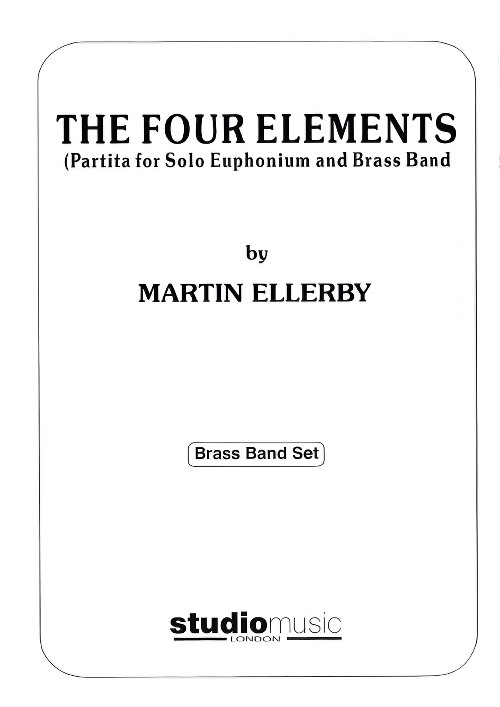
The Four Elements (Euphonium Solo with Brass Band - Score and Parts) - Ellerby, Martin
Partita for Solo Euphonium and Brass BandThe Four Elements was written for Gary Curtin and the Black Dyke Band as part of a recording project of Martin Ellerby's brass band music. The composer, having previously written a large scale concerto for the euphonium, decided to write something much more concise though still enabling the soloist to display flair and lyricism in equal measure. Each movement is approximately 2 minutes long, a set of miniatures, based on the four elements of earth, water, air and fire, and are given their Latin manes of terra, aqua, aer and ignis in the score. The term partita is used to indicate that the work is a collection, or suite, of pieces and in keeping with former examples, uses both song and dance forms to provide suitable musical structures.Duration: 8.00
Estimated dispatch 7-14 working days
-
 £38.00
Blewz (Brass Band - Score and Parts) - Anderson, Keiron
There are many harmonic forms of the blues from a standard chord sequence to a more complex set with a circle of fifths. This bright, entertaining work is fun to play and easy to programme with a hint of jazz and a swing feel, complete with a little interplay section for bass trombone and tuba, which adds to the entertainment value of this piece. Duration: 3.30. Suitable for 1st Section Bands and above
Estimated dispatch 7-14 working days
-
 £38.00
Flanfayre (Brass Band - Score and Parts) - Deazley, Stephen
"I was asked by Music for Youth to write a flexibly scored fanfare for the School Proms at the Royal Albert Hall and the National Festival in Birmingham in 2013. At its first performance, over 200 young brass players performed "Flanfayre" in Birmingham Town Hall, directed by Roger Argente, members of Superbrass and myself. The score is a progressive romp through some increasingly dance-like grooves, borrowing some of its swing from South America, from marches and big band, moving from a really quite straight opening to a "let-go" moment at the end. It is more like a flan full of different flavours, than a fanfare, hence the title. I set myself a challenge to write 100 bars but ended up with 102, which, after the introduction, can be broken down into 10 easily discernible sections each with their own mini-musical narrative. Feel free to teach the audience the clapping groove and perform only under the strict instruction that you have fun !" - Stephen Deazley. Duration: 4.00. Suitable for 2nd Section Bands and above.
Estimated dispatch 7-14 working days
 View Music