
Results
-
 £39.95
War Dance of the Red Cossacks - Jonathan Bates
DURATION: 2 minutes. DIFFICULTY: 1st+. 2018 marked the centenary of the Red Cossack's declaring independence from the Russian state following the revolutions of 1917. The music combines more contemporary musical elements with that of the melodies, rhythms and modes traditionally used in early soviet music. This piece was composed for Jaren Hornmusikkforening as part of their programme for the 2018 SIDDIS Championships held in Stavanger, Norway. .
In Stock: Estimated dispatch 1-3 working days
-
 £34.99
Submerged... (Cornet Concerto No.2) - Jonathan Bates
'Submerged..' is a virtuoso concerto for Cornet composed as a response to the 'lost' Derbyshire villages of Ashopton & Derwent,. both of which were drowned in the early 1940's to make way for a new reservoir to aid the ever-increasing water demand from nearby. Sheffield and it's steel industry during World War 2. The work is through-composed but is defined by 3 clear main sections, 'The . Packhorse Bridge, Derwent', 'Ashopton Chapel' and 'Operation Chastise'. Much of the melodic and harmonic material throughout the. concerto is inspired by 3 contrasting sources; an original motif of towering block chords which opens the concerto, the famous opening. fragment of Eric Ball's 'High Peak' (1969) which was composed as a tribute to the district of Derbyshire where Ashopton & Derwent lie, . and finally Claude Debussy's haunting 'La Cath drale Engloutie' or 'The Sunken Cathedral', which was composed in 1910 around the legend of. the submerged cathedral of Ys. . I. Packhorse Bridge, Derwent (1925). One of the most striking features of the former village of Derwent was it's Packhorse Bridge, which spanned the River Derwent. adjacent to the Derwent Hall - a grand, picturesque Jacobean country house. In 1925, the renowned impressionist artist Stanley. Royle painted a striking image of the two in midwinter, with the partially frozen river sat quietly underneath the snow-topped. bridge in the foreground, while the old hall sits peacefully and dark in the background. The opening setion of this concerto paints. this picture in a quite schizophrenic manner; with frosty, shrill march-like material picturing the villagers crossing the narrow icy. bridge, combined with wild and frenzied waltz music of the grand hall and it's masquerade balls laying, for now, quietly mysterious. across the river. . II. Ashopton Chapel (1939). Ashopton was much the smaller and less-populated of the 2 'lost' villages, but still bore home to a Roman Catholic Chapel which was. the focal point of the village. The chapel - along with the rest of Ashopton - was drowned in 1943, but the final service to take place there. was held in 1939, with the final hymn being 'Day's Dying in the West'. This hymn forms a haunting coda to the 2nd section, with firstly the . piano leading the melody before an audio track containing an old recording of the hymn is accompanied by the sound of flowing water and . the rumble of storms as the village hypothetically disappears from existence with the hymn tune still echoing around the valley, before . subsiding into the growing roar of the engine of a Lancaster Bomber as it soars overhead towards Derwent to practise it's 'Dam-Buster' raid. . III. Operation Chastise (1943). The Derwent Reservoir lies adjacent to Ladybower Reservoir (of which Ashopton & Derwent were flooded to make way for) in the . Derbyshire High Peak, and during the 2nd World War was used as one of the central low-atitude practise areas of the 617 Squadron - more . commonly known affectionately as the 'Dambusters'. Before the destruction of Derwent, it's 'Packhorse Bridge' was dismantled stone by stone . and re-assembled upstream at Howden Dam to the north end of Derwent Reservoir. This is where the music begins, with a reconstruction of . the opening material before taking flight into a whirlwind tour of virtuosity from the soloist. .
In Stock: Estimated dispatch 1-3 working days
-
 £8.50
ALLEGRO DECISO (score) - Handel, George Frideric (1685-1759)
For 10 or more brass players, with parts also enclosed for orchestral brass (no percussion)
In Stock: Estimated dispatch 1-3 working days
-
 £27.50
ALLEGRO DECISO (score & parts) - Handel, George Frideric (1685-1759)
For 10 or more brass players, with parts also enclosed for orchestral brass (no percussion)
In Stock: Estimated dispatch 1-3 working days
-
 £30.00
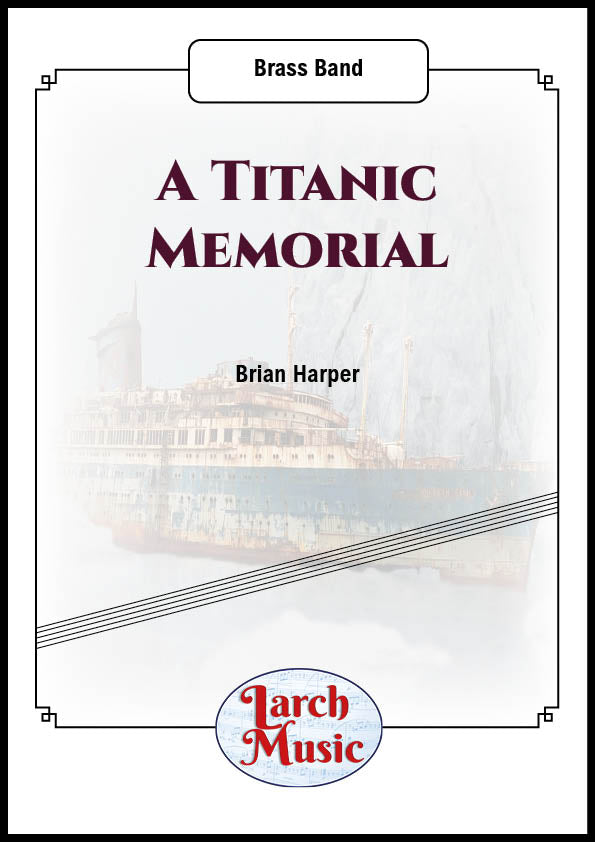
A Titanic Memorial - Brass Band Sheet Music Full Score & Parts - LM393
COMPOSER: Brian HarperRMSTitanicwas a British passengerliner, operated by theWhite Star Line, thatsank in the North Atlantic Oceanon 15 April 1912 after striking anicebergduring her maiden voyage fromSouthampton, England toNew York City, United States.Of theestimated 2,224 passengers and crewaboard, more than 1,500 died, making itthe deadliest sinking of a single shipup to that time.It remains the deadliest peacetime sinking of anocean linerorcruise ship.The disaster drew public attention, provided foundational material for thedisaster filmgenre, and has inspired many artistic works.LM393 - ISMN : 9790570003938
In Stock: Estimated dispatch 3-5 working days
-
 £30.00
Amazing Grace (W. Walker arr. by Paul Pennicotte-Henrie) - Brass Band Sheet Music Full Score and Parts - LM642
COMPOSER: W. WalkerARRANGER: Paul Pennicotte-Henrie"Amazing Grace" is a Christian hymn published in 1779 by English Anglican clergyman, abolitionist, and poet John Newton. It is possibly the most sung and most recorded hymn in the world and is especially popular in the United States, where it is used for both religious and secular purposes. Newton wrote the words from personal experience; he grew up without any particular religious conviction, but his life's path was formed by a variety of twists and coincidences that were often put into motion by others' reactions to what they took as his recalcitrant insubordination. He was pressed into service with the Royal Navy, and after leaving the service, he became involved in the Atlantic slave trade.In 1748, a violent storm battered his vessel off the coast of County Donegal, Ireland, so severely that he called out to God for mercy. While this moment marked his spiritual conversion, he continued slave trading until 1754 or 1755, when he ended his seafaring altogether. Newton began studying Christian theology and later became an abolitionist.Ordained in the Church of England in 1764, Newton became the curate of Olney, Buckinghamshire, where he began to write hymns with poet William Cowper. "Amazing Grace" was written to illustrate a sermon on New Year's Day of 1773. It is unknown if there was any music accompanying the verses; it may have been chanted by the congregation. It debuted in print in 1779 in Newton's and Cowper's Olney Hymns, but settled into relative obscurity in England. In the United States, "Amazing Grace" became a popular song used by Baptist and Methodist preachers as part of their evangelizing, especially in the American South, during the Second Great Awakening of the early 19th century. It has been associated with more than 20 melodies. In 1835, American composer William Walker set it to the tune known as "New Britain" in a shape note format; this is the version most frequently sung today.
In Stock: Estimated dispatch 3-5 working days
-
 £46.00
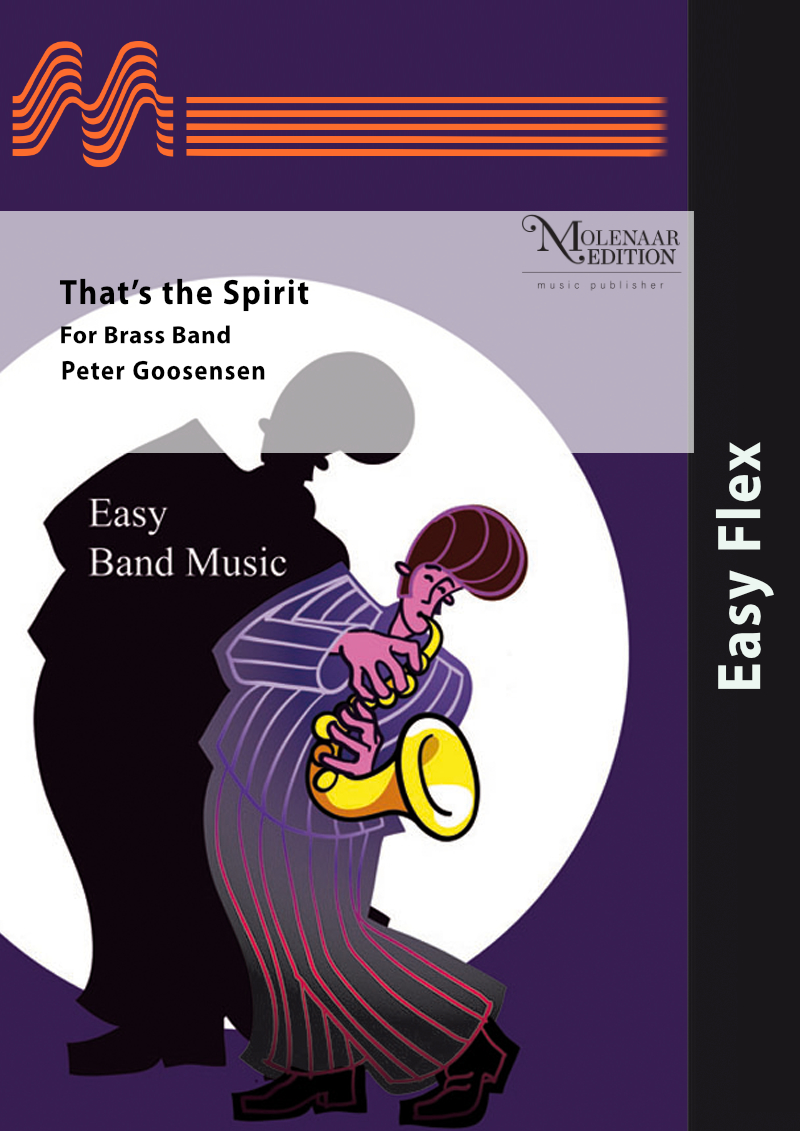
That's the Spirit - Peter Goosensen
That's the Spirit! Is a fun and challenging work that is a great flashy opening to concert programs, for youth orchestras and smaller bands. The driving drum and percussion groove provides a solid rhythmic base. The various wind sections of the band deliver both impressive themes but also more subtle melodic lines.
Estimated dispatch 10-14 working days
-
 £69.00
Enjoy Your Weekend! - Peter Goosensen
Enjoy your Weekend! is a fun and varied composition that offers lots of playing pleasure for both youth and smaller bands. The composition is based on a simple and pretty theme. The first part, Lazy Sunday, is built around a relaxed swinging tune. The second part, Close Friends, is more melodic and serious in nature. In Party Rock, the third part, the drummer plays a central role and the band can play their hearts out. Enjoy your Weekend!
Estimated dispatch 10-14 working days
-
 £78.00
Dual - Andrew Pearce
Dual (for euphoniums and band) was commissioned by Robbert Vos and Anteun Hoesen of Altena Brass, the Netherlands. Pearce strived to write a fun, melodic and challenging piece that showed off the vast range and virtuosity of these fine players. The octatonic scale forms the harmonic basis for much of the piece, which is a musical competition or race between our mighty Euphonium soloists! Rapidly ascending and descending atonal lines create constant drama for both soloists and band, culminating in a more expressive and tonal ending.
Estimated dispatch 10-14 working days
-
 £65.00
Interlude - Andrew Pearce
As a young man, Andrew Pearce had fond memories of playing Cornet in the local Youth Brass Band, where he first experienced the power and beauty of brass music. After completing 'Maestro' concertino for Philip Cobb, he decided to write a more gentle and lyrical piece for him, which paid homage to his musical roots in the Salvation Army. 'Interlude' is ideal for a proficient solo cornet player in any brass band: tuneful, reflective and elegiac with lots of expression.
Estimated dispatch 10-14 working days

 View Music
 Listen to MP3