
Results
-
 £37.50
Stories From The Steel City - Jonathan Bates
In 2013, Deepcar Brass Band, based in the north of Sheffield at the foot of the Pennines, celebrated their 25th Anniversary year. To that end, they commissioned the upcoming composer Jonathan Bates to pen a new work for the band that reflected not only the band's triumphant milestone, but also the history of the steel city. This exciting work features a variety of styles and has an interlude that hears the sounds of metal being clanged to conjure up images of the cities steelwork heritage. Jonathan Bates has since gone on to compose for many of the country's top bands and all his works see success with melodic lines and skilful use of the brass band colours.
In Stock: Estimated dispatch 1-3 working days
-
 £106.99
Evolution - Philip Sparke
Evolution was commissioned by Kunstfactor for the 4th section of the Dutch National Brass Band Championships (NBK) 2011. It is dedicated to Jappie Dijkstra and the Music Information Centre (MUI), Arnhem, Holland, in acknowledgement of their outstanding work in developing brass band repertoire. The composer writes:-The idea for the piece came when I was reading an article about a branch of Chinese philosophy which is abbreviated as Wu Xing, which has no exact translation but can mean, for example, five elements, five phases or five states of change. It is central to all elements of Chinese thought, including science, philosophy, medicine and astrology, and in simpleterms tries to create various cyclic relationships between five elements in all walks of life. An example is: Earth - Metal - Water - Wood - Fire - (Earth) etc. where (in one cycle) earth bears metal, metal changes to liquid (water) when heated, water helps trees grow, wood burns to create fire, fire produces ash (earth) and the cycle continues.I was particularly interested in the cycle of emotions: Meditation - Sorrow - Fear - Anger - Joy - (Meditation) etc. and thought this cyclic principle would provide an effective emotional journey for a piece of music. So Evolution has five equal sections which loosely characterise this emotional cycle. I have tried to make the music grow organically, with minimal repetition, and each movement evolves from the musical elements at the end of the previous one, with the opening material appearing, transformed, at the end of the piece to complete the cycle.
Estimated dispatch 5-14 working days
-
 £74.99
Willow Pattern - Philip Harper
Composed in 2009 for Nicholas Childs and the Black Dyke BandThis piece tells the Willow Pattern legend through music. Several leitmotifs are used both for the different characters and also for some of the important emotions in the tale. Additionally, Knoon-se's part is mainly played by the flugel horn, Changby the euphonium, the Mandarin by the Eb Bass and the Duke Ta-jin by the trombone. The Willow Pattern LegendOnce, in ancient China, there lived a wealthy and powerful Mandarin who had a beautiful daughter, Knoon-se. She had fallen in love with Chang, a humble accountant, which angered her father who imprisoned her in the Pavilion by the river with only theexotic birds for company. She learnt that the Mandarin planned to marry her to the pompous Duke Ta-jin and that the wedding would take place on the day the blossom fell from the willow tree, so she sent Chang a message: "Gather thy blossom, ere it bestolen". The Duke arrived by sea amid great fanfare when the tree was heavy with bud, and nights of magnificent banquets followed. After one such occasion when the Mandarin slept, Chang crept over the crooked fence and tiptoed into the Pavilion to rescueKnoon-se, but as they escaped the alarm was raised. They fled over the bridge with the Mandarin close on their heels brandishing his whip.They managed to escape by boat to a secluded island where they lived happily for a time. Meanwhile, the Mandarin learned of their refuge and, intent on revenge, he ordered his soldiers to kill them. As Knoon-se and Chang slept at night, the men setfire to the pagoda in which they lived and the lovers perished in the flames. However, the Gods, moved by the lovers' plight, transformed their souls into two turtle-doves which rose from the charred remains, soaring above the Earth, symbolising eternal happiness. Willow Pattern is dedicated to the memory of Jean Harper who passed away as I was completing the piece and who was a great collector of porcelain and china-ware. NOTES ON PERFORMANCEMute Requirements:Metal mutes soprano cornet, repiano cornet, 2nd cornets, 3rd cornets (6 in total) Cup mutes all cornets and trombones (10 + 3) Harmon mutes soprano cornet, solo cornets, repiano cornet (6) Percussion Requirements:There are two parts for percussion on the score. The minimum requirements are as follows: 2 players - Timpani, 2 Large tom toms, 2 Wood Blocks, Triangle, Sleigh Bells, Whip, Clash Cymbals, Suspended Cymbal, Hi-hat, Glockenspiel, Xylophone, Tam tam (or susp. cym.) For performances with extra resources, and to achieve closer authenticity, the full requirements are as follows: 3 players - Timpani, 3 Taiko Drums played with thick wooden sticks (or Large tom toms), 2 Wood Blocks, Triangle, Chinese Bells (or Sleigh Bells), Whip, Clash Cymbals, Chinese Cymbals (small clash cymbals approx 12"), Suspended Cymbal, Glockenspiel,Xylophone, Tam tam
Estimated dispatch 5-14 working days
-
 £74.99
Kingdom of Dragons - Philip Harper
The 'Kingdom of Dragons' is Gwent in South Wales, known in ancient times as the Kingdom of Gwent, and more recently home to the Newport Gwent Dragons Rugby Union team. This piece was commissioned by the Gwent Music Service with additionalfunding from Ty Cerdd - Music Centre Wales to celebrate the 50th anniversary in 2010 of the formation of the Gwent Youth Brass Band. Although the music is continuous, it is divided into four distinct sections, each one representing one of theunitary authorities which make up the County of Gwent. I. Monmouthshire, which has a large number of ancient castlesII. Blaenau Gwent, an historic area of iron and coal miningIII. Torfaen, where Pontypool Park is a notablelandmarkIV. Newport, the largest city in the region. The music begins with a two-bar fanfare, which sets out all the thematic material of the piece. The mood of pageantry that follows describes some of the ancient castles inMonmouthshire, with rolling tenor drums and fanfaring cornets. After a majestic climax the music subsides and quite literally descends into the coal mines of Blaenau Gwent. The percussion provides effects that suggest industrial machineryclanking into life, and the music accelerates to become a perilous white-knuckle ride on the underground railroad. There is a brief respite as a miner's work-song is introduced and, after a protracted build-up, this is restated at fortissimo beforethe music comes crashing to an inglorious close, much like the UK's mining industry itself. The middle sonorities of the band portray the tranquillity of Pontypool Park, a place of great natural beauty. Brief cadenzas for cornet and euphoniumlead to a full band reprise of the pastoral mood. At the end of this section we find ourselves at the top of the park's 'Folly Tower' from which the distant castle turrets of Monmouthshire are visible. Pontypool RFC was one of eleven clubs inthe first Welsh league in 1881 and a brief but bruising musical portrayal of the formidable Pontypool front-row, the 'Viet Gwent' leads into the work's final section. This portrays Newport, a symbol for progress and optimism for the future, idealsshared by the Gwent Youth Band itself. The music is a vigorous fugue which advances through various keys and episodes before the final triumphant augmented entry which brings the work to a magnificent conclusion. NOTES ONPERFORMANCEPercussion requirements: (3 players) Timpani, 2 Tenor Drums, 2 Tom toms, Snare Drum (sticks and brushes required), Bass Drum, Clash Cymbals, Suspended Cymbal, Hi-hat, Sizzle Cymbal, Tambourine, Metal block with metalbeater (eg hammer), Rattle (eg football rattle), Glockenspiel, Xylophone
Estimated dispatch 5-14 working days
-
£120.00
Rhapsody in Black (Bra) - Andi Cook
The primary inspiration for this work comes from the composer's first encounter with the genre of Symphonic Metal - the opening track of the 2004 Nightwish album 'Once', entitled Dark chest of Wonders. The combination of full orchestra, operatically trained female vocals and the raw power of a Scandinavian metal band was a potent mix that instantly had me hooked.That same dark and powerful sound is one that a brass band can generate, and I've tried to capture that in this composition. Heavy Rock/Metal as a genre is arguably fifty years old now, but symphonic metal is a newer concept, and I feel possibly the one that can bridge the gap between two musical styles very dear to me.Composer Gilbert Vinter had explored through music the connotations that different colours held for him, and his movement Purple from 'Spectrum' gave me an idea for the structure of 'Rhapsody in Black'. Andi Cook explored the different connotations of one colour within his own life, black being an easy choice due to the personal dichotomy of the black leather jacket he wore to the rock club on Friday night and the black suit jacket and tie he wore to the concert hall the next day.To avoid repetition the word 'black' is omitted from the five movement titles, each of which is a different episode. '...as Thunder' is a furious argument between two people - the top and bottom of the band - set against the backdrop of a storm, with lightning flashing outside while barbs, insults, sarcasm, tears and even violence is traded inside. Following that '...Satin and Pearls' is an old black-and-white movie with a wistful character to it as if we're looking back a screen icon with fondness long after their career or even their life has ended. '...as the Raven's Wing.' is deliberately gothic and funereal, hinting at Edgar Allen Poe's similarly named poem, with undertones of death and afterlife. The shift into F/C Minor (band pitch) represents the descent - alive - into the grave that Poe had a paranoid fear of his entire life. Family and friends standing around grieving, oblivious as we're lowered into the earth despite frantic attempts to make ourselves heard. '...and Chrome' is an unashamed motorcycle reference with all its born-to-be-wild, open air, high speed and freedom overtones. In a deliberate contrast to what went before it continues several of the same motifs though this time in the major key. Lastly, we reprise the second movement with '...as the Night Sky' which is simply the feeling of walking home under the summer stars, with someone important - who that is, is left to the listener, but a walk under the stars is always that bit special.There's an old saying that very few things are black and white. I hope this work will prove that even black alone isn't quite as simple as it's often made out....'Rhapsody in Black' is dedicated to the composer's friend and mentor John Roberts, who shares his love of both brass and rock.
Estimated dispatch 7-14 working days
-
 £15.00
Anvil Chorus from Il Trovatore - Verdi
Programme Notes from Andrew Duncan:Like many of the arrangements in the Flexi-Collection - Popular Classics Series I have simplified the rhythms and time signature, etc. I have also omitted trills for ease of playing.Dynamics form a very important aspect of this arrangement and it is important to observe these, especially the p markings. Every dynamic from p through to ff is used as well as some crescendos.The 1st Cornet/Trumpet part is perhaps more difficult than in some of the other arrangements in the series, but the other parts are fairly simple in comparison.The Percussion part (which is optional) is unusual in that it calls for two 'Anvils' to be played. However if these are not available then a good effect can be obtained by hitting two pieces of metal with metal hammers.The Flexi-Collection ApproachFlexible scoring tailored to your needs - A perfect solution for expanding the repertoire of training and junior brass bands. The Flexi-Collection currently offers two series - Popular Classics and World Tour. Based on four-part harmony, these collections provide groups with the advantage of complete flexibility when they may not be balanced. If players or instruments are missing, the show can still go on!The Flexi-Collection - Popular Classics Series, encapsulates all that is great about the wonderful range of musical styles produced by Holst, Elgar, Handel, Verdi, Tchaikovsky, Grieg, Bizet and Parry.The thoughtful scoring and arranging by Andrew Duncan now means that groups of all abilities have access to a truly flexible set of music for their needs. With world parts, rudimentary theory, terminology translations and large format typesetting, The Flexi-Collection ticks all the boxes when it comes to bringing interesting music to the training and junior band/brass group environment.Available for Brass Band - The Flexi-Collection offers flexibility in every sense of the word.(Available individually or as part of the money-saving Flexi-Collection Popular Classics Album)
In Stock: Estimated dispatch 3-5 working days
-
Paint It Black - Mick Jagger & Keith Richards - Len Jenkins
"Paint It Black" (originally released as "Paint It, Black") was written by Mick Jagger and Keith Richards, and first released as a single on 6 May 1966. It became the Rolling Stones' sixth number one in the UK and has remained influential as the first number one hit featuring a sitar. The song came at a pivotal period in The Rolling Stones' recording history, a time that saw the song-writing collaboration of Jagger and Richards assert itself as the principal composers of the band's original material. Its lyrics are for the most part meant to describe bleakness and depression and describe the extreme grief suffered by one stunned by the sudden and unexpected loss of wife, lover or partner. It famously plays during the end credits of the film Full Metal Jacket. Beginning in the style of an ironic minuet, which can be by-passed by starting at bar 54 where the heavy rock beat takes over, the piece is interesting and within the capabilities of 3rd or 4th section bands. For those bands with a drummer and one percussionist, an alternative percussion part is provided.
-
 £42.00
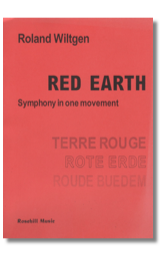
Red Earth (Score only) - Roland Wiltgen
The structure of Red Earth contracts and summarizes the classical four-movement symphony (Allegro, Lento, Scherzo, Allegro) into one movement, where the final Allegro is a modified recapitulation of the opening section. The musical substance of the work derives from a four-note 'motto', whose various statements throughout the piece clarify the structure. The title refers to the Luxemburg-born composer's native soil - a land of forsaken iron mines, smelting factories, and metal workers.
Estimated dispatch 7-9 working days
-
 £52.00
Red Earth (Parts only) - Roland Wiltgen
The structure of Red Earth contracts and summarizes the classical four-movement symphony (Allegro, Lento, Scherzo, Allegro) into one movement, where the final Allegro is a modified recapitulation of the opening section. The musical substance of the work derives from a four-note 'motto', whose various statements throughout the piece clarify the structure. The title refers to the Luxemburg-born composer's native soil - a land of forsaken iron mines, smelting factories, and metal workers.
Estimated dispatch 7-9 working days
-
 £29.95
Badinerie - Jonathan Bates
DURATION: 2'00". DIFFICULTY: Difficult. J.S Bach originally composed 'Badinerie' as part of his Orchestra Suite No. 2 in B Minor, and quickly became one of the most popular virtuoso show-pieces for flute players due to it's quick pace and complexity. In more modern times, the melody has become synonymous with the Nokia mobile phone ringtone, one of 2 famous early ringtones based on the music of Bach (alongside his Prelude to Cello Suite No.1). One lesser known take on the classic Badinerie is by Italian drummer Andrea Vadrucci (alias Vadrum) who has made a global reputation for himself by taking various well-known classical works and re-imagining them into a rock/metal style, and it is this interpretation which acts as the inspiration for this showy, yet tongue-in-cheek feature for percussion. .
In Stock: Estimated dispatch 1-3 working days
 View Music