
Results
-
 £43.99
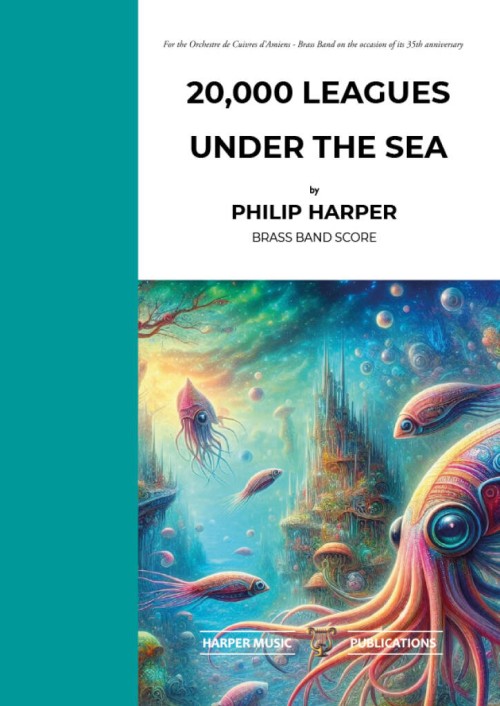
20,000 Leagues Under the Sea (Brass Band - Score only) - Harper, Philip
Frenchman Jules Verne was a pioneer in science fiction during the late 19th Century, penning some classic stories such as Journey to the Centre of the Earth and Around the World in 80 Days - both of which have already been the subject of brass band test-pieces. It was therefore natural for me to choose Verne's 1869 watery magnum opus as the subject for this piece to which there are five sections, as well as an introduction and a finale.THE NAUTILUS. After a mysterious introduction we are introduced to The Nautilus - a fantastical submarine.THE CORAL KINGDOM. We visit awe-inspiring underwater coral formations.SQUID ATTACK. The Nautilus is attacked by a school of giant squid, or 'devilfish'.CAPTAIN NEMO. Captain Nemo is a loner and an eccentric. Some say he is a madman. Soloists of the band help to uncover the character of this enigmatic but powerful figure.MAELSTROM. The Nautilus is dragged into the ocean's deadliest whirlpool but Captain Nemo lives to fight another day.Duration: 12.30
Estimated dispatch 7-14 working days
-
 £54.95
Songs of World War II (Brass Band - Score and Parts) - Wiffin, Rob
A Medley of Popular Songs (1939-1945)Includes:In the MoodA Nightingale Sang in Berkeley SquareWe're Gonna Hang Out the Washing on the Siegfried LineRun, Rabbit, Run!Kiss Me Goodnight, Sergeant MajorI'll Be Seeing You
Estimated dispatch 7-14 working days
-
 £69.95
Strange New Worlds (Brass Band - Score and Parts) - Graham, Peter
Strange New Worlds was commissioned by Nicholas Childs for the National Children's Brass Band of Great Britain with funds provided by Arts Council England.The COVID-19 pandemic made it necessary for the 2020 course to transition from residential to virtual and the work was designed to accommodate this change. The participants individually filmed themselves to a click track and the videos were collated to create a "virtual" performance. The premiere was streamed live on YouTube on August 7, 2020.The work is in 5 movements with a narrative dictated by the individual movement titles. Although to me this narrative is clearly defined, multiple scenarios present themselves. Some may interpret the story as being one from the ancients while others might identify with the science-fiction of H.G. Wells. Others still will relate to the recent surge of interest in 1980s culture and the Netflix series Stranger Things (to which the title of my work pays homage). Nor would it be unreasonable to consider the piece an analogy reflecting events in 2020. Listeners will decide the story (or message) for themselves.The five movements are: I. Things to Come; II. Descent to Darkness (featuring Cornets, Trombones and Percussion); III. Resistance (featuring Horns, Baritones, Euphoniums, Basses and Percussion); IV/V. Aftermath/A New HopeDuration: 8.00
Estimated dispatch 7-14 working days
-
 £57.99
Big Band Stars Revival! (Brass Band - Score and Parts) - Bernaerts, Frank
Includes: Big Spender; Just a Gigolo; Feeling Good; Fly Me to the Moon. Duration: 7.30
Estimated dispatch 7-14 working days
-
 £26.95
Do You Recall? (Trombone Solo with Brass Band - Score and Parts) - Wiffin, Rob
A slow, bluesy solo for trombone with band accompanimentLike many people, I took the opportunity offered by the COVID lockdown in Spring of 2020 to sort through old paperwork. I discovered a lot of songs that had not seen the light of day for many years and were mostly written with just the melody and chord symbols. Some offered the potential of becoming instrumental solos with a combination of heart-on-the-sleeve melodies the like of which I would not write now, together with maybe a greater sophistication in the instrumental writing. I had the notion in the back of my mind that Do you recall?; would work as a trombone solo but it seemed to fight me all the way. However, once finished it has proved to appeal to trombonists and has already been recorded by Brett Baker. It is not intrinsically difficult but needs a sense of the appropriate slow swing style and good control throughout the range.- Rob WiffinDuration: 4.15
Estimated dispatch 7-14 working days
-
 £125.00
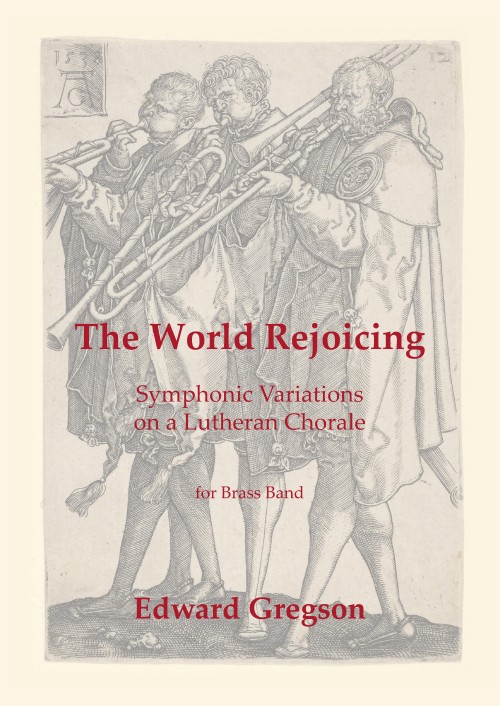
The World Rejoicing (Brass Band - Score and Parts) - Gregson, Edward
The World Rejoicing was commissioned by the National Brass Band Associations of Belgium, Netherlands, Norway, Switzerland, and the British Open, as the test piece for their competitions in 2020/21. Although the work was completed in 2019, the pandemic of 2020 meant that these competitions were postponed until 2021/22. The premiere took place in September 2021 at Symphony Hall, Birmingham, UK.In searching for a common link between the brass band traditions of the various European countries that commissioned this work, I considered the fact that hymns have always played an important role in the relationship that brass bands have with their particular communities; and thus I turned to a well- known Lutheran chorale, Nun danket alle Gott (Now thank we all our God), written around 1636 by Martin Rinkart, with the melody attributed to Johann Cruger. A number of composers have incorporated this chorale into their music, most famously J.S. Bach in his Cantatas no. 79 and 192, and Mendelssohn in the Lobsegang movement of his 2nd Symphony (the harmonisation of which is usually used when this hymn is sung).It seemed fitting therefore for me to return to a compositional form I have used many times before (Variations) and to write a work based on this hymn. I have used it in a similar way to that which I employed in my Variations on Laudate Dominum of 1976 - that is, rather than writing a set of variations using elaborations of the complete tune, I have taken various phrases from the chorale and used them within the context of other musical material, applying an overall symphonic process of continuous variation and development. The structure, or sub-divisions of the work, which is through composed and plays without a break, is as follows:Prelude, Capriccio, La Danza 1, Processional, La Danza 2, Arias and Duets, Fuga Burlesca, Chorale, and Postlude.The work, which is around 16 minutes in length, is also partly autobiographical - in the manner say of Strauss's Ein Heldenleben - in that I have incorporated into the score brief quotations from many of my other major works for brass band. In that respect, The World Rejoicing sums up a particular facet of my life as a composer, and reflects the admiration I have always had for what is surely one of the great amateur music-making traditions in the world.Duration: 16.00
Estimated dispatch 7-14 working days
-
£40.00
The World Rejoicing (Brass Band - Score only) - Gregson, Edward
The World Rejoicing was commissioned by the National Brass Band Associations of Belgium, Netherlands, Norway, Switzerland, and the British Open, as the test piece for their competitions in 2020/21. Although the work was completed in 2019, the pandemic of 2020 meant that these competitions were postponed until 2021/22. The premiere took place in September 2021 at Symphony Hall, Birmingham, UK.In searching for a common link between the brass band traditions of the various European countries that commissioned this work, I considered the fact that hymns have always played an important role in the relationship that brass bands have with their particular communities; and thus I turned to a well- known Lutheran chorale, Nun danket alle Gott (Now thank we all our God), written around 1636 by Martin Rinkart, with the melody attributed to Johann Cruger. A number of composers have incorporated this chorale into their music, most famously J.S. Bach in his Cantatas no. 79 and 192, and Mendelssohn in the Lobsegang movement of his 2nd Symphony (the harmonisation of which is usually used when this hymn is sung).It seemed fitting therefore for me to return to a compositional form I have used many times before (Variations) and to write a work based on this hymn. I have used it in a similar way to that which I employed in my Variations on Laudate Dominum of 1976 - that is, rather than writing a set of variations using elaborations of the complete tune, I have taken various phrases from the chorale and used them within the context of other musical material, applying an overall symphonic process of continuous variation and development. The structure, or sub-divisions of the work, which is through composed and plays without a break, is as follows:Prelude, Capriccio, La Danza 1, Processional, La Danza 2, Arias and Duets, Fuga Burlesca, Chorale, and Postlude.The work, which is around 16 minutes in length, is also partly autobiographical - in the manner say of Strauss's Ein Heldenleben - in that I have incorporated into the score brief quotations from many of my other major works for brass band. In that respect, The World Rejoicing sums up a particular facet of my life as a composer, and reflects the admiration I have always had for what is surely one of the great amateur music-making traditions in the world.Duration: 16.00
Estimated dispatch 7-14 working days
-
£15.00
The World Rejoicing (Brass Band - Study Score) - Gregson, Edward
The World Rejoicing was commissioned by the National Brass Band Associations of Belgium, Netherlands, Norway, Switzerland, and the British Open, as the test piece for their competitions in 2020/21. Although the work was completed in 2019, the pandemic of 2020 meant that these competitions were postponed until 2021/22. The premiere took place in September 2021 at Symphony Hall, Birmingham, UK.In searching for a common link between the brass band traditions of the various European countries that commissioned this work, I considered the fact that hymns have always played an important role in the relationship that brass bands have with their particular communities; and thus I turned to a well- known Lutheran chorale, Nun danket alle Gott (Now thank we all our God), written around 1636 by Martin Rinkart, with the melody attributed to Johann Cruger. A number of composers have incorporated this chorale into their music, most famously J.S. Bach in his Cantatas no. 79 and 192, and Mendelssohn in the Lobsegang movement of his 2nd Symphony (the harmonisation of which is usually used when this hymn is sung).It seemed fitting therefore for me to return to a compositional form I have used many times before (Variations) and to write a work based on this hymn. I have used it in a similar way to that which I employed in my Variations on Laudate Dominum of 1976 - that is, rather than writing a set of variations using elaborations of the complete tune, I have taken various phrases from the chorale and used them within the context of other musical material, applying an overall symphonic process of continuous variation and development. The structure, or sub-divisions of the work, which is through composed and plays without a break, is as follows:Prelude, Capriccio, La Danza 1, Processional, La Danza 2, Arias and Duets, Fuga Burlesca, Chorale, and Postlude.The work, which is around 16 minutes in length, is also partly autobiographical - in the manner say of Strauss's Ein Heldenleben - in that I have incorporated into the score brief quotations from many of my other major works for brass band. In that respect, The World Rejoicing sums up a particular facet of my life as a composer, and reflects the admiration I have always had for what is surely one of the great amateur music-making traditions in the world.Duration: 16.00
Estimated dispatch 7-14 working days
-
 £124.95
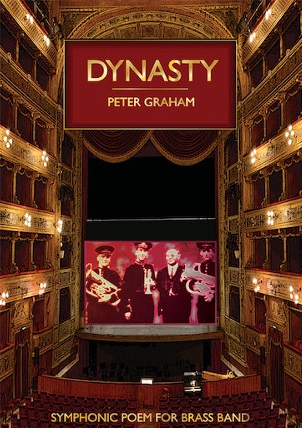
Dynasty (Brass Band - Score and Parts) - Graham, Peter
Dynasty takes the form of a Symphonic Poem, a musical form first introduced to a contest audience at the Crystal Palace in 1913 by Percy Fletcher in his work Labour and Love.Using key passages from the autobiography of Harry Mortimer, On Brass, as the source for the narrative, the work opens with a four-note leitmotif (Harry's theme, "as if descending from the heavens"), and the timeline unfolds as follows:Harry - One's destiny decided at birth "I'll make him the best cornet player in England"War - Why do the nations so furiously rage together? Fred volunteers for military serviceTheatre - And suddenly "I dashed to the rescue like a hero in the silent movies I was about to get to know so well"Journey - Comfort Ye A new life and new challengesTogether - Come unto me "A golden age"Farewell - For behold, darkness "Fred's death surely marked the passing of an era"Amen - The Trumpet shall soundListeners familiar with brass band repertoire will recognise a few pertinent quotes within the piece.In my imagination Harry is joined by Fred on cornet and the euphoniums of Alex and Rex for the quartet cadenza from Sovereign Heritage by Jack Beaver in Together.The Amen section from Handel's Messiah provides the basis for a contrapuntal flight of fancy as the work moves towards a conclusion. Other less overt fragments contribute to the story.Dynasty was co-commissioned by the British Open Brass Band Championships for the September 2019 contest, and the Brass Band Committee VLAMO for the Belgian Brass Band Championships 2019.- Peter GrahamDuration: 17.00
Estimated dispatch 7-14 working days
-
 £69.99
The Greatest Showman, Selections from (Brass Band - Score and Parts) - Pasek & Paul - Murtha, Paul
From the powerful soundtrack of the hit movie The Greatest Showman, here is a dramatic and exciting medley for the concert stage. Includes: 'The Greatest Showman', 'Never Enough', 'A Million Dreams', 'This Is Me' and 'From Now On'.
Estimated dispatch 7-14 working days
 View Music