
Results
-
 £55.00
Triumph Series Brass Band Journal, March 2022, Numbers 1335 - 1338
Includes:1335: March - Heavenly Joy by Norgan Juel Stavik1336: Joy! by Kenneth Downie1337: Whisper a Prayer in the Morning by Andrew Blyth1338: March - Crowning Glory by Noel Jones
Estimated dispatch 7-14 working days
-
 £70.00
General Series Band Journal August 2017 Numbers 2170-2173
Praise to the Lord! (Andreas Holmund)A joyful and exuberant setting of the tune 'Lobe den Herren' which will be popular amongst many groups looking for an exciting programme item.Carol of the bells (Warren Brookes)The 'Carol of the bells' is an extremely popular and much used carol. This setting will bring a useful addition to the Christmas repertoire and is arranged by a Salvationist from Australia.Breathe on me (Paul Drury)This work is based on the 'Sing to the Lord' setting by Mark Porter which has proved popular amongst many vocal groups. It is hoped that this developed setting will enhance its popularity.March Cedarlights (Norman Bearcroft)Lt. Colonel Norman Bearcroft provides a march with all his hallmarks of energy and rhythmic and melodic interest. The march was written as a tribute to the International College for Officers and features the tunes 'Joy, joy, joy there is joy in The Salvation Army', 'They shall come from the East' and 'The World for God' reflecting the internationalism of the College.
Estimated dispatch 7-14 working days
-
 £50.00
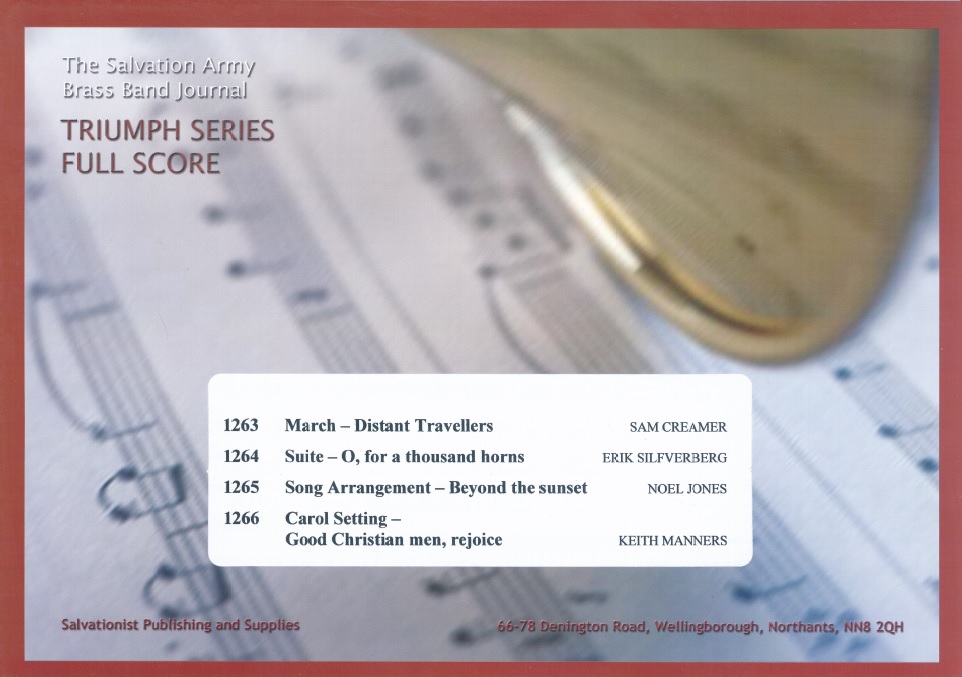
Triumph Series Band Journal July 2015 Numbers 1263 - 1266
No. 1263 March - Distant Travellers (Sam Creamer)With this Christmas march, we introduce a new contributor to our journals. Sam Creamer is a bandsman and songster at the Carindale Corps in Brisbane, Australia Eastern Territory. This march should prove a useful addition to the Christmas repertoire of many groups, as it features the well-known Christmas carols; When wise men come seeking (NCP 92) and While shepherds watched (NCP 93), as well as brief references to others.No. 1264 Suite - O, for a thousand horns (Erik Silfverberg)Bandmaster Erik Silfverberg OF has taken the song O for a thousand tongues by Charles Wesley, and has composed a suite in three movements with each of the movements exploring the sentiments of one of the verses. The tune Grimsby is heard in part throughout, but the majority of the musical material used is original.No. 1265 Song Arrangement - Beyond the sunset (Noel Jones)A three-verse setting of the song Beyond the sunset which speaks of the Christian's eternal home in Heaven.No. 1266 Carol Setting - Good Christian men, rejoice (Keith Manners)A bright setting of the well-known Christmas carol.
Estimated dispatch 7-14 working days
-
 £45.00
Triumph Series Band Journal March 2013 Numbers 1235 - 1238
No. 1235 March - Lord of the future (Erik Silfverberg)The title of this short, lively march is connected to the tune 'With Christ into the future' which appears in its second half.No. 1236 Selection - The peace of the Lord (Terry Camsey)This selection seeks to portray the peace that is found in Jesus, both in its style and the tunes used; 'Peace, peace, sweet peace', 'O the peace' and 'Brahms' Lullaby'.No. 1237 Horn Solo - St Bees variations (Ray Steadman-Allen)St Bees is a simple melody and this treatment is compatible with its character. Florid and meditative passages conclude with a brisk finale.No. 1238 Song Arrangement - Stand up for Jesus (Noel Jones)The old well-known gospel song appears here in a swing style.
Estimated dispatch 7-14 working days
-
 £34.95
The Canadian (Brass Band - Score and Parts)
The centrepiece of this decidedly patriotic and stately march is the Canadian anthem 'O Canada' although the original score (1932) refers to a different set of words ('O Canaan'). The anthem is presented in successively more ornate fashion in the trio section, the musical drama building like a Sousa march so that a da capo is not required. While now considered to be bit of a 'war horse', the march remains great fun to play.
Estimated dispatch 7-14 working days
-
£24.95
March for the Phoebe (Score Only)
March for the 'Phoebe'was written in July 1942 for the ship's band, that is HMS Phoebe, a Dido-class cruiser, which was active on the Malta convoys. It's an excellent nautical march, very crisp and bouncy.
Estimated dispatch 7-14 working days
-
£64.95
March for the Phoebe- Score and Parts
March for the 'Phoebe'was written in July 1942 for the ship's band, that is HMS Phoebe, a Dido-class cruiser, which was active on the Malta convoys. It's an excellent nautical march, very crisp and bouncy.
Estimated dispatch 7-14 working days
-
 £17.50
Northwold - The ELB March
Sub-titled "The ELB March" as it was composed for the East London Brass band, this is a nice catchy march, ideal for the opening of a concert or 2nd half opener to a concert.
Estimated dispatch 7-14 working days
-
 £48.56
The Nutcracker Suite - Brass Band (Tchaikovsky arr. Keith Wilkinson)
VIEW SCORE PDF Step into the enchanting world of Tchaikovsky's beloved The Nutcracker with this exciting brass band arrangement which features March, Trepak and Waltz of the Flowers. Expertly adapted for brass band by Keith M. Wilkinson, this suite captures the festive spirit and magical charm of the original score, while showcasing the full power and brilliance of brass and percussion. To view a rolling score video featuring the Amsterdam Staff Band performing Trepak please visit www.youtube.com/watch?v=ur8p2d8nZ3A To view the other movements please click on the videos attached to this product. PDF download includes score and full set of parts. Sheet music available from: UK - www.brassband.co.uk USA - www.solidbrassmusic.com To purchase individual movements, please visit: March - click here Trepak - click here Waltz of the Flowers - click here Difficulty Level: 2nd Section + Instrumentation: Soprano Cornet Eb Solo Cornet Bb Repiano Cornet Bb 2nd Cornet Bb 3rd Cornet Bb Flugel Horn Bb Solo Horn Eb 1st Horn Eb 2nd Horn Eb 1st Baritone Bb 2nd Baritone Bb 1st Trombone Bb 2nd Trombone Bb Bass Trombone Euphonium 1-2 Bb Bass Eb Bass Bb Timpani Percussion 1-2
In Stock: Estimated dispatch 1-3 working days
-
 £25.00
Zephyrus. March for Brass Band
Recommended - Suitable for all bands The Big Blow, was a formal record attempt to create the largest brass band in the world. It took place at Butlin's Resort, Skegness on 20 January 2007, and it's main goal was to raise money in support of the work of Brass Band Aid, and specifically to provide long-term sponsorship for two children in the village of Adet in Ethiopia. The Music Company (UK) Ltd were one of the Official Partners of The Big Blow, providing the performance piece for the record attempt. Andrew Duncan wrote 'Zephyrus' to mark the occasion. The title takes its name from the Greek God of the West Winds - Zephyrus. Zephyrus is a traditional British brass band march with an interesting African-feel lilt to the trio. This is enhanced by optional percussion instruments including djembi and bongos, which can alternatively be covered by standard drum kit. The Music Company are pleased to continue their support of Brass Band Aid by offering a donation to this worthy charity for every set of this music sold. Includes score & parts
 Watch video