Results
-
£60.99The Swan on the Hill - Jan Van der Roost
This stately opening work begins in the low register with a broad main theme from the low brass immediately setting the tone. Gradually other sections and registers enter and despite retaining a majestic character the rhythmic element becomes more active. This work makes truly creative use of sound, without great virtuosity or complexity, but maintains a good balance between static and dynamic elements.
Estimated dispatch 5-14 working days
-
£70.95Mars Hill Fantasia - Eric Ewazen
Says Ewazen, The work is scored for two combined ensembles ? an 8-part low brass ensemble of trombones, euphoniums, and tubas, and an 8-part percussion ensemble of both mallet and non-pitched percussion instruments. The music contains rich, sonorous, and joyful gestures, with stentorian fanfares, resonant chords, and lyrical melodies. It was given a truly exciting and festive premiere in October 2006 by the combined low brass and percussion ensembles of the music department of Mars Hill.
Estimated dispatch 5-14 working days
-
£104.99Scottish Dances - Peter Martin - Menno Haantjes
Scottish Dances is based on three Scottish traditionals: Cock of the North, The Bonnie Bank's O'Loch Lomond and Marie's Wedding. I. Cock of the North's name is used for multiple things or events. For example for a locomotive to a famous, it seems, delicious liqueur, and rallies to snowboard competitions. Furthermore is "Cock O' the North " a nickname of a famous Duke. (The 4th Duke of Gordon). In this composition Cock of the North (a Jig) is a traditional Scottish bagpipe tune, regularly played on tattoos by Pipe Bands. Not infrequently the drummers sing the text. Auntie Mary, had a canary, Up the leg of her trousers While she was sleeping Iwas peeping Up the leg of her trousers. II. " The Bonnie Bank's O'Loch Lomond " is about a sad story that took place during an revolt against the British. In 1745 Bonnie Prince Charlie had to retreat. Two of his men were captured. One was convicted and executed, while the other was released. The spirit of the executed soldier would arrive in Scotland via the 'low road' (underworld) before his companion, who had still a long way to go. You'll take the high road And I'll take the low road And I'll be in Scotland afore ye But me and my true love will never meet again On the Bonnie Bonnie Banks of Loch Lomond III. In a Scottish wedding, after the official ceremonies, there is often danced. This is called a ceilidh. For this we use traditional Scottish music such as "Marie's Wedding '. Mid dance we go back to the church, where a lovely song in honor of the couple sounds. Marie's Wedding has been recorded by Van Morrison (among many others). Step we gaely, on we go, heel for heel and toe for toe Arm and arm and on we go, all for Marie's wedding
Estimated dispatch 5-14 working days
-
£7.47Adoration (Cornet Solo with Brass Band - Additional Parts) Price arr. Wainwright
Florence Price was an American classical composer, pianist, organist and music teacher. She is noted as the first African-American woman to be recognised as a symphonic composer, and the first to have a composition played by a major orchestra. Price composed over 300 works: four symphonies, four concertos, as well as choral works, art songs, chamber music and music for solo instruments. In 2009, a substantial collection of her works and papers that had been previously considered lost was found in her abandoned summer home. Amongst these was this delightful work, Adoration, which had been composed in the 1950s for organ. According to IMSLP.org, the piece "failed to meet notice or renewal requirements to secure statutory copyright with no 'restoration' under the GATT amendments" and therefore is in the public domain. A version for violin and piano by Elaine Fine has become popular. This setting for cornet soloist with brass band has been arranged by Andrew Wainwright. It is also available as a Bb solo with piano here. The additional parts included in this download are for low brass in bass clef. The full brass band set is available here. To view a video of Andrew Roe performing the work, please visit: www.youtube.com/watch?v=_7UYlz8Fzxo Difficulty Level: 4th Section + Length: 3.15 minutes Sheet music available from: UK - www.brassband.co.uk USA - www.cimarronmusic.com Included in download: 1st Baritone B.C. 2nd Baritone B.C. 1st Trombone B.C. 2nd Trombone B.C. Euphonium B.C. Tuba B.C. (Eb Bass Part) Tuba B.C. (Bb Bass Part)
In Stock: Estimated dispatch 1-3 working days
-
£37.37Nicaea - Band Warm-up (Brass Band) John Bacchus Dykes arr. Steve Kellner
This warm-up is designed to help players and conductors hear and improve section, group, and full band intonation, rhythmic precision, and balance in an efficient and musically satisfying way. The tune Nicaea was selected because of its easy-to-hear triads and intervals, and the harmonisation used throughout is purposely simple and consistent, so that the players can become very familiar with potential intonation trouble spots. Likewise, discrepancies in precision and balance will easily be heard. Keys have been carefully selected to expose specific intonation problems within the sections and groups, like the overlap between Eb and Bb instruments in the horns/baritones and later in euphoniums/basses, and 5th position tuning in the trombones. The format in sections 2 through 5 is consistent, beginning with a single section of the band playing in unison, then expanding into two-part and four-part harmony. After eight bars that section is joined by another section or sections to form a common multi-section group used in brass band scoring, such as the 'mellow choir', 'low brass', 'tuba-euphonium choir', and 'bright choir'. Section 6 features the two largest groupings, the 'all but cornets' and 'high brass'. Section 7 brings the whole band together for a majestic and powerful finish. To view a rolling score video please visit https://www.youtube.com/watch?v=RR3zQhsNTuc Duration: Approx. 5.10 minutes Difficulty Level: 4th Section + Sheet music available from www.brassband.co.uk Instrumentation: Soprano Cornet Eb Solo Cornet Bb Repiano Cornet Bb 2nd Cornet Bb 3rd Cornet Bb Flugel Horn Bb Solo Horn Eb 1st Horn Eb 2nd Horn Eb 1st Baritone Bb 2nd Baritone Bb 1st Trombone Bb 2nd Trombone Bb Bass Trombone Euphonium Bb Bass Eb Bass Bb Percussion 1-2
In Stock: Estimated dispatch 1-3 working days
-
£14.94Down by the Riverside (Trombone Solo with Piano) arr. Thomas Hulten
This arrangement by Thomas Hulten of the beloved spiritual Down by the Riverside was born out of a special request from a Danish friend of the arranger - a bass trombonist - who wanted a solo piece to perform alongside his pianist wife at their local Salvation Army corps. Long familiar to traditional jazz players, the tune is often passed around informally, shaped by the spirit of the moment. But here, at last, it has found its way onto the page. Set in a relaxed swing style, this version invites performers to settle into a steady, unhurried groove. While arranged for both tenor and bass trombone, the piece is flexible enough to be played on a wide range of low brass and wind instruments - baritone, euphonium, tuba, sousaphone, serpent, ophicleide, bass sackbut, contrabassoon - whatever is at hand. Whether you're playing in a recital hall or a Sunday service, Down by the Riverside brings warmth, charm, and a touch of New Orleans tradition to any setting. To view a video of Thomas Hulten performing the solo please visit www.youtube.com/watch?v=frmdvfOFkyI Duration: approx. 3.00 minutes PDF download includes solo parts for trombone in bass clef and Bb treble clef, and piano accompaniment. Sheet music available at www.brassband.co.uk (UK) or www.cimarronmusic.com (USA)
In Stock: Estimated dispatch 1-3 working days
-
£14.94Down by the Riverside (Bass Trombone Solo with Piano) arr. Thomas Hulten
This arrangement by Thomas Hulten of the beloved spiritual Down by the Riverside was born out of a special request from a Danish friend of the arranger - a bass trombonist - who wanted a solo piece to perform alongside his pianist wife at their local Salvation Army corps. Long familiar to traditional jazz players, the tune is often passed around informally, shaped by the spirit of the moment. But here, at last, it has found its way onto the page. Set in a relaxed swing style, this version invites performers to settle into a steady, unhurried groove. While arranged for both tenor and bass trombone, the piece is flexible enough to be played on a wide range of low brass and wind instruments - baritone, euphonium, tuba, sousaphone, serpent, ophicleide, bass sackbut, contrabassoon - whatever is at hand. Whether you're playing in a recital hall or a Sunday service, Down by the Riverside brings warmth, charm, and a touch of New Orleans tradition to any setting. To view a video of Thomas Hulten performing the solo please visit www.youtube.com/watch?v=frmdvfOFkyI Duration: approx. 3.00 minutes PDF download includes solo part and piano accompaniment. Sheet music available at www.brassband.co.uk (UK) or www.cimarronmusic.com (USA)
In Stock: Estimated dispatch 1-3 working days
-
£40.00
Darkest Hour
A wonderfully dark and moody piece from the pen of Keiron Anderson. Low chords slowly spread out through the whole ensemble as the piece progresses and reaches it's climax before fading away to a resigned end. Minor keys predominate until the final section.
-
£79.95Amundsen - Jonathan Bates
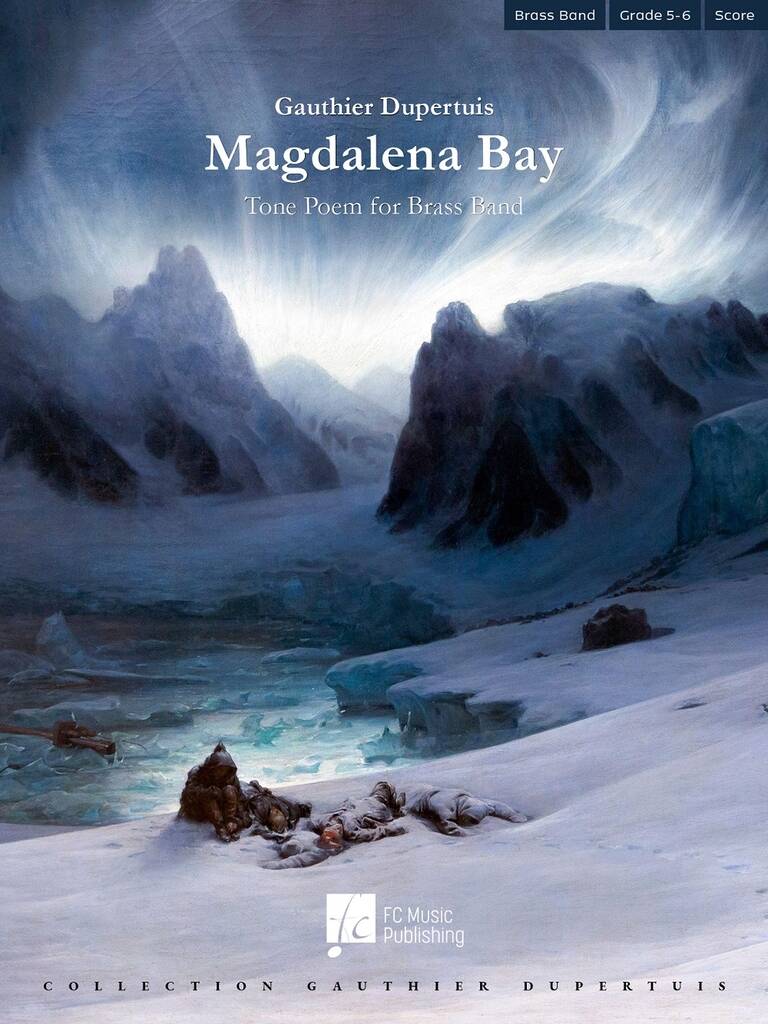
DURATION: 14'00". DIFFICULTY: 1st+. 'Amundsen' was commissioned by rskog Brass, Norway for their winning performance at the 2020 Norwegian National Championships held at the Grieghallen in Bergen. In December 1911, Norwegian Roald Amundsen gained global fame by becoming the first explorer to lead a team to the geographic South Pole. Amundsen and 4 other members of his team arrived 5 weeks ahead of a rival team from the UK led by Robert Falcon Scott, all of which perished on their attempted return from the pole. Initially when Amundsen's team set out in 1910, they were under the impression that they would be making the far shorter journey to the arctic drift to attempt to reach the North Pole, but Amundsen had received news that American explorers Peary and Cook had beaten them to this goal, and so Amundsen's focus changed southward. 'Fram, Forward' - 'Fram' (translating to English as "forward") was the name of the ship Amundsen used for this particular polar expedition. Amundsen had only informed 2 people of his real intentions of conquering the South Pole when the ship first left port in Kristiansand before heading south to the Portuguese island of Madeira in the Atlantic Ocean. After weeks at sea - causing the uninformed members of the crew to raise a number of questions and produce a general feel of uncertainty and low spirits - it was here that Amundsen announced his true plans to the rest of his crew. They were asked whether they wished to continue with their expedition, to which all - some begrudgingly - agreed to sail on to the South Pole, through the great Ice Barrier before docking in the Bay of Whales on the Ross Ice Shelf. 'Ross Ice Shelf' - Upon Amundsen's arrival in the Bay of Whales, the team were greeted by the sight of the enormous ice plateau's and glaciers, towering into the Antarctic sky. In 1907, Ernest Shackleton had attempted - and failed - to reach the South Pole, but his route and mapping was by now well documented. Scott and the UK team were to follow this route, whereas Amundsen and his men forged their own way to the pole through unchartered territory and deadly terrain littered with deep crevasses and canyons. The music here though, is a picture of tranquility. The eerie silence of total emptiness with only the heavy snow falling around Amundsen as Fram and the Bay of Whales disappears into the distance, faced by the maginute of the expedition ahead. 'Advance to Polheim' - The first new challenge Amundsen discovered on this route was a rough, sharp and extremely steep glacier (which was later named the Axel heiberg Glacier after the Norwegian monarch who funded much of the expedition), which would take his team up from sea level to an altitude of over 9,000ft in just 20 miles, with most of this over just 7 miles. Once scaled, only the vast Antarctic Plateau stood between Amundsen and the pole. Here the race began, with only one aim - victory for himself, his team, and for the whole of Norway. .
In Stock: Estimated dispatch 1-3 working days
-
£110.00
Red Lines (Bra) - Stijn Aertgeerts
Red Lines was commissioned by the Swiss Army Brass Band and their conductor Philipp Werlen. The title is a reference to their very distinctive black uniforms with Red vertical lines. Switzerland is a country with a tremendously rich brass band culture and have some of the best bands in the world. The individual level of musicians is also of incredibly high quality. The work begins very bombastically with continuous 8th notes. This immediately sets the drive for the entire first movement where the low brass can also show off huge sounds several times. It culminates in a grand tutti before the music calms down in the second movement where the euphonium can show its solistic qualities and the band can show a big difference in dynamics and sound. The final movement is driven by the drums and timpani that provide a solid boost to keep moving the thematic material forward in the band and through the percussion solo a big build-up to a glorious finale.
Estimated dispatch 7-14 working days