
Results
-
 £24.95
Of Whom I Sing Jeg Elsker Dig (Brass Band - Score and Parts) - Grieg, Edvard - Ballantine, Leonard
The original, Jeg elsker Dig, is a plaintive love song for voice and piano with words by Hans Christian Anderson; 'You have become thought of my thought, you are my heart's first love. I love you, as no one here on earth, I shall love you through time and eternity!'
Estimated dispatch 7-14 working days
-
£12.50
Of Whom I Sing Jeg Elsker Dig (Brass Band - Score only) - Grieg, Edvard - Ballantine, Leonard
The original, Jeg elsker Dig, is a plaintive love song for voice and piano with words by Hans Christian Anderson; 'You have become thought of my thought, you are my heart's first love. I love you, as no one here on earth, I shall love you through time and eternity!'
Estimated dispatch 7-14 working days
-
 £30.00
Voi Che Sapete (from The Marriage of Figaro) (Euphonium Solo with Brass Band - Score and Parts) - Mozart, Wolfgang Amadeus - Littlemore, Phillip
Mozart's opera, The Marriage of Figaro, was based on what was a rather scandalous play by Pierre Beaumarchais, because the drama involves an incompetent nobleman being upstaged by a crafty, quick-witted servant named Figaro, in their quest for the same woman. The action takes place in just one day and offers a series of awkward and humorous situations, complete with a vibrant dialogue between the all the main characters. Voi Che Sapete?is performed by Cherubino, who is about to be sent off to the army because the Count finds him a nuisance. When Cherubino appears before the Countess and Susanna to tell them of his fate, this aria is sung at the request of Susanna for a love song. Cherubino is characterized as a young adolescent who is in love with every woman he meets, and because his voice is yet unbroken, he is always played by a female singer.?Duration: 2:30
Estimated dispatch 7-14 working days
-
 £30.00
Voi Che Sapete (from The Marriage of Figaro) (Vocal Solo (Soprano) with Brass Band - Score and Parts) - Mozart, Wolfgang Amadeus - Littlemore, Phillip
Mozart's opera, The Marriage of Figaro, was based on what was a rather scandalous play by Pierre Beaumarchais, because the drama involves an incompetent nobleman being upstaged by a crafty, quick-witted servant named Figaro, in their quest for the same woman. The action takes place in just one day and offers a series of awkward and humorous situations, complete with a vibrant dialogue between the all the main characters. Voi Che Sapete?is performed by Cherubino, who is about to be sent off to the army because the Count finds him a nuisance. When Cherubino appears before the Countess and Susanna to tell them of his fate, this aria is sung at the request of Susanna for a love song. Cherubino is characterized as a young adolescent who is in love with every woman he meets, and because his voice is yet unbroken, he is always played by a female singer.?Duration: 2:30
Estimated dispatch 7-14 working days
-
 £94.95
An Age of Kings (Mezzo-Soprano Solo with Brass Band and optional choir - Score and Parts) - Gregson, Edward
The origins of this work date back to 1988, when I was commissioned by the Royal Shakespeare Company to write the music for The Plantagenets trilogy, directed by Adrian Noble in Stratford-upon-Avon. These plays take us from the death of Henry V to the death of Richard III. Later, in 1991, I wrote the music for Henry IV parts 1 and 2, again in Stratford. All of these plays are concerned with the struggle for the throne, and they portray one of the most turbulent periods in the history of the British monarchy.Much of the music used in these productions was adapted into two large symphonic suites for wind band - The Sword and the Crown (1991) and The Kings Go Forth (1996). An Age of Kings is a new version for brass band incorporating music from both the symphonic suites for wind band. It was specially composed for a recording made by the Black Dyke Band, conducted by Nicholas Childs, in 2004.An Age of Kings is music on a large-scale canvas, scored for augmented brass band, with the addition of harp, piano, mezzo-soprano solo, male chorus, as well as two off-stage trumpets. The music is also organized on a large-scale structure, in three movements, which play without a break - "Church and State", "At the Welsh Court", and "Battle Music and Hymn of Thanksgiving".The first movement, "Church and State", opens with a brief fanfare for two antiphonal trumpets (off-stage), but this only acts as a preface to a Requiem aeternam (the death of Henry V) before changing mood to the English army on the march to France; this subsides into a French victory march, but with the English army music returning in counterpoint. A brief reminder of the Requiem music leads to the triumphal music for Richard Plantagenet, Duke of York, father of Edward IV and Richard III (the opening fanfare transformed). However, the mood changes dramatically once again, with the horrors of war being portrayed in the darkly-drawn Dies Irae and Dance of Death, leading to the final section of the first movement, a funeral march for Henry VI.The second movement, "At the Welsh Court", takes music from the Welsh Court in Henry IV part 1 with a simple Welsh folk tune sung by mezzo-soprano to the inevitable accompaniment of a harp. This love song is interrupted by distant fanfares, forewarning of battles to come. However, the folk song returns with variation in the musical fabric. The movement ends as it began with off-stage horn and gentle percussion.The final movement, "Battle Music and Hymn of Thanksgiving", starts with two sets of antiphonally placed timpani, drums and tam-tam, portraying the 'war machine' and savagery of battle. Trumpet fanfares and horn calls herald an heroic battle theme which, by the end of the movement, transforms itself into a triumphant hymn for Henry IV's defeat of the rebellious forces.- Edward GregsonDuration - 22'00"Optional TTBB available separately.
Estimated dispatch 7-14 working days
-
 £56.00
City Lights (Brass Band - Score and Parts) - Fernie, Alan
A Love Song to Edinburgh
Estimated dispatch 7-14 working days
-
 £15.99
Tis the Last Rose of Summer (Flugel Horn Solo with Brass Band - Score and Parts) - Westwood, Gary
It is often thought that 'Tis the Last Rose of Summer came from the Victorian era, when Irish songs were very popular. However this was first published in 1813 and has been adapted and arranged by many composers and arrangers over the years. This arrangement, as a Flugel Horn solo, by Gary Westwood reveals the tenderness in this wistful love song. Suitable for Advanced Youth/3rd Section Bands and above. Duration: 5.00
Estimated dispatch 7-14 working days
-
 £50.90
POKAREKARE ANA (Brass Band) - Lorriman, Howard
Maori Love Song. Grade: Easy. Recorded on Obrasso CD954 Forever Shining (Black Dyke Band conducted by Nicholas J Childs)
Estimated dispatch 7-14 working days
-
£50.90
POKAREKARE ANA (Trombone or Eb Soprano Cornet Solo with Brass Band) - Richards, Goff
Love Song. Grade: Easy/Medium.
Estimated dispatch 7-14 working days
-
 £105.20
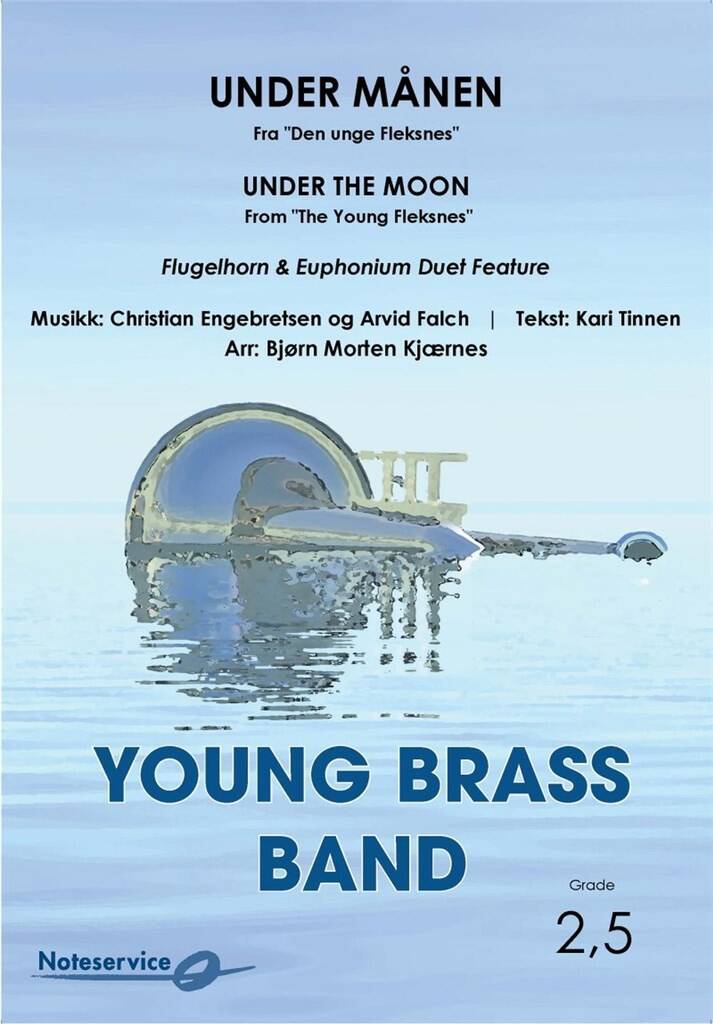
Under manen (Fra Den unge Fleksnes) - Christian Engebretsen - Bjorn Morten Kjaernes
This has become a Christmas song that has its roots in a love duet between the young Fleksnes and classmate Victoria. The class will be competing with a duet in a song competition. The text gives hope of love and links it to Christmas traditions. "A Dream of Christmas, About Love" is the first line of the text. "The Young Fleksnes" runned as advent calender on TV Norge in 2010. This arrangement feature an flugelhorn soloist and a euphonium soloist. Please be aware of the dynamics between soloists and accompaniment. Adjust the dynamics according to the musicians in the ensemble.
Estimated dispatch 5-14 working days
 View Music