
Results
-
 £119.99
The Binding of the Wolf - Torstein Aagaard-Nilsen
This piece was commissioned by Nordhordland Brass Seminar in 1990 and written for a youth band. The title referes to a story from norse mythology. "The Binding of the Wolf" is not a programmatic piece of music, but I felt that there was a kind of coherence between the music and the dramatic story: "...The wolf Fenrir was one of the demonic offspring of Loki, and as he grew up in Asgard among the gods, he became so huge and fierce that only Tyr was willing to feed him. It was decided that he must be bound, and Odin in his wisdom caused the cunning dwarfs to forge a chain which could not be broken. It was made from the invisible and yet potent powers ofthe world, such as the roots of a mountain, the noise of a moving cat, the breath of a fish. When completed, this chain seemed to be no more than a silken cord, but the wolf refused to let it be laid upon him unless one of the gods would put a hand between his jaws as a pledge that it was harmless. Only Tyr was prepared to do this, and when the wolf found that the chain was unbreakable, the gods rejoiced, but Tyr lost his hand. The binding of the wolf may be seen as a means of protecting the world of men, as well as that of the gods, from destruction. The story of the god losing his hand appears to be one of the fundamental myths of nothern Europe..."
Estimated dispatch 5-14 working days
-
 £65.00
Lyonesse. - Simon Dobson
Lyonesse was commissioned by the Brass Band Heritage Trust as the test piece for the Finals of the National Youth Brass Band Championships held in Manchester in April 2005. This atmospheric music, ideal as atest piece for First and Second section bands, takes its inspiration from the lost kingdom of Lyonesse, the mythical spur of land linking Cornwall and the Scilly Isles, and its associated legend of Tristan and Isolde. BrassBand Grade 5: 1st Section Duration: 13 minutes
Estimated dispatch 5-14 working days
-
 £95.00
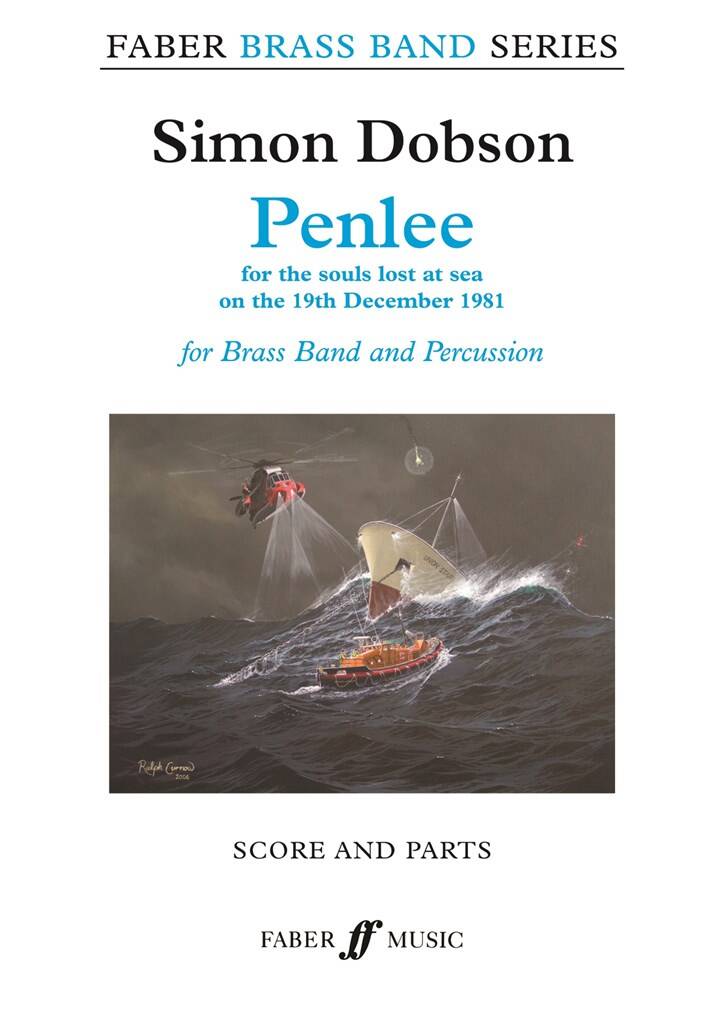
Penlee - Simon Dobson
To some, the tragic story of the Penlee lifeboat, Solomon Browne, would need no introduction, and to some the pain felt is still very much a reality. The composer, born just a few weeks before that fateful night on the19th December 1981, has created this work as a musical homage to the bravery of the souls who lost their lives and has dedicated it to their memory. Penlee was commissioned by the Cornwall Youth BrassBand using funds bequeathed by Michael Pickett. The first performance was given by the Cornish Youth Brass Band, conducted by Ian Porthouse, at St. Michael's Church, Newquay, on 30th December 2008.Penleehas been voted into the Classic FM Hall of Fame 2011 at No.106. Not only is it the first time a brass work has been featured in the Hall of Fame, but it was also thehighest new entry. The work has subsequently been recorded by the Leyland Band, conducted by Jason Katsikaris, on the CD entitled Penlee.Brass Band Grade 4: Advanced Youth and 3rd Section Duration: 13 minutes
Estimated dispatch 5-14 working days
-
 £105.20
Jyn Erso Theme - Michael Giacchino - Idar Torskangerpoll
After seven soundtracks written by John Williams for the Star Wars. the music for Rogue One A Star Wars Story is composed by Michael Giacchino. Giacchino is one of the leading composers of film music today with soundtracks for "The Incredibles", "Star Trek", Zootropolis", "Inside Out", and TV-series "Lost" as his greatest achievements. With his music to "Rogue One", Giacchino puts his own mark on the new Star Wars movie but with natural influences by "the master" himself John Williams.. Jyn Erso Theme portraits one of the new characters of the "Rogue One" movie. British actress Felicity Jones plays the role of Jyn Erso in "Rogue One"
Estimated dispatch 5-14 working days
-
 £79.95
Neverland - Christopher Bond
"All children, except one, grow up" wrote J.M. Barrie about Peter Pan in 1911; the first line and an expression of beautiful melancholy and fantasy, coming to represent one of the best-loved children's stories of the twentieth century. 'Peter & Wendy', as the book was first released, has subsequently been transformed into adaptations for film and stage, with subsequent books based on this iconic tale. In writing this new work for brass band, the composer has taken three of the main themes from J. M. Barrie's book, and used these themes to create new musical material, forming a work in three contrasting sections. I. Journey to Neverland The opening of the work, mysterious in its style, reflects the opening chapters of the story - a leafy London street, still in the dead of night - with the music transforming quickly as it builds in texture and momentum - a Journey to Neverland through the night sky; Second Star to the Right and straight on 'til morning. "Then Peter knew that there was not a moment to lose. 'Come,' he cried imperiously, and soared out at once into the night, followed by John and Michael and Wendy. Mr & Mrs Darling and Nana rushed into the nursery too late. The birds were flown." II. The Windows that Closed The central section of the work takes its inspiration from the sense of longing throughout the book, mainly by Peter Pan, the Darling Children & The Lost Boys. Distant memories of life before Neverland, memories of the Lost Boys' mothers, and regret at what the children have missed. Peter says "Long ago, I thought like you that my mother would always keep the window open for me; so I stayed away for moons and moons and moons, and then flew back; but the window was barred, for mother had forgotten all about me, and there was another little boy sleeping in my bed." III. Aboard the Pirate Ship The final section of the work takes its inspiration from the Pirate Ship, and Peter Pan's ultimate battle with its infamous Captain Hook. "In person, he was cadaverous and blackavized, and his hair was dressed in long curls, which at a distance looked like black candles, and gave a singularly threatening expression to his handsome countenance. His eyes were the blue of the forget-me-not, and of a profound melancholy, save when he was plunging his hook into you, at which time two red spots appeared in them and lit them up horribly."
Estimated dispatch 10-14 working days
-
 £34.99
Submerged... (Cornet Concerto No.2) - Jonathan Bates
'Submerged..' is a virtuoso concerto for Cornet composed as a response to the 'lost' Derbyshire villages of Ashopton & Derwent,. both of which were drowned in the early 1940's to make way for a new reservoir to aid the ever-increasing water demand from nearby. Sheffield and it's steel industry during World War 2. The work is through-composed but is defined by 3 clear main sections, 'The . Packhorse Bridge, Derwent', 'Ashopton Chapel' and 'Operation Chastise'. Much of the melodic and harmonic material throughout the. concerto is inspired by 3 contrasting sources; an original motif of towering block chords which opens the concerto, the famous opening. fragment of Eric Ball's 'High Peak' (1969) which was composed as a tribute to the district of Derbyshire where Ashopton & Derwent lie, . and finally Claude Debussy's haunting 'La Cath drale Engloutie' or 'The Sunken Cathedral', which was composed in 1910 around the legend of. the submerged cathedral of Ys. . I. Packhorse Bridge, Derwent (1925). One of the most striking features of the former village of Derwent was it's Packhorse Bridge, which spanned the River Derwent. adjacent to the Derwent Hall - a grand, picturesque Jacobean country house. In 1925, the renowned impressionist artist Stanley. Royle painted a striking image of the two in midwinter, with the partially frozen river sat quietly underneath the snow-topped. bridge in the foreground, while the old hall sits peacefully and dark in the background. The opening setion of this concerto paints. this picture in a quite schizophrenic manner; with frosty, shrill march-like material picturing the villagers crossing the narrow icy. bridge, combined with wild and frenzied waltz music of the grand hall and it's masquerade balls laying, for now, quietly mysterious. across the river. . II. Ashopton Chapel (1939). Ashopton was much the smaller and less-populated of the 2 'lost' villages, but still bore home to a Roman Catholic Chapel which was. the focal point of the village. The chapel - along with the rest of Ashopton - was drowned in 1943, but the final service to take place there. was held in 1939, with the final hymn being 'Day's Dying in the West'. This hymn forms a haunting coda to the 2nd section, with firstly the . piano leading the melody before an audio track containing an old recording of the hymn is accompanied by the sound of flowing water and . the rumble of storms as the village hypothetically disappears from existence with the hymn tune still echoing around the valley, before . subsiding into the growing roar of the engine of a Lancaster Bomber as it soars overhead towards Derwent to practise it's 'Dam-Buster' raid. . III. Operation Chastise (1943). The Derwent Reservoir lies adjacent to Ladybower Reservoir (of which Ashopton & Derwent were flooded to make way for) in the . Derbyshire High Peak, and during the 2nd World War was used as one of the central low-atitude practise areas of the 617 Squadron - more . commonly known affectionately as the 'Dambusters'. Before the destruction of Derwent, it's 'Packhorse Bridge' was dismantled stone by stone . and re-assembled upstream at Howden Dam to the north end of Derwent Reservoir. This is where the music begins, with a reconstruction of . the opening material before taking flight into a whirlwind tour of virtuosity from the soloist. .
In Stock: Estimated dispatch 1-3 working days
-
 £37.35
World War III (Brass Band) Joe Galuszka
This descriptive work for brass band by Joe Galuszka depicts the horrors of war. War is all around us. Every day, another life is lost. Myanmar, Sudan, Ethiopia, Ukraine, Colombia, Afghanistan, Somalia, Syria and Yemen. As time goes on, more and more countries are brought to the end of what is a diplomatic struggle - in where war seems to be the only option. 'War! Terror! Panic! captures the tumultuous and relentless nature of war. With driving rhythms, aggressive brass fanfares, and thundering percussion, the listener is immersed in the chaos of battle. Dissonance and clashing harmonies depict the discord that pervades war and takes us on a journey through the terror and panic that comes with the brutality of conflict. Remembrance (For Those That We Have Lost) provides a poignant and reflective interlude, allowing the audience to contemplate the human cost of war. Mournful melodies and expressive solos for trombone, euphonium and glockenspiel, convey the depth of sorrow and loss, serving as a powerful reminder of the toll war takes on individuals and communities. The final movement, Hymn for Peace and Hope is a testament to the enduring human spirit and the yearning for harmony - dissonance and conflict gradually give way to consonance and resolution. We celebrate the human capacity for unity and the triumph of peace over strife, as we imagine a world at piece. To listen to an audio demo of the work please visit https://on.soundcloud.com/Udt1AWRThgwuWnQv5 Duration: Approx. 5.00 mins Difficulty Level: 2nd Section + PDF download includes parts and score. Sheet music available from www.brassband.co.uk (UK) or https://satradecentral.org (USA) Instrumentation: Soprano Cornet Eb Solo Cornet Bb Repiano Cornet Bb 2nd Cornet Bb 3rd Cornet Bb Flugel Horn Bb Solo Horn Eb 1st Horn Eb 2nd Horn Eb 1st Baritone Bb 2nd Baritone Bb 1st Trombone Bb 2nd Trombone Bb Bass Trombone Euphonium Bb Bass Eb Bass Bb Timpani Percussion 1-3
In Stock: Estimated dispatch 1-3 working days
-
£35.00
Epitaph (for Hillsborough) - Peter Meechan
Epitaph (for Hillsborough) was written on the 20th anniversary of the Hillsborough stadium disaster, April 15 1989, in memory of the 96 victims. All of the victims were fans of Liverpool Football Club, the club I have supported since I was a young child.The disaster unfolded in front of the BBC television cameras, and due to the importance of the match (FA Cup semi final), millions, including myself, witnessed it first hand, leaving a lasting impression in the public psyche.Several features of the piece were determined by the tragedy. The length of the piece, 6 and a half minutes, represents the minutes of the game that were played that day (The match was abandoned after 6 minutes), and the final thirty seconds of the work, where the band gently applaud, is a reference to the first match played after the tragedy, a European Cup semi final between AC Milan and Real Madrid.After 6 minutes, the referee blew his whistle and all the players stood still where they were, both sets of fans applauded in memory of the perished, and the fans of AC Milan began singing Youall Never Walk Alone, the anthem of Liverpool Football Club.The work also features 96 strikes of the tubular bells, in memory of each person who lost their life.Epitaph is dedicated to the 96 people who died that day, and to their families whose fight for justice is an inspiration to all.
Estimated dispatch 12-14 working days
-
 £48.40
Alchemists' Fire - Lucy Pankhurst
An original composition from Lucy Pankhurst and Winner of the 2011 John Golland Award, receiving its premiere at the RNCM Festival of Brass that same year.It is a complex, energetic and invigorating major work for brass band, and one which rightly demands attention through its intricate scoring, impact-making effects and bubbling brilliance!Comments from the composer on the work's title and its multi-purpose influence and inspiration upon her composition:"The phrase "Alchemists' Fire" has several possible connotations:Firstly, Alchemists' Fire is a magical weapon featured in the Dungeons & Dragon role playing game. It is a potion, so can be used to splash, throw or pour onto a target, dealing fire damage if it hits successfully.The second possible meaning comes from an historical source, where it was also known as Greek Fire, from which the D&D element takes its influence. This was an incendiary weapon used by the Byzantine Empire, typically used in naval battles to great effect, as it could continue to burn on water. It provided a technological advantage and was responsible for many key Byzantine victories. The manufacture of this 'fire' was kept a deadly secret; so much so that the formula was eventually lost and contemporary scientists and historians can only speculate at what the chemical make-up might have been.The final implication is a much more visual and sensory concept; that of the fire actually used by the Alchemist in his work - raging, dangerous and white-hot. Some sections of the work reflect the idea of 'magic' and ongoing experiments, some successful, some failing dangerously, in a cacophony of pops, fizzes and explosions amidst furious heat and brief moments of calm as the fire slowly cools, sizzling with residual components and elemental energy."
In Stock: Estimated dispatch 3-5 working days
-
 £67.24
Armistice at Flanders Fields (Brass Band) Dwayne Bloomfield
This poignant and powerful work for brass band by Dwayne Bloomfield describes the day peace was announced to end World War I. The piece was written in 2023 to be played by bands around the world to mark Armistice Day. The composer writes: 'Unless you were there, it's impossible to imagine what it must have been like the day peace was announced ending World War I. The feelings soldiers experienced, who after years of fighting and suffering, to know it was over and they would return home to see family and loved ones again. This piece tries to tell their story. The work begins by approaching the front, distant artillery and battle sounds heard while the carnage and loss of lives was already known to the world. The band builds as we enter the thick of battle, the death and destruction, the conditions faced and the loss of hope of ever surviving. The next section, in 7/8 time, reflects the two sides fighting - both sides attacking and defending with mostly little result, but for the loss of more lives. Two euphoniums then depict the news and hope of peace talks. However, fighting did continue right up to the very end and on the last day there would be another 2,738 casualties. The Canadians were still battling to capture the town of Mons that morning. A song is sung in reflection of the estimated 5.5 million allied soldiers who lost their lives during World War I, then a clock ticks down the final minutes. The last three known casualties are depicted with French soldier Augustin Trebuchon, killed at 10:45am by a single shot as he rushed down the trenches to spread the news of coming peace; Canadian George Lawrence Price killed by a sniper round at 10:58am at the battle of Mons, and lastly a machine gun burst that killed American Henry Gunther, who is believed to have fallen on the 11th hour. Bells then toll ringing around the world announcing the end of the war. After years of war, it must have been jubilation for the families at home knowing their loved ones would be returning to them. The band builds with a hymn for peace as a final tribute to those who fought, before the piece resides with one of the most dreaded sounds at that time, the knock on the door from a telegram delivery boy or better known then as the Angels of Death. It wasn't just the 2,738 families from the casualties of the last day who would receive such a knock, but many more who expected their loved ones to be returning home would instead find out they were instead killed in the last weeks. So close. Driving around the battlefields today one comes across many intersections in the countryside which have cemetery signposts pointing in every direction. While the last post sounds in ceremonies today, this last bugle call instead depicts the horrors, devastation and death the soldiers faced during the war and right up the 11th hour of the 11th day of the 11th month, Armistice at Flanders Fields.' To view a video of Dallas Brass Band performing the work please visit https://www.youtube.com/watch?v=ljfyVz3cMgk Duration: Approx. 15.00 minutes Difficulty Level: 2nd Section + PDF download includes parts and score. Sheet music available from www.brassband.co.uk Instrumentation: Soprano Cornet Eb Solo Cornet Bb Repiano Cornet Bb 2nd Cornet Bb 3rd Cornet Bb Flugel Horn Bb Solo Horn Eb 1st Horn Eb 2nd Horn Eb 1st Baritone Bb 2nd Baritone Bb 1st Trombone Bb 2nd Trombone Bb Bass Trombone Euphonium Bb Bass Eb Bass Bb Percussion 1-3
In Stock: Estimated dispatch 1-3 working days
 View Music