
Results
-
 £44.95
Themes from The New World Symphony (Brass Band - Score and Parts) - Steadman-Allen, Ray
For three years the Czech composer Dvorak lived and worked in America and this, his ninth and last symphony, contains impressions of that continent. This arrangement for brass band follows the scheme of the original in movement order and theme presentation although a certain amount of 'condensing' of material has naturally been inevitable.
Estimated dispatch 7-14 working days
-
£22.50
Themes from The New World Symphony (Brass Band - Score only) - Steadman-Allen, Ray
For three years the Czech composer Dvorak lived and worked in America and this, his ninth and last symphony, contains impressions of that continent. This arrangement for brass band follows the scheme of the original in movement order and theme presentation although a certain amount of 'condensing' of material has naturally been inevitable.
Estimated dispatch 7-14 working days
-
 £54.99
The Show Must Go On (Brass Band - Score and Parts) - Foster, Larry
The Show Must Go On was one of the last hits for Freddie Mercury in 1991, the year of his death. In this context the title has a tragic significance. This arrangement will please both musicians and audiences and will throw off the sad associations of this song.Duration: 3:45
Estimated dispatch 7-14 working days
-
 £44.95
The Great Race (Euphonium Solo with Brass Band - Score and Parts) - Graham, Peter
Finale from In League with Extraordinary GentlemenThe Great Race, for solo euphonium and band, follows Phileas Fogg on the last stage of his epic journey "Around the World in Eighty Days" (from the novel by Jules Verne). The moto perpetuo nature of the music gives full rein to the soloist's technical virtuosity. As the work draws to a conclusion, the frantic scramble by Fogg to meet his deadline at the Reform Club in Pall Mall, London, is echoed by the soloist's increasingly demanding ascending figuration, set against the background of Big Ben clock chimes.
Estimated dispatch 7-14 working days
-
 £134.99
Sinfonietta: The Town Beneath the Cliff (Brass Band - Score and Parts) - Sparke, Philip
Sinfonietta: The Town Beneath the Cliff was commissioned by Holmestrand Ungdomskorps from Vestfold in Norway. The work is in four movements: a spectacular fanfare followed by a moto perpetuo-like toccata. The third movement Hymn is a beautiful piece of music allowing the band to show its musicality and sound. The last movement Scherzo Finale opens with a short phrase from Holmestrand's own town song, Holmestrandsangen, which comes again in full at the end of the piece, accompanied by a florid passage based on the opening theme.Duration: 13.45
Estimated dispatch 7-14 working days
-
 £37.95
The Accursed Huntsman (Brass Band - Score only) - Franck, Cesar - Siebert, Edrich
This work was composed by Cesar Franck in 1881, and was inspired by Burger's Ballade. The dramatic and religious character of the Poem is set from the beginning by the horns and later, by the bells.The approaching Ride is preceded by a broader passage and then, in a quick 9/8 rhythm the horns are heard again, answered by the cornets and the trombones.After some agitated passages there is a brilliant Andante movement after which the rhythm becomes more and more animated.At last the Ride appears, the gallop becoming wilder and wilder until it finally dies away in a chilling roll on the cymbal.
Estimated dispatch 7-14 working days
-
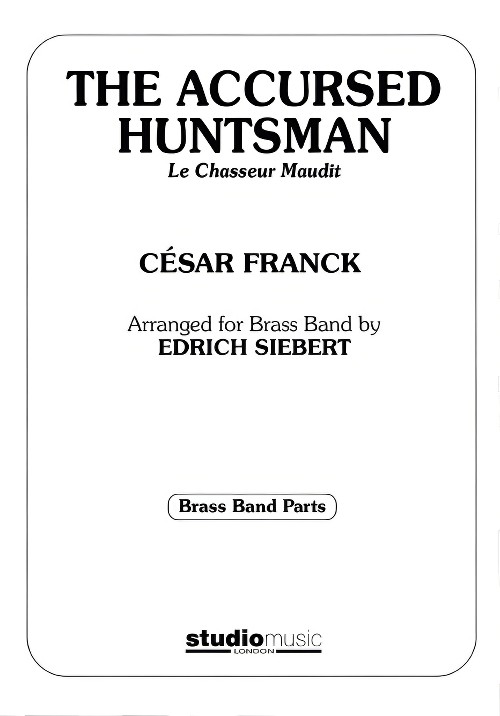 £74.95
The Accursed Huntsman (Brass Band - Score and Parts) - Franck, Cesar - Siebert, Edrich
This work was composed by Cesar Franck in 1881, and was inspired by Burger's Ballade. The dramatic and religious character of the Poem is set from the beginning by the horns and later, by the bells.The approaching Ride is preceded by a broader passage and then, in a quick 9/8 rhythm the horns are heard again, answered by the cornets and the trombones.After some agitated passages there is a brilliant Andante movement after which the rhythm becomes more and more animated.At last the Ride appears, the gallop becoming wilder and wilder until it finally dies away in a chilling roll on the cymbal.
Estimated dispatch 7-14 working days
-
£24.50
Hey Presto! - Gerry McColl
This new gem of a solo for Euphonium is a rousing piece from start to finish. Starting with heavy syncopation from the band before the soloist can show off with this catchy little tune that you will be whistling for days (if you can whistle that fast!) The middle section then breaks into a beautiful legato tune for the soloist up in the top register, whilst the rest of the band keep on ploughing away underneath. The original tune then returns after a modulation and finishing with the soloist showing off their chromatic runs in the last couple of bars. This is one of the best new entertaining solos around.
In Stock: Estimated dispatch 1-3 working days
-
£29.50
March - Civic Society - Various - Alexander Scaife-McGee
Civic society is a March written by Alexander Scaife-McGeethat came to their mind on last year's Remembrance Parade. the band of the South Wales Police. It struck me that on parade were representatives of all the Armed Forces, the emergency services and the numerous varieties of Scouts, from Brownies to Venture Scouts. This March is therefore a celebration of all of those who make up Civic Society on these important occasions.Melodies included;British GrenadiersColonel BogeyThe RAF March PastRule BritanniaHeart of OakA Policeman's Lot is not a Happy OneGing Gang Goolie
In Stock: Estimated dispatch 1-3 working days
-
£29.50
Masquerade - Carl Nielson - Bill Willis
The opera, Masqurade, plot revolves around Leander and Leonora, two young persons who meet fortuitously at a masquerade ball, swear their undying love for each other and exchange rings. The following day, Leander tells a servant of his newfound love. He soon becomes distraught when informed by the servant that his parents have betrothed him in marriage to a neighbour's daughter. Things get complicated when Leonard, the neighbour whose daughter is the other part of the previously unknown arrangement, comes complaining to Leander's father that his daughter is in love with someone she met at the masquerade last night. In the third act, all is resolved when the various parties slip off to the night's masquerade, where all is revealed to everyone's mutual satisfaction. The overture is a stunning work, very entertaining for audiences and players alike.
In Stock: Estimated dispatch 1-3 working days
 View Music
 Listen to MP3