Results
-
£89.99Torsion (Brass Band - Score and Parts)
Torsion was commissioned by the Leyland Band and first performed on 23 January 2010 at the Royal Northern College of Music Festival of Brass, Manchester, by Leyland Band conducted by Jason Katsikaris. This colourful and dynamic work is the most personal and ambitious that Simon Dobson composed during his residency with the Lancashire brass band. The dictionary defines torsion as the state of being twisted and the composer interprets this as the imagined dis-torsions and con-torsions of Time, Light and Sound in three contrasting movements. Simon Dobson fuses the traditional brass band sound with drive and energy of pop and funk jazz with optional digitally distorted 'echoes' providing added aural confusion at the points of climax. Although composed as a substantial concert work, Torsion would also make a challenging test-piece for contesting brass bands in the elite divisions. Suitable for Championship Section Bands. Duration: 15.00
Estimated dispatch 7-14 working days
-
£95.00Variations on a Theme of Michael Tippett (Brass Band - Score and Parts) - Hindmarsh, Paul
A Centenary Tribute by Michael Ball, Edward Gregson, Elgar Howarth, Bramwell Tovey and Philip WilbyThis unique 'pice d'occasion' arose out of a telephone conversation in 2004 with Alan Wycherley, who was the soprano cornet player of the Foden's Richardson Band at the time. He indicated that the band would like to include an original birthday tribute for Edward Gregson (60) and Elgar Howarth (70) in its concert at the 2005 RNCM Festival of Brass in Manchester. I have been Artistic Director of Manchester's Festival of Brass since it was established in 1990 as a BBC Radio 3 series, As the centenary of the birth of Sir Michael Tippett fell on 5 January 2005, I devised this collective work as a way of embracing all three anniversaries in a novel way.The idea of joint compositions is not a new one in the classical music world. In the 1860s, Verdi was joined by a number of his contemporaries in a Requiem Mass for Rossini. In this country there have been a number of orchestral examples over the past fifty years, but never before for the brass band. Although Tippett composed only one work for brass band, Festal Brass with Blues, his orchestral works and operas are full of idiomatic brass writing. The theme I chose for this celebration is one of Tippet's most memorable miniatures featuring wind and brass. In the opera Midsummer Marriage it marks the entry of the Ancients. It is also included in the orchestral Suite in D (1948), for the Birthday of Prince Charles.I invited five of the leading contemporary voices in brass band music to add their own creative perspectives to the little Tippett theme, with it's characteristic rhythms, embellishments and modality - the Lydian mode. Each contribution was designed to fit into a tonal and formal template to give the whole work a flow and continuity. In Danse des Amis, Bramwell Tovey has composed a jazzy, humorous variation. Inspiration came from Tippett's love of jazz and, more personally, from the characteristically syncopated gait of the distinguished music critic John Amis, who Tovey once observed leaving a performance of Tippett's opera King Priam before the end. Incidentally, that performance was conducted by Elgar Howarth.We hear Edward Gregson in lyrical mode. His Midsummer Song is redolent of the sound world of Tippett's opera A Midsummer Marriage and it ends with a brief reference to a favourite of Gregson's, Tippett's Concerto for Orchestra. Michael Ball provides a brief moment of light, airy activity bringing to mind perhaps Tippett's love of Shakespearian fantasy, especially The Tempest. Elgar Howarth juxtaposes a slowed down version of the processional theme with distant recollections of fanfares from King Priam. Philip Wilby has rounded the tribute off with a spectacular fugue. During its inexorable progress Wilby ingeniously introduces the two other birthday references - the three-note musical signature that Elgar Howarth includes in much of his music and the characteristic theme which begins Edward Gregson's substantial work for brass an organ The Trumpets of the Angels. An elaborated reprise of Tippett's little theme is followed by a dynamic coda.- Paul HindmarshDuration: 13.00
Estimated dispatch 7-14 working days
-
£40.00Variations on a Theme of Michael Tippett (Brass Band - Score only) - Hindmarsh, Paul
A Centenary Tribute by Michael Ball, Edward Gregson, Elgar Howarth, Bramwell Tovey and Philip WilbyThis unique 'pice d'occasion' arose out of a telephone conversation in 2004 with Alan Wycherley, who was the soprano cornet player of the Foden's Richardson Band at the time. He indicated that the band would like to include an original birthday tribute for Edward Gregson (60) and Elgar Howarth (70) in its concert at the 2005 RNCM Festival of Brass in Manchester. I have been Artistic Director of Manchester's Festival of Brass since it was established in 1990 as a BBC Radio 3 series, As the centenary of the birth of Sir Michael Tippett fell on 5 January 2005, I devised this collective work as a way of embracing all three anniversaries in a novel way.The idea of joint compositions is not a new one in the classical music world. In the 1860s, Verdi was joined by a number of his contemporaries in a Requiem Mass for Rossini. In this country there have been a number of orchestral examples over the past fifty years, but never before for the brass band. Although Tippett composed only one work for brass band, Festal Brass with Blues, his orchestral works and operas are full of idiomatic brass writing. The theme I chose for this celebration is one of Tippet's most memorable miniatures featuring wind and brass. In the opera Midsummer Marriage it marks the entry of the Ancients. It is also included in the orchestral Suite in D (1948), for the Birthday of Prince Charles.I invited five of the leading contemporary voices in brass band music to add their own creative perspectives to the little Tippett theme, with it's characteristic rhythms, embellishments and modality - the Lydian mode. Each contribution was designed to fit into a tonal and formal template to give the whole work a flow and continuity. In Danse des Amis, Bramwell Tovey has composed a jazzy, humorous variation. Inspiration came from Tippett's love of jazz and, more personally, from the characteristically syncopated gait of the distinguished music critic John Amis, who Tovey once observed leaving a performance of Tippett's opera King Priam before the end. Incidentally, that performance was conducted by Elgar Howarth.We hear Edward Gregson in lyrical mode. His Midsummer Song is redolent of the sound world of Tippett's opera A Midsummer Marriage and it ends with a brief reference to a favourite of Gregson's, Tippett's Concerto for Orchestra. Michael Ball provides a brief moment of light, airy activity bringing to mind perhaps Tippett's love of Shakespearian fantasy, especially The Tempest. Elgar Howarth juxtaposes a slowed down version of the processional theme with distant recollections of fanfares from King Priam. Philip Wilby has rounded the tribute off with a spectacular fugue. During its inexorable progress Wilby ingeniously introduces the two other birthday references - the three-note musical signature that Elgar Howarth includes in much of his music and the characteristic theme which begins Edward Gregson's substantial work for brass an organ The Trumpets of the Angels. An elaborated reprise of Tippett's little theme is followed by a dynamic coda.- Paul HindmarshDuration: 13.00
Estimated dispatch 7-14 working days
-
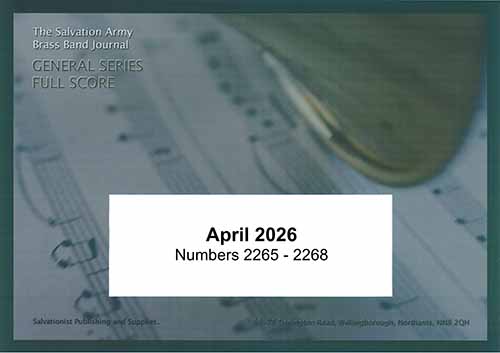
£77.00General Series Brass Band Journal, Numbers 2234 - 2237, August 2023
2234: Festival March - Above all names (Geoff McCorriston)This Festival March was originally written for the Camberwell Citadel Band, Melbourne, Australia. This composition marks the composers debut within our band journals. Geoff McCorriston served as Deputy Bandmaster at Preston Corps (Australia) for many years before joining the Camberwell Citadel Band. He has also been a member of the Melbourne Red Shield Band. Above all names is distinct from a standard street march in that it is more developed, both rhythmically and thematically. It is an original march that references We plough the fields and scatter (S.A.S.B. 70) and Camberwell (T.B. 182).2235: Flugel Horn Solo - Father, Creator (Simon Gash)Emma Pears has a gift for contemporary song-writing, with several of her songs featuring in the Sing to the Lord publication. The style and relaxed nature of the melody of Father, Creator (first published in the Children's Voices Series in 2011, and later in the Mixed Voices in 2014) seemed a perfect fit for the Flugel Horn. Throughout the piece, juxtaposed with Father, Creator, we hear snippets of the tune St Theodulph (T.B. 231), which outline the first lines of Albert Chesham's words, 'O Father and Creator, Thou God of perfect love' (S.A.S.B. 46).2236: A winter's carol (trs. Neil Smith)The history of the carol O come, Immanuel (C.C. 62) is, like the carol itself, a little mysterious! The melody was conceived as a monastic chant during the 8th century. It was not until 1851 that the priest and hymn writer John Mason Neale translated the verses into English, exposing the carol to a wider audience. There is an aura and enigmatic feel to this melody which is captivating to so many who hear it. This setting was originally conceived for wind band by American composer Mark Williams. The brass band transcription introduces a new name to our journals, Bandmaster Neil Smith, who is the Territorial Music Director for the USA Western Territory.2237: Mighty to keep (Eiliv Herikstad)Mighty to keep marks the composer's first publication since his Promotion to Glory in April 2023. Bandmaster Eiliv Herikstad served faithfully in his native Norway throughout his life, and since the early 1970s, has provided The Salvation Army with a wealth of original compositions and skilful arrangements. Eiliv explored many styles of big-band and jazz writing which, in the 70s, were not commonplace amongst brass bands, particularly in The Salvation Army. Music Editorial are grateful to Eiliv for using his gifts to support Salvation Army music ministry.The subject of this piece is Herbert Booth's song Mighty to keep, which was first published by The Salvation Army in 1889. The chorus of the song is more well-known that the verse and was included in the chorus section of the 1986 Salvation Army Song Book.
Estimated dispatch 7-14 working days
-
£89.99Torsion (Brass Band - Score and Parts)
Torsion was commissioned by the Leyland Band and first performed on 23 January 2010 at the Royal Northern College of Music Festival of Brass, Manchester, by Leyland Band conducted by Jason Katsikaris. This colourful and dynamic work is the most personal and ambitious that Simon Dobson composed during his residency with the Lancashire brass band. The dictionary defines torsion as the state of being twisted and the composer interprets this as the imagined dis-torsions and con-torsions of Time, Light and Sound in three contrasting movements. Simon Dobson fuses the traditional brass band sound with drive and energy of pop and funk jazz with optional digitally distorted 'echoes' providing added aural confusion at the points of climax. Although composed as a substantial concert work, Torsion would also make a challenging test-piece for contesting brass bands in the elite divisions. Suitable for Championship Section Bands. Duration: 15.00
Estimated dispatch 7-14 working days
-
£95.00Variations on a Theme of Michael Tippett (Brass Band - Score and Parts)
A Centenary Tribute by Michael Ball, Edward Gregson, Elgar Howarth, Bramwell Tovey and Philip WilbyThis unique 'pice d'occasion' arose out of a telephone conversation in 2004 with Alan Wycherley, who was the soprano cornet player of the Foden's Richardson Band at the time. He indicated that the band would like to include an original birthday tribute for Edward Gregson (60) and Elgar Howarth (70) in its concert at the 2005 RNCM Festival of Brass in Manchester. I have been Artistic Director of Manchester's Festival of Brass since it was established in 1990 as a BBC Radio 3 series, As the centenary of the birth of Sir Michael Tippett fell on 5 January 2005, I devised this collective work as a way of embracing all three anniversaries in a novel way.The idea of joint compositions is not a new one in the classical music world. In the 1860s, Verdi was joined by a number of his contemporaries in a Requiem Mass for Rossini. In this country there have been a number of orchestral examples over the past fifty years, but never before for the brass band. Although Tippett composed only one work for brass band, Festal Brass with Blues, his orchestral works and operas are full of idiomatic brass writing. The theme I chose for this celebration is one of Tippet's most memorable miniatures featuring wind and brass. In the opera Midsummer Marriage it marks the entry of the Ancients. It is also included in the orchestral Suite in D (1948), for the Birthday of Prince Charles.I invited five of the leading contemporary voices in brass band music to add their own creative perspectives to the little Tippett theme, with it's characteristic rhythms, embellishments and modality - the Lydian mode. Each contribution was designed to fit into a tonal and formal template to give the whole work a flow and continuity. In Danse des Amis, Bramwell Tovey has composed a jazzy, humorous variation. Inspiration came from Tippett's love of jazz and, more personally, from the characteristically syncopated gait of the distinguished music critic John Amis, who Tovey once observed leaving a performance of Tippett's opera King Priam before the end. Incidentally, that performance was conducted by Elgar Howarth.We hear Edward Gregson in lyrical mode. His Midsummer Song is redolent of the sound world of Tippett's opera A Midsummer Marriage and it ends with a brief reference to a favourite of Gregson's, Tippett's Concerto for Orchestra. Michael Ball provides a brief moment of light, airy activity bringing to mind perhaps Tippett's love of Shakespearian fantasy, especially The Tempest. Elgar Howarth juxtaposes a slowed down version of the processional theme with distant recollections of fanfares from King Priam. Philip Wilby has rounded the tribute off with a spectacular fugue. During its inexorable progress Wilby ingeniously introduces the two other birthday references - the three-note musical signature that Elgar Howarth includes in much of his music and the characteristic theme which begins Edward Gregson's substantial work for brass an organ The Trumpets of the Angels. An elaborated reprise of Tippett's little theme is followed by a dynamic coda.- Paul HindmarshDuration: 13.00
Estimated dispatch 7-14 working days
-
£40.00Variations on a Theme of Michael Tippett (Brass Band - Score only)
A Centenary Tribute by Michael Ball, Edward Gregson, Elgar Howarth, Bramwell Tovey and Philip WilbyThis unique 'pice d'occasion' arose out of a telephone conversation in 2004 with Alan Wycherley, who was the soprano cornet player of the Foden's Richardson Band at the time. He indicated that the band would like to include an original birthday tribute for Edward Gregson (60) and Elgar Howarth (70) in its concert at the 2005 RNCM Festival of Brass in Manchester. I have been Artistic Director of Manchester's Festival of Brass since it was established in 1990 as a BBC Radio 3 series, As the centenary of the birth of Sir Michael Tippett fell on 5 January 2005, I devised this collective work as a way of embracing all three anniversaries in a novel way.The idea of joint compositions is not a new one in the classical music world. In the 1860s, Verdi was joined by a number of his contemporaries in a Requiem Mass for Rossini. In this country there have been a number of orchestral examples over the past fifty years, but never before for the brass band. Although Tippett composed only one work for brass band, Festal Brass with Blues, his orchestral works and operas are full of idiomatic brass writing. The theme I chose for this celebration is one of Tippet's most memorable miniatures featuring wind and brass. In the opera Midsummer Marriage it marks the entry of the Ancients. It is also included in the orchestral Suite in D (1948), for the Birthday of Prince Charles.I invited five of the leading contemporary voices in brass band music to add their own creative perspectives to the little Tippett theme, with it's characteristic rhythms, embellishments and modality - the Lydian mode. Each contribution was designed to fit into a tonal and formal template to give the whole work a flow and continuity. In Danse des Amis, Bramwell Tovey has composed a jazzy, humorous variation. Inspiration came from Tippett's love of jazz and, more personally, from the characteristically syncopated gait of the distinguished music critic John Amis, who Tovey once observed leaving a performance of Tippett's opera King Priam before the end. Incidentally, that performance was conducted by Elgar Howarth.We hear Edward Gregson in lyrical mode. His Midsummer Song is redolent of the sound world of Tippett's opera A Midsummer Marriage and it ends with a brief reference to a favourite of Gregson's, Tippett's Concerto for Orchestra. Michael Ball provides a brief moment of light, airy activity bringing to mind perhaps Tippett's love of Shakespearian fantasy, especially The Tempest. Elgar Howarth juxtaposes a slowed down version of the processional theme with distant recollections of fanfares from King Priam. Philip Wilby has rounded the tribute off with a spectacular fugue. During its inexorable progress Wilby ingeniously introduces the two other birthday references - the three-note musical signature that Elgar Howarth includes in much of his music and the characteristic theme which begins Edward Gregson's substantial work for brass an organ The Trumpets of the Angels. An elaborated reprise of Tippett's little theme is followed by a dynamic coda.- Paul HindmarshDuration: 13.00
Estimated dispatch 7-14 working days
-
£28.93Alegria (Cornet Feature with Brass Band) Barrie Gott
This foot-tapping Latin-style cornet feature showcasing the front row was written by Barrie Gott for the Brisbane Excelsior Band. The composer writes: 'I had wanted to write something in this genre after the success of the third movement of the Jazz Suite. Entertainment numbers are always needed for park and popular concerts. It is important that the rhythm section maintains a consistent tempo. They can be featured also. The samba rhythm and feel should be maintained throughout. The occasional sombrero would not be out of place. Enjoy!' To view a follow-the-score video of the work please visit www.youtube.com/watch?v=TpFZPX3glxo PDF download includes score and parts. Sheet music available from: UK - www.brassband.co.uk USA - www.cimarronmusic.com Difficulty Level: 3rd Section + Length: 2.40 minutes Instrumentation: Soprano Cornet Eb Solo Cornet Bb Repiano Cornet Bb 2nd Cornet Bb 3rd Cornet Bb Flugel Horn Bb Solo Horn Eb 1st Horn Eb 2nd Horn Eb 1st Baritone Bb 2nd Baritone Bb 1st Trombone Bb 2nd Trombone Bb Bass Trombone Euphonium Bb Bass Eb Bass Bb Drum Kit Claves Maracas Cowbell Xylophone
In Stock: Estimated dispatch 1-3 working days
-
£32.55The Piano Preludes (Brass Band) George Gershwin arr. Rob Bushnell
First performed by the composer at the Roosevelt Hotel in New York in 1926, The Piano Preludes (or Three Preludes) are a collection of short pieces by George Gershwin, show casing early-20th-century American classical music, as influenced by jazz. Gershwin originally planned to compose 24 preludes, wrote seven, performed only six publically and was further reduced to three when first published. The work was dedicated to friend and musical advisor Bill Daly. The first prelude begins with a five-note blues motif. It features syncopated rhythms based on the Brazilian baiao and minor-seventh chords throughout. The second prelude, which Gershwin said was "a sort of blues lullaby" consists of two sections: the first a "lazy" melody upon a steady beat of crotchets; the second the bass takes the melody, continuing with the steady beats. The third prelude was called "Spanish" by Gershwin, and features a question-and-answer type melody, starting in a minor tonality and ending in major one. This arrangement is for the British-style brass band, with alternative parts for horns in F and bass-clef lower brass. To view a follow-the-score video please visit www.youtube.com/watch?v=XqIQ0j1SWlc PDF download includes score and parts. Sheet music available from: UK - www.brassband.co.uk USA - www.solidbrassmusic.com Difficulty Level: 1st Section + Instrumentation: Soprano Cornet Eb Solo Cornet Bb Repiano Cornet Bb 2nd Cornet Bb 3rd Cornet Bb Flugel Horn Bb Solo Horn Eb 1st Horn Eb 2nd Horn Eb 1st Baritone Bb 2nd Baritone Bb 1st Trombone Bb 2nd Trombone Bb Bass Trombone Euphonium Bb Bass Eb Bass Bb Timpani Drum Kit Mallet Percussion
In Stock: Estimated dispatch 1-3 working days
-
£32.55Swinging all the way (Brass Band) Dave Collins
Swinging all the way is a jazzy take on the most well known of Christmas tunes, Jingle Bells. We begin in a dark underground jazz club with the rich, luscious harmonies supporting the tune that we all know. But the melody is perhaps secondary to the timbres and dissonances of this darkly elegant ballad punctuated by the solo cornet, a contrast of styles between the joyous melody and sober accompaniment. As the work progresses it becomes more uplifting, with solo features from the trombone, before emerging into the bright lights of a big band set, with stride bass, crunchy punctuating rhythms and screaming trumpets. The arrangement ends where we began, after our exciting sleigh ride comes to an end. To view a rolling score video please visit www.youtube.com/watch?v=UbUMVuWFrNI PDF download includes score and parts. Sheet music available from: UK - www.brassband.co.uk USA - www.cimarronmusic.com Difficulty Level: 2nd Section + Length: 4.00 minutes Instrumentation: Soprano Cornet Eb Solo Cornet Bb Repiano Cornet Bb 2nd Cornet Bb 3rd Cornet Bb Flugel Horn Bb Solo Horn Eb 1st Horn Eb 2nd Horn Eb 1st Baritone Bb 2nd Baritone Bb 1st Trombone Bb 2nd Trombone Bb Bass Trombone Euphonium Bb Bass Eb Bass Bb Timpani/Sus. Cymbal Drum Kit Vibraphone/Xylophone
In Stock: Estimated dispatch 1-3 working days