
Results
-
 £34.95
Song of the Night Sky (Cornet Solo)
Cornet Solo with Brass BandOrpheus is known as the most talented music player of the ancient times. It is said that god Apollo was his father, from whom took his extreme talent in music, and the Muse Calliope was his mother. Tragedy struck when his wife, Eurydice stepped on a viper which in turn bit her, injecting its fatal venom. Nothing could stop his cries of anguish and sheer pain and sorrow upon realizing his beautiful Eurydice was dead. Orpheus decided to go into the Underworld to get his wife back. Apollo, his father, would talk to Hades, the god of the Underworld to accept him and hear his plea.And so Orpheus set off into the Underworld and was warned that for no reason must he look back while his wife was still in the dark, for that would undo everything he hoped for. As Orpheus was reaching the exit of the Underworld, he could hear the footfalls of his wife approaching him. As his was approaching the exit, his heart was beating faster and faster.The moment he stepped on the world of the living, he turned his head to hug his wife. Unfortunately, he got only a glimpse of Eurydice before she was once again drawn back into the underworld. When Orpheus turned his head, Eurydice was still in the dark, she hadn't seen the sun and, was drowned back to the dark world of the dead. Waves of anguish and despair swept over him and shuddering with grief he approached the Underworld again but this time, he was denied entry, the gates were standing shut and god Hermes, sent by Zeus, wouldn't let him in.His songs were no more joyful but extremely sad. His only comfort was to lay on a huge rock and feel the caress of the breeze, his only vision were the open skies.Song of the Night Sky was recorded by Tom Hutchinson and the Cory Band in June 2015, featuring on his debut solo album.
Estimated dispatch 7-14 working days
-
£44.00
Begin the Beguine - Cole Porter - Jan Utbult
Begin the Beguine is one of the most popular songs by Cole Porter. It was written in 1935 aboard the ocean liner "Franconia" en route from Indonesia to Fiji. It was later the same year introducted by June Knight as a part of the musical "Jubilee", premiered at The Imperial Theatre in New York City.After it's premiere, it has been performed and recorded a numerous times. This arrangement is a freely adaption of the Artie Shaw version.
Estimated dispatch 7-14 working days
-
£69.95
PROMISED LAND, The (Brass Band Set) - Kenneth Downie
The Promised Land was commissioned by the Buy As You View Band and first performed by them as their own choice test piece at the European Brass Band Contest 2006 in Belfast. The story of Moses leading the Hebrews out of Egypt to find the Promised Land is one of the most dramatic to be found in the Bible. This music, although continuous, seeks in its seven main sections, to portray something of the drama found in the story.
Estimated dispatch 7-14 working days
-
£35.00
Land of the Living Skies - Peter Meechan
From the composer:aCommissioned by tuba virtuoso Patrick Sheridan, Land of the Living Skies is inspired by the love of photography shared by both Patrick and I.After moving from the UK to Saskatchewan, Canada, there were many changes, but perhaps the most striking of all were the skyscapes that my new home produced; stunning sunsets, incredible views of the Milky Way, amazing moonlit landscapes, and - of course - the Northern Lights.This piece was the last I wrote before moving away from Saskatchewan and. given that the Province calls itself the aLand of the Living Skiesa, it seemed only fitting to name the work after its amazing skies that had provided a lifetimeas worth of inspiration.The piece is dedicated to Patrick Sheridan, an amazing tubist, musician, educator and friend.aPete Meechan, January 2018
Estimated dispatch 12-14 working days
-
 £30.00
Joy to the World - George Frideric Handel
"Joy to the World" is a popular Christmas Carol with words by Isaac Watts. As of the late 20th century, "Joy to the World" was the most published Christmas hymn in North America. The words of the hymn are by the English writer Watts are based on Psalm 98, 96:11-12 and Genesis 3: 17-18. The version of this carol usually heard today is from an edition by Lowell Mason and is named "Antioch" and attributed as "arranged by Handel". This tune has the first four notes in common with the chorus "Lift up your heads" from the Messiah and the third line recalls "Comfort ye" from the same work. But this resemblance is often dismissed as a chance resemblance by Handel scholars today. Another theory is its similarity to a tune called "Comfort" and associated with Charles Wesley's hymn "O Joyful Sound", which was written some three years earlier than Lowell Mason's "Antioch" in 1833. This carol has been recorded by many artists such as Andy Williams, The Supremes, Bing Crosby, Ella Fitzgerald, Johnny Cash, Nat King Cole, Perry Como, Vic Damone and Mariah Carey.
-
£38.00
Finale from Symphony No. 2 (The Resurrection) - Mahler, G - Harper, P
One of the most life-affirming pieces of music ever composed, Mahler's 2nd Symphony, subtitled 'The Resurrection', was first performed in Berlin in 1895. Mahler's interest in the mysteries of the afterlife is well-known and is a recurring theme throughout all his nine symphonies. Philip Harper has arranged the final passages of the 2nd Symphony, which begins with a profound hymn set to the words of Friedrich Klopstock-- 'Rise again, yea, thou shalt rise again'.The music contains one of Mahler's magical transitionary passages, building in intensity, before the hymn is restated in all its majesty at the moment of glorious resurrection. This arrangement was performed as the finale to Cory Band's winning Brass in Concert programme in 2012.Listen to Cory BandCourtesy of World of Brass
In Stock: Estimated dispatch 1-3 working days
-
£26.50
Hark the Herald Angels Sing - Traditional - Broadbent, D
Hark! The Herald Angels Sing is one of the most celebrated Christmas carols. The song joyfully proclaims the birth of Jesus and the message of peace on Earth, inviting all to join in the heavenly celebration. With its triumphant melody and uplifting lyrics, it has become a cornerstone of Christmas worship and festive performances, capturing the grandeur and jubilation of the holiday season.Part of Derek Broadbent's Showcase Carol Collection
In Stock: Estimated dispatch 1-3 working days
-
 £42.95
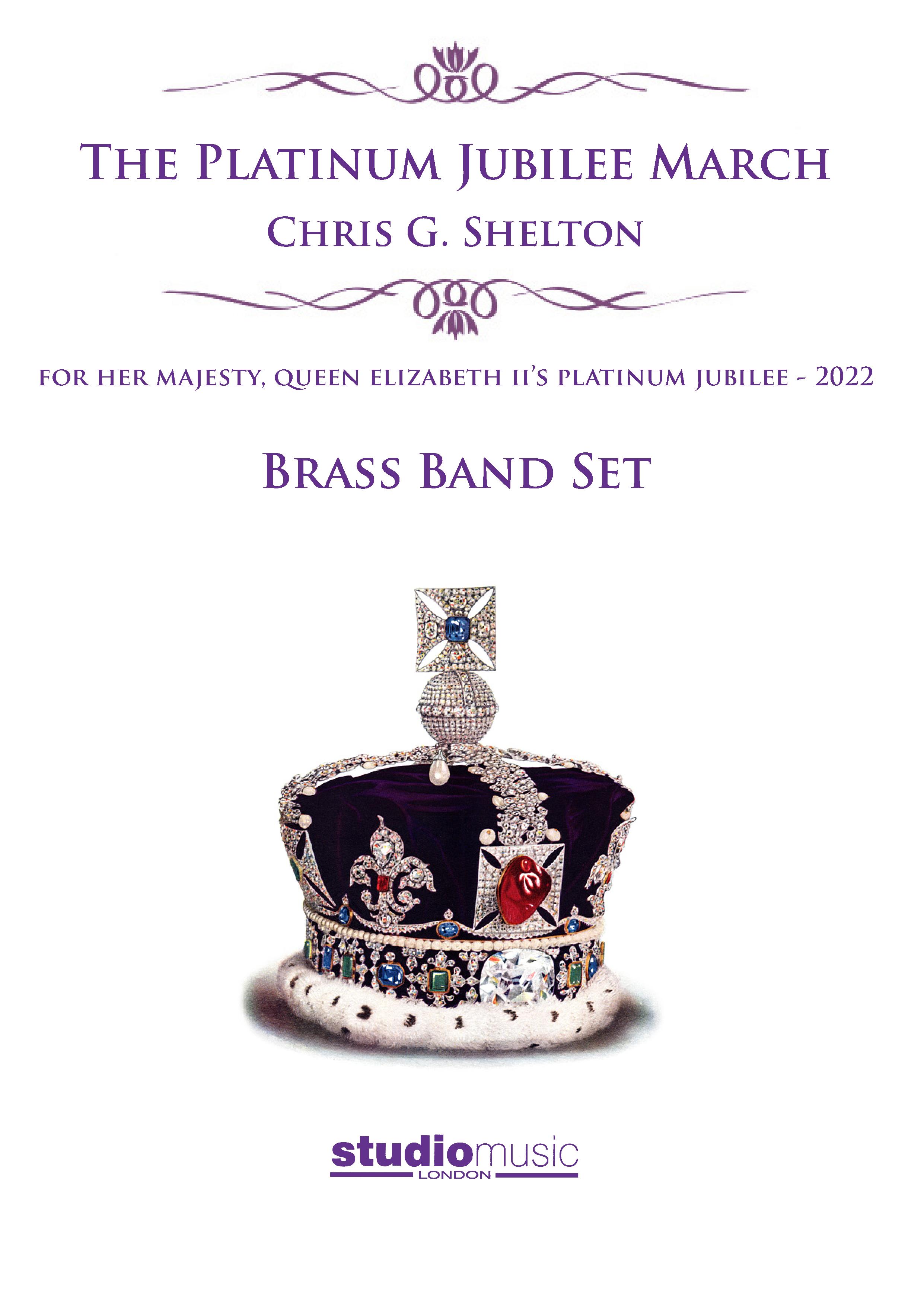
The Platinum Jubilee March (Brass Band - Score and Parts)
The Platinum Jubilee March was written to celebrate Her Majesty, Queen Elizabeth II's seventy-year reign as monarch of the United Kingdom. Its premiere was televised live around the world as part of the Queen's Birthday Parade which marked the start of the national Platinum Jubilee celebrations.The Queen's Birthday Parade 2022 saw the First Battalion of the Irish Guards trooping their colour. To reflect this, the march begins in a celebratory style and features a melody based around the opening motif of Let Erin Remember - the regimental slow march of the Irish Guards. In traditional style, the march develops excitement both harmonically and melodically, creating a strong sense of drive before reaching a stately trio. This section has a very regal and noble feel, lending subtle harmonic nods to two of the most quintessentially British composers, Gustav Holst, and Sir William Walton. The march culminates in a bold grandioso, featuring semi-quaver lines that are underpinned by a driving trombone countermelody. A forthright restatement of the introductory fanfare brings the march to a very definite and resolved ending.
Estimated dispatch 7-14 working days
-
 £69.95
Judd: The Promised Land
The Promised Land was commissioned by the Buy As You View Band and first performed by them as their own choice test piece at the European Brass Band Contest 2006 in Belfast. The story of Moses leading the Hebrews out of Egypt to find the Promised Land is one of the most dramatic to be found in the Bible. This music, although continuous, seeks in its seven main sections, to portray something of the drama found in the story.
Estimated dispatch 7-14 working days
-
£44.95
KINGDOM TRIUMPHANT, The (Brass Band Set) - Eric Ball
This landmark composition written in 1962 is perhaps the most universally known Eric Ball classic. With its magnificent finale treatment of the hymn tune 'Helmsley,' this is ideal concert repertoire.
Estimated dispatch 7-14 working days
 View Music