Results
-
£116.00The Four Temperaments (Parts only) - Robert SImpson
The Four Temperaments was commissioned by the Yorkshire Imperial Band and first performed by them in 1983. The suite depicts the four traditional temperaments, as Nielsen had done in his second symphony: Sanguine, Phlegmatic, Melancholic, and Choleric, though each movement stands up as absolute music. The composer has said of The Four Temperaments: 'The Melancholic wants to be broad, warm and grand, without haste or hysteria. As for the rest, it should go like a bomb.' It does! Duration: 22:00
Estimated dispatch 7-9 working days
-
£42.00Trittico (Score only) - James Curnow
Trittico was commissioned by the Swiss Brass Band Association for their national championships in 1988. A trittico is a tripych or group of three paintings or musical compositions based on a common theme and presented or performed together. The present work is a set of three extended variations on the American shaped-note hymn Consolation. The work opens in grand style with motives based on intervals of the hymn tune. The opening motif, and smaller fragments of it reappear throughout the piece and serve as an underlying element alongside the theme itself. The first variation is essentially a scherzo which echoes the minor mood of the theme. The hemiolic opposition of compound and duple time is used to good effect and, again, the main motif is never far away. This is music with energy and forward movement. The second variation gives the soloists a chance to shine. The mood is tranquil, yet there is always some activity and the musical material pre-echoes the third variation. The third variation is another scherzo-like section, the main theme accompanied by a rhythmic ostinato. Toward the conclusion there is a short aeleatoric passage - a variation within a variation allowing half the band to make their own variaitions in a cachophony of sound. An energetic coda draws together several elements to round off a work brim full of drive, energy, and self-propelled enthusiasm. Duration: 13:30
Estimated dispatch 7-9 working days
-
£52.00Trittico (Parts only) - James Curnow
Trittico was commissioned by the Swiss Brass Band Association for their national championships in 1988. A trittico is a tripych or group of three paintings or musical compositions based on a common theme and presented or performed together. The present work is a set of three extended variations on the American shaped-note hymn Consolation. The work opens in grand style with motives based on intervals of the hymn tune. The opening motif, and smaller fragments of it reappear throughout the piece and serve as an underlying element alongside the theme itself. The first variation is essentially a scherzo which echoes the minor mood of the theme. The hemiolic opposition of compound and duple time is used to good effect and, again, the main motif is never far away. This is music with energy and forward movement. The second variation gives the soloists a chance to shine. The mood is tranquil, yet there is always some activity and the musical material pre-echoes the third variation. The third variation is another scherzo-like section, the main theme accompanied by a rhythmic ostinato. Toward the conclusion there is a short aeleatoric passage - a variation within a variation allowing half the band to make their own variaitions in a cachophony of sound. An energetic coda draws together several elements to round off a work brim full of drive, energy, and self-propelled enthusiasm. Duration: 13:30
Estimated dispatch 7-9 working days
-
£37.03Fallen Souls (Brass Band) Andrew Wainwright
Fallen Souls was the winner of Grimethorpe Colliery Band's 1st Annual Composition Competition in 2023. This depictive and impactful work explores the theme of human fallibility. The piece begins with a slow, yearnful introduction that depicts a fall from grace, represented by a horn solo that reflects the innate goodness of humanity. However, the music soon becomes more agitated and dissonant as it represents the temptations that can lead us astray. The opening reaches a climax of chaos and despair, as we are shown the devastating consequences of our choices. The following section depicts the temptations of humanity. The music is chaotic and seductive in this section, with regular time changes and rhythmic instability, representing the many temptations that surround us. The section ends with a sense of uncertainty, as we are left wondering whether we will succumb to these temptations. There is a reprise of the opening horn solo, and a return to the notion of human fallibility, but this time in extended form. Again there is a build toward chaos, and the music becomes more complex and textured, reflecting the complexity of the human journey. The work ends somewhat abruptly with a blaze, leaving the listener with a sense of both hope and uncertainty. To view a rolling score video featuring Grimethorpe Colliery Band please visit www.youtube.com/watch?v=rM-p8CjnYo0 Duration: 5.00 minutes approx. Difficulty Level: 1st Section + PDF download includes parts and score. Sheet music available from www.brassband.co.uk/sheet-music/fallen-souls-brass-band-andrew-wainwright-brookwright Instrumentation: Soprano Cornet Eb Solo Cornet Bb Repiano Cornet Bb 2nd Cornet Bb 3rd Cornet Bb Flugel Horn Bb Solo Horn Eb 1st Horn Eb 2nd Horn Eb 1st Baritone Bb 2nd Baritone Bb 1st Trombone Bb 2nd Trombone Bb Bass Trombone Euphonium Bb Bass Eb Bass BbTimpani Percussion 1-3
In Stock: Estimated dispatch 1-3 working days
-
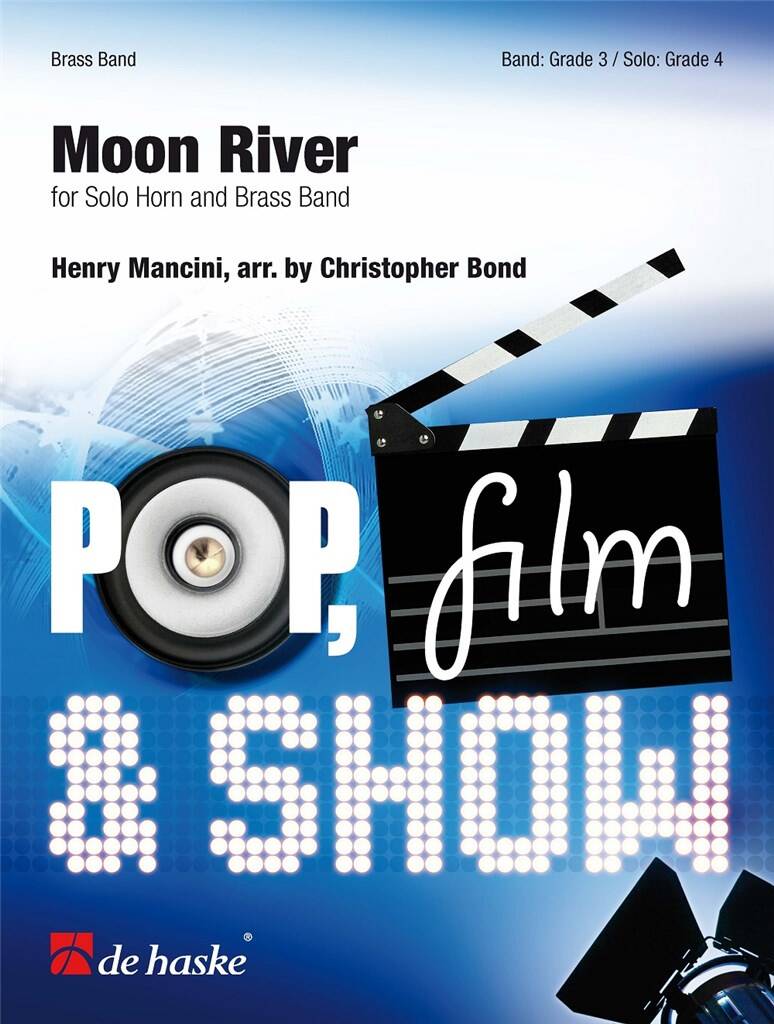
£59.99Moon River - Christopher Bond
Moon River is the title song of the famous 1961 motion picture Breakfast at Tiffany's. Over the years the song was covered by many major stars, turning it into an absolute evergreen around the world. The beauty of the melody is also suited for mellow sounding instruments like the Eb horn; a great reason to make this version for brass band and horn. This arrangement of Moon River received its premiere as part of Tongwynlais Temperance Band's winning 2017 Welsh Open programme, with soloist Emily Evans winning the soloist prize. The arrangement was since featured on Cory Band's CD release 'Destination Moon', recorded by Ailsa Russell.
Estimated dispatch 10-14 working days
-
£30.00Bandamonium 2024 (Neil Lock) - Brass Band Sheet Music Full Score & Parts - LM541
COMPOSER: Neil LockThis march was submitted to the march composers' competition for "Bandamonium 3"in Hatherleigh, Devon in July 2024. The winning march was played by massed bands at the conclusion of the celebrations on Saturday 27th July 2024. Unfortunately, this march took second place in the competition, behind the march of Paul Pennicotte-Henrie, conductor of Okehampton Silver Band.The march can be played with or without the singing. (Even at the Whit Friday marches, begad!) I suggest that it should be introduced by 3-beat rolls.When played with singing, the "Bandamonium" lyrics (bars 10-13 and 56-57) are to be sung by all players, keeping to their own parts, with appropriate octave adjustment for their individual singing voices. Conductor and percussionists should sing with the main theme (Db and C at bars 10-13, F at 56-57). Listen to the 3rd cornet players!There is an additional part for Singers, in which the trio melody (bars 58 onwards) can be sung by Soprano and Tenor singers at a moderate choir standard. An octave-down option is also provided in the higher bars. This part can be given to "spare" singers within the band, or to singers external to the band if opportunity permits. The lyrics are:We are in Devon,We're in Hatherleigh,Whit Friday heaven,But we're marching free!Now it's past seven,Time to party,At BandamoniumIn Hatherleigh!LM541 - ISMN : 9790570005413
In Stock: Estimated dispatch 3-5 working days
-
£90.00Impressions of Seurat (Chris Cobon) - Brass Band Full Score and Parts - LM482 - Chris Cobon
COMPOSER: Chris Cobon1 - Stone breakersThe Suite opens with the only picture, of the five, which is not in the pointillist style. Several pictures were produced on the Stone Breaker theme, painted in oil on small panels called croquetons. The subjects in the art are breaking stones for use in road building. Musically the piece starts canonically alluding to the repetitive nature of the labour. A more direct, rhythmic link of three hammer blows, are first heard in the opening passages in the percussion. These hammer blows are also built into each third bar of the cannon and, therefore, become embedded into the opening section. Arising from the flurry of activity are two, three bar legato phrases in a majestic style until it falls to a more dramatic sounding of the legato phrase over a resounding of the cannon in a new textural order. This leads to a short, new section, featuring a trombone trio underneath rising scales in the cornet section.2: Bathers at AsnieresBathers at Asnieres was Seurat's first major painting...The canvas is of a suburban, Parisian riverside scene. Isolated figures, with their clothes, piled sculpturally on the riverbank, together with trees, austere boundary walls and buildings, and the River Seine are presented in a formal layout. This moment aims to capture the tranquillity of a summer's day in the park. This painting led the development of the pointillist technique whereby the colours were applied as small dots that combine to form a picture when viewed at a distance. The trombones capture this idea in the opening bars with their carillon-style entries. The 2nd/3rd cornets make a more direct link by individual picking out single notes of a melody being sounded on Baritones and trombones at C. The use of mutes adds a subtle darker side to this movement which nods to the industrial working-class aspects of the painting.3: White DogWhite Dog features a few characters relaxing in the sun, and a white dog with its tail held high. Having two dogs myself, I've taken the idea of an excited dog with a waggy tail as the basis for this short, middle, movement.4: Sunday Afternoonon the Island of La Grande Jatte Sunday Afternoon on the Island of La Grande Jatte is arguably Seurat's most famous work.5: Parade de CirqueCircus Sideshow Parade de Cirque encompasses a circus scene's boisterousness, vitality and chaos. However, the painting, constructed with the new pointillist technique, also portrays stillness, calmness and precision. As expected from looking at the picture, the trombone takes centre stage in various locations on either side of the calming circus waltz and pointillist section (I).LM482ISMN : 9790570004829
In Stock: Estimated dispatch 3-5 working days
-
£67.00
Vise ved vintersolkverv - Bruvoll/Stangnes - Haakon Esplo
The beautiful song "Song at Winter Solstice" has within short time been highly loved by listeners all around Norway. It's performed by folk-rock band "Hekla Stalstrenga" who released their first album "Hekla Stalstrenga" in 2008. This album was nominated for "Spellemansprisen" (the Norwegian equivalent to Grammy) in the folk music / traditional music category."Song at Winter Solstice" was released as single record in 2013.To the conductor:In this band arrangement you can choose whether to perform with or without repetition of the melody. If you want to use a song soloist, play the piece as is with all the verses that belong. As instrumental you can choose to go straight in the 2nd house to make the song shorter.
Estimated dispatch 7-14 working days
-
£44.00
Hva var vel livet uten deg? - Ernfrid Ahlin og Gunnar Kaspersen - Jan Utbult
"Hva var vel livet uten deg" ("What was the life without you") is a song composed by Swedish composer Ernfrid Ahlin with lyrics by the Norwegian Gunnar Kaspersen.It has been features in both movies and TV-series from 1951 and onward. The most well-known version is from the TV-series "Fredrikssons Fabrikk" which was produced between 1990 and 1993.
Estimated dispatch 7-14 working days
-
£39.00
Rudolf er rod pa nesen - Johnny Marks - Arne Bendiksen - Jan Utbult
"Rudolph, the Red-Nosed Reindeer" is a song written by Johnny Marks based on the 1939 story Rudolph the Red-Nosed Reindeer published by the Montgomery Ward Company. Gene Autry's recording hit No. 1 on the U.S. charts the week of Christmas 1949.The song was first sung by crooner Harry Brannon on New York City radio in early November 1949, before Gene Autry's recording hit No. 1 in the U.S. charts during Christmas 1949. Autry's version of the song also holds the distinction of being the only chart-topping hit to fall completely off the chart after reaching No. 1. The official date of its No. 1 status was for the week ending January 7, 1950, making it the first No. 1 song of the 1950s.
Estimated dispatch 7-14 working days