
Results
-
 £29.95
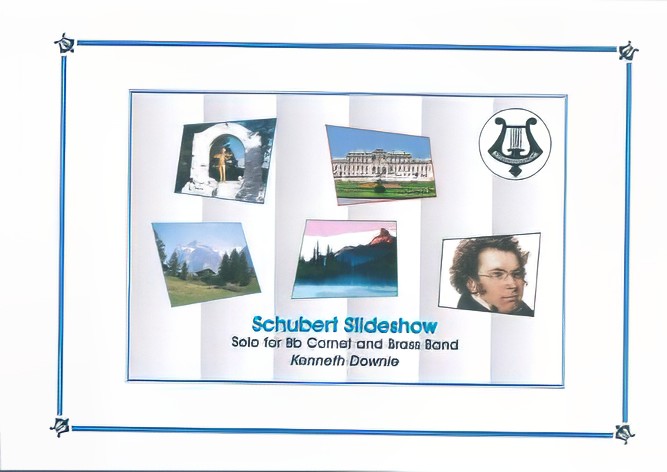
Schubert Slideshow - Cornet Solo (Brass Band - Score and Parts) - Downie, Kenneth
Heidenroslein' is a poem by Goethe, published in 1799, which was notably set to music by Schubert in 1815. It is this music which inspired this variation solo. It is called 'Slideshow' as each variation might be considered as a different view or aspect of the theme. Cornet players have the opportunity to demonstrate both the lyrical and the more bravura qualities of their playing.
Estimated dispatch 7-14 working days
-
£14.95
Schubert Slideshow - Cornet Solo (Brass Band - Score Only) - Downie, Kenneth
Heidenroslein' is a poem by Goethe, published in 1799, which was notably set to music by Schubert in 1815. It is this music which inspired this variation solo. It is called 'Slideshow' as each variation might be considered as a different view or aspect of the theme. Cornet players have the opportunity to demonstrate both the lyrical and the more bravura qualities of their playing.
Estimated dispatch 7-14 working days
-
 £29.95
Paean (Brass Band - Score and Parts) - Bright, Dudley
Commissioned by the Swiss Christian Brass Band Association in celebration of their 150th anniversary, the title 'Paean' means a shout of thanksgiving and praise. It is also the composer's personal expression of gratitude to God following major surgery. Although 'Paean' includes three fairly contemporary Christian songs, it is not intended to be played in any kind of rock or jazz style. The idiom is quite firmly rooted in brass band tradition. The opening fanfare-like section begins in celebratory mood before becoming more contemplative through the song 'Father God, I wonder'. A change of tempo heralds the statement of the thematically significant song 'Hosanna' before immediately moving to 'Faithful God'. Following a fugato the music retraces its steps to a triumphant restatement of the opening music.
Estimated dispatch 7-14 working days
-
£14.95
Paean (Brass Band - Score only) - Bright, Dudley
Commissioned by the Swiss Christian Brass Band Association in celebration of their 150th anniversary, the title 'Paean' means a shout of thanksgiving and praise. It is also the composer's personal expression of gratitude to God following major surgery. Although 'Paean' includes three fairly contemporary Christian songs, it is not intended to be played in any kind of rock or jazz style. The idiom is quite firmly rooted in brass band tradition. The opening fanfare-like section begins in celebratory mood before becoming more contemplative through the song 'Father God, I wonder'. A change of tempo heralds the statement of the thematically significant song 'Hosanna' before immediately moving to 'Faithful God'. Following a fugato the music retraces its steps to a triumphant restatement of the opening music.
Estimated dispatch 7-14 working days
-
£89.95
Infinity (Brass Band - Score and Parts) - Redhead, Robert
In the post-modern age in which we live, 'absolutes' are difficult for many to comprehend. Yet infinity, which means absolute, total, all-embracing, having no limits or boundaries in time, space, extent, or magnitude, has always been central to the Christian's concept of God.Through the ages, as human understanding has grown, particularly at a remarkable rate from the latter part of the twentienth century, Christianity has been continually challenged to interpret traditional beliefs in the light of new discoveries, but always within the reality of the infinite Being. In addition, scripture tells us that 'humanity was made in God's image'. Humankind is part of God's creation and as such, responsible for its upkeep. Such a commission has never been more relevant than in this present age. Psalm 8 creates a great picture of the majesty, eternal, infinte quality of God and yet reveals the desire of God to share in spirit with humankind. It recognises humankind as being, not a tool of the infinite, but as a creative contributing part of the ongoing movement and activity of the infinite. The music is deliberately melodic in context, creating a sense of unity with the infinite, in tandem with the varying expressions of individuality. It is not based on the Psalm but reflects some of the sentiments lying therein. The 'hymn-like' theme expresses the nature of the Divine using the Old Testament image of the infinite God coming to finite humankind, not in the 'wind', the 'earthquake', the 'fire', but in the 'still small voice' of quietness (1 Kings 19: 11-13). The ensuing musical development, in different styles and patterns, expresses this continual link between infinite and finite. Thus the conclusion, rather than being a symbol of might, power and magnificence, reflects the same sentiment as the opening.
Estimated dispatch 7-14 working days
-
£44.95
Infinity (Brass Band - Score only) - Redhead, Robert
In the post-modern age in which we live, 'absolutes' are difficult for many to comprehend. Yet infinity, which means absolute, total, all-embracing, having no limits or boundaries in time, space, extent, or magnitude, has always been central to the Christian's concept of God.Through the ages, as human understanding has grown, particularly at a remarkable rate from the latter part of the twentienth century, Christianity has been continually challenged to interpret traditional beliefs in the light of new discoveries, but always within the reality of the infinite Being. In addition, scripture tells us that 'humanity was made in God's image'. Humankind is part of God's creation and as such, responsible for its upkeep. Such a commission has never been more relevant than in this present age. Psalm 8 creates a great picture of the majesty, eternal, infinte quality of God and yet reveals the desire of God to share in spirit with humankind. It recognises humankind as being, not a tool of the infinite, but as a creative contributing part of the ongoing movement and activity of the infinite. The music is deliberately melodic in context, creating a sense of unity with the infinite, in tandem with the varying expressions of individuality. It is not based on the Psalm but reflects some of the sentiments lying therein. The 'hymn-like' theme expresses the nature of the Divine using the Old Testament image of the infinite God coming to finite humankind, not in the 'wind', the 'earthquake', the 'fire', but in the 'still small voice' of quietness (1 Kings 19: 11-13). The ensuing musical development, in different styles and patterns, expresses this continual link between infinite and finite. Thus the conclusion, rather than being a symbol of might, power and magnificence, reflects the same sentiment as the opening.
Estimated dispatch 7-14 working days
-
£10.00
Infinity (Brass Band - Study Score) - Redhead, Robert
In the post-modern age in which we live, 'absolutes' are difficult for many to comprehend. Yet infinity, which means absolute, total, all-embracing, having no limits or boundaries in time, space, extent, or magnitude, has always been central to the Christian's concept of God.Through the ages, as human understanding has grown, particularly at a remarkable rate from the latter part of the twentienth century, Christianity has been continually challenged to interpret traditional beliefs in the light of new discoveries, but always within the reality of the infinite Being. In addition, scripture tells us that 'humanity was made in God's image'. Humankind is part of God's creation and as such, responsible for its upkeep. Such a commission has never been more relevant than in this present age. Psalm 8 creates a great picture of the majesty, eternal, infinte quality of God and yet reveals the desire of God to share in spirit with humankind. It recognises humankind as being, not a tool of the infinite, but as a creative contributing part of the ongoing movement and activity of the infinite. The music is deliberately melodic in context, creating a sense of unity with the infinite, in tandem with the varying expressions of individuality. It is not based on the Psalm but reflects some of the sentiments lying therein. The 'hymn-like' theme expresses the nature of the Divine using the Old Testament image of the infinite God coming to finite humankind, not in the 'wind', the 'earthquake', the 'fire', but in the 'still small voice' of quietness (1 Kings 19: 11-13). The ensuing musical development, in different styles and patterns, expresses this continual link between infinite and finite. Thus the conclusion, rather than being a symbol of might, power and magnificence, reflects the same sentiment as the opening.
Estimated dispatch 7-14 working days
-
£44.95
The Present Age (Brass Band - Score and Parts) - Condon, Leslie
The present age' is almost a stock term familiar to Salvationists, stemming from the much-used verse - 'To serve the pres ent age .... ', which has expressed a purpose throughout Salvation Army history. It is, however , the present age of the late 1960's and 70's which claims the composer 's attention in this attempt to express in music the background against which the modem young Christian has to work. One pictures him with all the dash and impetuosity of youth setting out to 'turn the world upside down'. We here share with him reactions of his hearers, disappointments within himself, and a series of cameos depicting what kind of a world it is that he has pledged to win for Christ.
Estimated dispatch 7-14 working days
-
£22.50
The Present Age (Brass Band - Score only) - Condon, Leslie
The present age' is almost a stock term familiar to Salvationists, stemming from the much-used verse - 'To serve the pres ent age .... ', which has expressed a purpose throughout Salvation Army history. It is, however , the present age of the late 1960's and 70's which claims the composer 's attention in this attempt to express in music the background against which the modem young Christian has to work. One pictures him with all the dash and impetuosity of youth setting out to 'turn the world upside down'. We here share with him reactions of his hearers, disappointments within himself, and a series of cameos depicting what kind of a world it is that he has pledged to win for Christ.
Estimated dispatch 7-14 working days
-
 £59.99
Meditation (Flugel and Horn Section Feature with Brass Band - Score and Parts) - Hassler, Hans Leo - Sparke, Philip
This timeless melody by Hans Leo Hassler (1564-1612), is now chiefly remembered because of its inclusion in J. S. Bach's St. Matthew Passion, (hence its title) where it is treated to a variety of rich harmonisations. It is mostly sung to Paulus Gerhardt's words, O Sacred head! sore wounded. This setting features the flugel and horns, who first play a lyrical descant to the famous hymn tune and then the melody itself, against a Bach-like obbligato in the accompaniment.Duration: 4:30
Estimated dispatch 7-14 working days
 View Music