
Results
-
 £30.00
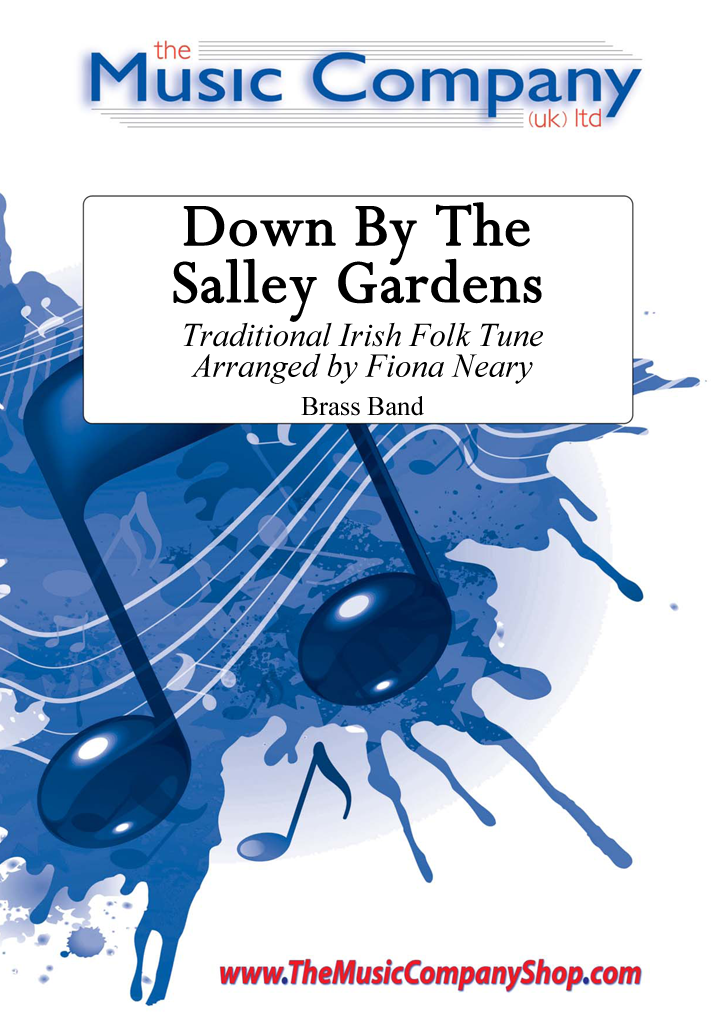
Down By The Salley Gardens
A new brass band release for 2023 which also welcomes Fiona Neary as a new member of our ever-growing family of writers!This traditional Irish folk tune has been beautifully arranged for brass band, offering a tranquil moment to your programme with a memorable jaunty jig section to keep your listeners on their toes!Every concert needs that 'Aaahhhh' element, and Down By The Salley Gardens certainly brings all the qualities required to meet that need.This original traditional Irish melody has been referred to by a variety of titles: 'Mourne Shore', 'Moorlough Shore' and 'The Maids of Mourne Shore', and is believed to have dated back to the 17th-18th century.In 1889, William Butler Yeats had his poem 'Down By The Salley Gardens' published in The Wanderings of Oisin and Other Poems. The verse was then later set to the Irish melody by Herbert Hughes in 1909. Since this combining, the music has become synonymous with the poem and naturally adopted the poem's title.Due to the beauty of the melody and the emotive words of the associated poem, both elements of this work has been embraced by a variety of artistes, including recordings by The Corrs and Sinead O'Connor; John Ireland (1879-1962) set the words to an original melody in his song cycle Songs Sacred and Profane, written in 1929-31; there is a vocal setting by the poet and composer Ivor Gurney, which was published in 1938; and Benjamin Britten published a setting of the poem in 1943.
In Stock: Estimated dispatch 3-5 working days
-
 £19.95
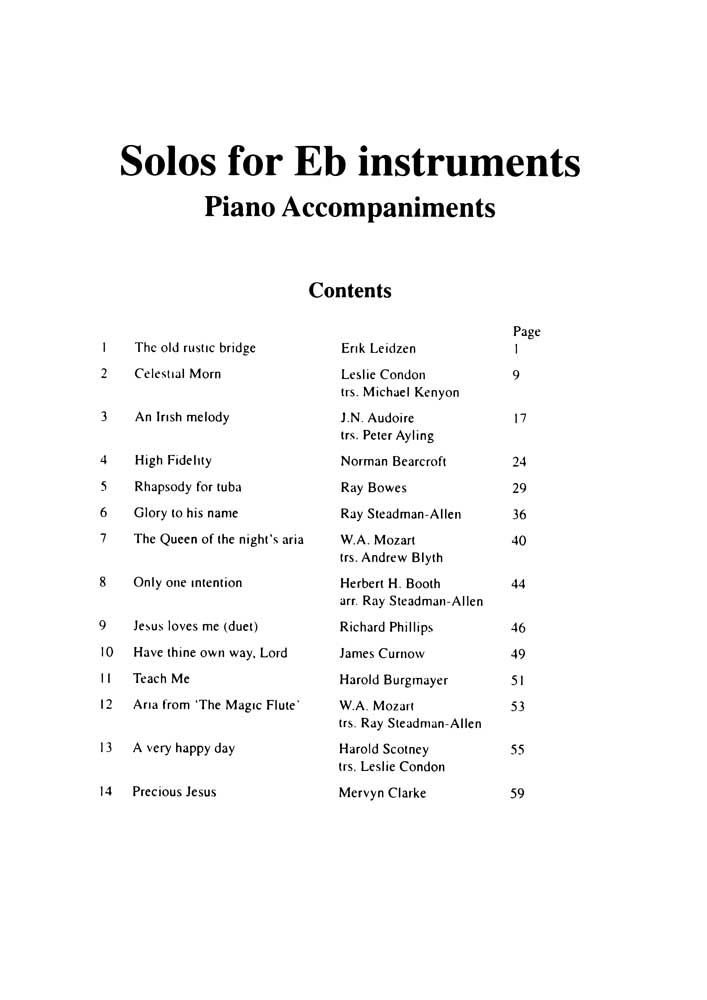
Eb Solos Album
Includes: The old rustic bridge; Celestial Morn; An Irish melody; High Fidelity; Rhapsody for tuba; Glory to his name; The Queen of the night's aria; Only one intention; Jesus loves me (duet); Have thine own way, Lord; Teach me; Aria from 'The Magic Flute'; A very happy day; Precious JesusInstrumentation: Solos for Eb Soprano Cornet, Eb Tenor Horn & Eb Bass with Piano Accompaniment
Estimated dispatch 7-14 working days
-
 £24.50
Be Thou My Vision
This famous traditional Irish melody has been arranged and described as Thee Verse Variations. Building up from the beginning to a huge climaz where the whole band explodes into the gorgeous theme. Sure to make the hairs on your neck rise!
Estimated dispatch 7-14 working days
-
 £69.99
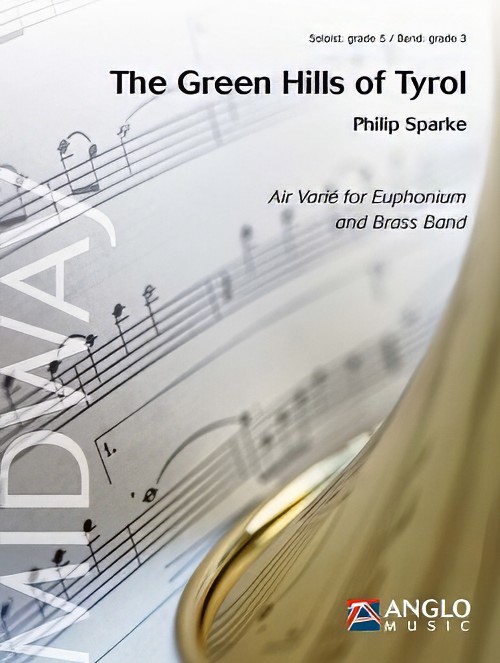
The Green Hills of Tyrol (Euphonium Solo with Brass Band - Score and Parts) - Sparke, Philip
The Green Hills of Tyrol was commissioned by Jrena and Beat Knusel for their son, Swiss euphonium player Joel Knusel, to celebrate his 20th birthday in 2019. The request was for a piece suitable for use in a solo competition, possibly using a Scottish or Irish melody, and composer Philip Sparke suggested an old-fashioned air varie might be a suitable idea. The piece follows the well-established formula of a theme followed by four variations. The history of the original melody is fascinating and, although it is now well-known as a bagpipe tune, its background is Austrian or Italian, rather than Scottish. The tune appears as a chorus of Swiss soldiers in Rossini's 1829 opera William Tell but was possibly an existing Tyrolean folk tune. In 1854, during the Crimean War, Pipe Major John MacLeod of the 93rd Highlanders heard a band of the Sardinian contingent playing selections from the opera in camp before the Siege of Sebastopol. He was struck by the melody and arranged it for his pipers, calling it The Green Hills of Tyrol, referring to Tell's visit to that corner of Austria in the opera. It has since become universally popular among pipe bands who usually refer to it as A Scottish Soldier, following the addition of new lyrics in a 1961 hit by Andy Stewart.Duration: 5.45
Estimated dispatch 7-14 working days
-
 £69.99
Down by the Salley Gardens - Patrick Millstone
A thoroughly gripping melody of Irish descent constitutes the basis on which this exceedingly beautiful little piece of music rests. Down by the Salley Gardens is a guaranteed heartbreaker on your next concert. Since the lyrics of this Irish traditional are also supplied with the set, a combination of band with solo voice or even choir is a definite possibility. The Arranger: Leafing through a song-book containing traditionals etc., I was immediately struck by this song and its exceptionally beautiful and atmospheric melody. I simply had to do something with it. Een meeslepende traditional van Ierse komaf staat aan de basis van dit wonderschone werkje. Down bythe Salley Gardens belooft een hartenbreker te worden op uw eerstvolgende concert. De tekst van deze Ierse traditional wordt meegeleverd en daarmee is een combinatie met zang ook zeer goed mogelijk. De arrangeur: Bladerend door een liedboek met traditionals, enz., was ik meteen getroffen door dit nummer en zijn uitzonderlijk mooie en sfeervolle melodie. Ik moest gewoon iets mee doen.
Estimated dispatch 5-14 working days
-
 £57.50
Erin's Isle - Philip Sparke
Erin's Isle was commissioned by euphonium player Micah Parsons and premiered by him in June 2024. The idea was to write a slow melody with an Irish flavour and the title is a romantic, 19th century name often used to refer to the island of Ireland itself. The work opens with fluttering, muted cornets, under which a tentative theme appears. This leads to an accompanied cadenza for the soloist, out of which the main theme emerges. This is a long and expansive melody, which winds through several related phrases with a folk-like flavour. A change of key heralds snatches of the theme by the band with interjections from the soloist, leading to a second cadenza. Eventually the band takes up the main theme again, over which the euphonium weaves an elaborate counter melody. The fluttering cornets return to allow the soloist to close the work with a brief and flowery coda.
Estimated dispatch 5-14 working days
-
 £42.95
The Platinum Jubilee March - Chris G. Shelton
The Platinum Jubilee March was written to celebrate Her Majesty, Queen Elizabeth II's seventy-year reign as monarch of the United Kingdom. Its premiere was televised live around the world as part of the Queen's Birthday Parade which marked the start of the national Platinum Jubilee celebrations. The Queen's Birthday Parade 2022 saw the First Battalion of the Irish Guards trooping their colour. To reflect this, the march begins in a celebratory style and features a melody based around the opening motif of Let Erin Remember - the regimental slow march of the Irish Guards. In traditional style, the march develops excitement both harmonically and melodically, creating a strong sense of drive before reaching a stately trio. This section has a very regal and noble feel, lending subtle harmonic nods to two of the most quintessentially British composers, Gustav Holst, and Sir William Walton. The march culminates in a bold grandioso, featuring semi-quaver lines that are underpinned by a driving trombone countermelody. A forthright restatement of the introductory fanfare brings the march to a very definite and resolved ending.
Estimated dispatch 5-14 working days
-
 £105.20
Irsk Fantasi - Roar Minde Fagerli
Irish fantasy is a short piece inspired by irish folk music. The melody consists of an A og B theme which both appears in many parts throughout the piece.The composer wrote this music originally for a kind of "musical journey around the world" project for beginning bands.
Estimated dispatch 5-14 working days
-
 £115.60
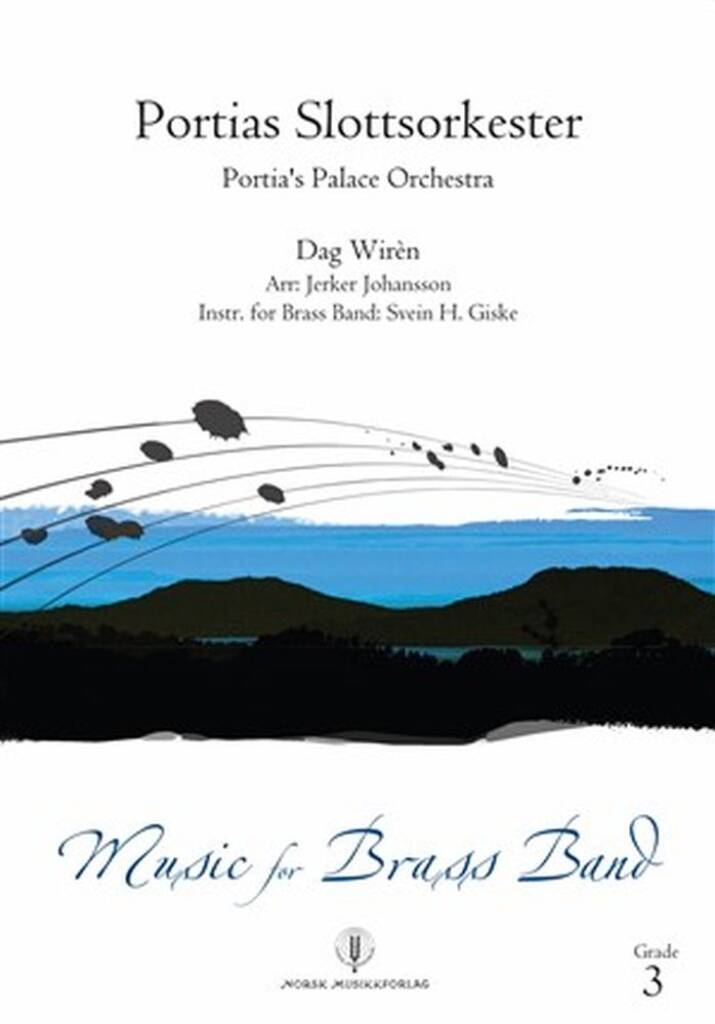
Portias Slottsorkester - Dag Wirèn - Svein H. Giske
Dag Wiren (1905-1986) came to fame as a composer in 1937 with Serenade for string orchestra, Op. 11, which remains his most played work to date. His opus list is mainly instrumental music; five symphonies, five string quartets, several overtures and a lot of film and theatre music.He composed the stage music for William Shakespeare's The Merchant of Venice, which was performed at Dramaten in Stockholm in 1944. The drama was performed again in 1961, somewhat revised by Wiren. From this production, Wiren compiled a concert suite that he called Romantic Suite, Op. 22.The fifth and final movement is Portia's Castle Orchestra, which is based on an Irish folk melody.This instrumentation for Brass Band is based on the arrangement for wind band by Jerker Johansson. The instrumentation was written for Askoy Brass Band's performance at Siddis Brass 2022.
Estimated dispatch 5-14 working days
-
 £15.99
'tis The Last Rose Brass Band - Traditional
It is often thought that this melody came from the Victorian era, when Irish songs were very popular, however this Air was first published in 1813 and has been adapted and arranged by many composers and arrangers over theyears. This arrangement, as a Flugel Horn solo, by Gary Westwood is a new treatment and shows off this tender and wistful love song.
Estimated dispatch 5-14 working days
 View Music