Searching for Wind Band Music? Visit the Wind Band Music Shop
We've found 251 matches for your search. Order by

Results

  • £69.99

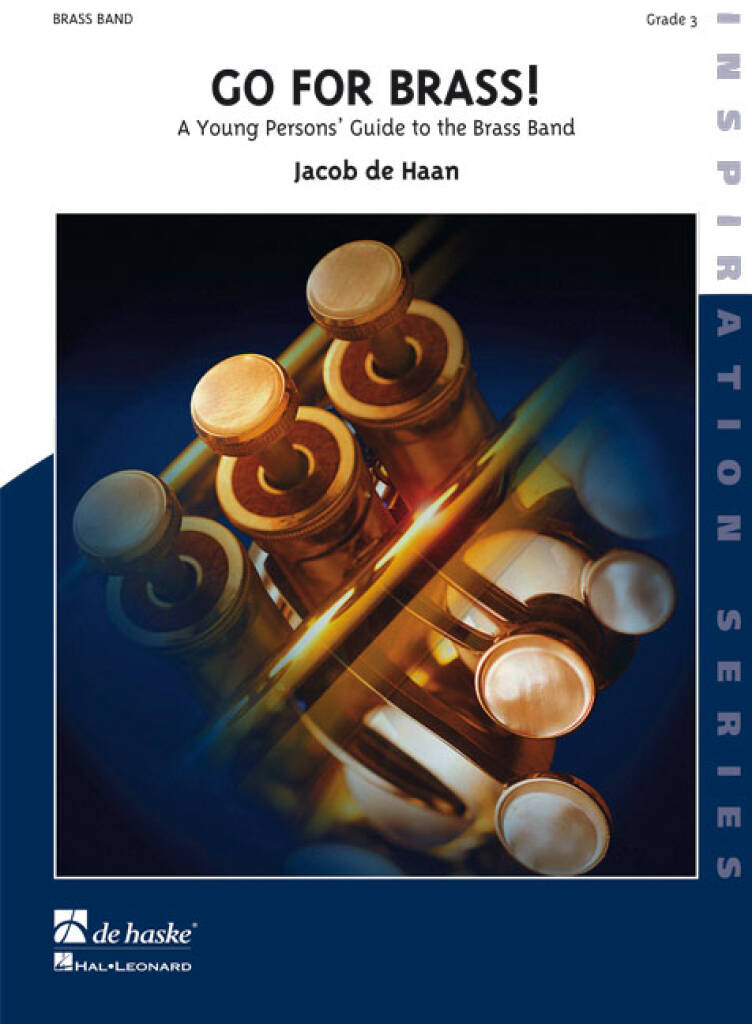
    Go for Brass! - Jacob de Haan

    Subtitled "A Young Person's Guide to the Brass Band", Go for Brass! is a musical introduction to the sound, instrumental groups and the individual instruments of the brass band. Your players will love this work as they stand to highlight their particular section with snippets of the sparkling up-tempo dance style theme. An extremely entertaining concert item with a little fun educational content!

    Estimated dispatch 5-14 working days

     PDF View Music

  • £60.99

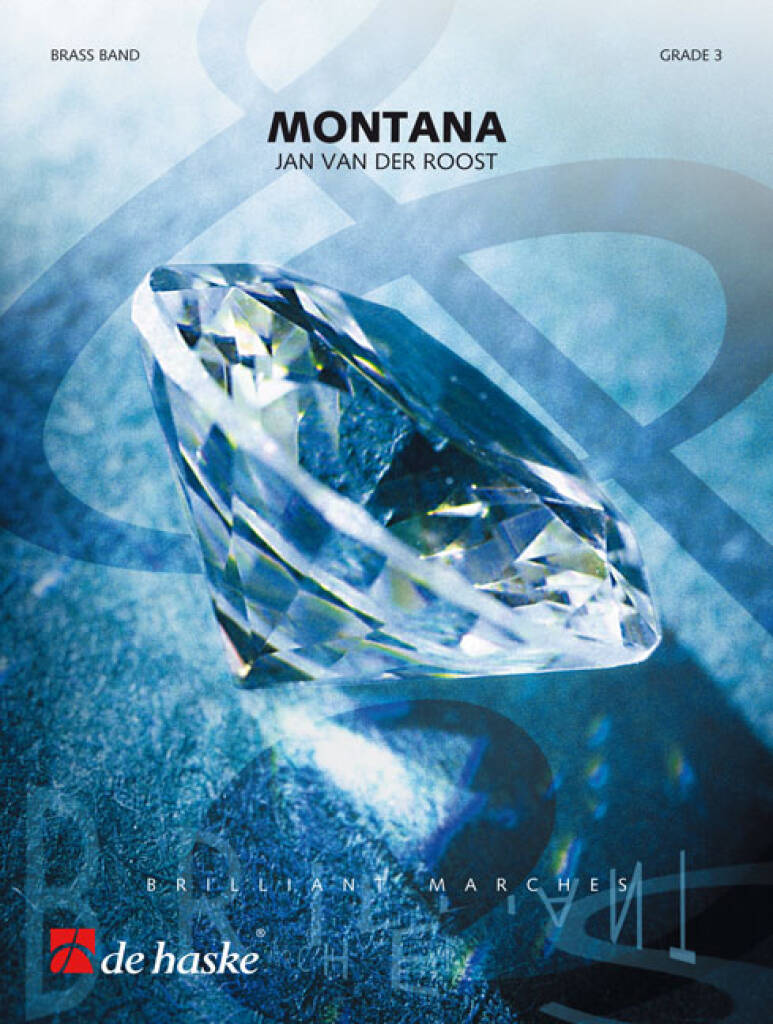
    Montana - Jan Van der Roost

    From the first bars the stately character of this solemn, yet celebratory, march is clearly heard. The introduction of the main theme takes place in the medium register, immediately resulting in a noble tone. A lyrical trio melody provides contrast, but the march closes in a festive and imposing mood. A march worthy of any concert program.

    Estimated dispatch 5-14 working days

     PDF View Music

  • £69.99

    Czardas (Xylophone solo) - Monti - Gert Bomhof

    Vittorio Monti was born on January 6, 1868 in Naples (Italy). His musical education (Violin and composition), he enjoyed at the conservatory there. Around his 30's Monti went to Paris. He earned a living as a conductor and wrote several ballets and operettas. In his last years, before his death in 1922, Monti devoted himself to teaching and composing. His famous 'Czardas' has made his name known even today.Initially the Czardas was a Hungarian folk dance, but after the mid-nineteenth century it was even a dance for the upper-class. Czardas begins with a slow introduction, the Lassan (slow and sad), and then the fast part,Friska, follows. Czardas is not, as so many people think, typical gypsy music.

    Estimated dispatch 5-14 working days

     PDF View Music

  • £69.99

    Dance of the Shepherds - Patrick Millstone

    Patrick Millstone based his Dance of the Shepherds on the song Quem pastores laudavere by Michael Praetorius.After an upbeat flashy introduction, you can hear this wonderful Christmas song. A good choice for a Christmas concert or church service!

    Estimated dispatch 5-14 working days

     PDF View Music

  • £102.99

    The African Connection - Carl Wittrock

    Carl Wittrock's wide interest in global folk-music resulted in this concert-piece based on original African rhythms. Obviously, the percussion section has a conspicious role to play, but the band too may indulge itself in moments of thoroughly delightful excitement. The introduction depicts the awakening of nature, and develops into a dance. The (main) motif of this dance is from a dance entitled Apollo and comes from Gambia. Its accompaniment consists of an ostinato pattern by balaphon-master Maudo Susa. The quiet middle movement is based on the rhythm of the 'gigbo' : a traditional dance from Ghana. In the final movement -which also bears a slight resemblanceto a theme from 'The Lion King'- the so-called 'Kono' rhythm is used. The work is played most advantageously using djembes. Challenge and please your percussion section with 'The African Connection'.

    Estimated dispatch 5-14 working days

     PDF View Music

  • £109.99

    Land of Legends - Andreas Ludwig Schulte

    In 'Land of Legends' German composer Andreas Ludwig (what's in a name) Schulte takes you along to the fictional world of legends, myths and fairy tales. The introduction to the first part (The Castle) describes the majestic contours of the scene of action. Its instrumentation (horns) immediately makes you imagine being in Medieval spheres. The addition of trenchant copper instruments even gives the part a heroic tinge. After entering through the gate, a lot of hustle and bustle appears to be going on in the courtyard. Pages, squires and soldiers are busy attending to their arms. Beer is being brewed, flax is being spun, cattle are being tended and some craftsmen fromneighbouring villages are busily at work. In the upper chamber of the round tower lives an old man (The Old Wizard). He hardly ever comes out, and nobody knows exactly what he is doing. It is said that he is engaged in wizardry and magic. It is all very mysterious. There are also festivities, some of them sober, others exuberant. The wedding in the third part is celebrated in a grand manner. With a flourish of trumpets, the bride makes her entrance at the hand of her father. Afterwards, at the party there is dancing to the music played by minstrels and of course a plentiful banquet follows.

    Estimated dispatch 5-14 working days

     PDF View Music

  • £60.99

    Consolation - Jan de Haan

    Wer nur den lieben Gott lasst walten was composed by Georg Neumark in about 1641 and was subtitled 'Trostlied' literally meaning consolation song. Songbooks at the time showed the popularity of this song and it is still well-known today partly due to Johann Sebastian Bach's use of the melody for one of his own chorals. In Jan de Haan's arrangement the choral is heard twice, once, alternating with the original motif from the introduction and a second time, without interruption, reflecting the composer's original intention - a song of consolation.

    Estimated dispatch 5-14 working days

     PDF View Music

  • £76.99

    The Universal Band Collection (Brass Band - Score and Parts) - De Haan, Jacob

    A collection of 5 short works in pop style which can be performed by any kind of compilation. The titles can be presented on the programme as separate works but the Universal Band Collection can also be performed as a complete suite. From a didactic point of view it is a suitable work to teach musicians something about the structure in music. For this purpose not only the big structure but also the small structure was kept very clear.Western Girl: A girl from the west of the USA rides her horse across the prairie, dreaming of her future. The rough structure: introduction - theme in a blues scale - the same thing in a different instrumentation - finale.Just a ballad: A ballad in pop style with a rough A-B-A form. First there is the introduction of the main theme (A), then follows a tenor melody in minor with a rhythmical reference to the main theme (B). Finally there is the main melody, performed tutti with a different rhythm in the drums (A').Play the Game: An English saying meaning: play fairly. Playful music in up-tempo with a wink to China, where almost all games are manufactured nowadays. Once again an A-B-A structure here.San Diego: A Mexican fugitive enjoys his freedom in America but also remembers his place of birth with melancholy. A sad minor melody with a straight trendy beat appears twice. The second time it has a slightly different instrumentation, in which the muted trumpets represent the Mexican feeling.Final Dance: Eventually there is a dance with an introduction in renaissance style, followed by a fast dance in rock style. All this composed in a classical song structure: introduction, verse, bridge, chorus, shortened verse, bridge, chorus, chorus.Duration: 10:30

    Estimated dispatch 7-14 working days

     PDF View Music

  • £65.00

    AN ELGAR PORTRAIT - D.Price

    This work was composed in commemoration of the 150th Anniversary of the birth English Composer Sir Edward Elgar. The suite is in three movements: 'Introduction', 'Elegy' and 'March', each of which have been inspired by three of Elgar's most celebrated works; Chanson de Matin, Nimrod ('Variation IX' from the Enigma Variations) and Pomp and Circumstance No.1.'Introduction' - Hollybush HillHollybush Hill is the name of one of the peaks of the Malvern Hills in Worcestershire. The Malverns were a favourite walking area for Elgar and his wife, and their panoramic views inspired much of Elgar's music.'Elegy' - BroadheathBroadheath is the small village at the foot of the Malvern Hills where Elgar was born (and lived at various times throughout his life). Elgar is buried not far from Broadheath at St Wulstan's in Little Malvern. 'March' - Worcester CathedralMany of the Worcestershire ensembles and music festivals played an important role in Elgar's early musical education. He was heavily involved in The Three Choirs Festival and either conducted or played in many of the light orchestras and vocal groups that performed at venues across Worcester. A statue of Elgar overlooks the Cathedral at the end of Worcester High Street.An Elgar Portrait has been used regularly as an own-choice test-piece for Section 4 bands, and was also selected as the set work for the Swiss National Championships in 2007 as well as the Pontins Championships in 2008. The composer has slightly reworked this piece for the Section 4 Final of the National Brass Band Championships of Great Britain 2020 and it's this version that should be performed at the contest. If bands currently have an older version in their libraries, please contact us directly for more information.

    In Stock: Estimated dispatch 3-5 working days
  • £22.50

    Edward Gregson: Concertante for Piano and Brass Band

    DescriptionProgramme NoteThe Concertante for Piano and Brass Band was written in 1966, when the composer was an undergraduate student at the Royal Academy of Music in London. It received its first public concert performance in 1967 at the Royal Festival Hall, London, when the composer was the soloist with the International Band of the Salvation Army, conducted by Bernard Adams. It was one of the first major works to be written for this particular combination.The Concertante is unashamedly romantic in idiom and is in three movements: Prelude, Nocturne and Rondo. The Prelude is cast in sonata form and opens with a short cadenza-like flourish from the soloist, followed by two main ideas - the first sweepingly dramatic, the second highly lyrical. The interplay between these two themes forms the main focus of the movement, and after a return to the opening theme, an exuberant codetta brings the music to a close, albeit a quiet one. https://morthanveld.com/wp-content/uploads/2017/09/Gregson-Concertante-1st-movt-clip.mp3The tender Nocturne opens with an introduction from the band that contains precursors of the two main ideas to follow. The solo piano announces the main theme, which has a slightly 'bluesy' character with its flattened third and seventh notes of the scale, and is a love song dedicated to the composer's wife-to-be. The band enters with phrases of a chorale already hinted at in the introduction - Ray Steadman-Allen's hymn tune 'Esher' - but never quite presented in its complete state. Both ideas are developed alongside each other, with eventually the first theme returning, this time with piano and band together, and building to a majestic climax, before subsiding to a peaceful coda - a return to the very opening of the movement. https://morthanveld.com/wp-content/uploads/2017/09/Gregson-Concertante-movt-2-clip.mp3The final Rondo is full of energetic rhythms and changing time patterns. The main theme is playful in character, with much interplay between soloist and band, whilst the middle section presents a new theme, and one that has more than a hint of the hymn tune 'Onward Christian Soldiers', in what amounts to a good humoured parody. The opening Rondo theme returns, this time leading to a powerful and dissonant climax from the band. This is followed by an extended piano cadenza, underlying the virtuoso aspect of the work, and leading to an energetic and life-affirming coda, which brings the work to a triumphant conclusion. https://morthanveld.com/wp-content/uploads/2017/09/Gregson-Concertante-movt-3-clip.mp3Duration: 18 minutesInstrumentation:Please note that there is no 1st/Repiano Cornet part in this work. The 1st/Repiano Cornet player should join the Solo Cornet bench. As such an extra Solo Cornet part is provided in the set of parts.Version for two pianosA version of the Concertante for two pianos is available for rehearsal purposes. Piano 1 is the solo part and Piano 2 the band reduction. However, for those pianists not needing to rehearse the work in this way, a solo piano part is also provided with the main set of band parts.To view a preview of the solo part for the first movement click here.The youthful Gregson (his work was written as a third year undergraduate) was seemingly a bit of a musical magpie - but one heck of a skilful one at that.These were shiny baubles of poise, panache and pastiche, with affectionate, remarkably mature nods of appreciation towards Gershwin, Rachmaninov, Ireland and even Elmer as well as Leonard Bernstein.The rich colour palette and flowing lines (with the tenderest of central Nocturnes) were a joy - as were the little buds of motifs that dotted the score like seeds ready to be planted on a future fertile brass band compositional field. - Iwan Fox, 4Barsrest.com, June 2019For more information on Edward Gregson's music please visit the composer's website: www.edwardgregson.com

    Estimated dispatch 7-14 working days

     PDF View Music