
Results
-
 £45.00
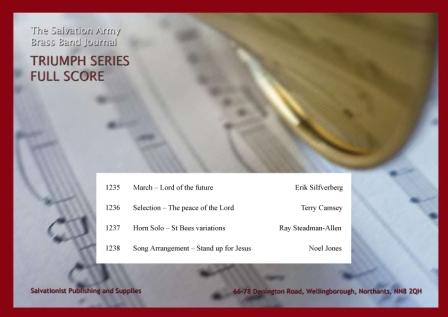
Triumph Series Band Journal March 2013 Numbers 1235 - 1238
No. 1235 March - Lord of the future (Erik Silfverberg)The title of this short, lively march is connected to the tune 'With Christ into the future' which appears in its second half.No. 1236 Selection - The peace of the Lord (Terry Camsey)This selection seeks to portray the peace that is found in Jesus, both in its style and the tunes used; 'Peace, peace, sweet peace', 'O the peace' and 'Brahms' Lullaby'.No. 1237 Horn Solo - St Bees variations (Ray Steadman-Allen)St Bees is a simple melody and this treatment is compatible with its character. Florid and meditative passages conclude with a brisk finale.No. 1238 Song Arrangement - Stand up for Jesus (Noel Jones)The old well-known gospel song appears here in a swing style.
Estimated dispatch 7-14 working days
-
 £74.95
Eden (Score and Parts)
This work was commissioned by the Brass Band Heritage Trust as the test piece for the final of the 2005 Besson National Brass Band Championship, held at the Royal Albert Hall, London.The score is prefaced by the final lines from Milton's epic poem Paradise Lost (completed in 1663), in which Adam and Eve, expelled from Paradise, make their uncertain way into the outside world:"...The world was all before them, where to chooseTheir place of rest, and providence their guide:They hand in hand with wandering steps and slow,Through Eden took their solitary way."My work is in three linked sections. In the first, the characters of Adam, Eve and the serpent guarding the Tree of Knowledge are respectively represented by solo euphonium, cornet and trombone. The music opens in an idyllic and tranquil mood and leads into a duet between euphonium and cornet. Throughout this passage the prevailing mood darkens, though the soloists seem to remain oblivious to the increasingly fraught atmosphere. A whip-crack announces the malevolent appearance of the solo trombone who proceeds to engage the solo cornet in a sinister dialogue.The second section interprets the Eden story as a modern metaphor for the havoc mankind has inflicted upon the world, exploiting and abusing its resources in the pursuit of wealth. Though certainly intended here as a comment on the present-day, it is by no means a new idea: Milton himself had an almost prescient awareness of it in Book I of his poem, where men, led on by Mammon:"...Ransacked the centre and with impious handsRifled the bowels of their mother earthFor treasures better hid. Soon had his crewOpened into the hill a spacious woundAnd digged out ribs of gold."So this section is fast and violent, at times almost manic in its destructive energy. At length a furious climax subsides and a tolling bell ushers in the third and final section.This final part is slow, beginning with an intense lament featuring solos for tenor-horn, flgel-horn and repiano cornet and joined later by solo baritone, soprano cornet, Eb-bass and Bb-bass.At one stage in the planning of the work it seemed likely that the music would end here - in despair. Then, mid-way through writing it, I visited the extraordinary Eden Project in Cornwall. Here, in a disused quarry - a huge man-made wound in the earth - immense biomes, containing an abundance of plant species from every region of the globe, together with an inspirational education programme, perhaps offer a small ray of hope for the future. This is the image behind the work's conclusion and the optimism it aims to express is real enough, though it is hard-won and challenged to the last.John Pickard 2005
Estimated dispatch 7-14 working days
-
 £29.50
Eden (Score Only)
This work was commissioned by the Brass Band Heritage Trust as the test piece for the final of the 2005 Besson National Brass Band Championship, held at the Royal Albert Hall, London.The score is prefaced by the final lines from Milton's epic poem Paradise Lost (completed in 1663), in which Adam and Eve, expelled from Paradise, make their uncertain way into the outside world:"...The world was all before them, where to chooseTheir place of rest, and providence their guide:They hand in hand with wandering steps and slow,Through Eden took their solitary way."My work is in three linked sections. In the first, the characters of Adam, Eve and the serpent guarding the Tree of Knowledge are respectively represented by solo euphonium, cornet and trombone. The music opens in an idyllic and tranquil mood and leads into a duet between euphonium and cornet. Throughout this passage the prevailing mood darkens, though the soloists seem to remain oblivious to the increasingly fraught atmosphere. A whip-crack announces the malevolent appearance of the solo trombone who proceeds to engage the solo cornet in a sinister dialogue.The second section interprets the Eden story as a modern metaphor for the havoc mankind has inflicted upon the world, exploiting and abusing its resources in the pursuit of wealth. Though certainly intended here as a comment on the present-day, it is by no means a new idea: Milton himself had an almost prescient awareness of it in Book I of his poem, where men, led on by Mammon:"...Ransacked the centre and with impious handsRifled the bowels of their mother earthFor treasures better hid. Soon had his crewOpened into the hill a spacious woundAnd digged out ribs of gold."So this section is fast and violent, at times almost manic in its destructive energy. At length a furious climax subsides and a tolling bell ushers in the third and final section.This final part is slow, beginning with an intense lament featuring solos for tenor-horn, flgel-horn and repiano cornet and joined later by solo baritone, soprano cornet, Eb-bass and Bb-bass.At one stage in the planning of the work it seemed likely that the music would end here - in despair. Then, mid-way through writing it, I visited the extraordinary Eden Project in Cornwall. Here, in a disused quarry - a huge man-made wound in the earth - immense biomes, containing an abundance of plant species from every region of the globe, together with an inspirational education programme, perhaps offer a small ray of hope for the future. This is the image behind the work's conclusion and the optimism it aims to express is real enough, though it is hard-won and challenged to the last.John Pickard 2005
Estimated dispatch 7-14 working days
-
 £18.95
BBA March - Roy Newsome
This is a concert march with a difference!The whole of the first section is in minor mode - unusual and intended to depict the trials and tribulations which inspired the original (and now successfully completed) Africa-based projects of Brass Band Aid. The Trio then goes into the major and begins with a Prayer motif that starts with the notes B-B-A. Following a rather turbulent episode (a reminder that there is still much to do), the Prayer theme returns triumphantly, reflecting optimism for the future.Roy Newsome composed this work in support of a charitable project, known in 2005 as Brass Band Aid. The organisation called for original compositions to be included in a follow-up CD release - Into Africato help raise funds for projects in Adet, Africa, and to build awareness of theMake Poverty History campaign. African Adventure was featured on the CD with a recording by the Wingates Band.Now that the original BBA projects are complete, funds raised by the titles we publish from theBrass Band Aidseries continue to support other music-related projects on a regular basis.
In Stock: Estimated dispatch 3-5 working days
-
 £70.00
General Series Band Journal April 2016 Numbers 2154-2157
No. 2154 Cornet Solo - The victory cry! (Andrew Blyth)This solo features the popular song by Stuart Townend and Keith Getty entitled 'Power of the Cross', along with an original song by the composer, 'The Cross of hope'. It was originally written at the request of Staff Bandsman Gerry Todd and the Melbourne Staff Band.No.2155 Mission Force (Stephen Bulla)This is programmatic music, portraying the determination and forward vision of the modern church's mission. It includes two well-known hymns, 'Trentham' (T.B.159) and 'Slane' (T.B.831), using their words as metaphors that describe this quest into a spiritual future.No.2156 Prelude on 'Lavenham' (Geoffrey Nobes)An arrangement of a hymn, written by the composer with words by Reverend Nick Fawcett. The three statements of the melody correspond to three verses of the hymn and seek to reflect their meaning.No. 2157 On we march (Kevin Larsson)This piece was written for the Pasadena Tabernacle Band for their 120th anniversary. It includes a number of tunes closely connected with the Corps including 'Everything's coming up roses' from Gypsy, a song closely associated with the Rose Parade, and 'Hooray for Hollywood' as the Corps was previously called Hollywood Tabernacle. Continuing on the Rose Parade theme, 'On we march' (T.B.788) and the well-known hymn tune, 'Rachie' (T.B.190), are also featured.
Estimated dispatch 7-14 working days
-
 £33.89
Fawkes (Brass Band) Fendall Hill
Bring explosive drama and striking historical resonance to your ensemble's repertoire with Fawkes by Fendall Hill.Dedicated to Alan Gifford and Sovereign Brass, this compelling work delves into the dark intrigue of November 5, 1605 - the fateful night Guy Fawkes and his conspirators plotted to obliterate the foundation of English royal and political power. While the 36 barrels of gunpowder hidden beneath Parliament never detonated, the looming spectre of what could have been remains one of history's most lingering images. Had a single fuse been lit, the trajectory of future empires and superpowers would have changed forever.Rather than commemorating a physical blast, Fawkes celebrates this iconic 'non-explosive event' with breathtaking musical pyrotechnics.Key Features & Musical HighlightsDramatic Narrative: Captures the suspense, secret plotting, and shadowy tension leading up to the discovery beneath the House of Lords.Virtuosic Display: Packed with fiery technical runs, powerful brass fanfare, and rapid artful passagework designed to emulate brilliant fireworks.Latent Historical Tremors: Features haunting, driving rhythmic motifs that symbolize the sheer kinetic potential of 36 barrels of gunpowder waiting in the dark.Concert Opener or Finale: An exhilarating showpiece guaranteed to captivate audiences and showcase the dynamic range, power, and precision of your ensemble.To view a video of the work featuring Wellington Brass please visit www.youtube.com/watch?v=4fZZzuVrPjgDuration: Approx. 4-5 minutes (adjust based on score specifics)Difficulty Level: 2nd Section +This PDF download includes the full score and parts.Sheet music available at www.brassband.co.uk (UK) or https://satradecentral.org (USA)Instrumentation:Soprano Cornet EbSolo Cornet BbRepiano Cornet Bb2nd Cornet Bb3rd Cornet BbFlugel Horn BbSolo Horn Eb1st Horn Eb2nd Horn Eb1st Baritone Bb2nd Baritone Bb1st Trombone Bb2nd Trombone BbBass TromboneEuphonium BbBass EbBass BbTimpaniPercussion 1-2
In Stock: Estimated dispatch 1-3 working days
-
 £34.95
Real Northern Powerhouse, The - Jonathan Bates
DURATION: 4'00". DIFFICULTY: Championship. Commissioned by the NASUWT Riverside Band for their 2019 appearance at the Brass in Concert Championships, held at The Sage in Gateshead, 'The Real Northern Powerhouse' is a musical representation of the huge impact various forms of industrial life had on the history, and indeed future of the North East of England. Defined into 3 clear sections - By Sea, By Land, and By Rail, the music paints a picture of the various scenes in the dockyards, coalfields and rail stations as the industrial revolution boomed. .
In Stock: Estimated dispatch 1-3 working days
-
 £116.00
Decennium - Eric Swiggers
'Decennium' was composed in 2003 as a commission by the municipality of Berheze for its tenth anniversary. The composition describes the history of this town in the Province of Brabant, consisting of 6 different villages: Heesch, Heeswijk, Dinther, Nistelrode, Loosbroek and Vorstenbosch. The composition starts with a slow introduction, Adagio Misterioso, suggesting the atmosphere in long-ago days when the area consisted mainly of swamps, meres and low woods. (The word 'Bern' is a synonym of 'Born' meaning source or water, whereas 'Hese' is derived from 'Haisjo' meaning brushwood ). Above the dark sounds we hear far away trumpet signals announcing the Middle Ages. After a piercing crescendo, we hear the full sound of festive trumpets. A medieval dance, as was to be heard in the Heeswijk castle, follows. This dance gets a more and more stirring character and finally turns into a merry popular dance ending with a burst of laughter reproduced by descending scales with the muted trombones and trumpets. A slow transition with a quotation from a Gregorian plainsong (Domine Deus) and church bell ringing, referring to the Abbey of Berne, brings us to a romantic Larghetto. This part describes the quiet rural life in a beautiful natural surrounding. The last dying note contrasts with the threatening ostinato, referring to the rise of the industrialization, which provoked quite some resistance with the local people. Once more we hear the 'Domine Deus' but much more powerful this time. When the resistance calms down, the work concludes with an Alla Marcia. The first notes of the main theme could be heard all through the composition and now we hear the complete main theme again. The new town is born. A festive conclusion refers both to the tenth anniversary and the optimism and confidence as to the future.
Estimated dispatch 10-14 working days
-
 £34.95
Do You Take This Monster to be Your Lawful Wedded Husband - Paul Saggers
Solo for Tenor Horn and Lower Brass BandWritten for Ross Dunne and The Tredegar Town Band for Brass in Concert 2021 for their theme based on The Strange Case of Dr Jekyll & Mr Hyde.Programme NotesSoon, Dr Jekyll's increasingly erratic behaviour and prolonged absences from home begin to worry Millicent.On the eve of their wedding, she is overcome by a sense of fear.Is this the man who she loves - the Doctor who administers to the sick and poor amid the squalor and deprivation?Why does he return there night after night - only to return each morning exhausted, bedraggled, blood stained and deeply troubled?A sad melancholy seeps deep into Millicent's own soul as the distant sound of the bells of the local church ring out in a wedding day celebration - or warning.The questions remain unanswered as she tries to find a meaning to her future husband's bouts of strangeness.Is her love enough to save him - or is she about to take a monster to be her lawful wedded husband...?
-
 £32.50
Kingdom of Dragons (Brass Band - Score only) - Harper, Philip
The 'Kingdom of Dragons' is Gwent in South Wales, known in ancient times as the Kingdom of Gwent, and more recently home to the Newport Gwent Dragons Rugby Union team.This piece was commissioned by the Gwent Music Service with additional funding from Ty Cerdd - Music Centre Wales to celebrate the 50th anniversary in 2010 of the formation of the Gwent Youth Brass Band.Although the music is continuous, it is divided into four distinct sections, each one representing one of the unitary authorities which make up the County of Gwent.Monmouthshire, which has a large number of ancient castlesBlaenau Gwent, an historic area of iron and coal miningTorfaen, where Pontypool Park is a notable landmarkNewport, the largest city in the regionThe music begins with a two-bar fanfare, which sets out all the thematic material of the piece. The mood of pageantry that follows describes some of the ancient castles in Monmouthshire, with rolling tenor drums and fanfaring cornets. After a majestic climax the music subsides and quite literally descends into the coal mines of Blaenau Gwent. The percussion provides effects that suggest industrial machinery clanking into life, and the music accelerates to become a perilous white-knuckle ride on the underground railroad. There is a brief respite as a miner's work-song is introduced and, after a protracted build-up, this is restated at fortissimo before the music comes crashing to an inglorious close, much like the UK's mining industry itself. The middle sonorities of the band portray the tranquillity of Pontypool Park, a place of great natural beauty. Brief cadenzas for cornet and euphonium lead to a full band reprise of the pastoral mood. At the end of this section we find ourselves at the top of the park's 'Folly Tower' from which the distant castle turrets of Monmouthshire are visible. Pontypool RFC was one of eleven clubs in the first Welsh league in 1881 and a brief but bruising musical portrayal of the formidable Pontypool front-row, the 'Viet Gwent' leads into the work's final section. This portrays Newport, a symbol for progress and optimism for the future, ideals shared by the Gwent Youth Band itself. The music is a vigorous fugue which advances through various keys and episodes before the final triumphant augmented entry which brings the work to a magnificent conclusion.Duration: 12:00
Estimated dispatch 7-14 working days
 View Music