
Results
-
 £16.00
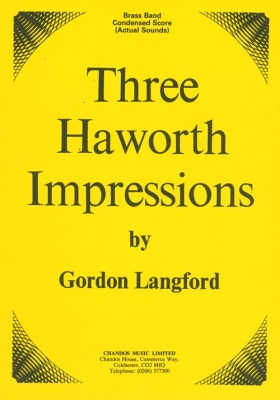
Three Haworth Impressions (Brass Band - Score only)
A wonderful three movement suite which conjures up fabulous musical imagery of the lands of northern England. Well worth including as a concert item in your next programme, but this great original composition should really should be set again as a test-piece soon - rewarding musically for audience and bandsmen alike.Includes:TOP WITHENS - A GENERAL EVOCATION OF THE ATMOSPHERE OF WUTHERING HEIGHTS The sinister opening motif symbolises the influence of the evil Heathcliffe, Soon this motif experiences several changes of character in order to portray emotions other than those of hatred and jealousy. The overall mood is, however, one of gloom and foreboding.THE THREE BELLS This is a reference to the pseudonyms adopted by Ann, Charlotte and Emily Bronte. The music begins with three "bell"-notes; Ab for Acton Bell, Cb for Currer Bell and Eb for Ellis Bell, and these three notes form the basis of a wistful waltz tune. Again the mood is rather sombre -- save for a brighter middle section -- and the opening motif from "Top Withens" is to be heard, again symbolising the frustrations and ill-fortune by which their lives were plagued.THE WORTH VALLEY RAILWAY The Brontes were not the only people in Haworth and not all is desperation and gloom. The third impression is a celebration of the victory of the people of Haworth in their fight to retain their railway. The nine-eight rhythm of a slow train is prominent, and our once-sombre motif is transformed into a triumphant fanfare.Duration: 12.00Please note that there are only 3 solo cornet parts included in this set
Estimated dispatch 7-14 working days
-
.NOBOX-1.jpg) £40.00
£40.00Bass Trombone Concerto - Gareth Wood
Written in 2006 for Roger Argente, Gareth Wood brings his considerable experience of writing for brass, and brass bands in particular, to an instrument not often blessed with opportunities for solo exposure. It is scored for soloist accompanied by traditional brass band line-up, including timpani and two percussion, and follows the standard three-movement pattern. In the first movement, the soloist launches straight into the musical argument with a low-lying repeated quaver figure punctuated by the band. A lyrical second subject in the high register is also entrusted to the soloist, and the movement comes to a thrilling conclusion. The slow movement opens softly with the percussion, and a mournful bass line sets the mood for a thoughtful long melody. It reaches a powerful climax, which subsides to a return of the opening mood. In the march-like finale, the soloist is pitted against a number of solo instruments from the band and a driving ostinato carries the momentum through to the blazing ending.
-
 £42.00
Trittico (Score only) - James Curnow
Trittico was commissioned by the Swiss Brass Band Association for their national championships in 1988. A trittico is a tripych or group of three paintings or musical compositions based on a common theme and presented or performed together. The present work is a set of three extended variations on the American shaped-note hymn Consolation. The work opens in grand style with motives based on intervals of the hymn tune. The opening motif, and smaller fragments of it reappear throughout the piece and serve as an underlying element alongside the theme itself. The first variation is essentially a scherzo which echoes the minor mood of the theme. The hemiolic opposition of compound and duple time is used to good effect and, again, the main motif is never far away. This is music with energy and forward movement. The second variation gives the soloists a chance to shine. The mood is tranquil, yet there is always some activity and the musical material pre-echoes the third variation. The third variation is another scherzo-like section, the main theme accompanied by a rhythmic ostinato. Toward the conclusion there is a short aeleatoric passage - a variation within a variation allowing half the band to make their own variaitions in a cachophony of sound. An energetic coda draws together several elements to round off a work brim full of drive, energy, and self-propelled enthusiasm. Duration: 13:30
Estimated dispatch 7-9 working days
-
 £52.00
Trittico (Parts only) - James Curnow
Trittico was commissioned by the Swiss Brass Band Association for their national championships in 1988. A trittico is a tripych or group of three paintings or musical compositions based on a common theme and presented or performed together. The present work is a set of three extended variations on the American shaped-note hymn Consolation. The work opens in grand style with motives based on intervals of the hymn tune. The opening motif, and smaller fragments of it reappear throughout the piece and serve as an underlying element alongside the theme itself. The first variation is essentially a scherzo which echoes the minor mood of the theme. The hemiolic opposition of compound and duple time is used to good effect and, again, the main motif is never far away. This is music with energy and forward movement. The second variation gives the soloists a chance to shine. The mood is tranquil, yet there is always some activity and the musical material pre-echoes the third variation. The third variation is another scherzo-like section, the main theme accompanied by a rhythmic ostinato. Toward the conclusion there is a short aeleatoric passage - a variation within a variation allowing half the band to make their own variaitions in a cachophony of sound. An energetic coda draws together several elements to round off a work brim full of drive, energy, and self-propelled enthusiasm. Duration: 13:30
Estimated dispatch 7-9 working days
-
 £33.20
Les Chasseresses from 'Sylvia' (Brass Band) Delibes arr. Rob Bushnell
Clement Philibert Leo Delibes was a French composer, best known for his ballets and operas, including works such as Lakme (with its famous "Flower Duet"), Coppelia and Sylvia (both key works in the development of modern ballet). The latter started as a play, Aminta, by the Italian poet Torquato Tasso, which Delibes set to music. It was then adapted for the Paris Opera with rehearsals starting in August 1875. The premiere took place on 14 June 1876 and was the first ballet to be shown at the newly-built Opera Garnier. Whilst the scenery and costumes were created by top artists and designers (Cheret and Lacoste), it was Delibes's music that shown thrown, being said to have saved the production, preventing the ballet from drifting into obscurity.Sylvia is said to be one of the first modern ballets, with Tchaikovsky remarking to composer Sergei Taneyev upon its ingenuity: "... the first ballet, where the music constitutes not only the main, but the only interest. What charm, what elegance, what richness of melody, rhythm, harmony." Although Swan Lake, a contemporary to Sylvia, is considered one of the best ballets there is, Tchaikovsky preferred Sylvia to his own work, saying Swan Lake was "poor stuff in comparison". Tchaikovsky said to Taneyev, "I was ashamed. If I had known this music early then, of course, I would not have written Swan Lake". The music to Sylvia, rather than setting only the mood, also sets the action and is noted for its use of leitmotifs - Delibes was an admirer of Wagner - and more dominant use of brass and wind. The most famous piece from this ballet is the Pizzicati in the third act.Act I of the ballet takes place in sacred wood, where creatures are worshipping before Eros when Sylvia arrives with her huntresses to mock the god of love. Aminta, a lowly shepherd and infatuated with Sylvia, protects the deity and Sylvia is wounded by Eros's arrow. The hunter Orion kidnaps Sylvia, whilst Eros revives Aminta. Act II takes place in Orion's Island cave, where Sylvia tries to bribe Orion with jewels and wine. Unsuccessful, she appeals to Eros for help, who arrives and takes her to the temple of Diana (where the final act takes place). Orion and Aminta fight, Sylvia and Orion cause the goddess of the hunt, Diana, to be outraged, smiting Orion and denying the love of Aminta and Sylvia. Eros shows Diana a vision, which changes her mind and the couple finally come together.This brilliant and lively fanfare that introduces the huntresses in the first act is arranged here for the UK-style brass band, with alternative parts for horns in F and bass-clef lower brass. The piece has been lowered by a tone compared to the original. A recording of the original composition can be found here https://youtu.be/6yoGrUH38PI?si=0L0bFa1qXnYNvkR3 Duration: Approx. 3.10 minutes Difficulty Level: 1st Section + This PDF download includes the full score and parts. Includes alternative parts for soloist in Eb, horns in F and lower brass in bass clef. Sheet music available at www.brassband.co.uk (UK) or https://satradecentral.org (USA) Instrumentation: Soprano Cornet Eb Solo Cornet Bb Repiano Cornet Bb 2nd Cornet Bb 3rd Cornet Bb Flugel Horn Bb Solo Horn Eb 1st Horn Eb 2nd Horn Eb 1st Baritone Bb 2nd Baritone Bb 1st Trombone Bb 2nd Trombone Bb Bass Trombone Euphonium Bb Bass Eb Bass Bb Timpani Percussion - Triangle, Cymbal & Bass Drum
In Stock: Estimated dispatch 1-3 working days
-
 £69.95
Ceremony - Jonathan Bates
DIFFICULTY: 2nd+. DURATION: 10'00". 'Ceremony' was commisioned by Musica da Domat, Switzerland and their Musical Director Gian Stecher in 2019. The concept of the work revolves around a number of religious processions which take place around the mountainous region of Graubunden in the south of the country and in more musical terms, a specific setting of the 'Stabat Mater' (heard in fragments throughout the piece, but only at the finale is it heard in it's entirety) which is traditionally the ceremonies around this area. Through-composed yet in 4 clear sections, 'Ceremony' opens with 3 fanafare trumpets/cornets positioned antiphonally across the back of the stage, each paired with a different pitched tenor drum, and in a different key - inspired by the idea of being able to hear the different ceremonies from all regions of Graubunden echoing up the valley in equal strength. Following this opening fanfare section, the procession around the hills begins with a tongue-in-cheek quasi-march in a far more upbeat and jovial mood. The centrepiece of the work is simply entitled 'Echoes', and once again returns to the idea of music breaking the almost eerie-silence as it reverberates around the vast valleys, before the culmination of the piece returns to material from the opening 'Ceremony' section in a more grandioso and bold style. . .
In Stock: Estimated dispatch 1-3 working days
-
 £95.00
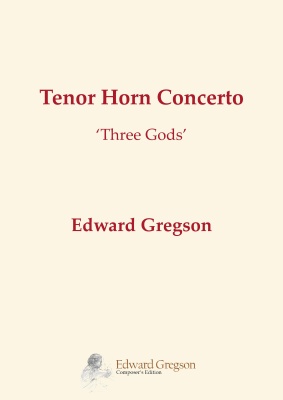
Tenor Horn Concerto 'Three Gods' (Tenor Horn Solo with Brass Band - Score and Parts)
Edward Gregson's Tenor Horn Concerto (Three Gods) was commissioned by the Belgian tenor horn soloist Tim de Maeseneer for a recording of commissioned works he made in 2024 with his own band, Brass Band Willebroek.The subtitle of 'Three Gods' refers to three mythological Greek Gods: Zeus, Hermes and Apollo. The idea for this came from Gregson's Viola Concerto, which he composed in 2023 and which was similarly subtitled 'Three Goddesses'. Indeed, the first movement of the horn concerto shares some common material with the viola concerto, although the other movements are newly composed.The concerto exploits the noble character of the horn, but the writing is also virtuosic in character as well as lyrical and melodic, demanding an extended playing range of nearly four octaves with a variety of colouration in its sonorities. The unifying motif of the whole concerto is the interval of a rising 5th, heard at the outset. The opening also has some other surprises (both seen and heard).The musical ideas, cast in three separate movements, take their starting point from the characters of the Three Gods in the title:Zeus, ruled as King of the Gods on Mount Olympus, and was the God of Thunder and Lightning and of War. His music is often threatening and violent, but also has a more tender side as portrayed in the lyrical second subject. However, the dominant mood is one of foreboding.Hermes was the great messenger to the Gods who could travel between realms on his winged sandals. Thus, his music is fast, fleet of foot, and mercurial - a dashing scherzo, but with lyrical and expressive moments.Apollo, the God of Music and Dance (and the Sun), symbolises virtue and beauty. This final movement, 'Hymn to Apollo', is mainly slow and hymn-like and cast in a continuous stream of melody passed between soloist and band. Brief fanfares herald a triumphant march, before the music returns to its quiet opening, gradually rising to a triumphant climax with glittering melodic percussion leading the way. The music ends in a blaze of glory!Duration: 17.00
Estimated dispatch 7-14 working days
-
 £29.95
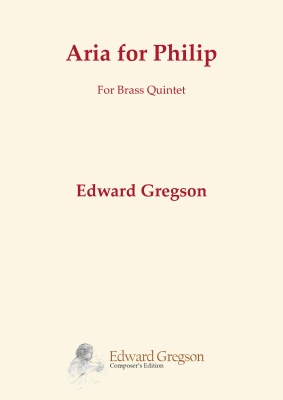
Aria for Philip (Brass Quintet - Score and Parts)
Instrumentation:2 Trumpets in CHorn in FTromboneTubaWritten in memory of Philip Jones, this short work was first performed at his memorial concert held at the Royal Northern College of Music in 2000. Scored for Brass Quintet, it was performed by former members of the Philip Jones Brass Ensemble.My friendship with Philip Jones stretched back to my student days, when my Quintet for Brass was performed during my final year at the Royal Academy of Music. Philip was present at that premiere in 1967, and soon after that his ensemble performed and broadcast the Quintet on a UK Tour, including a performance in the finals of the BBC Young Composer's Competition. I owe him a huge debt of gratitude for promoting a work by a then unknown young composer.I use a brief quote from the opening of my 1967 Brass Quintet in this work, which is generally rather sombre in character, except for the sudden change of mood and tempo in the short final section, when the clouds suddenly lift and the sun shines through.- Edward GregsonDuration: 5.00
Estimated dispatch 7-14 working days
-
 £70.00
General Series Band Journal August 2016 Numbers 2158 - 2161
No. 2158 Prelude - My God and King! (Paul Sharman)Based on the hymn tune 'Luckington', this music is a paean of praise to the Lord of all creation.No. 2159 A Christmas overture (Kevin Larsson)An exciting collection of well-known Christmas carols, originally written as a concert opener.No. 2160 March - A voice from above (Eiliv Herikstad)This march refers to a number of Christmas carols. It starts with four bars of 'Hark! the herald angels sing' followed by fragments of 'Joy to the world!' before James R. Murray's 'Den himmelske lovsang' is presented in full. 'Come children, come quickly' requires legato playing from the lower band.No. 2161 In God we trust (Ralph Pearce)Although the title derives from the United States of America's much-neglected motto, the music is a journey through to total trust in God and our Lord Jesus Christ. The tunes featured are 'In thee, O Lord, do I put my trust' leading to 'Trust in God'. Increasingly calm music leads to the more recent song 'In Christ alone, I placed my trust'. The music ends with a brief reference to 'In Thee, O Lord, do I put my trust' now in a mood of calm assurance.
Estimated dispatch 7-14 working days
-
 £89.95
Orion (Brass Band - Score and Parts)
Orion was named after the giant huntsman in Greek mythology and is a prominent constellation located on the celestial equator and visible throughout the world. It is one of the most conspicuous and recognisable constellations in the night sky. This piece and its inspiration were composed as a tone poem creating a musical picture of this amazing phenomenon.The opening introduces the constellation. Starting mysteriously with the percussion and basses this section develops a series of rhythmic and harmonic interludes from the upper brass. As this introduction develops, the melodic line lead by the Solo Cornet and Euphonium builds as the accompanying instruments increase in their rhythmic complexity. This section climaxes with a short fanfare motif which will be a prominent theme throughout this piece.The fast rhythmic section that follows serves as a technical test for the players. The thematic device introduced by the Solo Cornets is passed around various soloists and sections within the ensemble. This part of the tone poem gives the opportunity for the ensemble to highlight their technical prowess. The fanfare motif returns to conclude this section and takes the piece into the slow middle movement.Motifs heard earlier are mixed with new ideas in this slow section which give an opportunity for a variety of soloists to demonstrate their musical prowess. After the various solo passages and cadenzas, the mood shifts dramatically to a more ominous section that builds in texture and dynamic. Concluding with our returning fanfare motif the piece then builds in momentum towards our finale section.This finale is a technical showcase which will further test the playing ability and stamina of soloists, small groups and the full ensemble. Using prominent musical themes heard throughout this piece the music builds to a glorious conclusion fitting with wonderful constellation.
Estimated dispatch 7-14 working days