
Results
-
£29.95
The Land of the Long White Cloud (Score Only)
Dating from 1979, The Land of the Long White Cloud (Aotearoa) was Philip Sparke's first test-piece. It was commissioned by the New Zealand Brass Band Association for their 1980 National Championships (their centenary year) and set for the European Brass Band Championships, the same year, at the Royal Albert Hall in London. Aotearoa was the name given to New Zealand by its Polynesian settlers whose first sight of the islands was a long, flat cloud lying low over the land. The work has no specific programme although many have seen pictures of the surging ocean in the opening bars. A faster dance-like section leads to a slow, haunting solo for soprano cornet; this is taken up by the whole band before earlier material returns. The dance-like tune is, this time, given a fugal treatment and the opening bars return to close the work.Philip Sparke was born in London and studied composition, trumpet and piano at the Royal College of Music, where he gained an ARCM. It was at the College that his interest in bands arose. He played in the College wind orchestra and also formed a brass band among the students, writing several works for both ensembles.At that time, his first published works appeared - Concert Prelude (brass band) and Gaudium (wind band). A growing interest in his music led to several commissions, his first major one being this featured piece for the Centennial Brass Band Championships in New Zealand - The Land of the Long White Cloud. He has written for brass band championships in New Zealand, Switzerland, Holland, Australia and the UK, including three times for the National Finals at the Royal Albert Hall.In September 2000, he was awarded the Iles Medal of the Worshipful Company of Musicians for his services to brass bands and in 2005 Music of the Spheres won the National Band Association/William D. Revelli Memorial Band Composition Contest. In 2011, he received the BUMA International Brass Award for his contribution to brass music.His conducting and adjudicating activities have taken him to most European countries, Scandinavia, Australia, New Zealand, Japan, Taiwan, South Korea, Canada and the USA. In May 2000, he took the major step of becoming a full-time composer by founding his own publishing company, Anglo Music Press. The company is devoted to publishing his brass band, concert band, fanfare band and instrumental publications as well as recordings dedicated to his latest works.
Estimated dispatch 7-14 working days
-
 £34.95
Lady of the Lake - Christopher Bond
A remote Carmarthenshire lake shrouded in Welsh legend has been named as one of the 1,000 must-see sights across the globe by an influential travel bible. Llyn y Fan Fach, 12km southeast of Llandovery in the Brecon Beacons, is the only spot in Wales to make the list, which was put together by Lonely Planet. "This isolated drop of blue, beneath a cirque of raw Welsh hills, is enchanting - and enchanted," Lonely Planet's 1,000 Ultimate Sights tells readers. The story goes that in the 13th Century, a farmer grazing cattle on the nearby slopes spotted the most beautiful woman he'd ever seen. She was a fairy maiden, who agreed to marry him on one proviso - he must not hit her more than twice. In time, the inevitable happened - three strikes, and the otherworldly wife disappeared back into the lake, taking her magic cows with her. This work, for flugel horn and brass band, is reflective in nature, portraying the dismay of the man in losing his wife for his own selfishness. The work was written for and premiered by Rob Nesbitt & City of Cardiff (Melingriffith) Band, at the 2019 Welsh Open Entertainment Contest in Porthcawl, Wales.
Estimated dispatch 10-14 working days
-
 £79.95
Lost Village of Imber, The - Christopher Bond
The village of Imber on Salisbury Plain had been inhabited for over one thousand years when it was evacuated in 1943 to make way for military training in the Second World War. At the time, with preparations for the Allied invasion of Europe underway, most villagers put up no resistance, despite being upset, with the belief that they'd return once the war had concluded. To this day, Imber and its surrounding land remain a military training ground. The villagers never returned, and just the shell of what was once a community remains. Structured in three movements, it is on this very real story that the work is based, setting out the series of events of 1943 in chronological order. The first movement, On Imber Downe, portrays a sense of jollity and cohesiveness - a community of individuals living and working together before news of the evacuation had broken. Sounds of the village are heard throughout, not least in a series of percussive effects - the anvil of the blacksmith; the cowbell of the cattle and the bells of the church. The second movement, The Church of St. Giles, begins mysteriously and this sonorous, atmospheric opening depicts Imber in its desolate state and the apprehension of residents as they learn they have to leave their homes. Amidst this is the Church, a symbol of hope for villagers who one day wish to return, portrayed with a sweeping melodic passage before the music returns to the apprehension of villagers facing eviction around their sadness at losing their rural way of life. In complete contrast, the third movement, Imemerie Aeternum, portrays the arrival of the military, complete with the sounds of the ammunition, firing and tanks - sounds which were all too familiar to those living in the surround areas. To close, the Church of St. Giles theme returns in a triumphant style, representing the idea that the church has always been, even to this day, a beacon of hope for the villagers and local community - both the centrepiece and pinnacle of a very real story. The work was commissioned by Bratton Silver Band in celebration of the band's 160th Anniversary, with funding from the Arts Council National Lottery Project Grants Fund and the Brass Bands England Norman Jones Trust Fund.
Estimated dispatch 10-14 working days
-
 £38.95
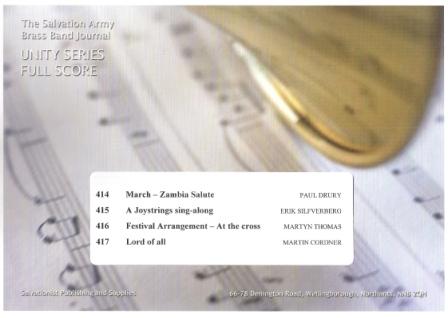
Unity Series Band Journal February 2014 Numbers 414-417
No.414 March - Zambia Salute (Paul Drury)In April 2009, a group from Chelmsford Citadel Corps visited Zambia. The purpose of the visit was to assist in the leadership of the Zambian Territorial Music School, held at Chikankata. This march was written to commemorate the event and received its premiere performance at the final festival. The melody featured is the chorus of the song, I know not why Dod's wondrous grace (S.A.S.B. 730).No.415 A Joystrings sing-along (Erik Silfverberg O.F.)This piece represents the first published work since the sudden Promotion to Glory of Bandmaster Erik Silfverberg O.F. The Joystrings made Salvation Army history about fifty years ago, introducing rock music on the Christian music scene. Many of their songs have become classics and have been used as thematic material in our brass music. Here is a selection of three of their songs, to be used either as a band piece or as accompaniment to a sing-along. The three songs are:- 'I want to sing it', 'It's an open secret' and 'Have faith in God'.No.416 Festival Arrangement - At the cross (Martyn Thomas)The well-known song, 'At the cross' (T.B. 580), is given a lively new setting by Martyn Thomas. The rock and swing treatment of this old melody should appeal to many!No.417 Lord of all (Martin Cordner)This piece was written for the 120th Anniversary of Balham corps (London Central Division) in 2011. In terms of a theme, the anniversary occasion prompted the primary thought that the piece should first be a praise-offering to God, acknowledging him for who he is. Therefore songs referenced in the piece are praide songs: 'Lord, reign in me', 'He is Lord', 'All hail the Lamb', along with a song of testimony, 'I'm a soldier bound for Glory' (T.B. 382),which speaks of the Christian hope in Heaven and challenges Salvationists to influence others by living out that hope. There is also a brief reference to the National Anthem of the Democratic Republic of Congo (4 bars before D)- man acknowledgement to the faithfulness of corps soldiers who in recent years have arrived from that country.
Estimated dispatch 7-14 working days
-
 £39.95
Swing into Christmas (Brass Band - Score and Parts)
Written during Colonel Robert Redhead's tenure as Bandmaster of The International Staff Band, this bright and good-humoured selection - originally titled Sounds of the forties - was composed for the UK Territory's annual Christmas event at the Westminster Central Hall in 1993. It features lively treatments of Good King Wenceslas, Carol of the drum, Silent Night! and Deck the hall and brings fresh sparkle to these familiar carols. With the permission of the Redhead family, the work has been readied for publication. Colonel Redhead lives in retirement in Canada, and this release stands as a welcome addition to the journals.The secret to a successful presentation of this piece (and any swing number) is for the band to have a clear grasp of basic swing principles. Players should aim for a relaxed, buoyant feel built on back'beat emphasis (2 and 4), light articulation, and a sense of forward motion without rushing. Note that, apart from the intentionally straight quavers on the drum kit in sections D and E, quavers elsewhere should be swung.A drum kit will be essential as it provides the stylistic anchor throughout, setting up the tempo, supporting the back'beat, and giving the band confidence to embrace the swing style.The Glenn Miller-inspired opening cornet feature sets the tone for the whole piece and should be played with strength, clarity, and stylistic assurance. The outer movements share this brighter, punchier swing character, with crisp rhythmic definition and confident ensemble playing.In contrast, the central setting of Silent Night! adopts a slow 'shuffle' feel. This section should feel spacious and unhurried, with warm phrasing, gentle back'beat, and a laid'back rhythmic pulse. In the melody line, think breadth, and in the accompaniment, think subtlety rather than weight.
Estimated dispatch 7-14 working days
-
 £27.95
Three Fanfares (Brass Ensemble - Score and Parts)
This set includes three fanfares by Edward Gregson for symphonic brass and percussion ensemble:Fanfare for a New EraFanfare for the NorthFanfare for EuropeFanfare for a New Era: This fanfare was commissioned by Lady Sheila Stoller to celebrate the opening of the Stoller Hall at Chetham's School of Music in Manchester (UK). It is dedicated to Sir Norman Stoller, who generously donated the funding for the new concert hall. It was first performed by students of Chetham's School of Music, conducted by Stephen Threlfall, at the Royal Opening of the Stoller Hall on 24 April 2017. Ideally, the fanfare should be performed using as much spatial arrangement as possible, so that the antiphonal effects are heard to their best advantage. Whatever the chosen lay-out, the 1st Trumpet should be positioned off-stage in a suitable position. This could be a rear balcony if the venue is not too large, or in a side balcony in a larger concert hall. Duration: 3.00Fanfare for the North: This fanfare was commissioned by the Gateshead Garden Festival of 1990 and was first performed by London Brass Virtuosi, directed by David Honeyball, at the Royal Opening by HM The Queen. Its four-note motif (G, A, E, D), which is heard throughout the fanfare, is derived from the letters of 'Gateshead'. Duration: 1.15Fanfare for Europe: This fanfare was specially commissioned for two concerts celebrating the UK's entry into Europe (or the European Economic Community as it was then known) in 1973. The first performances were given at York Minister and the Royal Albert Hall, London, in January 1973. The fanfare was also featured as the opening music for the first episode of a series of short documentary programmes made for BBC Radio 4 in 2018 by Mark Mardell entitled Brexit: A Love Story? Duration: 1.15Duration: 5.30
Estimated dispatch 7-14 working days
-
 £74.99
Cornet Concerto No.1 - Jonathan Bates
My 'Cornet Concerto No.1' was composed for Lode Violet and Brass Band Willebroek in 2018 and features 2 movements, entitled 'Dystopia' and 'Utopia'. . The nature of the music in the opening section, 'Dystopia', is very jagged, disjointed and unsettling, as the soloist almost battles against the constant churning of the mechanical accompaniment, trying to persevere with it's own ideas and styles without being dragged into conforming to it's surroundings. The movement is based largely on the 3 note interval heard right at the outset of the piece (C, D & G#, a series of notes that lends itself so well to different modes, scales, harmonies and intervals) and this forms much of the rhythmic and harmonic structure of the opening section.Whilst this movement acts as a virtuoso feature to demonstrate the extended capabilities of both the soloist and instrument, I feel the accompanying ensemble plays an equal role in the narrative of 'dystopia', and features a number of demanding and prominent episodes for soloists within the accompanying band. A short and heavy coda concludes the movement, with a sense of real pain and sorrowfulness as the music fades away into darkness. . 'Utopia' opens in an instantly more hopeful nature, with the soloist introducing the first real 'theme' of the movement, taken up shortly by the accompaniment. Throughout this movement, there are a number of timbral and melodic references back to the darkness of 'dystopia', but transformed into a much more positive outlook and soundworld. There is a moment of quiet reflect (using the initial 3 note cell as a basis) before flying head first into a frenzied wild 'tarantella' like section, full of joy and energy which tests the dexterity and light-natured approach to virtuosity (much unlike the heavier material in the 1st movement) of the soloist. Primarily, the concept of this finale is fun - joy, happiness, and freedom from restraint, so the addition of a quirky 'tongue-in-cheek' habanera section offers a brief moment of respite from the craziness of the tarantella. To conclude the work, there is an extended cadenza for the soloist which is built on several motifs heard throughout the concerto, which leads the band into a dramatic and energetic final few bars.. Jonathan Bates. (2018). .
In Stock: Estimated dispatch 1-3 working days
-
 £10.00
Kopanitsa
DescriptionKopanitsa was commissioned by Gavin Pritchard, who is also the work's dedicatee and gave the first performance with the Tongwynlais Temperance Band conducted by Gareth Pritchard at the Butlins Mineworkers Championship on 20 January 2008, winning the prize for best soloist as a result. He has recorded it on the CD "Enter the Galaxies" accompanied by the Cory Band conducted by Robert Childs.Gavin had requested a virtuoso showpiece featuring as many instruments as possible. The solo part is therefore written for vibraphone (bowed and struck), 10 x tuned tom toms, 5 x suspended cymbals plus hi-hat and a xylophone. The soloist's 'choreography' therefore forms an integral part of the performance. This can be seen to great effect in Gavin's performance of the work at the 2013 Brass in Concert Championship with Tredegar Band, available on the DVD of the event from World of Brass. A 'kopanitsa' is a Bulgarian folk dance that traditionally features two slow beats and two quick beats, reflected in the central 10/8 section. The music is deliberately Balkan in character, using the characteristic modes of Greek and Bulgarian folk music, and accelerates regularly to finish at breakneck speed. The tom-tom section marked 'ad lib.' after [D] can be improvised if the soloist wishes.You can follow the score in the preview video below!
Estimated dispatch 7-14 working days
-
 £50.00
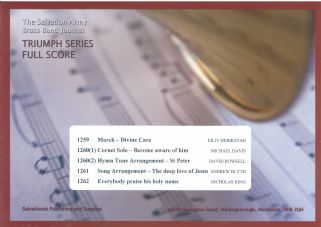
Triumph Series Band Journal March 2015 Numbers 1259 - 1262
No. 1259 March - Divine Care (Eiliv Herikstad)The message of this march is 'God will take care of you!' The introduction reflects the beginning of the song, God will take care of you (T.B.C.S. 124), which is presented in full at sections C and D.No. 1260 (1) Cornet Solo - Become aware of him (Michael Davis)A setting for Cornet and band of Colonel Robert Redhead's song, Become aware of him, which was originally published in The Musical Salvationist.No. 1260 (2) Hymn Tune Arrangement - St Peter (David Rowsell)An arrangement of the tune, St Peter, associated with the song, In Christ there is no east or west.No. 1261 Song Arrangement - The deep love of Jesus (Andrew Blyth)The strong hymn tune of Ebenezer (T.B. 433) was composed by Welshman, Thomas John Williams (1869-1944), who served as organist and choir director at various churches in and around Llanelli. This arrangement is more relaxed in style than the original and attempts to convey the freedom of the verses mostly associated witht he tune by Samuel T. Francis (1835-1925) O deep, deep love of Jesus, vast, unmeasured, boundless, free.No. 1262 Everybody praise his holy name (Nicholas King)A bright arrangement by Nicholas King of Remco Hakkert's song, Praise his holy name.
Estimated dispatch 7-14 working days
-
 £39.95
When Thunder Calls (Brass Band - Score and Parts)
When Thunder Calls was commissioned by Dr Nicholas Childs and the Black Dyke Band for their performance at the Gala Concert of the Swiss Open Championships in September 2011. When composing this piece, I decided to focus on both the music and the stage presentation. The way the piece has been composed and designed makes it a very effective way of starting a concert or a second half of a concert.At the start of the piece, the percussion enter the stage and take their positions in their usual place behind the band. They begin playing the piece without a conductor. They keep repeating the opening section while the Basses, Horns, Baritones and Euphoniums march onto the stage.This group of musicians take their seats with the Horns, Baritones and Euphoniums sitting where they usually sit in the band but the Basses sit where the solo cornets usually sit, forming an inner semi-circle of lower brass. When seated and when the music gets to the end of bar 4 the piece continues onto section A. All performers keep repeating this next 4-bar phrase until the trombones march onto stage and stand at the front of the stage with the Bass Trombone standing in between the other two trombones.All performers then play from figure B to C with the trombones taking the lead at the front. When the performers get to rehearsal figure C they repeat this section (the same as section A) while the trombones move from the front of the stage and take their positions where the Basses would normally sit (between the horns and the percussion) and remain standing. Meanwhile, the flugel enters the stage and stands at the front of the stage (standing where the trombones did). When in position the flugel soloist picks up into rehearsal figure D.When the flugel soloist finishes playing, just before rehearsal figure F they then move to their normal seat in the band. At figure F the cornets march onto the stage from either side, they turn and stand side by side each other facing outward towards the audience forming two 'fanfare' lines either side of the lower brass. The conductor follows the cornets on stage and on cue they lift their instruments at the same time and perform when the piece gets to figure G.There is no more moving around from this point on other than the solo cornet to move forward with the solo euphonium and perform their duet at letter H. Also the horns are required to stand and play at letter I and then sit just before J.When performed with all the choreography, this piece makes for an exciting addition to any concert repertoire both for the performer and the audience.Suitable for 3rd Section Bands and Above
Estimated dispatch 7-14 working days