
Results
-
£44.00
Don't Sit Under the Apple Tree - Stept-Brown-Tobias - Bjorn Morten Kjaernes
"Don't Sit Under the Apple Tree (With Anyone Else but Me)" is a popular song that was made famous by Glenn Miller and by the Andrews Sisters during World War II. Its lyrics are the words of two young lovers who pledge their fidelity while one of them is away serving in the war. Originally titled "Anywhere the Bluebird Goes", the melody was written by Sam H. Stept as an updated version of the nineteenth-century English folk song "Long, Long Ago". Lew Brown and Charles Tobias wrote the lyrics and the song debuted in the 1939 Broadway musical Yokel Boy. After the United States entered the war in December 1941, Brown and Tobias modified the lyrics to their current form, with the chorus ending with "...'till I come marching home".In 1942 the song was featured in the film Private Buckaroo as a performance by the Andrews Sisters with the Harry James orchestra and featuring a tap dancing routine by The Jivin' Jacks and Jills. It was featured in the films Twelve O'Clock High (1949), With a Song in My Heart (1952), Kiss Them for Me (1957), A Carol for Another Christmas (1964), In Dreams (1999) and The Master (2012). It also featured in the mini-series The Pacific. You can use the song both on musical concerts, movie concerts or just as a happy jazz tune on your next concert. On the sections (like from bar 25), please work carefully to make a good balance with all parts, and that each chord is balanced. With 4-part harmonies sometimes you need to hold back certain notes to make the accord sound good. If you want to open up for a longer improvisation, you can repeat 65 to 81, but then change the part 2 in bar 80 from Eb to a D on the repeat. The accord will be an F6 instead of F7 (on beat 3 and 4 in bar 80) Have fun and enjoy!
Estimated dispatch 7-14 working days
-
 £59.77
We Seven (Brass Band) Derek Jenkins
We Seven, the title of this work, comes from a book by the same name written by the United States's first astronauts. The composer writes: 'In 1959, the United States entered the space race by starting a programme whose main aims included sending a solo astronaut into space and recovering him safely. Project Mercury, as this programme was so called, recruited the first seven American astronauts and successfully sent six of them into space. These men were Scott Carpenter, Gordon Cooper, John Glenn, Gus Grissom, Wally Schirra, Alan Shepard, and Deke Slayton, and collectively they became known as the 'Mercury Seven.' Through their efforts and those of countless others, the United States Space Program accomplished much with these six flights, including successfully sending an astronaut into space, putting a man in orbit, and keeping him up there for more than 24 hours. In 1962, shortly after Glenn and Carpenter's orbital flights, the 'Mercury Seven' co-wrote the book We Seven and throughout it, the astronauts discuss the events leading from their selection into the programme up through Carpenter's flight in May of 1962. The primary material for the work comes from two sources: the use of musical cryptograms to encode the astronauts names and initials into pitches and the aria 'Un bel di vedremo' from Giacomo Puccini's opera, Madame Butterfly. The inclusion of the latter comes directly from one of Glenn's chapters in the book. Together with a couple of the other astronauts, he would often listen to the opera to unwind from a long day of training. I would like to think that as he was orbiting the Earth that this opera, particularly this aria, would be running through his mind.' This work commemorates the Project Mercury on the 50th anniversary of its conclusion and was written for Joseph Parisi and the University of Missouri-Kansas City Wind Ensemble. This version for brass band has been prepared by the composer for the Fountain City Brass Band. To view a video of Fountain City Brass Band performing the work please visit: www.youtube.com/watch?v=yD3sBWhGkOo Sheet music available from: UK - www.brassband.co.uk USA - www.solidbrassmusic.com Difficulty Level: 1st Section + Instrumentation: 1 Soprano Cornet (Eb) 9 Cornets (Bb) [Both 3rd Cornets double Crystal Glasses] 1 Flugelhorn 3 Tenor Horns (Eb) [2nd Horn doubles Crystal Glasses] 2 Baritones (Bb) 2 Trombones (Bb) 1 Bass Trombone 2 Euphoniums (Bb) 2 Basses (Eb) 2 Basses (Bb) 4 Percussion
In Stock: Estimated dispatch 1-3 working days
-
£132.00
Celebration for Band - John Brakstad
Many Norwegian bands have grown up around factories; but Norwegian factories are often located in the countrysides - by a fjord or lake, by a river or waterfall that provided power for the factory.The factory was the foundation for the existence of the community, but it was also essential for the community's cultural life; choirs, bands etc. (cp. British brass bands and mining)."Celebration for band" tries to give a picture of the environment and life around a band like this, with both factory noise and the natural world (Pastorale), as well as the challenges and development of the band itself.The composition is built up of five connected episodes:- Fanfare and Prologue (concludes with a feeling of the untamed power of the river) - Pastorale I: " At the river"- Intermezzo: " The Factory" (starts with the opening of water for the turbines: snare drum. Factory whistle and bell call to work, and the spinning and weaving machinery starts up.)- Pastorale II: " Summer evening on the fjord." - Finale: " Challenge and Progress"
Estimated dispatch 7-14 working days
-
 £30.00
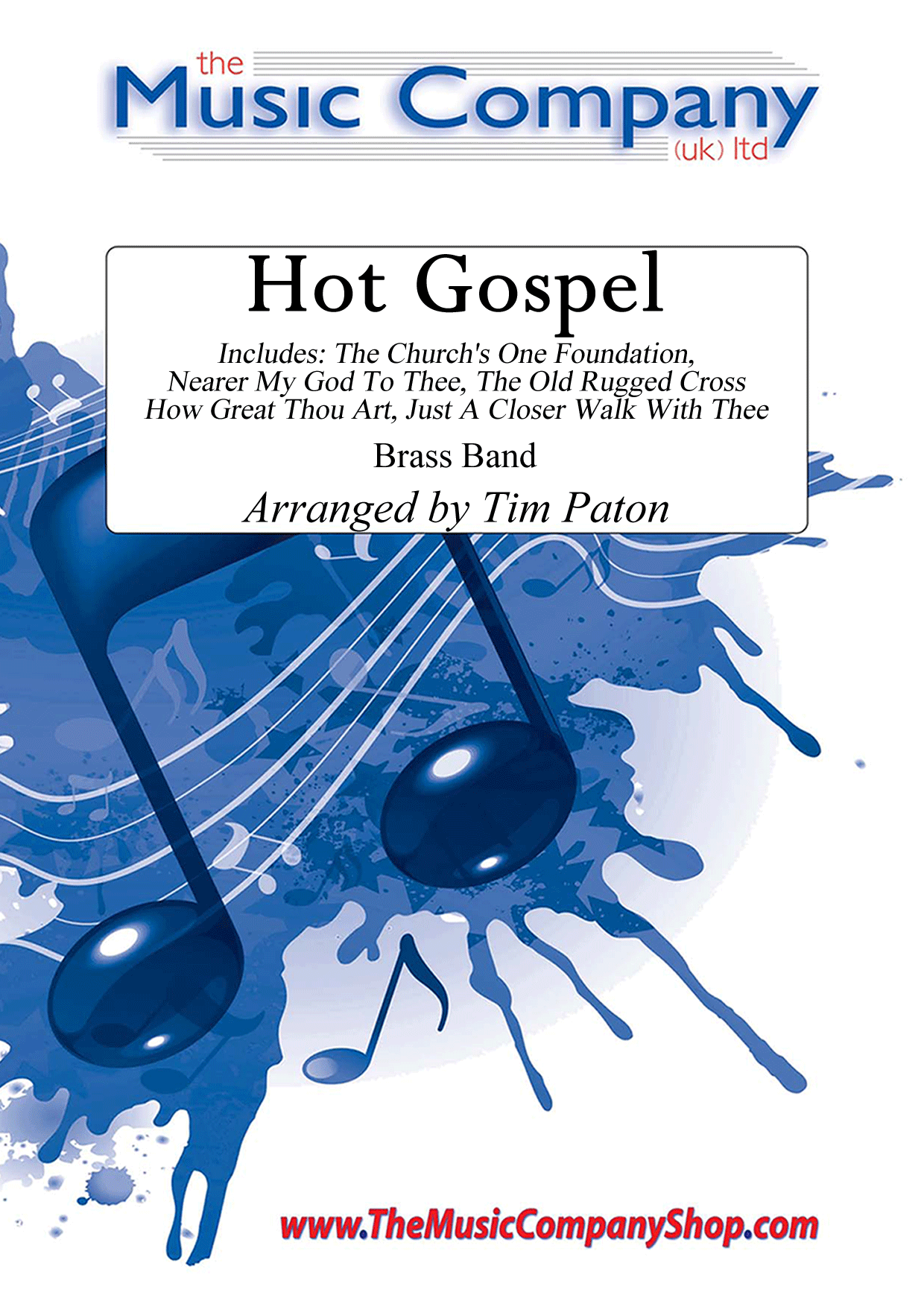
Hot Gospel - Various
Tim Paton has creatively arranged for brass band this selection of familiar hymns/religious songs to create a 5-movement, gospel-styled work. With features for soloists across the band and a great mix of styles including swing, traditional jazz, blues, and calypso, this makes for a versatile concert feature either as a complete piece piece (9 minutes); using the alternative optional cuts (4.5 minutes); or simply by cherry-picking the individual movements in order to spotlight the different styles/melodies/soloists of your choice.With solo features in each section, the piece includes:The Church's One Foundation - Swing version with Tenor Horn soloNearer My God To Thee - Traditional jazz style with Cornet soloThe Old Rugged Cross - Bluesy with Flugel soloHow Great Thou Art - Calypso with Euphonium soloJust A Closer Walk With Thee - Finale with jazzy Trombone soloTim comments:The community gospel choir sound has become very popular in recent years. "Hot Gospel" is my attempt to capture this charismatic experience in a medley of well known sacred music. Each of the five songs chosen follows a similar pattern - a verse for full band followed by a solo, and all solos are intended to sound like improvisation.I've included Optional Cuts which would reduce the play length from c. 9 minutes, down to approximately 4.5 mintues, should your concert programming not allow for the full version. The optional cuts simply side-step the solo section of each song.However you wish to perform Hot Gospel, it will definitely bring variety to programme choice.Also available for wind/concert band.
In Stock: Estimated dispatch 3-5 working days
-
 £99.95
Breath of Souls (Brass Band - Score and Parts)
Breath of Souls was commissioned by Weyland and Yvonne Roberts. It was composed especially for the 100th National Brass band Championships of Great Britain at the Royal Albert hall on October 15th 2011.Weyland has worked in science for many years and has always been fascinated by nature's capacity to grow and rebuild regardless of Mother Nature's catastrophic power. This is evident with the news of tsunami, forest fires, earthquakes and volcanic disasters around the world where animals, plant life and humans have overcome adversity and have demonstrated that unique regenerative quality.Speaking about the piece composer Paul Lovatt-Cooper commented: "With Breath of Souls I wanted to compose a piece of music that was a celebration of life. Not only that, but a piece of music that from the very first notes heard in the percussion and cornets, is bustling with activity, emulating that in life everything that is living has a soul and breathes - nothing stays still and everything keeps moving and growing.Just like life itself Breath of Souls also grows musically with each bar. You will hear many and various motifs and ideas grow and develop as the piece develops."
Estimated dispatch 7-14 working days
-
 £15.00
Breath of Souls (Brass Band - Study Score)
Breath of Souls was commissioned by Weyland and Yvonne Roberts. It was composed especially for the 100th National Brass band Championships of Great Britain at the Royal Albert hall on October 15th 2011.Weyland has worked in science for many years and has always been fascinated by nature's capacity to grow and rebuild regardless of Mother Nature's catastrophic power. This is evident with the news of tsunami, forest fires, earthquakes and volcanic disasters around the world where animals, plant life and humans have overcome adversity and have demonstrated that unique regenerative quality.Speaking about the piece composer Paul Lovatt-Cooper commented: "With Breath of Souls I wanted to compose a piece of music that was a celebration of life. Not only that, but a piece of music that from the very first notes heard in the percussion and cornets, is bustling with activity, emulating that in life everything that is living has a soul and breathes - nothing stays still and everything keeps moving and growing.Just like life itself Breath of Souls also grows musically with each bar. You will hear many and various motifs and ideas grow and develop as the piece develops."
Estimated dispatch 7-14 working days
-
 £30.00
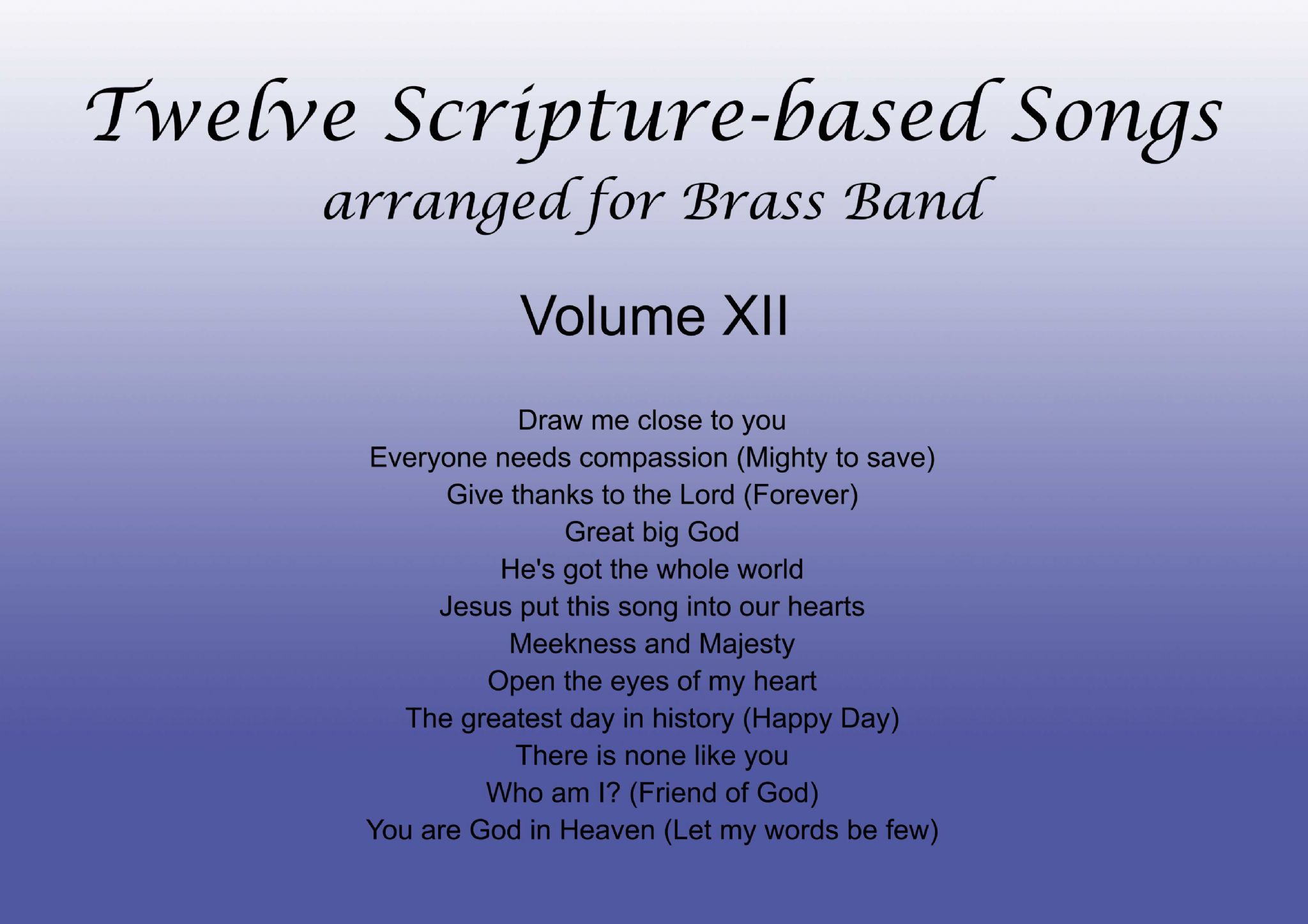
Twelve Scripture-Based Songs Volume XII
Twelve scripture-Based Songs arranged for Brass Band (Volume XII) are packaged and marketed in complete sets which include a full score and a set of master parts. It is intended that these parts be used as 'masters', for the purpose of photocopying a quantity of parts to accommodate the precise instrumentation needs of the band for which this has been purchased.Draw me close to you; Everyone needs compassion (Mighty to save); Give thanks to the Lord (Forever); Great big God;He's got the whole world; Jesus put this song into our hearts; Meekness and Majesty; Open the eyes of my heart;The greatest day in history (Happy Day); There is none like you; Who am I? (Friend of God);You are God in Heaven (Let my words be few).
Estimated dispatch 7-14 working days
-
 £69.95
Transformation (Brass Band - Score and Parts) - Downie, Kenneth
I believe in transformation, God can change the hearts of men, And refine the evil nature, till it glows with grace again'. So wrote John Gowans in the second verse of his great hymn, 'I believe that God the Father, can be seen in God the Son', written specifically to affirm Salvationists' beliefs. It is sung to the tune Bethany and in seeking to explore this great subject at the heart of the Christian gospel in musical terms, the composer has used this fine tune as the basis. Although it never appears in its entirety, it is seldom out of the picture and much of the work is derived from it. The other main source of material is the lovely, simple chorus, 'Some day I shall be like him, changed to heavenly beauty, when his face I see'. This chorus is especially prominent in the middle section but there are important references to it throughout. There are also brief references to Charles Wesley's hymn, 'Love Divine' and, in particular, the telling lines, 'Changed from glory into glory, till in Heaven we take our place'. The work suggests that, at times, the process of being transformed is a struggle, portrayed with many passages of fraught and demanding music. Considerable reserves of stamina and technique are required while, in contrast, the chorus, 'Some day I shall be like him' provides the warm, gentle centre of the work. The premiere of the work was given by The International Staff Band of The Salvation Army in Cadogan Hall on Friday 3rd June 2011, as part of the band's 120th anniversary celebrations.
Estimated dispatch 7-14 working days
-
£34.95
Transformation (Brass Band - Score only) - Downie, Kenneth
I believe in transformation, God can change the hearts of men, And refine the evil nature, till it glows with grace again'. So wrote John Gowans in the second verse of his great hymn, 'I believe that God the Father, can be seen in God the Son', written specifically to affirm Salvationists' beliefs. It is sung to the tune Bethany and in seeking to explore this great subject at the heart of the Christian gospel in musical terms, the composer has used this fine tune as the basis. Although it never appears in its entirety, it is seldom out of the picture and much of the work is derived from it. The other main source of material is the lovely, simple chorus, 'Some day I shall be like him, changed to heavenly beauty, when his face I see'. This chorus is especially prominent in the middle section but there are important references to it throughout. There are also brief references to Charles Wesley's hymn, 'Love Divine' and, in particular, the telling lines, 'Changed from glory into glory, till in Heaven we take our place'. The work suggests that, at times, the process of being transformed is a struggle, portrayed with many passages of fraught and demanding music. Considerable reserves of stamina and technique are required while, in contrast, the chorus, 'Some day I shall be like him' provides the warm, gentle centre of the work. The premiere of the work was given by The International Staff Band of The Salvation Army in Cadogan Hall on Friday 3rd June 2011, as part of the band's 120th anniversary celebrations.
Estimated dispatch 7-14 working days
-
 £9.99
£9.99Christmas Collection - 1st Trombone Bb - Large Print A4
Christmas Collection is a newly revised carol book with original, additional and rearranged carols from New Christmas Praise as well as 10 extended pieces. Parts are now also available in large print A4 size!Titles:A child this day is bornA Christmas lullabyA great and mighty wonderAll I want for Christmas is youAll my heart this night rejoicesAngels, from the realms of Glory (Come and worship)Angels, from the realms of Glory (Iris)Angels we have heard on highA starry nightAs with gladness men of oldAuld lang syneA virgin most pureAway in a manger (The manger scene)Away in a manger (Traditional)A winter's taleBethlehemBrightest and best (Spean)Brightest and best (Traditional)Calypso CarolCarol for the NativityCarol of the bellsCarol of the drumChild of MaryChristians Awake!Christ is born (Il est n)Christ was born on Christmas DayCome and join the celebrationCome, children, come quicklyCoventry CarolDeck the hallDing dong! merrily on highDo you hear what I hear?Frosty the snowmanGabriel's MessageGaudeteGlory in the highestGlory in the highest HeavenGod of God, the uncreatedGod rest you merry, gentlemenGood Christian men, rejoiceGood King WenceslasGo, tell it on the mountain!Happy Christmas (War is over)Hark the glad sound!Hark! the herald angels singHave yourself a merry little ChristmasHere we come a-wassailingHow far is it to Bethlehem?Huron CarolInfant HolyIn the bleak midwinter (Cranham)In the bleak midwinter (Darke)I saw mommy kissing Santa ClausI saw three ships come sailing inIt came upon a midnight clear (Traditional)It came upon a midnight clear (Willis)It's beginning to look a lot like ChristmasIt's the most wonderful time of the yearI wish it could be Christmas everydayI wonder as I wanderJesus, good above all otherJingle BellsJingle bell rockJoy to the world!Last ChristmasLet it snow!Little baby JesusLittle children, wake and listenLittle DonkeyLittle Jesus, sweetly sleepLo! he comes with clouds descendingLong, long agoLove came down at ChristmasMary's boy childMary's ChildMasters in this hallMerry Christmas everyoneMistletoe and wineNoelO Christmas treeO come, all ye faithfulO come, ImmanuelO Heaven-sent KingO holy night!O little town of Bethlehem (Christmas Carol)O little town of Bethlehem (Forest Green)O little town of Bethlehem (St Louis)Once in royal David's cityPast three o'clockPatapanPersonent HodiePraise ye the LordRing the bellsRise up, shepherd!Rockin' around the Christmas treeRudolph, the red-nosed reindeerSans day carolSanta Claus is comin' to townSaviour's DaySee, amid the winter's snowSilent Night!Sleigh RideSoftly the night is sleepingSo here it is, merry ChristmasStars are shiningStill, still, stillStop the cavalrySussex CarolSweet chiming bellsSweet chiming Christmas bellsThe candle songThe cherry tree carolThe Christmas songThe first NowellThe holly and the ivyThe infant KingThe light has comeThe shepherds' farewellThe stable doorThe star in the eastThe twelve days of ChristmasThe virgin Mary had a baby boyThey all were looking for a kingThou didst leave thy throneThree kings' marchUnto us a boy is bornWalking in the airWe gather round the manger-bedWe three kings of Orient areWe wish you a merry ChristmasWhat child is this?When a child is bornWhen Santa got stuck up the chimneyWhence is that goodly fragrance flowing?When wise men came seekingWhile shepherds watched (Cranbrook)While shepherds watched (Handel)While shepherds watched (Winchester Old)White ChristmasWho is he?Winter WonderlandWorldwide Christmas messageZither CarolA starry nightChristmas JoyChristmas PraiseCoventry CarolInfant HolyMid-winterRudolph, the red-nosed reindeerThe everlasting lightTo celebrate his birthYuletide Rag
Estimated dispatch 7-14 working days