
Results
-
 £60.99
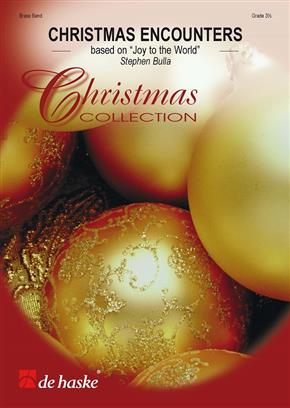
Christmas Encounters (Brass Band - Score and Parts)
Every year it is a challenge to find new music in addition to all of the traditional carols and hymns. Stephen Bullas Christmas Encounters is a refreshing and surprising Christmas tune, based on Joy to the World. A classic with a twist!
Estimated dispatch 7-14 working days
-
 £118.99
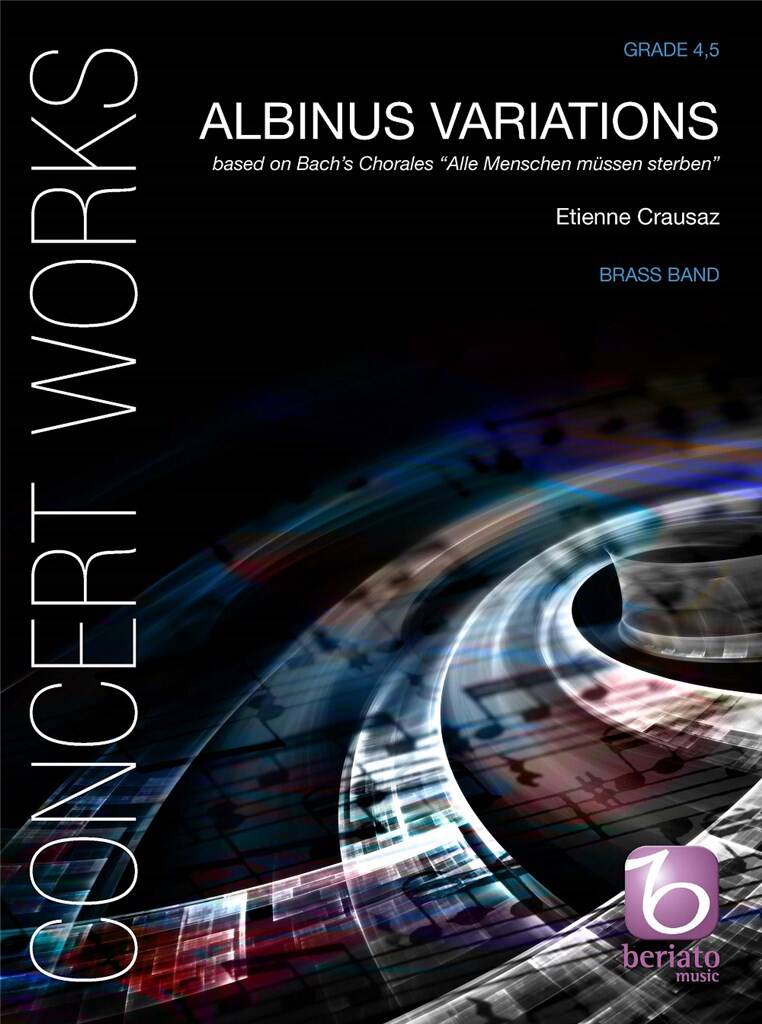
Albinus Variations - Etienne Crausaz
Johann Georg Albinus wrote a number of Lutheran hymns set to music by various composers. Johann Sebastian Bach reworked and inserted some of these hymns into his cantatas, particularly the chorale "Alle Menschen mussen sterben" in BWV 162. Albinus Variations opens with a solemn cadenza followed by five contrasted variations on this chorale. Both versions of the chorale, in major and minor keys, were used as a reference for this work.
Estimated dispatch 5-14 working days
-
 £60.99
Grace and Glory - Wim Stalman
The chorale Glory to God on High is one of todays most often sung hymns. The words are an expression of praise to God and gratefulness for his mercy. The internationally familiar melody of this chorale forms the basis for Wim Stalman's Grace and Glory, in which the elements of praise and thanks are shown by means of both festive and more subdued melodies and harmonies. The choir parts allow the work to be performed by brass band with mixed choir.
Estimated dispatch 5-14 working days
-
 £119.50
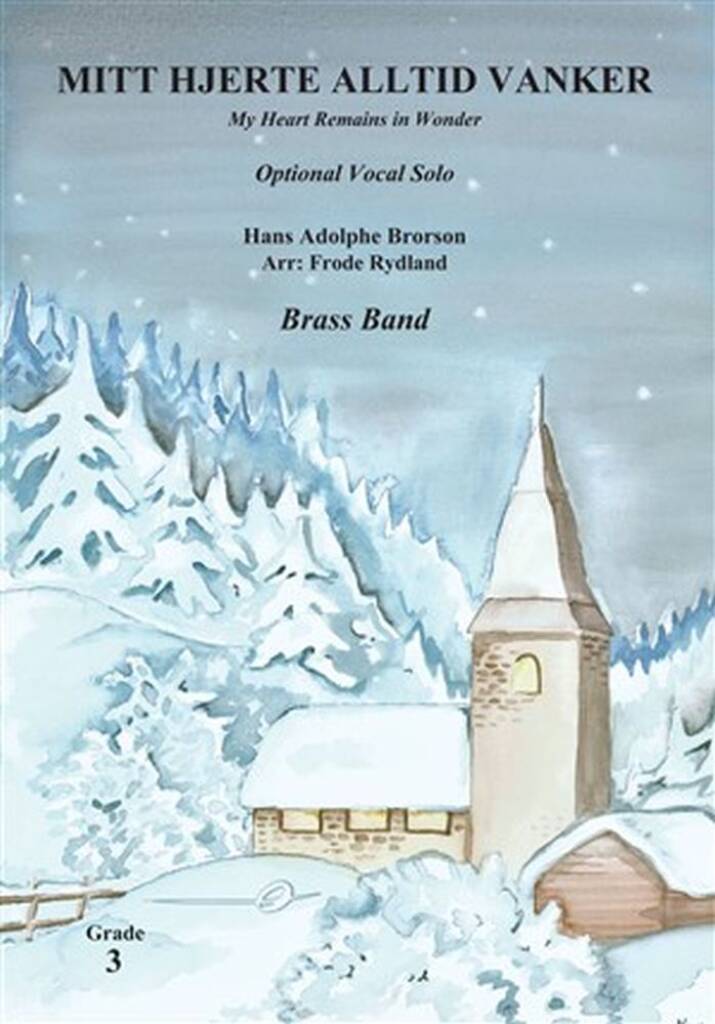
Mitt hjerte alltid vanker - Hans Adolphe Brorson - Frode Rydland
One of the world's most famous Christmas songs was composed by the Dane Hans Adolph Brorson, who was primarily a theologian and bishop, but is also recognized as one of Scandinavia's greatest composers of hymns. "My Heart Remains in Wonder" was first published in 1732.This arrangement was originally written for the Eikanger-Bjorsvik Musikklag with soloist Christine Gulbrandsen for their recording "A Christmas Journey with Eikanger-Bjorsvik."This published version has been adapted so that it can also be performed instrumental. What should be omitted when using a soloist is clearly noted in the score and parts.
Estimated dispatch 5-14 working days
-
 £79.99
Variants on an English Hymn Tune - Philip Sparke
This set of variations on the well-known hymn tune Holy, holy, holy! will make a most satisfying addition to the solo repertoire for euphonuim and brass band. It is in the traditional air varie form with an introduction, theme and 3 variations. The original melody (known as Nicaea) was composed by John Bacchus Dykes' especially for Reginald Heber's renowned hymn of praise and became universally popular when it was included in Hymns Ancient and Modern in 1861. A beautiful solo that will test the soloists ability to show true emotion.
Estimated dispatch 5-14 working days
-
 £60.99
Introitus - Traditional - Jacob de Haan
The Latin word "Introitus" means 'entry'. Originally, this was a psalm sung to accompany the entrance of a bishop, priest or celebrant into the church. Later it was incorporated into the mass with alternating sung and spoken text, reflecting the mood of the liturgy. Jacob de Haan's Introitus, in which he has arranged the hymns Puer natus est nobis and Lobt Gott, Ihr Christen alle gleich, is a wonderful introduction to the Christmas season and can be performed with any instrumental combination with mixed choir and organ ad libitum.
Estimated dispatch 5-14 working days
-
 £60.99
Christmas Encounters - Stephen Bulla
Every year it is a challenge to find new music in addition to all of the traditional carols and hymns. Stephen Bulla's Christmas Encounters is a refreshing and surprising Christmas tune, based on Joy to the World. A classic with a twist!
Estimated dispatch 5-14 working days
-
 £30.00
Amazing Grace (W. Walker arr. by Paul Pennicotte-Henrie) - Brass Band Sheet Music Full Score and Parts - LM642
COMPOSER: W. WalkerARRANGER: Paul Pennicotte-Henrie"Amazing Grace" is a Christian hymn published in 1779 by English Anglican clergyman, abolitionist, and poet John Newton. It is possibly the most sung and most recorded hymn in the world and is especially popular in the United States, where it is used for both religious and secular purposes. Newton wrote the words from personal experience; he grew up without any particular religious conviction, but his life's path was formed by a variety of twists and coincidences that were often put into motion by others' reactions to what they took as his recalcitrant insubordination. He was pressed into service with the Royal Navy, and after leaving the service, he became involved in the Atlantic slave trade.In 1748, a violent storm battered his vessel off the coast of County Donegal, Ireland, so severely that he called out to God for mercy. While this moment marked his spiritual conversion, he continued slave trading until 1754 or 1755, when he ended his seafaring altogether. Newton began studying Christian theology and later became an abolitionist.Ordained in the Church of England in 1764, Newton became the curate of Olney, Buckinghamshire, where he began to write hymns with poet William Cowper. "Amazing Grace" was written to illustrate a sermon on New Year's Day of 1773. It is unknown if there was any music accompanying the verses; it may have been chanted by the congregation. It debuted in print in 1779 in Newton's and Cowper's Olney Hymns, but settled into relative obscurity in England. In the United States, "Amazing Grace" became a popular song used by Baptist and Methodist preachers as part of their evangelizing, especially in the American South, during the Second Great Awakening of the early 19th century. It has been associated with more than 20 melodies. In 1835, American composer William Walker set it to the tune known as "New Britain" in a shape note format; this is the version most frequently sung today.
In Stock: Estimated dispatch 3-5 working days
-
 £36.00
Edward Gregson: The World Rejoicing
DescriptionComposer's NoteIn searching for a common link between the brass band traditions of the various European countries that commissioned this work, I considered the fact that hymns have always played an important role in the relationship that brass bands have with their particular communities; and thus I turned to a well-known Lutheran chorale, Nun danket alle Gott (Now thank we all our God), written around 1636 by Martin Rinkart, with the melody attributed to Johann Cruger. A number of composers have incorporated this chorale into their music, most famously J.S.Bach in his Cantatas no. 79 and 192, and Mendelssohn in the Lobsegang movement of his 2nd Symphony (the harmonization of which is usually used when this hymn is sung).It seemed fitting therefore for me to return to a compositional form I have used many times before (Variations) and to write a work based on this hymn. I have used it in a similar way to that which I employed in my Variations on Laudate Dominum of 1976 - that is, rather than writing a set of variations using elaborations of the complete tune, I have taken various phrases from the chorale and used them within the context of other musical material, applying an overall symphonic process of continuous variation and development. The structure, or sub-divisions of the work, which is through composed and plays without a break, is as follows: Prelude, Capriccio, La Danza 1, Processional, La Danza 2, Arias and Duets, Fuga Burlesca, Chorale, and Postlude.The work is also partly autobiographical - in the manner say of Strauss's Ein Heldenleben - in that I have incorporated into the score brief quotations from many of my other major works for brass band. In that respect, The World Rejoicing sums up a particular facet of my life as a composer, and reflects the admiration I have always had for what is surely one of the great amateur music-making traditions in the world.The World Rejoicing is dedicated 'in loving memory of my brother', Bramwell Logan Gregson, who sadly passed away in the Autumn of 2018.Edward Gregson
Estimated dispatch 7-14 working days
-
 £81.18
All Tuned Up - 120 Famous Tunes for All Occasions (Brass Band Set - A5) PDFs
This unique new resource from BrookWright Music will be an essential part of every band's library! All Tuned Up is designed to cater for ensembles for occasions throughout the year. Tunes are drawn from genres including Classical, Hymns, Folk and Patriotic amongst many others to form a comprehensive book that will cover a wide variety of events such as Weddings, Funerals, Graduation Ceremonies, Parties, Proms, Remembrance, Street Playing and Thanksgiving. Playable by as few as five players but also designed to work for full brass band or wind band, it features flexible parts in a wide variety of transpositions. These excellent arrangements have been expertly created by Andrew Wainwright, David E. Jones, Dean H. Jones and Steven Ponsford. The general harmonic format of All Tuned Up is in five parts, although additional notes have been included to thicken the harmony where more players are available. Therefore, the book will work equally well with larger groups, including full brass bands and wind bands. To view a promotional video please visit www.youtube.com/watch?v=nmodRrXQRRs At the end of the Part 1 Bb book are four a capela tunes for Remembrance/Memorial occasions. This PDF download is for International sizes: Full Score - A4 Size - 297mm x 210mm Band Parts - A5 Size - 210mm x 148mm Physical copies of the books available from: UK - Individual Books Full Set Brass Band Set USA - www.solidbrassmusic.com/product/all-tuned-up-ensemble-books The Brass Band set includes: Full Score Part 1 Eb (optional) - Soprano Cornet Eb Part 1 Bb - Cornet Bb, Flugel Part 2 Bb - Cornet Bb, Flugel Part 2 Eb - Tenor Horn Part 3 Bb - Baritone, Trombone, Euphonium Part 3 Eb - Tenor Horn Part 4 Bb - Euphonium, Baritone Part 5 C (Bass Clef) - Bass Trombone Part 5 Eb - Bass Eb Part 5 Bb - Bass Bb Percussion (optional) - Various
In Stock: Estimated dispatch 1-3 working days
 View Music