Searching for Wind Band Music? Visit the Wind Band Music Shop
We've found 251 matches for your search. Order by

Results

  • £65.50

    Windsor Variations - Gavin Somerset

    The first major Concert Work/Test Piece by Gavin Somerset for brass band takes the familiar tune, St. George's Windsor (Elvey) and gives us a highly enjoyable opus, full of music with which players & MDs can fully express themselves. Often sang to the harvest hymn, Come, Ye Thankful People Come, Its majesty and motifs make this an enjoyable piece to both play and listen to. The work's primary focus is on melody and music with all sections of the band involved in bringing this piece to life. At harvest time or any other, this is a great new feature work for the brass band repertoire. GET THE PARTS FREE TO REHEARSE AT HOME Whilst Brass Band rehearsals continue to be suspended, we are offering FREE downloads of any of the instrumental parts for this new work*. A downloadable playback of the work is also available for you to play along to with a click track included where deemed appropiate to aid your home practice. To download your free instrumental part, please send us a quick email to [email protected]. Once we have received your request, you shall be emailed your free music. Please allow up to 24hrs for this to arrive. Thank you. To download the playback audio to play along to, please RIGHT CLICK HERE & Save As . *A maximum of 2 parts per email address allowed

    In Stock: Estimated dispatch 1-3 working days

     PDF View Music

  • £59.99

    Veni Immanuel - Philip Sparke

    The Advent hymn we all know today as O Come, O Come, Immanuel was arranged in its modern form by Thomas Helmore and published in Hymnal Noted in 1856. Both the words and melody, however, predate this version by centuries. The words are based on a 9th century antiphon and the tune, Veni Immanuel, is taken from a 15th century processional of French Franciscan nuns, part of the setting for the funeral hymn Libera Me. This arrangement aims to expand on the power and mystery of the original tune and will be most effective if the solo Cornet at the start and end of the piece can be placed away from the band, maybe at the back of the auditorium.

    Estimated dispatch 5-14 working days

     PDF View Music

  • £80.00

    St. Magnus - Kenneth Downie

    Dedicated to Alastair Massey, an inspirational music teacher. Commissioned by the Scottish Brass Band Association for the 2004 European Brass Band Championships in Glasgow. This music is a set of variations on the tune known as St Magnus, which is attributed to Jeremiah Clarke. Most people will associate it with Thomas Kelly's hymn which begins: "The Head that once was crowned with thorns is crowned with glory now". The tune is very simple, consisting of just two, four-bar phrases. Neither is there much in the way of rhythmic variety, every note being a crotchet with the exception of two quavers, and the last note in each phrase. Within such a simple structure, however, lies considerable strength. THEME The listener is given the opportunity of hearing it twice, in full, at the beginning, starting with one player but soon taken up by the full ensemble. It returns in the middle of the music and is stated again near the end. This has been done quite deliberately in the hope that there will be an appreciation of what material is being developed, by the listener as well as by those with access to the score, who are able to see the visual connections. VARIATION 1 This takes the rhythm of the last part of the theme and also uses the shape of the opening as a recurring figure. The mood is whimsical and skittish, with short, teasing rhythmic figures tossed around the band, and quick interplay with percussion, at a fast tempo. An energetic flourish finishes this variation before the Andante espress. VARIATION 2 This commences with chords related to the opening of Variation 1. The cantabile on solo comets establishes a new, lyrical mood and there is scope for expressive playing in a series of short solo passages. The theme works its way unobtrusively into the texture before a reprise of the solo cornet melody and some more lyrical interchanges between Eb bass, euphonium, flugel horn and comets. The variation ends serenely with clear references to the last phrase of the theme. VARIATION 3 The first idea to dominate is clearly linked to the shape of the theme's first phrase. There is a frenetic feel to much of this variation, with considerable energy and instability created by extensive use of cross-rhythms. A thinning-out of the score marks a clear change to development of the start of the second phrase of the theme. This proves to be short-lived however, and the opening material returns leading to a restatement of the theme, "Maestoso," after which a euphonium cadenza links to Variation 4. VARIATION 4 Here we have some solos for euphonium, cornet, trombone and Eb bass set against a background of horns and baritones presenting a pensive statement of the theme's opening. VARIATION 5 This commences Allegro, with lively work for cornet and euphonium spreading to the whole band before attention focuses on the beginning of the second phrase of the theme which is initially presented in diminution, then in regular rhythm, then in inversion. An increase in tempo coupled with a decrease in volume, requires dexterity and control, with several metrical challenges thrown in for good measure. The same fragment of phrase becomes an ostinato which generates a frenzied climax, punctuated by short, dramatic silence, before the opening figure returns and the music gradually winds down. The tubular bells herald the final return of the theme, in augmentation, marking the start of the Finale. FINALE This features the running semiquavers of the previous variation sounding in counterpoint. A fast, furious coda speeds the work to a conclusion while references to the opening of the theme are still trying to break into the texture of the music. Kenneth Downie

    Estimated dispatch 5-14 working days
  • £59.99

    Old Hundredth - Louis Bourgeois - Philip Sparke

    The tune Old Hundredth is one of the best-known melodies in all Christian musical traditions and first appeared in the 1551 psalter "Pseaumes Octante Trois de David", where it is used as a setting for a version of Psalm 134; it is usually attributed to the French composer Louis Bourgeois (c.1510 - c.1560). The melody was then used in 1561 by the Scots clergyman, William Kethe in Sternhold and Hopkins' Psalter for his paraphrase of Psalm 100 - All People that on Earth do Dwell, which is still the most familiar hymn sung to this noble tune. When Tate and Brady's "New Version of the Psalms" was published in 1696, the melody became know as the 'old' version - henceits current title. This arrangement presents three contrasting verses and is effective as a concert piece as well as an instrumental interlude as part of a church service or wedding.

    Estimated dispatch 5-14 working days

     PDF View Music

  • £26.00

    Prelude- The truth from above - Ralph Vaughan Williams - Paul Hindmarsh

    In hisPrelude - The Truth from Above, outstanding arranger and curator Paul Hindmarsh has distilled the essence of a timeless Christmas classic by Ralph Vaughan Williams into five minutes of ravishingly unforgettable music for brass band. The variants of the Herefordshire tune popular from theFantasia on Christmas CarolsandThe Oxford Book of Carolsare skilfully and stylishly woven together, from an evocative opening to an ecstatic, multi-layered coda. Unerringly true to the timeless spirit of the original, with the added beauty of the brass-band sound at its most sonorously grave and haunting,Prelude - The Truth from Abovemay be performed separately, or as the first of two preludes, preceding Paul's arrangement ofRhosymedre from the Three Preludes Founded on Welsh Hymn Tunes, also available from Stainer & Bell.

    Estimated dispatch 5-14 working days
  • £115.60

    Det er makt i de foldede hender - Trygve Bjerkrheim - John Philip Hannevik

    This arrangement is written to commemorate Robert Kvam, a trumpeter, conductor and instrument repair technician.He died of cancer in 2019, only 54 years old.The quiet, beautiful hymn There is power in the folded hands (Trygve Bjerkrheim / Oivind Tonnesen) was his favorite song, and the tune and lyrics are the fundament of this arrangement. Especially the line in themselves, the hands are small and weak is an important motif to the arrangement.

    Estimated dispatch 5-14 working days
  • £59.99

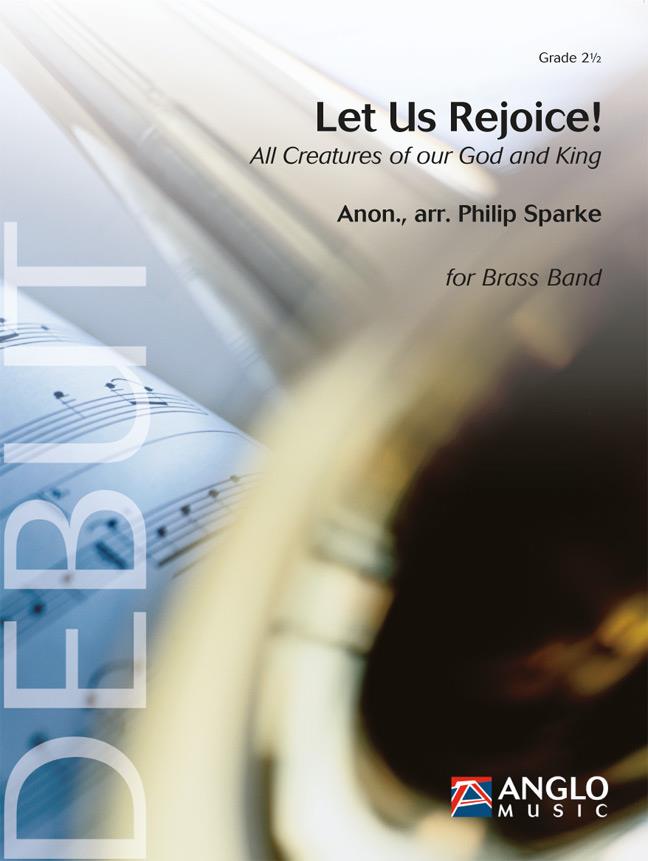
    Let Us Rejoice! - Philip Sparke

    This arrangement presents three contrasting verses of the ancienthymn tune Let Us Rejoice!, which in the English-speaking worldis usually sung to the hymn All creatures of our God and King. Itis effective as a concert piece as well as an instrumental interludeduring a church service, particularly at Easter or Whitsun.

    Estimated dispatch 5-14 working days

     PDF View Music

  • £30.00

    Joy to the World - George Frideric Handel

    "Joy to the World" is a popular Christmas Carol with words by Isaac Watts. As of the late 20th century, "Joy to the World" was the most published Christmas hymn in North America. The words of the hymn are by the English writer Watts are based on Psalm 98, 96:11-12 and Genesis 3: 17-18. The version of this carol usually heard today is from an edition by Lowell Mason and is named "Antioch" and attributed as "arranged by Handel". This tune has the first four notes in common with the chorus "Lift up your heads" from the Messiah and the third line recalls "Comfort ye" from the same work. But this resemblance is often dismissed as a chance resemblance by Handel scholars today. Another theory is its similarity to a tune called "Comfort" and associated with Charles Wesley's hymn "O Joyful Sound", which was written some three years earlier than Lowell Mason's "Antioch" in 1833. This carol has been recorded by many artists such as Andy Williams, The Supremes, Bing Crosby, Ella Fitzgerald, Johnny Cash, Nat King Cole, Perry Como, Vic Damone and Mariah Carey.

  • £69.95

    TRANSFORMATION (Brass Band Set) - Kenneth Downie

    I believe in transformation, God can change the hearts of men, And refine the evil nature, till it glows with grace again'. So wrote John Gowans in the second verse of his great hymn, 'I believe that God the Father, can be seen in God the Son', written specifically to affirm Salvationists' beliefs. It is sung to the tune Bethany and in seeking to explore this great subject at the heart of the Christian gospel in musical terms, the composer has used this fine tune as the basis. Although it never appears in its entirety, it is seldom out of the picture and much of the work is derived from it. The other main source of material is the lovely, simple chorus, 'Some day I shall be like him, changed to heavenly beauty, when his face I see'. This chorus is especially prominent in the middle section but there are important references to it throughout. There are also brief references to Charles Wesley's hymn, 'Love Divine' and, in particular, the telling lines, 'Changed from glory into glory, till in Heaven we take our place'. The work suggests that, at times, the process of being transformed is a struggle, portrayed with many passages of fraught and demanding music. Considerable reserves of stamina and technique are required while, in contrast, the chorus, 'Some day I shall be like him' provides the warm, gentle centre of the work. The premiere of the work was given by The International Staff Band of The Salvation Army in Cadogan Hall on Friday 3rd June 2011, as part of the band's 120th anniversary celebrations.

    Estimated dispatch 7-14 working days
  • £69.95

    Transformation (Brass Band - Score and Parts) - Downie, Kenneth

    I believe in transformation, God can change the hearts of men, And refine the evil nature, till it glows with grace again'. So wrote John Gowans in the second verse of his great hymn, 'I believe that God the Father, can be seen in God the Son', written specifically to affirm Salvationists' beliefs. It is sung to the tune Bethany and in seeking to explore this great subject at the heart of the Christian gospel in musical terms, the composer has used this fine tune as the basis. Although it never appears in its entirety, it is seldom out of the picture and much of the work is derived from it. The other main source of material is the lovely, simple chorus, 'Some day I shall be like him, changed to heavenly beauty, when his face I see'. This chorus is especially prominent in the middle section but there are important references to it throughout. There are also brief references to Charles Wesley's hymn, 'Love Divine' and, in particular, the telling lines, 'Changed from glory into glory, till in Heaven we take our place'. The work suggests that, at times, the process of being transformed is a struggle, portrayed with many passages of fraught and demanding music. Considerable reserves of stamina and technique are required while, in contrast, the chorus, 'Some day I shall be like him' provides the warm, gentle centre of the work. The premiere of the work was given by The International Staff Band of The Salvation Army in Cadogan Hall on Friday 3rd June 2011, as part of the band's 120th anniversary celebrations.

    Estimated dispatch 7-14 working days