
Results
-
 £36.00
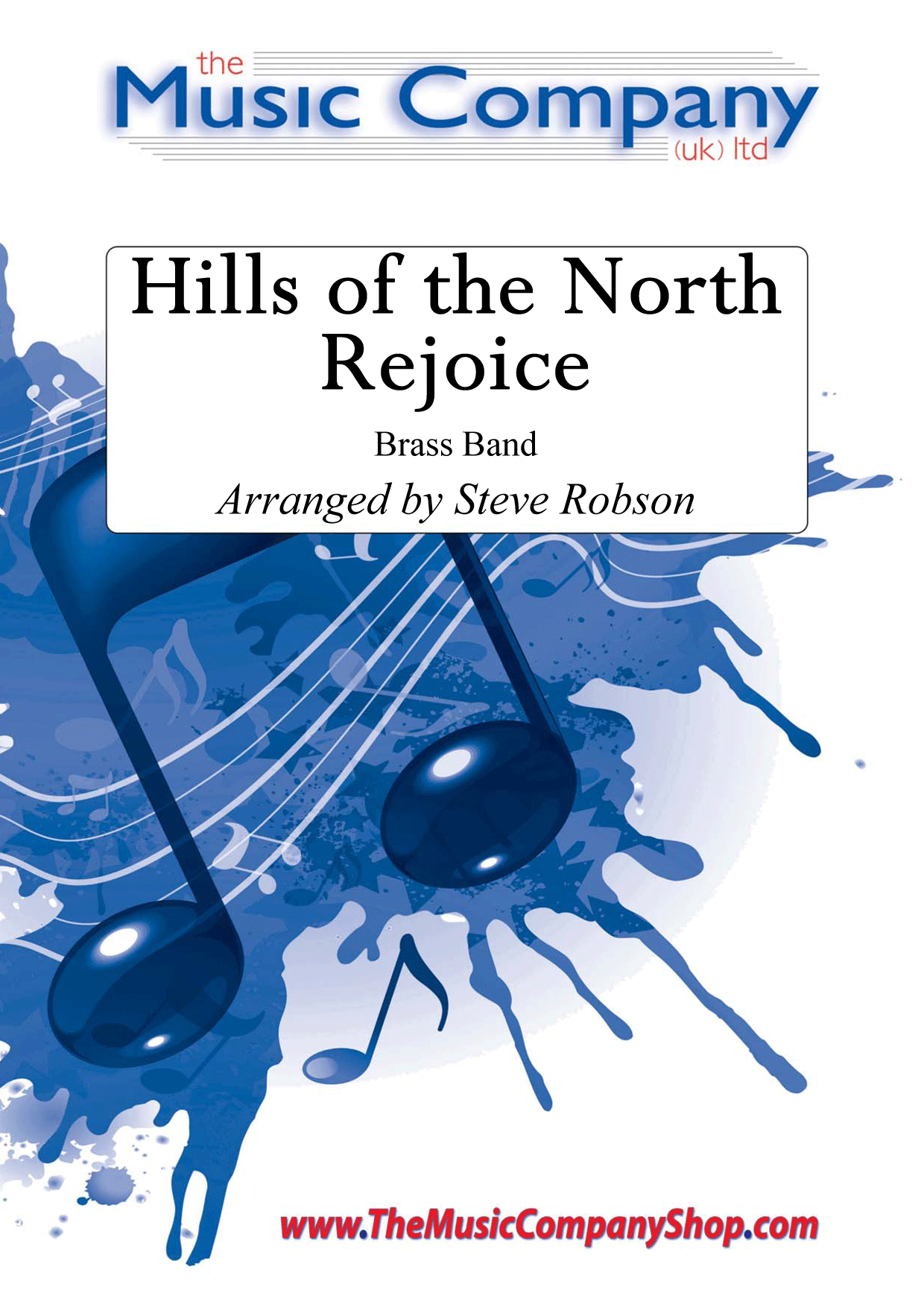
Hills of the North Rejoice - Martin Shaw
This is a beautiful hymn setting arranged for brass band by Steve Robson, inspired by the words of Charles Oakley (1832-1865), set to the melody of Little Cornard by Martin Shaw (1875-1958).Steve writes: The words of the opening line of the Hymn have added significance for me, in that I am fortunate to live high amongst England's most northerly hills, "The North Pennines".A strikingly beautiful melody which has been artfully scored by Steve to create waves of emotion throughout. A stunning piece to include in programmes for concerts and entertainment contests.Look and Listen (courtesy of the Reg Vardy Band):
In Stock: Estimated dispatch 3-5 working days
-
 £46.00
Hymns at Heaven's Gate (Score only) - Elgar Howarth
A flourish: a crowd assembles at the gate of Heaven, saints and sinners. As in a film the immensity of the crowd is illustrated, and the camera zooms to focus onparticular groups and individuals. Monks sing a 'medieval' hymn, interrupted by the fanfares of mischievous seraphim; gradually the whole crown join in. The fanfares grow wilder, and grubby, naughty children enter, singing mock fanfares, making jazzy gestures and trying to sing a chirldren's hymn. They are joined by roughnecks who take up the fanfare idea. The camera zooms again at the entrance of Jesus. A commanding flourish causes consternation. Separate groups react, interrupted by mysterious percussion effects. Then, as the whole panorama explodes in sound, William Booth (founder of the Salvation Army) approaches awestruck. A triple Alleluia is followed by the third hymnand further Alleluias. A dance finale begins using material from the whole piece. A tumultuous climax preceds sudden quiet Alleluias, and the crown exits into Heaven to the music of the monks, reharmonised and transformed. The camera shots extend to the heavens and the stars. Duration: 15:00
Estimated dispatch 7-9 working days
-
 £58.00
Hymns at Heaven's Gate (Parts only) - Elgar Howarth
A flourish: a crowd assembles at the gate of Heaven, saints and sinners. As in a film the immensity of the crowd is illustrated, and the camera zooms to focus onparticular groups and individuals. Monks sing a 'medieval' hymn, interrupted by the fanfares of mischievous seraphim; gradually the whole crown join in. The fanfares grow wilder, and grubby, naughty children enter, singing mock fanfares, making jazzy gestures and trying to sing a chirldren's hymn. They are joined by roughnecks who take up the fanfare idea. The camera zooms again at the entrance of Jesus. A commanding flourish causes consternation. Separate groups react, interrupted by mysterious percussion effects. Then, as the whole panorama explodes in sound, William Booth (founder of the Salvation Army) approaches awestruck. A triple Alleluia is followed by the third hymnand further Alleluias. A dance finale begins using material from the whole piece. A tumultuous climax preceds sudden quiet Alleluias, and the crown exits into Heaven to the music of the monks, reharmonised and transformed. The camera shots extend to the heavens and the stars. Duration: 15:00
Estimated dispatch 7-9 working days
-
 £42.00
Trittico (Score only) - James Curnow
Trittico was commissioned by the Swiss Brass Band Association for their national championships in 1988. A trittico is a tripych or group of three paintings or musical compositions based on a common theme and presented or performed together. The present work is a set of three extended variations on the American shaped-note hymn Consolation. The work opens in grand style with motives based on intervals of the hymn tune. The opening motif, and smaller fragments of it reappear throughout the piece and serve as an underlying element alongside the theme itself. The first variation is essentially a scherzo which echoes the minor mood of the theme. The hemiolic opposition of compound and duple time is used to good effect and, again, the main motif is never far away. This is music with energy and forward movement. The second variation gives the soloists a chance to shine. The mood is tranquil, yet there is always some activity and the musical material pre-echoes the third variation. The third variation is another scherzo-like section, the main theme accompanied by a rhythmic ostinato. Toward the conclusion there is a short aeleatoric passage - a variation within a variation allowing half the band to make their own variaitions in a cachophony of sound. An energetic coda draws together several elements to round off a work brim full of drive, energy, and self-propelled enthusiasm. Duration: 13:30
Estimated dispatch 7-9 working days
-
 £52.00
Trittico (Parts only) - James Curnow
Trittico was commissioned by the Swiss Brass Band Association for their national championships in 1988. A trittico is a tripych or group of three paintings or musical compositions based on a common theme and presented or performed together. The present work is a set of three extended variations on the American shaped-note hymn Consolation. The work opens in grand style with motives based on intervals of the hymn tune. The opening motif, and smaller fragments of it reappear throughout the piece and serve as an underlying element alongside the theme itself. The first variation is essentially a scherzo which echoes the minor mood of the theme. The hemiolic opposition of compound and duple time is used to good effect and, again, the main motif is never far away. This is music with energy and forward movement. The second variation gives the soloists a chance to shine. The mood is tranquil, yet there is always some activity and the musical material pre-echoes the third variation. The third variation is another scherzo-like section, the main theme accompanied by a rhythmic ostinato. Toward the conclusion there is a short aeleatoric passage - a variation within a variation allowing half the band to make their own variaitions in a cachophony of sound. An energetic coda draws together several elements to round off a work brim full of drive, energy, and self-propelled enthusiasm. Duration: 13:30
Estimated dispatch 7-9 working days
-
 £77.00
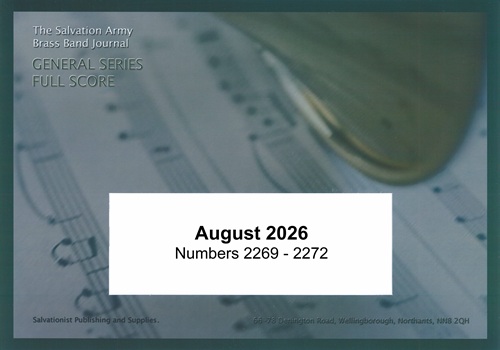
General Series Brass Band Journal, Numbers 2269 - 2272, August 2026
2269: Intrada - Christians Awake (Stephen Gibson)This intrada heralds the happy morning when Christians celebrate the birth of Jesus. Fanfares surround the traditional Christmas Day hymn, Christians Awake (C.C. 20), where we are encouraged to 'awake, salute the happy morn'. Written in a processional style, this music was composed as a concert opener to be performed in a large church setting.2270: Jesus loves me (Stanley Kelley)Jesus loves me! (S.A.S.B. 807) is a song many church-goers learn as children. While written for children, its message is for everyone. John 15:9 says, 'As the Father has loved me, so have I loved you.'2271: Prelude on 'Deep Harmony' (Geoffrey Nobes)This piece was written for the Blendworth Band of Hampshire. The hymn tune, by Handel Parker, is one of the most beautiful and iconic melodies ever written, with lovely harmony supporting the rise and fall of a simple but perfect melodic line.2272: To the hills (Paul Sharman)The inspiration for this arrangement came during a walking holiday in the Lake District. Looking towards the hills brought to mind the words of Psalm 121 and Ernest Rance's setting of that passage, I Lift Up My Eyes (S.A.S.B. 208), with its lovely tune Ochills. This arrangement was written shortly after the composer's return home.
Estimated dispatch 7-14 working days
-
 £33.08
All Your Anxiety (Brass Band) Edward Joy arr. Jonathan Rowsell
All Your Anxiety is a reflective and expressive work for brass band inspired by Edward Joy's sacred song of the same name. Drawing deeply from the hymn's text and message, the piece explores the tension between human unease and the promise of peace found in faith. The work opens with a distinctive eighth-note figure in the euphonium that immediately establishes an unsettled character. Wide intervallic leaps and atypical slur groupings evoke a sense of fragility and uncertainty, musically portraying the weight of sorrow and care described in the opening verse of the hymn. This motivic material becomes the foundation of the entire arrangement, reappearing in varied forms as counter-melody, accompaniment, and featured solo lines across the ensemble. As the piece unfolds, the music gradually broadens and warms, reflecting the invitation of the text to "come to the cross" and leave one's burdens behind. Moments of lyricism and calm contrast with the earlier unease, leading toward a more settled and hopeful conclusion that mirrors the refrain's assurance: "Never a burden He cannot bear, never a friend like Jesus." To view a video of the Canadian Staff Band playing the piece please visit https://www.youtube.com/watch?v=5Ms8ubug4yA Sheet music available from www.brassband.co.uk or https://satradecentral.org Difficulty Level: 3rd Section + Length: 3.30 minutes Instrumentation: Soprano Cornet Eb Solo Cornet Bb 1st Cornet Bb 2nd Cornet Bb Flugel Horn Bb Solo Horn Eb 1st Horn Eb 2nd Horn Eb 1st Baritone Bb 2nd Baritone Bb 1st Trombone Bb 2nd Trombone Bb Bass Trombone Euphonium Bb Bass Eb Bass Bb Timpani Percussion
In Stock: Estimated dispatch 1-3 working days
-
 £73.52
Blaenwern Diversions (Brass Band) Karl Whelan
Commissioned by Micah Dominic Parsons, Blaenwern Diversions is based on the well loved hymn, Love Divine. The composer writes: 'Originally intended to be a set of variations, I found myself wandering around the notes of the hymn tune at the piano and found that the variations almost took on a life of their own resulting in what we have here - diversions. There are 8 diversions in total; the introductory diversion; diversions 1 - 6; and the finale which are divided into three linked movements. Blaenwern Diversions represents my entry into the world of contest works, so even though the piece aims to test the band, it is important that the band enjoy the music within no matter how treacherous!' To view a follow-the-score video please visit www.youtube.com/watch?v=6X5gTMTHkfg PDF download includes score and parts. Sheet music available from: UK - www.brassband.co.uk USA - www.solidbrassmusic.com Difficulty Level: Championship Instrumentation: Soprano Cornet Eb Solo Cornet Bb Repiano Cornet Bb 2nd Cornet Bb 3rd Cornet Bb Flugel Horn Bb Solo Horn Eb 1st Horn Eb 2nd Horn Eb 1st Baritone Bb 2nd Baritone Bb 1st Trombone Bb 2nd Trombone Bb Bass Trombone Euphonium Bb Bass Eb Bass Bb Timpani Percussion 1-3
In Stock: Estimated dispatch 1-3 working days
-
£38.00
Finale from Symphony No. 2 (The Resurrection) - Mahler, G - Harper, P
One of the most life-affirming pieces of music ever composed, Mahler's 2nd Symphony, subtitled 'The Resurrection', was first performed in Berlin in 1895. Mahler's interest in the mysteries of the afterlife is well-known and is a recurring theme throughout all his nine symphonies. Philip Harper has arranged the final passages of the 2nd Symphony, which begins with a profound hymn set to the words of Friedrich Klopstock-- 'Rise again, yea, thou shalt rise again'.The music contains one of Mahler's magical transitionary passages, building in intensity, before the hymn is restated in all its majesty at the moment of glorious resurrection. This arrangement was performed as the finale to Cory Band's winning Brass in Concert programme in 2012.Listen to Cory BandCourtesy of World of Brass
In Stock: Estimated dispatch 1-3 working days
-
 £40.00
A Song for Bram (Brass Band - Score and Parts)
A Song for Bram is a short work, originally composed piano and brass band, and is dedicated to the memory of Bramwell Tovey, a close friend and colleague of the composer, and a conductor, composer, pianist and musician of huge talent, who sadly passed away before his time in the summer of 2022. In this short piece the composer has tried to imagine what kind of tune Bram would have improvised at the piano, something he frequently engaged in. No doubt it would have been a mixture of bluesy jazz, hymn tune, and love song, and this is how the solo piano takes off. In the middle section of a what is a simple tertiary structure, introduced are quotes from two hymn tunes Bram particularly loved, never having forgotten his Salvation Army roots. Bram's 'Song' returns, this time on a plaintive flugelhorn horn, and which reaches a climax with the full band before receding, literally, into the distance.....(to a new life beyond?).Duration: 6.00
Estimated dispatch 7-14 working days
 View Music